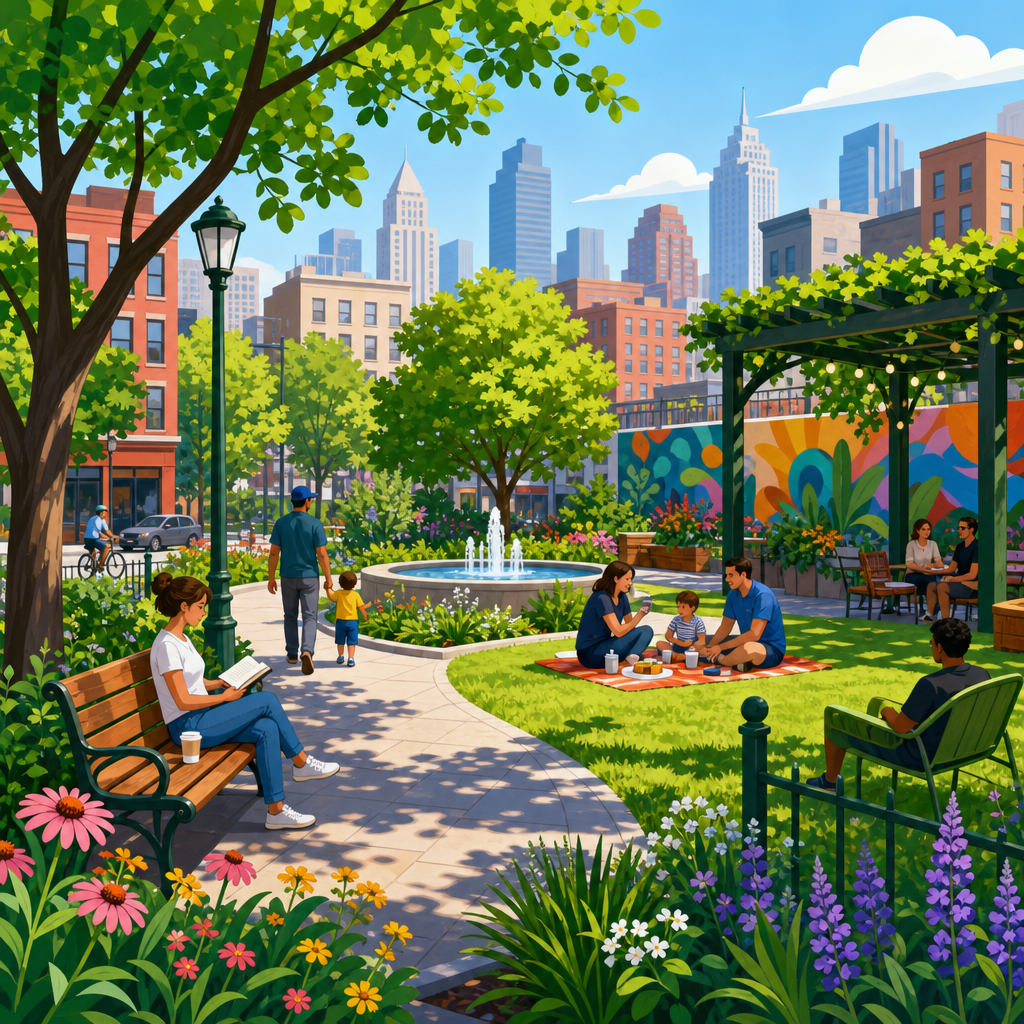
What makes a great small urban park? It is not simply grass, benches, and a few trees placed on leftover land. A great small urban park is a compact public open space, usually embedded within dense neighborhoods, that delivers social, environmental, and economic value far beyond its footprint. In planning practice, I have seen parks smaller than one acre become the most used civic places in a district, while larger spaces nearby sat empty because they lacked comfort, identity, and clear purpose. Size matters less than design quality, maintenance, accessibility, and the ability to serve daily life. That is why small urban parks deserve serious attention within sustainable urban development.
Small urban parks include pocket parks, neighborhood greens, plazas with planting, play lots, and small commons. Their core function is to provide accessible public space within walking distance of homes, schools, transit stops, and local businesses. They support physical activity, offer shade and cooling, absorb stormwater, create habitat, reduce stress, and give communities a place to gather. Research from the Trust for Public Land and the World Health Organization consistently links proximity to quality parks with better public health outcomes, increased social connection, and higher neighborhood resilience. In dense cities where land is scarce and expensive, a small park often delivers the highest public return per square foot of any civic investment.
A great small urban park works because every element is intentional. People need to feel welcome within seconds of arrival. They need safe entrances, visible seating, clear sightlines, a mix of sun and shade, and reasons to stay at different times of day. Children need flexible play. Older adults need comfort and dignity. Office workers need places to pause at lunch. Residents need spaces for routine, not just special events. Good parks also respond to climate realities through durable materials, native planting, water management, and heat mitigation. The best examples feel effortless to users, but they are the result of careful decisions about circulation, programming, operations, and stewardship. Understanding those decisions is the key to creating small parks that truly strengthen urban neighborhoods.
Start with location, access, and everyday visibility
The first test of a great small urban park is whether people can reach it easily and see it clearly. In practical terms, that means placing parks where foot traffic already exists or should exist: along neighborhood main streets, beside schools and libraries, near transit stations, and within a short walk of housing. A park hidden behind blank walls or cut off by fast traffic will underperform, no matter how attractive the landscaping looks on opening day. I have watched underused plazas transform after planners added safer crosswalks, reduced curb radii, and opened direct entrances on all active edges. Access is not an afterthought; it is the foundation of use.
Visibility matters just as much as distance. People are more likely to enter a park when they can quickly understand what is happening inside. Transparent edges, low fencing where needed, and active frontages from adjacent shops or community buildings create natural surveillance and a sense of legitimacy. William H. Whyte’s street life observations remain highly relevant here: people sit where there are people, and they choose spaces that make them feel part of city life rather than isolated from it. In successful small parks, paths are intuitive, entrances are legible, and the space reads as public, open, and safe. Lighting, signage, and universal access features such as ramps, tactile warnings, and smooth surfaces should be integrated from the start, not retrofitted later.
Design for comfort first, because comfort drives use
If a small urban park is uncomfortable, programming will not save it. Comfort begins with microclimate. In hot cities, shade from broad-canopy trees, pergolas, or tensile structures can determine whether a park is occupied or empty for much of the year. In cool or windy climates, sun exposure and wind buffering become more important. Seating is the next critical layer. Great small parks offer varied seating types: benches with backs and arms for older adults, movable chairs for choice and social flexibility, seat walls for informal use, and picnic tables for groups. One bench type cannot serve every user.
Basic amenities shape dwell time. Drinking fountains, bottle fillers, clean restrooms nearby, waste bins, lighting, and surfaces that stay usable after rain all contribute to repeated visits. Noise management also matters. Dense planting, water features, and strategic orientation can soften traffic noise, though they cannot eliminate it entirely. Material selection should balance durability, heat reflectivity, slip resistance, and ease of maintenance. I have seen expensive paving fail within a few winters because freeze-thaw cycles and utility cuts were ignored. Strong park design is never just aesthetic composition; it is an operational decision about how a place will perform every day under real urban conditions.
Comfort also includes psychological ease. Users need to know where they can sit alone, where children can play safely, and where informal gatherings will not create conflict. That is why successful small parks often include subtle zoning rather than hard separation. A quiet edge with planting can coexist with a social plaza if circulation is clear and sightlines remain open. The best spaces allow both solitude and sociability without making either group feel unwelcome.
Create a flexible program mix that supports daily life
A great small urban park gives people reasons to return on ordinary days, not only during festivals. Program mix should reflect surrounding demographics and neighborhood rhythms. Near family housing, play elements and open visibility are essential. In commercial districts, lunchtime seating, shade, and quick food-friendly layouts matter more. Near senior housing, walking loops, comfortable seating, and easy access to toilets may be the priority. The most resilient parks support multiple uses without overdesigning every square foot. A small lawn that can host children’s play, tai chi, informal picnics, and community events is often more valuable than a single-purpose installation that is busy for one hour and dormant the rest of the day.
Programming should include both fixed and flexible elements. Fixed elements may include play equipment, a splash feature, fitness stations, or a performance corner. Flexible elements include open paving for markets, movable furniture, power access for events, and lawns sized for informal recreation. Bryant Park in New York is larger than a pocket park, but its operational lesson applies everywhere: when managers provide simple, repeatable activities such as chess, reading, movable seating, and seasonal events, people treat the space as part of daily life. Small parks should be curated with the same discipline, scaled to local needs and budgets.
| Design priority | Why it matters | Typical small-park solution |
|---|---|---|
| Access | Increases daily footfall and inclusivity | Multiple entrances, safe crossings, step-free routes |
| Comfort | Extends dwell time and repeat visits | Shade trees, varied seating, lighting, fountains |
| Flexibility | Supports changing needs over time | Open lawn, movable chairs, power access |
| Safety | Builds trust across user groups | Clear sightlines, active edges, durable lighting |
| Ecology | Improves resilience and environmental performance | Native planting, rain gardens, permeable surfaces |
| Stewardship | Protects long-term quality | Maintenance plans, community partnerships, funding |
Make safety visible, fair, and rooted in management
People often ask what makes a small urban park feel safe. The short answer is good design plus consistent management. Safety is not created by surveillance technology alone, and it is not achieved by over-policing public life. Parks feel safer when entrances are obvious, planting does not create hidden corners, lighting supports facial recognition at night, and adjacent buildings contribute eyes on the space. Maintenance is a safety strategy too. Broken fixtures, overflowing bins, vandalism left unaddressed, and dead planting signal neglect and reduce public confidence quickly.
Fairness matters. Rules should protect shared use without criminalizing ordinary behavior such as sitting for long periods, gathering in small groups, or being young in public. In many cities, the most successful approach combines design, staff presence, outreach, and partnerships with local organizations. For example, attendants, gardeners, and programmed activity often prevent conflict more effectively than punitive enforcement because they establish norms of care and shared ownership. When I assess parks with recurring safety complaints, the root issue is usually not one feature but a chain of failures: poor sightlines, weak maintenance, isolated location, and no one clearly responsible for operations.
Use landscape and water systems as infrastructure
Small urban parks should perform as green infrastructure, not just decoration. In compact neighborhoods with high levels of impervious surface, even a modest park can reduce runoff, lower surface temperatures, and support biodiversity. Rain gardens, bioswales, structural soils, permeable paving, and tree trenches help manage stormwater close to where it falls. Native and climate-adapted planting reduces irrigation demand and improves habitat value for pollinators and birds. Tree canopy is especially important because it combines shade, carbon storage, air quality benefits, and visual relief from hard urban surfaces.
However, ecological features only work when matched to local conditions and maintenance capacity. A bioswale that clogs because sediment control was ignored is not sustainable. A native meadow planted in a tiny high-traffic park may be trampled unless pathways and protective edges are clear. The strongest projects align planting design with operations, soils, drainage patterns, and human behavior. Copenhagen, Melbourne, and Singapore all offer useful lessons in integrating cooling, stormwater management, and attractive public space, but the principle is universal: landscape systems should solve urban problems while making parks more pleasant to use. That dual function is one reason small parks are central to climate-resilient city planning.
Reflect local identity and invite community stewardship
A great small urban park feels rooted in its neighborhood. That does not mean every park needs a literal history display or public art commission, but it should respond to local culture, daily habits, and community memory. Materials, planting palettes, signage, and programming can all express identity. In one redevelopment district I worked on, residents rejected an early concept because it looked interchangeable with any luxury plaza. The final design incorporated local stone, bilingual signage, a small performance area for neighborhood events, and planting tied to regional ecology. Use increased because people recognized the space as theirs.
Stewardship should be built into the project model from the beginning. Community involvement is most useful when it goes beyond a one-time consultation meeting and continues through design review, opening, and long-term care. Friends groups, business improvement districts, schools, and nonprofit partners can support planting days, event calendars, fundraising, and feedback loops. Still, volunteer energy cannot replace public responsibility. Municipal agencies need clear maintenance standards, budget commitments, and accountability for cleaning, repairs, horticulture, and asset replacement. The best parks succeed because civic ownership and community stewardship reinforce one another rather than compete.
Measure success by use, health, and resilience
Evaluating a small urban park requires more than counting square feet of green space. The right question is whether the park improves urban life measurably. Useful metrics include footfall at different times of day, dwell time, diversity of users, tree canopy growth, stormwater captured, surface temperature reduction, maintenance response time, event participation, and perceived safety. Public health indicators matter too. Studies published in journals such as The Lancet Planetary Health and Environmental Health Perspectives have linked access to quality green space with reduced stress, greater physical activity, and lower heat exposure. While cause and effect vary by context, the direction is clear: better parks contribute to healthier neighborhoods.
Economic effects should be assessed carefully. Good parks can raise nearby retail activity and property values, but they can also contribute to displacement if cities do not pair investment with housing protections and inclusive planning. That tradeoff is real. A sustainable approach treats parks as public goods that must benefit existing residents, not amenities that price them out. When cities measure social use, ecological performance, and equity outcomes together, they make better decisions about where to invest next.
The best small urban parks are not miniature versions of large parks. They are highly intentional public spaces designed for everyday urban life. They succeed when they are easy to reach, clearly public, comfortable in all seasons, flexible in use, safe through design and management, ecologically productive, and rooted in local identity. When those qualities come together, even a tiny site can become the social heart of a neighborhood.
For cities pursuing sustainable urban development, small parks are one of the most practical and cost-effective tools available. They cool streets, manage water, support health, strengthen community ties, and create visible public value within walking distance of residents. Their impact is amplified when planners treat them as infrastructure, not leftover beautification projects, and when operators commit to long-term stewardship instead of one-time capital spending.
If you are planning, funding, or advocating for a small urban park, start with the basics that matter most: access, comfort, safety, ecological performance, and maintenance. Then shape the space around the people who will use it every day. Done well, a small urban park can solve multiple city challenges at once. Use that standard to guide your next project, audit your existing spaces, and make every square foot of public land work harder for the neighborhood.
Frequently Asked Questions
What defines a great small urban park?
A great small urban park is defined less by its size and more by how well it serves the people around it. The best ones are compact, intentional public spaces that feel useful, welcoming, and memorable from the moment someone enters. They are designed for everyday life, not just for visual appeal. That means they offer comfort, shade, seating, safe circulation, and a clear reason to stay. In dense neighborhoods, where private outdoor space may be limited, a small park often becomes the local outdoor living room, meeting place, and quiet retreat all at once.
What separates a great small park from an underused one is usually clarity of purpose. Successful parks are not random collections of benches, lawn, and planting squeezed onto leftover land. They are shaped around how people actually behave. Some support lunchtime use, casual gathering, and people-watching. Others prioritize children’s play, passive recreation, community events, or ecological performance. The strongest examples combine several of these functions without feeling crowded or confused. They create a distinct identity, respond to local neighborhood needs, and make people feel that the space belongs to them.
In practice, this often means balancing social, environmental, and economic value in a very small footprint. A great small urban park encourages interaction, improves mental well-being, reduces heat, manages stormwater, supports local businesses through increased foot traffic, and raises the quality of the public realm. When it is designed and maintained well, even a park under one acre can become one of the most heavily used and valued civic places in a district.
Why do some small urban parks feel lively and successful while others remain empty?
The difference usually comes down to design quality, context, and management rather than acreage. Small parks feel lively when they are located where people already move, pause, and gather. Visibility matters. So does access. If a park sits along a comfortable walking route, near homes, shops, schools, transit stops, or offices, it has a much better chance of becoming part of daily routines. If it is hidden, awkwardly entered, poorly lit, or cut off by traffic, people tend to pass it by no matter how much greenery it contains.
Comfort is another major factor. People stay where they feel physically at ease. That includes shade in summer, sun in cooler seasons, movable or varied seating, clean surfaces, protection from excessive wind or traffic noise, and a sense of safety created through lighting, visibility, and regular activity. Small parks that remain empty are often too exposed, too barren, too rigid, or simply unpleasant to occupy for more than a few minutes. Great parks are scaled to the human experience and invite different kinds of use throughout the day.
Programming and identity also play a major role. A small urban park does not need constant events to succeed, but it does need a recognizable character. That may come from a fountain, public art, a play feature, a grove of trees, a food kiosk, a reading garden, or a flexible paved area for informal gatherings. Spaces that lack a focal point or coherent use can feel like residual land rather than a destination. Finally, maintenance and stewardship are essential. Clean, cared-for parks attract repeat use, while neglected spaces quickly signal that nobody is responsible for them. People respond not only to design, but to evidence that a place is loved and looked after.
What design elements matter most in a small urban park?
In a small urban park, every design decision has an outsized impact, so the most important elements are the ones that directly support comfort, usability, and identity. Seating is one of the biggest. Not just the quantity of seats, but their type and placement. People want options: benches with backs, seat walls, movable chairs, sociable clusters, and quieter edges. Good seating should take advantage of shade, views, activity, and seasonal sunlight. If a park offers nowhere comfortable to sit, it will struggle no matter how attractive the planting may be.
Shade and microclimate are equally critical. Trees are often the most valuable long-term investment in a small park because they improve thermal comfort, define space, soften the setting, and contribute ecological benefits. In hot urban environments, shade can determine whether a park is usable for much of the day. Water, planting, canopy, permeable surfaces, and thoughtful orientation all help create a more pleasant microclimate. The goal is to make the space feel inviting in real conditions, not just in a design rendering.
Circulation and layout are also fundamental. A great small park is easy to enter, easy to read, and easy to move through. The paths and open areas should support natural desire lines rather than force awkward movement. There should be a balance between openness and enclosure, allowing people to feel both connected and comfortable. Small spaces become much stronger when they include a focal point or organizing element, such as a central plaza, lawn, play area, garden, sculpture, or water feature. That focal element helps the park feel intentional and gives visitors an immediate sense of what the place is for.
Finally, details matter enormously in compact spaces. Lighting, paving, edges, planting design, materials, accessibility, drinking fountains, trash and recycling, and maintenance access all influence how the park performs over time. Because there is little room for wasted space, successful small urban parks are carefully edited. They do not try to do everything. They do a few things exceptionally well and make those experiences feel natural, inclusive, and durable.
How can a small urban park deliver social, environmental, and economic value?
A small urban park can create social value by giving people a shared place to gather, rest, observe, and connect. In dense neighborhoods, that function is especially important because many residents may not have large private yards or nearby recreational amenities. A well-designed park supports chance encounters between neighbors, provides safe and visible places for children and older adults, and offers a low-cost public setting for everyday life. These spaces can reduce isolation, strengthen neighborhood identity, and improve mental well-being simply by making it easier for people to spend time outdoors in a comfortable and attractive environment.
Its environmental value can be impressive despite its modest footprint. Trees and planting help reduce urban heat, improve air quality, support biodiversity, and absorb stormwater. Permeable paving, rain gardens, and healthy soils can make a small park part of a wider green infrastructure network, helping cities manage runoff and climate stress more effectively. Even a compact space can provide cooling, habitat, and ecological function if it is designed with these goals in mind. The key is not to think of small parks as decorative leftovers, but as working pieces of urban environmental systems.
Economically, a successful park often benefits the surrounding district in visible ways. Attractive and active public spaces increase foot traffic, support nearby cafes and shops, and make commercial areas more appealing to residents, workers, and visitors. They can improve perceived neighborhood quality and contribute to stronger property values and investment confidence. Just as important, small parks can offer high returns relative to their size when compared with larger, more expensive spaces that fail to attract consistent use. When a compact park is actively used throughout the day, it becomes an efficient civic asset that supports both community life and local economic vitality.
What should cities and designers prioritize when planning a small urban park?
Cities and designers should begin by understanding the surrounding neighborhood before drawing the first plan. The most successful small parks are rooted in local patterns of use, demographics, culture, and movement. Who lives nearby? Who passes through? Are there families with children, older adults, office workers, students, or transit riders? Is the greatest need for quiet seating, play space, community gathering, or climate relief? A small park cannot be all things to all people, so planning should focus on the highest-value uses for that location and community.
They should also prioritize visibility, accessibility, and inclusivity from the start. Entrances need to be obvious and barrier-free. The park should feel safe and legible to first-time users. Good sightlines, lighting, and active edges make a major difference. So does universal design. A great small urban park should work for people of different ages, abilities, and comfort levels, whether they are spending twenty minutes there or simply passing through. Inclusivity is not a bonus feature; it is central to what makes a public space truly successful.
Another priority is long-term stewardship. Too many parks are planned as capital projects without equal attention to maintenance, programming, and management. Yet these factors often determine whether the space thrives after opening. Cities should think early about who will maintain planting, clean the site, repair furnishings, and support community use. Partnerships with local organizations, business groups, or neighborhood associations can be especially helpful in keeping small parks active and cared for.
Most importantly, planners and designers should resist the temptation to treat a small urban park as leftover land with generic amenities. Compact public spaces demand precision. They should have a clear purpose, a strong sense of place, and a design that responds to real urban conditions. When these priorities are in place, a small park can outperform larger spaces and become one of the most beloved and effective pieces of public infrastructure in a neighborhood.