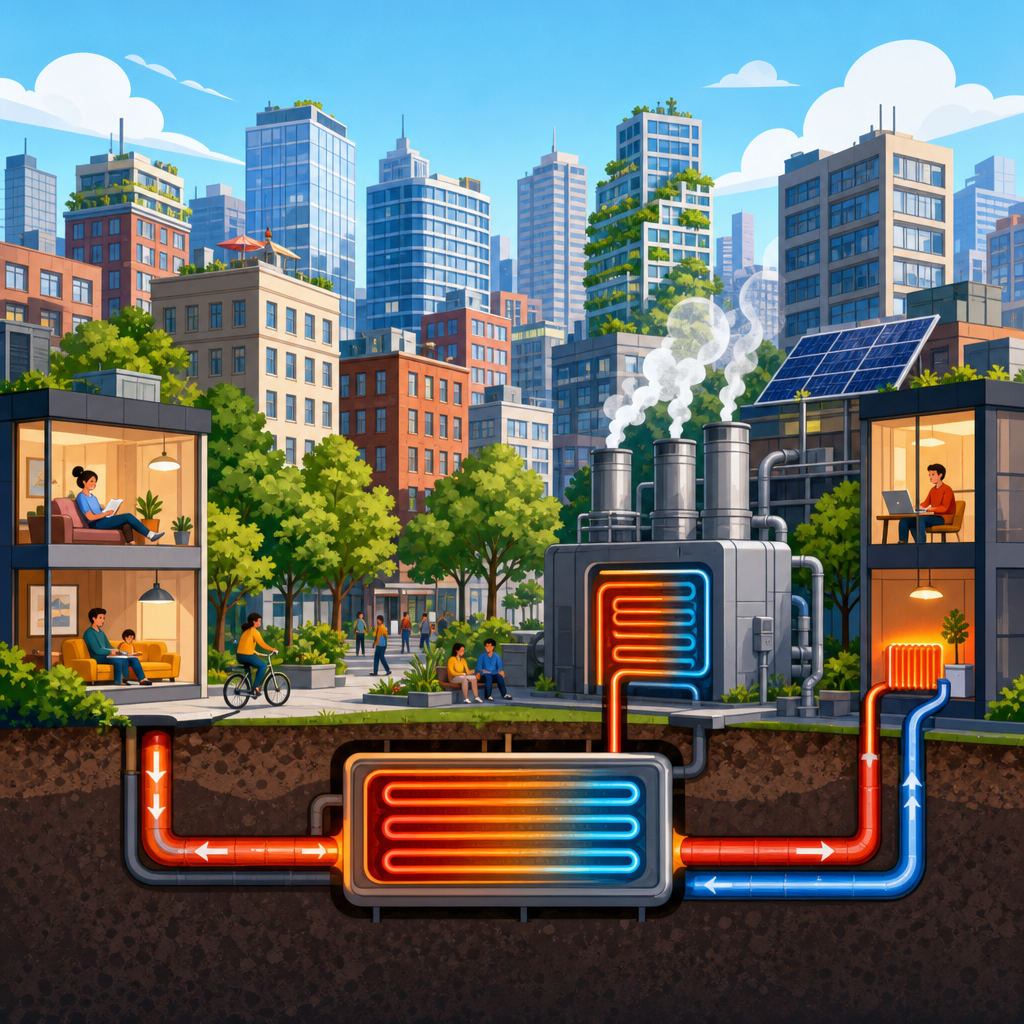
Waste heat recovery in dense urban districts turns a chronic inefficiency into a practical energy resource. Cities reject vast amounts of usable heat every hour from subway tunnels, data centers, supermarkets, wastewater mains, electrical substations, industrial kitchens, hospitals, and cooling systems mounted on roofs and in basements. In compact neighborhoods where heat demand is concentrated and infrastructure is shared, that rejected energy can be captured, upgraded, and redistributed through district networks. I have worked on urban energy planning studies where this “hidden fuel” changed project economics more than adding new generation capacity, because the heat source already existed inside the block. The core idea is simple: recover low-, medium-, or high-temperature heat that would otherwise be vented, then match it to nearby demand using heat exchangers, heat pumps, thermal storage, and insulated pipe networks.
Waste heat recovery matters in dense urban districts for three reasons. First, it lowers fossil fuel use and carbon emissions by displacing gas-fired boilers and reducing peak electricity demand. Second, it improves local resilience because a city with multiple heat sources is less exposed to fuel price spikes or supply interruptions. Third, it can reduce operating costs for building owners when systems are designed around actual load profiles rather than rough assumptions. Key terms are worth defining clearly. Waste heat is thermal energy released from a process or building service that is not currently used. Heat recovery is the capture and reuse of that energy. District heating moves hot water through a network to multiple buildings, while fifth-generation ambient loops circulate water at near-ground temperature and let buildings use reversible heat pumps to lift or reject heat as needed.
Urban density makes these systems technically attractive because heat sources and heat sinks sit close together. Shorter pipe runs mean lower capital cost and lower thermal losses. Mixed-use districts also create complementary demand patterns. Offices often need cooling during the day while housing requires domestic hot water in the morning and evening; hospitals and leisure centers need steady year-round heat; grocery stores reject condenser heat continuously. A planner looking at one building might see a modest opportunity, but a planner mapping an entire district often sees a portfolio. That portfolio view is why waste heat recovery has become a central strategy within sustainable urban development, especially where electrification targets, clean heat policies, and stricter building performance standards are converging.
Where urban waste heat comes from and how much is usable
The first question decision-makers ask is straightforward: where is the heat, and is it hot enough to matter? In dense districts, the answer usually begins with wastewater, comfort cooling, refrigeration, transit systems, and digital infrastructure. Wastewater in sewer trunks and building outfalls often stays between 12°C and 25°C, a remarkably stable source for heat pumps. Data centers commonly reject air or liquid cooling heat year-round. Supermarkets and cold-storage facilities reject condenser heat at useful temperatures for domestic hot water. Metro tunnels and stations accumulate heat from trains, braking systems, people, and electrical equipment. Even electrical transformers and telecom rooms can contribute small but steady loads when aggregated districtwide.
Usability depends on three variables: temperature, flow, and coincidence with demand. A high-temperature source with intermittent operation may be less valuable than a lower-temperature source that runs continuously. Engineers therefore analyze hourly profiles, not just annual totals. In one district screening exercise I worked on, a cluster of medium-sized supermarkets yielded better economics than a single larger office tower because refrigeration waste heat was stable across all seasons, while the office cooling load collapsed in winter. This is why source mapping matters. Geographic information systems, utility meter data, building management system trends, and sewer network models help identify sources that can support base load, shoulder load, or seasonal balancing.
Temperature upgrading is also central. Most urban waste heat is low grade, meaning it cannot directly serve legacy radiator systems designed for 80°C supply water. However, modern low-temperature district heating can operate around 50°C to 70°C, and domestic hot water can be produced hygienically through heat interface units, booster heat pumps, or carefully controlled storage. Where existing buildings are inefficient, envelope upgrades and emitter replacements often unlock heat recovery by lowering required supply temperatures. In practice, the best projects combine source capture with demand reduction, because every degree shaved from network temperature improves heat pump coefficient of performance and cuts distribution losses.
Core technologies that make district-scale recovery work
The technology stack is mature. Plate-and-frame heat exchangers transfer heat between source and network without mixing fluids. Water-source heat pumps raise low-grade heat to usable temperatures. Variable-speed pumps move energy efficiently through primary and secondary loops. Buffer tanks smooth short-term fluctuations, while large thermal stores shift energy across hours or days. Supervisory controls coordinate source availability, electricity prices, weather forecasts, and building demand. None of these components is exotic on its own; the challenge lies in integrating them so the district behaves as one optimized thermal system rather than a collection of isolated mechanical plants.
Heat pumps deserve specific attention because they determine both carbon performance and operating cost. Their efficiency is usually expressed as coefficient of performance, or COP. A COP of 3 means one unit of electricity delivers roughly three units of heat. In urban applications, COP depends heavily on source temperature and output temperature. Sewer heat at 18°C serving a 55°C network can perform far better than ambient air at 0°C serving the same network, especially during winter peaks. That is one reason wastewater heat recovery has become prominent in European and Asian cities. It offers relatively stable source temperatures exactly when air-source systems struggle most.
Network architecture also matters. Traditional district heating uses centralized generation and unidirectional hot-water distribution. Newer ambient networks move near-neutral water through a loop, allowing some buildings to extract heat while others reject it. This is especially powerful in mixed-use developments with simultaneous heating and cooling. A hotel laundry, residential hot water demand, and office cooling can all be linked through one loop. The result is less wasted cooling energy and lower central plant size. Standards and guidance from ASHRAE, CIBSE, and the International Energy Agency increasingly support these approaches, particularly where decarbonization requires flexible, electrified thermal infrastructure.
| Source | Typical Temperature | Best Urban Application | Main Limitation |
|---|---|---|---|
| Wastewater sewer main | 12°C to 25°C | Base-load heating via water-source heat pumps | Access, fouling, and permitting complexity |
| Data center cooling | 25°C to 40°C | Year-round district heating and domestic hot water | Contract structure and future tenant turnover |
| Supermarket refrigeration | 20°C to 35°C | Local hot water and neighborhood loop balancing | Distributed ownership and small individual loads |
| Metro tunnel air | 15°C to 30°C | Station heating or nearby public buildings | Dust, access windows, and transport operator approvals |
Planning, design, and economics in real city districts
Good projects start with district energy mapping, then move quickly into load validation. I never trust headline floor-area benchmarks without meter data, because urban buildings often operate far from design assumptions. A hospital may have lower steam demand after sterilization upgrades. An apartment block may have extreme morning peaks from domestic hot water. A university lab may reject heat all night. The planner’s task is to build an hourly energy model that captures these realities, test multiple network temperatures, and identify which anchor loads justify initial pipe investment. Anchor loads are buildings with stable demand or supply, such as hospitals, leisure centers, wastewater interceptors, campuses, or data facilities.
Economics depend on density, diversity, and phasing. Pipe networks are capital intensive, so projects need enough heat sales per meter of trench. As a rule, compact districts with mixed uses and public-sector anchors perform better than dispersed suburbs. Phasing is equally important. The first phase should connect the strongest sources and loads with the shortest route, leaving clear expansion corridors for later blocks. Too many schemes fail by overbuilding network capacity on day one. The stronger approach is modular: install heat pumps and plant in stages, size headers for realistic growth, and preserve plantroom space and electrical capacity for future modules as customer connections increase.
Commercial structure often decides success more than engineering. Building owners need confidence on tariff stability, service reliability, maintenance responsibilities, and contract length. Cities need concession models that align public goals with private investment. Some projects use utility-owned networks; others rely on energy service companies with long-term heat purchase agreements. Transparent tariffs are essential. Customers will compare district heat with gas boilers, direct electric resistance, and individual air-source heat pumps. Therefore, proposals must explain avoided capital replacement, freed roof space, lower maintenance, and carbon compliance value, not just unit energy price. Financial models also need realistic assumptions for electricity prices, carbon factors, debt cost, and customer churn.
Barriers, governance, and what separates viable schemes from weak ones
The biggest barrier is not technology; it is coordination. Heat sources, demand centers, roads, sewers, planning powers, and utility rights-of-way are controlled by different entities. Without a city-led framework, each owner optimizes only their own asset, and district value remains stranded. Successful urban heat recovery programs usually have three governance features: a citywide heat map, planning policy that protects corridors and plant space, and a delivery vehicle capable of negotiating across agencies. London boroughs, Scandinavian municipalities, and several Dutch cities have advanced furthest where local government created predictable rules and required major developments to assess district energy connection before defaulting to stand-alone plant.
Technical barriers are manageable but real. Sewer heat exchangers foul if solids management is poor. Data center waste heat can disappear if a tenant relocates. Older buildings may need radiator upgrades to accept lower supply temperatures. Legionella control requires careful domestic hot water design. Electrical grid capacity can constrain large heat pump installations, especially where transport electrification is growing simultaneously. Noise, vibration, and plant footprint can trigger local opposition if poorly handled. These are solvable issues, but only when addressed early through surveys, contingency allowances, redundancy design, and honest stakeholder engagement. The worst projects are the ones that hide uncertainty until procurement.
What separates a viable scheme from a weak one is disciplined screening. A strong project has proximate source and demand, an anchor customer, realistic phasing, and a clear path through permits and power connection. It also has fallback modes. For example, if sewer access is delayed, can the network begin with data center heat and temporary electric boilers? If a source underperforms, can thermal storage and demand response maintain service? Reliability standards should be explicit from the start. In critical districts serving hospitals or housing, N+1 redundancy, backup generation, and service-level guarantees are not optional extras; they are prerequisites for financing and public acceptance.
What cities should do next to scale waste heat recovery
Cities should begin with evidence, not slogans. Map heat demand and rejected heat at district scale, identify anchor opportunities, and publish priority zones where connection is most practical. Update planning rules so new developments reserve risers, pipe routes, and plant space for future network integration. Require major cooling loads, including data centers and large retail, to assess export of recoverable heat. Coordinate streetworks so pipe installation rides alongside water, sewer, or transit upgrades. Train permitting teams to handle thermal networks consistently. Most importantly, package projects at a size investors can finance, because small fragmented schemes rarely attract affordable capital or deliver stable long-term operation.
The main benefit of waste heat recovery in dense urban districts is simple: it turns unavoidable local losses into dependable local supply. Done well, it cuts emissions, reduces wasted energy, and builds a more resilient urban energy system without waiting for speculative technology. The practical route is clear: start with the best mapped sources, connect the strongest nearby loads, phase networks carefully, and design contracts that customers understand. If you are shaping a sustainable urban development strategy, treat waste heat as infrastructure, not an afterthought. The next step is to identify one district, assemble the data, and move from thermal potential to an investable project pipeline.
Frequently Asked Questions
What is waste heat recovery in dense urban districts, and why does it matter?
Waste heat recovery in dense urban districts is the process of capturing heat that would otherwise be expelled into the air, water, or underground environment and putting it to work as a usable energy source. In cities, large amounts of low- and medium-temperature heat are continuously rejected by subway systems, data centers, supermarkets, wastewater networks, hospitals, commercial kitchens, refrigeration equipment, electrical rooms, and building cooling systems. On their own, many of these heat streams seem too dispersed or too low in temperature to be valuable. In a compact urban district, however, they become much more practical because buildings are close together, demand for heating and hot water is concentrated, and shared infrastructure can move energy efficiently from source to user.
This matters because it changes the role of heat from being a byproduct to being a local utility resource. Instead of relying exclusively on boilers, electric resistance heating, or long-distance fuel supply chains, districts can use energy that is already being generated on-site or nearby. That improves overall energy efficiency, reduces operating costs over time, lowers greenhouse gas emissions when paired with clean electricity, and decreases pressure on urban power and gas networks during peak demand periods. It also strengthens local energy resilience. In a dense neighborhood, one facility’s rejected heat can support another building’s domestic hot water, space heating, or process needs, creating a more integrated and practical urban energy system.
Where does usable waste heat typically come from in cities?
Urban waste heat comes from a surprisingly broad range of sources, and the best projects usually begin by identifying which of these sources are steady, accessible, and close to heat demand. Data centers are one of the most talked-about examples because their servers generate continuous heat year-round, often with highly predictable operating profiles. Supermarkets and food retail facilities also produce recoverable heat through refrigeration systems. Wastewater mains and sewer lines carry thermal energy from showers, laundry, kitchens, and industrial uses, making them an important and often underused source in mixed-use districts. Transit systems, especially subway tunnels and stations, release large amounts of heat from trains, braking systems, passengers, and ventilation equipment.
Other common urban sources include hospitals, laboratories, hotels, swimming pools, industrial laundries, commercial kitchens, ice rinks, and office buildings with substantial cooling loads. Rooftop condensers, basement chiller plants, and mechanical ventilation exhausts frequently reject heat that could be captured before it is lost. Even electrical substations and utility infrastructure can contribute in certain circumstances. The key is not simply whether heat exists, but whether it exists at the right scale, at suitable temperatures, and with enough consistency to justify recovery equipment and distribution connections. In dense districts, the diversity of these sources is actually a major advantage because combining multiple contributors can create a more reliable and balanced heat network.
How is waste heat captured, upgraded, and distributed to nearby buildings?
The technical pathway usually involves three main steps: capture, upgrade, and distribution. First, the heat is intercepted using equipment such as heat exchangers, recovery coils, or specially designed interfaces connected to exhaust air, cooling water loops, refrigeration circuits, wastewater lines, or process systems. At this stage, the recovered heat may be too cool for direct use in most buildings. That is where heat pumps play a central role. They upgrade lower-temperature heat to a useful level for district heating, domestic hot water, or other thermal applications. In modern urban systems, electric heat pumps are often the enabling technology that makes local waste heat practical at scale.
Once upgraded, the heat is moved through a district energy network, typically a set of insulated pipes carrying hot water at temperatures matched to the needs of connected buildings. Lower-temperature networks are increasingly common because they reduce losses and work well with efficient buildings and heat pump systems. Buildings connected to the network use heat interface units or internal heat exchangers to draw the thermal energy they need without mixing building water with the district loop. Thermal storage tanks may also be added to smooth demand peaks, improve equipment performance, and make better use of intermittent or time-varying heat sources. In the best-designed systems, operators can coordinate multiple heat sources and multiple loads dynamically, allowing the district to use whatever local energy is most available and cost-effective at a given time.
What are the biggest benefits and challenges of implementing waste heat recovery in dense neighborhoods?
The benefits are substantial. Waste heat recovery can reduce carbon emissions, improve total system efficiency, lower dependence on fossil fuels, and make better use of energy that is already being paid for elsewhere in the district. In neighborhoods with high year-round hot water or heating demand, it can provide a stable base thermal supply. It also helps cities move toward electrified, flexible energy systems by pairing low-carbon electricity with heat pumps rather than burning fuel on-site in every building. For property owners and institutions, a shared heat network can reduce long-term exposure to fuel price volatility and can create new opportunities for cooperation between buildings that have excess heat and those that need it.
The challenges are real and usually involve coordination more than technology alone. Urban projects must align many stakeholders, including utilities, building owners, transit agencies, municipalities, and private developers. Retrofitting dense districts can be difficult because underground space is congested, road access is limited, and legacy building systems may not be ready for lower-temperature heating. Financially, these projects often require meaningful upfront capital for piping, energy centers, heat pumps, controls, and source-side connections, even when long-term economics are strong. Another challenge is contractual and operational complexity: reliable service depends on clear agreements about heat supply, maintenance responsibilities, pricing, backup generation, and future expansion. In short, the engineering is increasingly proven, but successful deployment depends on planning, governance, and phased implementation just as much as equipment selection.
What makes a waste heat recovery project successful in a dense urban district?
Successful projects usually start with a district-scale view rather than a single-building mindset. That means mapping local heat sources, identifying anchor loads such as housing, hospitals, campuses, hotels, or public facilities, and understanding how demand changes by season and time of day. The strongest candidates generally combine steady sources with nearby, predictable loads and enough density to justify shared infrastructure. A good project also accounts for future growth. If planners design the network so it can connect additional buildings or heat sources later, the economics and carbon benefits often improve over time.
Success also depends on practical design and governance choices. Lower distribution temperatures, modular energy centers, high-quality controls, and thermal storage can all improve performance and flexibility. Building retrofits may be needed so internal systems can work efficiently with district-supplied heat. Just as important, project sponsors need a clear business model, a durable operating entity, and contracts that balance risk fairly among participants. Municipal support often helps with permitting, street access, rights-of-way, and long-term planning. When these elements come together, waste heat recovery becomes more than an energy efficiency measure; it becomes a durable piece of urban infrastructure that cuts emissions, improves resilience, and turns the constant thermal output of city life into a valuable shared resource.