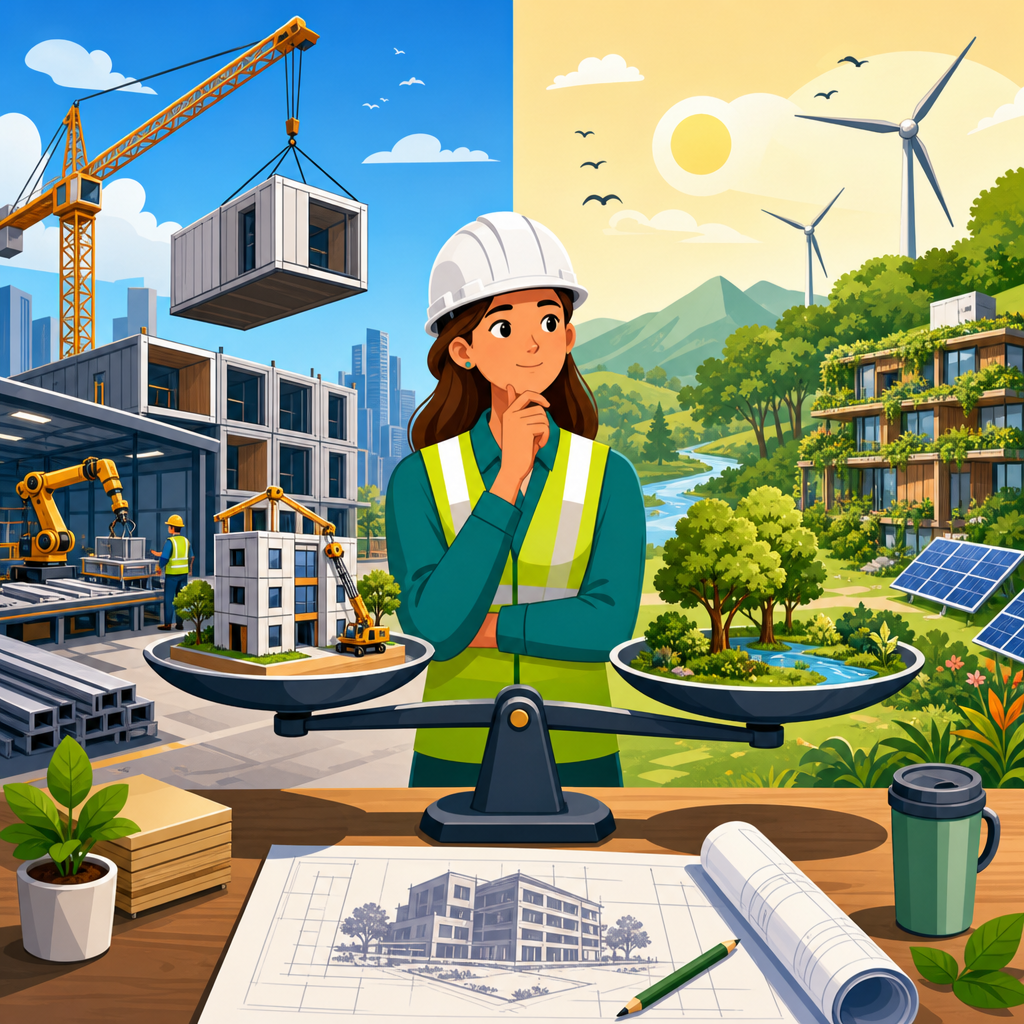
Industrialized construction promises faster projects, cleaner sites, and measurable efficiency gains, but its sustainability profile is more complex than many headlines suggest. The term refers to building methods that shift substantial work from the jobsite into controlled production environments, then assemble standardized or engineered components in the field. It includes modular construction, panelized systems, precast concrete, mass timber kits, bathroom pods, mechanical racks, and other forms of off-site manufacturing. In practice, I have seen teams use the phrase loosely, so clarity matters: industrialized construction is not one product or one material, but a delivery approach built on repeatability, digitization, logistics planning, and manufacturing discipline.
Sustainability trade-offs matter because buildings create large environmental impacts across extraction, manufacturing, transport, construction, operations, maintenance, and end-of-life. Decisions that reduce waste on site can increase factory energy demand. A lighter structural system can cut foundations yet require longer transport distances. Standardized assemblies can improve quality and airtightness, while limiting adaptation or repair if proprietary parts become unavailable. For city leaders, developers, designers, and contractors working on sustainable urban development, the real question is not whether industrialized construction is good or bad. The question is where it performs better than conventional delivery, under what conditions, and by which metrics.
A sound assessment starts with scope. Sustainability in construction usually includes embodied carbon, operational energy, water use, waste generation, local air pollution, worker safety, cost stability, schedule certainty, community disruption, and resilience. Those outcomes must be measured across the full life cycle rather than judged from a factory photo or a marketing claim. Standards such as EN 15978, ISO 14040, and whole-building life-cycle assessment frameworks provide the right lens. When teams compare options using equivalent functional units, realistic transport assumptions, and documented product data, the trade-offs become visible. That transparency is what makes industrialized construction useful as a serious strategy instead of a slogan.
How industrialized construction changes the sustainability equation
Industrialized construction changes environmental performance because it changes process control. In a factory, cutting patterns are optimized, moisture exposure is limited, tolerances are tighter, and repetitive work can be refined over many cycles. Compared with conventional stick-built methods, this often reduces material waste, lowers rework, and improves installation consistency. On several multifamily projects, I have seen framing waste reduced materially after shifting to panelized wall systems because openings, service penetrations, and lengths were coordinated in a digital model before fabrication. That is a real sustainability benefit, especially when landfill fees and hauling emissions are counted.
Yet process efficiency does not guarantee lower total impact. Factory production concentrates energy use in manufacturing facilities that may run climate control, curing systems, welding equipment, and material handling lines for long hours. If the plant operates on carbon-intensive grid electricity, some waste savings can be offset by higher manufacturing emissions. Industrialized systems also depend on packaging, lifting frames, and transport planning. Oversized modules may require escort vehicles, constrained routes, and just-in-time sequencing that increases logistical complexity. For urban sites, reduced neighborhood disruption can be a major win, but that benefit must be weighed against transport intensity and crane operations.
The basic sustainability equation is therefore comparative, not absolute. A project with repeated room types, stable geometry, and short haul distances to a well-run factory often performs strongly. A one-off building with late design changes, long transport routes, and poor coordination may not. Climate, local labor markets, energy mix, and regulatory approvals also influence results. Industrialized construction works best when product strategy, design for manufacture and assembly, procurement, and site logistics are aligned from the beginning. When teams treat off-site fabrication as a late procurement substitution, they often lose both efficiency and sustainability advantages.
Embodied carbon: where the gains are real and where they disappear
Embodied carbon is usually the first metric discussed, and for good reason: up-front emissions occur before a building opens and contribute immediately to atmospheric warming. Industrialized construction can reduce embodied carbon through material optimization, structural efficiency, and lower waste rates. Precast systems can be designed with optimized reinforcement and repeated molds. Mass timber kits can achieve high material utilization with digital cutting files. Light-gauge steel panels can minimize over-ordering and site offcuts. In each case, repeatability helps teams remove unnecessary material while maintaining performance.
However, the material itself still dominates the footprint. Precast concrete remains carbon-intensive because cement production is emissions-heavy. Steel modules carry the carbon burden of steelmaking unless high recycled content and lower-carbon electric arc furnace routes are verified. Mass timber can show favorable biogenic carbon accounting, but the result depends on accounting rules, forest management, transportation, adhesives, fire protection layers, and end-of-life assumptions. I have reviewed product comparisons where a highly optimized conventional concrete frame outperformed a poorly planned modular steel solution, simply because the module chassis added substantial tonnage and transport distances were long.
Environmental product declarations are useful but easy to misuse. They often report cradle-to-gate impacts for a product, not the whole-building outcome. A lower-carbon wall panel does not guarantee a lower-carbon building if additional transfer structure, bracing, or shipping steel is required. The correct method is whole-building life-cycle assessment using coordinated quantities and scenario assumptions. Teams should test module size, plant distance, material substitutions, and structural grid early. Small design decisions, such as reducing module width to avoid abnormal-load transport, can materially lower both cost and carbon while preserving manufacturing efficiency.
Operational performance and building quality
One of the strongest sustainability arguments for industrialized construction is quality control, which often translates into better operational performance. Factory-made assemblies can improve airtightness, insulation continuity, and service coordination because work happens in controlled conditions with jigs, templates, and repeat inspection points. In housing, that can mean fewer thermal bridges, less water intrusion risk, and more consistent window installation. Better envelopes reduce heating and cooling demand for decades, and operational savings often outweigh modest differences in construction-stage impacts over time.
Still, operational performance depends on design execution, not manufacturing alone. A modular building with weak junction detailing can suffer from air leakage at inter-module connections. Poor commissioning can erase gains from high-quality mechanical skids. Bathroom pods can reduce installation defects but still fail if sealants, ventilation, or maintenance access are compromised. I have seen teams assume the factory solved quality, then underinvest in site integration, testing, and handover. The result was callbacks, remedial work, and avoidable energy penalties. Industrialized construction improves the probability of quality; it does not eliminate the need for rigorous commissioning and post-occupancy verification.
The practical lesson is to connect manufacturing precision with performance standards. Use blower door testing targets, hygrothermal analysis for envelope details, and monitored energy data where possible. Digital twins and model-based coordination help, but they must be paired with clear responsibility matrices. Sustainability improves when design intent, fabrication tolerances, and operational requirements are linked contractually and technically. That is especially important in schools, healthcare, and multifamily buildings where comfort, acoustics, and indoor air quality are part of the sustainability outcome, not side issues.
Waste, water, logistics, and site impacts
Industrialized construction usually reduces visible site waste, and that matters in dense urban areas where skips, deliveries, and noise directly affect neighbors. Factory cutting plans improve yield. Materials are protected from weather. Wet trades can be reduced, which lowers water use and shortens drying time. Sites are cleaner and often safer because less fabrication happens overhead or in congested zones. For municipalities concerned with traffic management and local nuisance, these are practical sustainability benefits, not public relations talking points.
But impacts shift rather than vanish. Packaging waste can increase, especially for finished modules and delicate prefabricated components. Temporary bracing, lifting gear, and shipping frames may be single-use unless a reverse logistics system exists. Transport emissions can be significant for bulky volumetric modules that carry a lot of air. Factory waste also becomes less visible to the client unless reporting is required. I always advise teams to ask for audited waste data from both plant and site, not just site diversion rates. Otherwise, the comparison is incomplete.
| Issue | Typical industrialized advantage | Main trade-off to verify | Best metric |
|---|---|---|---|
| Material waste | Higher cutting precision and less rework | Hidden factory scrap and packaging waste | kg waste per square meter delivered |
| Transport | Fewer on-site deliveries and shorter site duration | Long-distance hauling of oversized modules | ton-kilometers and fuel type |
| Water use | Reduced wet trades and weather exposure | Factory process water and cleaning demand | liters per square meter |
| Neighborhood impact | Less noise, dust, and street occupation on site | Peak crane lifts and delivery windows | days of disruption and complaint rates |
Urban developers should also examine curb space, crane time, and road restrictions. A panelized system may fit city logistics better than fully volumetric modules, even if factory labor savings are lower. In other words, the most sustainable choice is often the one that balances factory efficiency with urban transport reality.
Labor, safety, social value, and local economic effects
Sustainability is not only environmental. Industrialized construction can improve worker safety by moving tasks off ladders and scaffolds into ergonomic production stations. Repetitive work in controlled settings reduces exposure to weather and can support better training, quality assurance, and workforce inclusion. On projects facing skilled labor shortages, factory production can stabilize output and reduce schedule volatility. That is one reason healthcare and hospitality developers have adopted bathroom pods and MEP racks: predictable installation lowers coordination failures and compresses timelines.
There are trade-offs here as well. Off-site manufacturing can shift economic value away from local subcontractor networks toward centralized plants. Communities may gain fewer site jobs even if projects finish faster. Factory work can become repetitive and tightly timed, creating different ergonomic and labor concerns. Regional resilience also matters: if a project depends on a single supplier and that plant faces financial, regulatory, or capacity issues, the disruption can be severe. Social sustainability therefore includes procurement diversity, fair labor standards, apprenticeship pathways, and supply-chain resilience.
In public projects, I recommend evaluating local content, safety performance, and training commitments alongside carbon and cost. A lower-waste delivery model that weakens local industry capacity may not align with broader urban development goals. Conversely, a regional manufacturing base for standardized housing components can support decarbonization, job quality, and housing delivery at the same time. The local context determines whether industrialized construction strengthens or fragments social value.
Design flexibility, durability, circularity, and end-of-life
The long-term sustainability of industrialized construction depends on how well systems age and adapt. Standardization can support replacement parts, documented assemblies, and planned maintenance. Bolted or dry connections can make disassembly easier than conventional composite construction. Some kit-of-parts strategies are well suited to circular economy goals because components can be reconfigured, refurbished, or reused. In temporary buildings, event facilities, and certain commercial uses, that can be a major advantage.
Yet many industrialized systems are optimized for speed, not future adaptability. Proprietary dimensions, hidden connections, and composite layers can complicate repair and selective disassembly. Module stacking may constrain later layout changes. If a supplier exits the market, matching facade panels, pods, or integrated service parts may become difficult. Durability also depends on transport and lifting stresses; finishes and seals can be damaged before occupancy if tolerances are poor or weather protection fails. These are not theoretical risks. They show up in warranty claims and maintenance budgets.
To protect sustainability outcomes, teams should require design-for-disassembly principles where feasible, maintain an asset register of component specifications, and avoid unnecessary proprietary lock-in. Adaptability should be tested at concept stage: can units be combined, services upgraded, facades replaced, and interiors reconfigured without major structural intervention? The most sustainable building is often the one that stays useful longest. Industrialization helps when it supports that longevity and hurts when it bakes in obsolescence.
Industrialized construction is neither a sustainability shortcut nor a false promise. It is a powerful delivery model with clear strengths and equally clear conditions. It can cut waste, improve quality, shorten schedules, reduce neighborhood disruption, and in many cases lower embodied impacts through better material efficiency. It can also increase transport burdens, concentrate supply-chain risk, hide factory impacts, and limit adaptability if used without full life-cycle thinking. The responsible position is comparative: judge each system against a realistic conventional baseline, using whole-building assessment, verified product data, logistics analysis, and operational performance targets.
For sustainable urban development, the best use of industrialized construction is targeted and evidence-led. Favor it where repetition, design stability, regional manufacturing capacity, and tight urban constraints make its advantages meaningful. Be cautious where projects are highly bespoke, haul distances are long, or proprietary systems undermine resilience and repair. Above all, ask better questions early: What is the carbon baseline? Where is the plant? How will the building perform in use? Can parts be maintained or replaced? Who gains economically, and who carries risk?
If you are planning a project in this subtopic, treat this page as your starting framework. Map trade-offs across carbon, quality, logistics, labor, and long-term adaptability before selecting a system. That approach turns industrialized construction from a trend into a disciplined sustainability decision.
Frequently Asked Questions
What is industrialized construction, and why is it often described as more sustainable?
Industrialized construction is an umbrella term for building approaches that move a significant share of design, fabrication, and assembly away from the traditional jobsite and into controlled manufacturing environments. Instead of relying exclusively on sequential site-built trades, teams produce standardized or engineered components such as volumetric modules, wall panels, precast concrete elements, mass timber assemblies, mechanical racks, or prefabricated bathroom pods in factories or specialized fabrication facilities. Those parts are then transported to the project and installed with a higher degree of planning and coordination than conventional construction typically allows.
It is often described as more sustainable because the model can reduce several well-known sources of waste and inefficiency. Factory settings generally improve material yield, support tighter quality control, reduce weather-related damage, and make it easier to track inputs and outputs. Projects may generate fewer dumpsters on site, use less packaging in some cases, and shorten construction schedules enough to reduce neighborhood disruption, idling equipment, and temporary site energy use. Repetition also allows teams to refine details over time, which can improve durability and reduce rework.
That said, the sustainability case is not automatic. Industrialized construction can shift impacts rather than simply eliminate them. Material choices still matter, transportation can be significant, and factory production requires energy, equipment, and sometimes highly specialized supply chains. A project may look cleaner on the jobsite while carrying hidden emissions upstream in manufacturing or long-distance freight. The most accurate way to describe industrialized construction is that it creates new opportunities for sustainability gains, but the final outcome depends on design decisions, sourcing, logistics, assembly methods, and long-term building performance.
Does industrialized construction always reduce carbon emissions compared with traditional building methods?
No. Industrialized construction can reduce embodied carbon in some scenarios, but it does not guarantee lower emissions across the board. The answer depends on what system is being used, how far components travel, what materials are specified, how efficiently factories operate, and whether the design truly takes advantage of repeatability and waste reduction. A modular or panelized approach built around optimized material use and local fabrication may outperform a comparable site-built project. But a project that ships heavy components long distances, relies on carbon-intensive materials, or overbuilds assemblies for transportation and lifting may narrow or even erase those benefits.
One of the biggest misconceptions is that “off-site” automatically means “low-carbon.” In reality, embodied carbon comes from extraction, manufacturing, transport, and installation. Precast concrete, for example, can improve quality and speed, but cement-heavy systems may carry substantial upfront emissions unless lower-carbon mixes or supplementary cementitious materials are used. Steel-framed modular units can support precision manufacturing, yet steel production remains energy-intensive. Mass timber may offer carbon advantages in some contexts, but those outcomes depend on sourcing, forest management, adhesives, fire protection requirements, and transportation logistics.
Operational performance also matters. If industrialized methods help create tighter building envelopes, better fit and finish, and more consistent installation of insulation and mechanical systems, they can improve energy efficiency over the life of the building. In many cases, those long-term operational savings are central to the sustainability equation. The most credible comparisons rely on life-cycle assessment rather than assumptions. Project teams need to examine embodied carbon, transport emissions, installation impacts, expected service life, maintenance requirements, and operational energy together. Industrialized construction can be a powerful low-carbon strategy, but only when the system, the supply chain, and the building design are aligned around that goal.
What are the main sustainability trade-offs that project teams should evaluate before choosing an industrialized approach?
The main trade-offs usually fall into five categories: materials, transportation, energy use in production, design flexibility, and end-of-life outcomes. On materials, industrialized systems can cut waste through precision manufacturing, but they may also require added structural reinforcement, extra packaging, or specialized connection hardware to survive transport and installation. Those additions can increase embodied impacts even while reducing onsite scrap. Transportation is another major factor. Large modules, precast components, or oversized panels can require long-haul trucking, escort vehicles, cranes, and carefully staged deliveries, all of which add environmental burdens that are easy to underestimate.
Factory energy use is also important. Controlled environments can be more efficient than scattered field operations, but that depends on the facility’s power source, production intensity, and utilization rate. A well-run plant using cleaner electricity and high throughput may perform very well. A facility with low utilization, fossil-heavy energy, or significant idle time may not. Design flexibility creates another trade-off. Standardization enables efficiency, but rigid module sizes or pre-engineered assemblies can push teams toward solutions that are not always optimal for orientation, passive design, adaptability, or material efficiency. In other words, manufacturing logic can sometimes override project-specific environmental opportunities.
End-of-life considerations round out the picture. Some industrialized systems are well suited to disassembly, component reuse, and circularity, especially when parts are designed with mechanical connections and clear material documentation. Others may be difficult to separate, repair, or repurpose because of composite assemblies, sealants, embedded systems, or proprietary interfaces. The sustainable choice is rarely the one with the simplest marketing story. It is the one that balances speed, quality, resource efficiency, carbon, durability, maintenance, and future adaptability. Teams that evaluate those trade-offs early tend to make better decisions than those that treat industrialized construction as inherently green from the outset.
How do modular construction, precast concrete, and mass timber differ in their sustainability profiles?
These systems are often grouped together under the industrialized construction umbrella, but their sustainability characteristics are quite different. Modular construction is a process strategy more than a single material category. It can be built from steel, wood, or hybrid systems, and its environmental profile depends heavily on those material choices as well as factory efficiency, transport distances, and the amount of completion achieved off-site. Its strongest sustainability advantages often come from reduced site disruption, shorter schedules, better quality control, and lower rework. Its main risks include transport impacts, overengineering for lifting and shipping, and potential limitations on design optimization.
Precast concrete offers durability, consistency, thermal mass benefits in some applications, and high-quality fabrication under controlled conditions. It can reduce site waste and improve installation speed, particularly on projects with repetitive structural or enclosure elements. However, concrete’s sustainability profile is closely tied to cement content, aggregate sourcing, reinforcement, and plant energy use. Because concrete elements are heavy, transportation can be a significant factor, especially when plants are far from the project. Lower-carbon concrete strategies, optimized structural design, and regional sourcing can improve outcomes, but precast should never be assumed to be low-carbon simply because it is prefabricated.
Mass timber is often viewed as the sustainability standout because wood can store biogenic carbon and may replace more emissions-intensive structural materials in certain building types. It also lends itself well to digital fabrication and kit-of-parts assembly. But its performance depends on forest stewardship, certification, manufacturing energy, adhesives, coatings, fire and acoustic assemblies, and shipping distances from mills or fabricators. In some projects, added layers required for code compliance or performance can reduce the simplicity of the sustainability narrative. The practical takeaway is that there is no universal ranking that applies in every context. Modular, precast, and mass timber each have scenarios where they can support meaningful sustainability gains and scenarios where their trade-offs become more pronounced. The right comparison is project-specific and should be based on measurable data, not category-wide assumptions.
How can developers, architects, and contractors make industrialized construction genuinely more sustainable?
The first step is to treat sustainability as a design and procurement criterion from the beginning, not as a benefit that will appear automatically once off-site methods are selected. Teams should establish clear performance goals for embodied carbon, operational energy, waste reduction, water use, durability, and circularity early in concept design. That allows the industrialized strategy to be shaped around actual outcomes. Early collaboration is especially important because industrialized construction rewards front-loaded decision-making. If designers, manufacturers, engineers, contractors, and major suppliers work together early, they can optimize dimensions, reduce redundant materials, simplify connections, and avoid late changes that create waste.
Teams should also demand transparency from the supply chain. Environmental product declarations, life-cycle assessments, material ingredient disclosures, and verified sourcing information are essential if sustainability claims are going to hold up under scrutiny. Transportation planning deserves equal attention. Regional manufacturing, efficient load planning, reduced double-handling, and coordinated installation sequencing can materially improve a project’s footprint. On the factory side, cleaner energy procurement, efficient machinery, scrap recovery programs, and closed-loop material handling can strengthen the environmental case. On the building side, teams should focus on high-performance envelopes, reliable air sealing, efficient mechanical systems, and commissioning, since better building performance over decades can outweigh smaller short-term gains.
Finally, project teams should think beyond completion. A truly sustainable industrialized building is easier to maintain, adapt, repair, and potentially disassemble. That means documenting assemblies clearly, favoring accessible connections where appropriate, selecting durable materials, and designing for future modifications rather than assuming a fixed use forever. Post-occupancy measurement is also valuable. Tracking actual waste generation, installation efficiency, indoor environmental quality, and energy performance helps separate real benefits from optimistic assumptions. Industrialized construction becomes genuinely more sustainable when it is used as a disciplined framework