Parking lots are usually treated as blank utility space, but in cities facing heat, flooding, and rising infrastructure costs, they are becoming one of the most practical places to build climate resilience. Reimagining parking lots as climate infrastructure means redesigning paved areas so they do more than store cars: they can absorb stormwater, reduce urban heat, generate renewable power, support walking and transit, and create land use flexibility as travel habits change. This matters because parking covers enormous urban acreage. In many North American downtowns, land devoted to parking rivals or exceeds land used by housing or parks, and most of it is hard, dark, and exposed. I have worked on site planning reviews where a single suburban shopping center had more impervious parking area than roof area, making runoff control and summer surface temperatures the central environmental issue on the site.
Climate infrastructure refers to physical systems that help communities mitigate emissions and adapt to climate impacts. Traditionally, that category included storm sewers, levees, transit, and power grids. Today it also includes distributed systems embedded in everyday places: bioswales along streets, district energy in neighborhoods, and solar canopies over parking fields. Parking lot redesign belongs in this category because it affects several urban systems at once. A retrofitted lot can lower peak runoff entering combined sewers, cut pavement temperatures, provide shade where people actually walk, and host charging equipment that supports electrified transport. Unlike large greenfield projects, parking lots are already graded, owned, and connected to roads and utilities, which makes them unusually actionable.
The key terms are straightforward. Impervious surface is any ground cover, such as asphalt, that prevents water from infiltrating into soil. Green infrastructure uses vegetation, soils, and permeable materials to manage water and improve environmental performance. Albedo describes how much sunlight a surface reflects; higher-albedo pavements absorb less heat. Distributed energy means power generated near where it is used, often with solar arrays and batteries. Shared mobility includes transit, walking, cycling, and vehicle services that reduce the need for every trip to rely on a private car. When these ideas are brought together, parking lots stop being passive heat islands and start functioning as flexible urban assets.
For sustainable urban development, this topic sits at the intersection of land use, transportation, water management, public health, and municipal finance. Local governments often struggle to fund standalone climate projects, yet they regularly approve resurfacing, restriping, drainage upgrades, and redevelopment plans for parking facilities. That creates a powerful opportunity: climate performance can be added during routine capital cycles instead of waiting for a perfect, fully funded master plan. The best results come from treating parking lots not as isolated parcels, but as neighborhood-scale infrastructure nodes connected to streets, buildings, transit stops, and watersheds.
Why parking lots are a climate liability and a strategic opportunity
Conventional parking lots worsen three linked urban problems: runoff, heat, and inefficient land consumption. During storms, rain hits sealed pavement and moves quickly into drains, carrying oil, tire particles, heavy metals, and sediment. In older cities with combined sewer systems, large runoff pulses can contribute to overflows that discharge untreated wastewater into waterways. In newer systems, the problem shifts downstream as creeks erode and detention ponds fill. From a heat perspective, asphalt can reach temperatures far above surrounding air on sunny days, intensifying the urban heat island effect and making simple tasks like walking from a car to a store physically stressful, especially for older adults, children, and outdoor workers.
The same lots are also strategic opportunities because they are flat, open, and repetitive. Those qualities make them ideal for modular interventions that can be standardized across a city. A municipality can create a retrofit template for tree islands, permeable parking bays, solar canopies, EV charging clusters, accessible pedestrian routes, and rainwater capture, then apply it to libraries, schools, park-and-ride facilities, hospitals, retail centers, and office campuses. In practice, parking lots are one of the few places where stormwater engineers, urban foresters, mobility planners, and energy teams can all contribute to a single project with measurable co-benefits.
This hub article provides the framework for that work. It is designed to connect the major subtopics city leaders, developers, institutions, and property owners need to evaluate: stormwater retrofits, heat mitigation, energy generation, mobility transition, land use reform, design standards, maintenance, finance, and policy. Each of these deserves deeper treatment in supporting articles, but the central point is simple: parking lots can move from environmental burden to climate asset when design choices are intentional and performance-based.
Stormwater management: turning runoff problems into water infrastructure
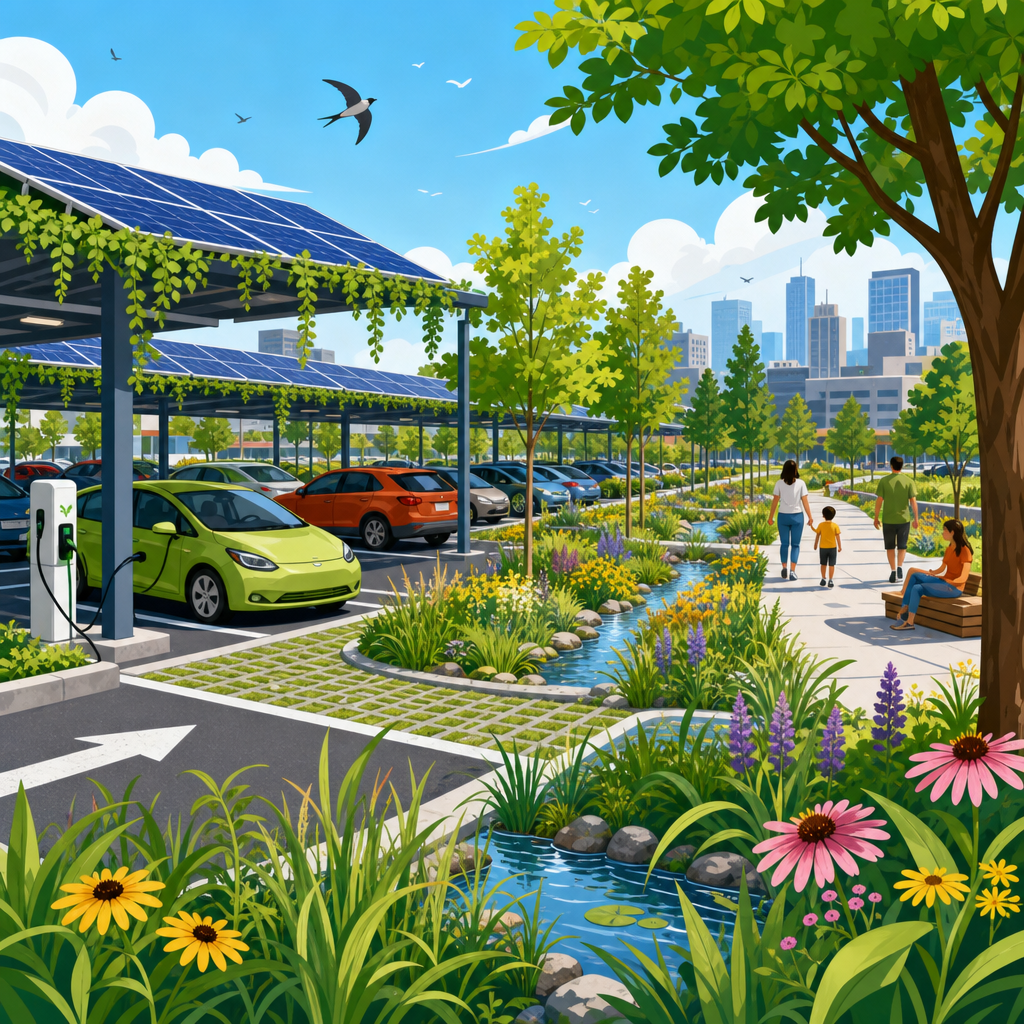
The most immediate climate function a parking lot can serve is stormwater control. Retrofitting begins with slowing, storing, filtering, and infiltrating runoff on site. Common tools include permeable pavers in low-turnover parking rows, bioretention islands between parking aisles, vegetated swales at lot edges, underground detention under drive lanes, and curb cuts that let water enter planted areas instead of racing directly to catch basins. The right mix depends on soil infiltration rates, groundwater depth, winter maintenance needs, and local storm standards. In dense urban sites with poor soils, lined bioretention with underdrains may perform better than full infiltration systems. In campuses or suburban centers with more space, infiltration basins and tree trenches can be highly effective.
Real-world examples show why the details matter. The U.S. Environmental Protection Agency and many state stormwater manuals document pollutant removal benefits from bioretention and permeable pavement when systems are correctly designed and maintained. I have seen projects fail not because the concept was wrong, but because pretreatment was omitted, sediment clogged surfaces, or overflow structures were undersized. Good retrofit practice includes watershed calculations, maintenance access, vacuum sweeping plans for permeable surfaces, and plant palettes that tolerate road salt, drought, and inundation. The payoff is substantial: lower peak flows, reduced burden on public drainage systems, better water quality, and in some cases lower regulatory fees where stormwater utilities charge by impervious area.
| Climate goal | Parking lot intervention | Primary benefit | Key design consideration |
|---|---|---|---|
| Reduce runoff | Bioretention islands and permeable paving | Slows and filters stormwater on site | Protect from sediment clogging and confirm soil capacity |
| Lower heat | Shade trees and high-albedo surfaces | Cools pavement and improves walking comfort | Choose species and materials suited to local climate |
| Generate clean power | Solar canopies with battery storage | Produces electricity and shade simultaneously | Coordinate structural loads, fire access, and utility interconnection |
| Support mobility shift | Transit stops, bike parking, EV charging, pickup zones | Reduces dependence on single-occupant vehicle trips | Prioritize safe pedestrian circulation across the lot |
| Create future flexibility | Convertible layouts and reduced minimum parking supply | Allows redevelopment as travel behavior changes | Align zoning, shared parking data, and phased design |
Heat mitigation and public health: making paved land safer
Heat is not just a comfort issue. It is a public health risk with clear spatial patterns, and large parking fields are among the hottest parts of many neighborhoods. Effective mitigation combines shade, surface strategy, and circulation design. Trees provide the strongest long-term cooling benefit because they reduce radiant heat while improving air quality and visual quality. Solar canopies can complement tree cover, especially where parking demand remains high and immediate shade is needed. Cool pavements with higher solar reflectance can help, but they are not a universal solution; some reflective materials reduce surface temperatures while increasing glare or reflected radiation experienced by pedestrians. The best designs test both thermal performance and human experience.
Walking routes are often overlooked. In many lots, people are forced to cross wide drive aisles without shade, clear crossings, or protection from moving vehicles. A climate-informed redesign adds direct, accessible pedestrian paths from transit stops and sidewalks to building entries, using landscaped medians, raised crossings, bollards, and wayfinding. Health outcomes improve when parking areas become safer and less physically punishing. Hospitals, schools, and senior housing sites should treat this as basic resilience planning. During recent heat waves, shaded access routes and covered waiting areas were not amenities; they were critical safety features.
Energy, transportation, and land use: from car storage to flexible urban systems
Parking lots can also support decarbonization through distributed energy and changing mobility patterns. Solar parking canopies are one of the clearest examples because they stack functions on already-developed land. They generate electricity without consuming new open space, shade vehicles and people, and pair naturally with EV charging. In regions with high peak demand charges, batteries can improve economics by shifting load and providing resilience during outages. Airports, universities, hospitals, and corporate campuses have used this model because they control large parking inventories and can consume power on site. The economics vary by utility rates, incentives, interconnection timelines, and structural costs, but the concept is proven.
Transportation behavior is changing too. Many cities still carry outdated minimum parking requirements based on peak demand assumptions from decades ago. As transit access improves, remote work changes commute patterns, and shared mobility expands, those standards can lock in oversupply. Reimagining parking lots therefore includes demand management: shared parking agreements, unbundled parking in residential projects, dynamic pricing, and phased construction that avoids paving every future stall on day one. In redevelopment districts, parts of a surface lot can be reserved for interim uses such as food markets, recreation, stormwater landscapes, or modular buildings, then converted later as demand evolves. This is how parking becomes flexible land rather than stranded asphalt.
Implementation works best when policy and design move together. Zoning reform, stormwater ordinances, tree canopy requirements, and capital planning should reinforce one another. Property owners need clear standards, predictable approval pathways, and maintenance guidance. Start with the lots that deliver the most co-benefit: public facilities in flood-prone or heat-vulnerable areas, commercial lots scheduled for resurfacing, and transit-adjacent sites where parking can be right-sized over time. Audit existing conditions, set measurable performance targets, and retrofit in phases. Cities that treat parking lots as climate infrastructure will gain cooler streets, cleaner water, more resilient energy systems, and land that can adapt to the next generation of urban needs. The next step is practical: identify one parking lot in your portfolio or neighborhood and evaluate how it can perform more than one job.
Frequently Asked Questions
What does it mean to treat parking lots as climate infrastructure?
Treating parking lots as climate infrastructure means redesigning these paved areas so they actively help cities manage environmental stress instead of functioning only as places to store vehicles. In practical terms, that can include replacing conventional asphalt with permeable pavement, adding bioswales and rain gardens to capture stormwater, planting shade trees to lower surface temperatures, installing solar canopies to generate electricity, and reorganizing layouts to better support walking, cycling, and transit access. The basic idea is that parking lots occupy a large amount of urban land, are often highly impervious, and tend to intensify heat and runoff problems. Because of that, they are also one of the most immediate opportunities for cities, schools, shopping centers, hospitals, and commercial property owners to add resilience without starting from scratch on undeveloped land.
This approach matters because the risks cities face are becoming more expensive and more frequent. Heavy rain overwhelms drainage systems, extreme heat makes paved districts dangerous and uncomfortable, and infrastructure budgets are under pressure. A conventional parking lot usually worsens all three problems by shedding water quickly, storing heat, and generating little long-term value beyond vehicle storage. A climate-ready parking lot, by contrast, can become part of a district-scale resilience strategy. It can hold or infiltrate water during storms, reduce nearby air and surface temperatures, create cleaner and safer pedestrian connections, and even provide energy generation and electric vehicle charging. In other words, parking lots can shift from being environmental liabilities to multipurpose public assets.
How can redesigned parking lots help reduce flooding and manage stormwater?
Parking lots are often major contributors to urban runoff because they are covered with hard, impervious surfaces that prevent water from soaking into the ground. During intense storms, rain that lands on a large paved area moves quickly into storm drains, streets, and nearby waterways. That surge can overwhelm local drainage systems, flood adjacent properties, erode streams, and carry pollutants such as oil, metals, trash, and tire residue into the environment. Reimagined parking lots address this by slowing, storing, filtering, and infiltrating water on-site as much as possible.
There are several proven design strategies. Permeable pavement allows water to pass through the surface into an underlying stone reservoir, where it can infiltrate gradually into the soil or be released slowly. Bioswales and vegetated curb extensions channel runoff into planted areas that absorb water and remove pollutants. Rain gardens, infiltration trenches, detention basins, and underground storage systems can all be integrated into parking lot retrofits depending on site constraints. Even relatively simple interventions, such as reducing excess paved area and directing drainage into landscaped islands, can significantly improve performance. In larger projects, smart water controls can also be used to manage storage capacity ahead of forecasted storms.
The broader value is that stormwater improvements in parking lots can reduce pressure on aging sewer networks and lower the cost of downstream flood damage. They can also support regulatory compliance for sites subject to stormwater permits and help property owners avoid expensive gray infrastructure expansions. For cities facing more intense rainfall, parking lot retrofits are appealing because they turn highly visible, highly problematic surfaces into distributed stormwater management assets. Instead of relying exclusively on larger pipes and underground systems, communities can use parking areas themselves as part of the solution.
Can parking lots really help reduce urban heat and improve comfort?
Yes. Conventional parking lots are some of the strongest contributors to the urban heat island effect because dark pavement absorbs and stores solar radiation all day, then releases that heat over time. Surface temperatures on asphalt can become dramatically hotter than the surrounding air, making adjacent sidewalks, storefronts, transit stops, and buildings less comfortable and sometimes unsafe during heat events. That heat also increases cooling demand in nearby structures and can make walking across large lots unpleasant enough to discourage active transportation altogether.
Redesigned parking lots can reduce these impacts through a combination of shade, materials, and layout. Tree canopy is one of the most effective tools because it blocks direct sun, cools the air through evapotranspiration, and improves the overall user experience. Solar canopies can provide similar shading benefits while also generating renewable electricity. High-albedo or reflective paving materials can help reduce heat absorption compared with traditional dark asphalt, and permeable systems may also contribute to lower surface temperatures depending on the design. In some projects, reducing the total amount of paved area and replacing unused sections with planted zones, public space, or mobility corridors can produce an even bigger cooling effect.
Heat reduction is not just a comfort issue; it is also a public health and equity issue. Large expanses of unshaded pavement are especially harmful in neighborhoods with fewer trees and limited access to cooling resources. By targeting parking lots for heat mitigation, cities can improve conditions in exactly the kinds of places where daily exposure is highest: retail corridors, apartment complexes, schools, medical campuses, and transit-oriented districts. The result is a site that works better for people, lowers thermal stress, and contributes to a more resilient urban environment.
What role do solar canopies, electric vehicle charging, and mobility upgrades play in climate-friendly parking lots?
These features help parking lots serve not just as passive surfaces, but as active infrastructure that supports cleaner energy and lower-emission transportation. Solar canopies are one of the clearest examples. They turn open parking areas into energy-generating sites by placing photovoltaic panels above parked vehicles, which creates the dual benefit of renewable power production and shaded parking. That electricity can be used on-site, fed into the grid, paired with battery storage, or directed toward electric vehicle charging. For property owners with large daytime energy loads, such as shopping centers, offices, campuses, and hospitals, this can improve resilience and lower operating costs over time.
Electric vehicle charging is another important layer. As transportation electrification grows, parking lots are becoming strategic charging locations because cars are often parked there for extended periods. Integrating charging stations into redesigned lots can support commuters, residents, fleets, and visitors while making the site more future-ready. If paired with solar generation and storage, a parking lot can function as a distributed energy hub that provides charging, reduces peak energy costs, and in some cases supports backup power during outages. This is especially valuable for critical facilities and high-traffic sites.
Mobility upgrades broaden the climate benefits further. Many lots were designed with a single purpose and little regard for how people arrive without a car or how they move safely once they are on-site. Reconfiguring circulation to include protected walking paths, bike parking, transit pick-up areas, bus shelters, micromobility zones, and safer street connections can reduce vehicle dependence and make the same land serve more users. In that sense, a climate-friendly parking lot is not anti-car so much as it is more adaptable, more efficient, and better aligned with changing travel behavior. It supports cleaner vehicles, but it also supports fewer unnecessary car trips over time.
Why is parking lot redesign increasingly seen as a smart long-term land use and investment strategy?
Parking demand is changing in many places due to remote and hybrid work, e-commerce, improved transit options, shared mobility, and shifting development patterns. That means many parking lots are now oversized for actual demand, yet they still impose maintenance costs, stormwater burdens, and heat impacts. Redesigning them as climate infrastructure allows cities and property owners to extract more value from land that is already paved and often underperforming. Rather than committing every square foot to vehicle storage, they can create flexible sites that solve immediate resilience problems while preserving options for future adaptation or redevelopment.
From an investment perspective, this can be a practical way to align asset management with climate risk reduction. A retrofit may lower flood exposure, improve tenant and customer experience, support sustainability targets, reduce energy costs, and enhance regulatory compliance all at once. In some cases, these upgrades can also increase property attractiveness and unlock public incentives, utility partnerships, or green infrastructure funding. Because parking lots are so common and often relatively straightforward to modify in phases, they offer a realistic path to climate action that does not always require large new land acquisitions or major structural changes to existing buildings.
There is also a strong planning advantage. Parking lots can act as transitional spaces that evolve over time. A site might begin with stormwater retrofits and tree planting, then add solar canopies and EV charging, and later convert excess parking into public space, housing, or mixed-use development as demand shifts. That flexibility is increasingly important in cities trying to balance resilience, affordability, mobility, and fiscal constraints. In that context, reimagining parking lots is not just about improving a single land use type. It is about recognizing that some of the most overlooked parts of the built environment can become some of the most useful tools for climate adaptation.