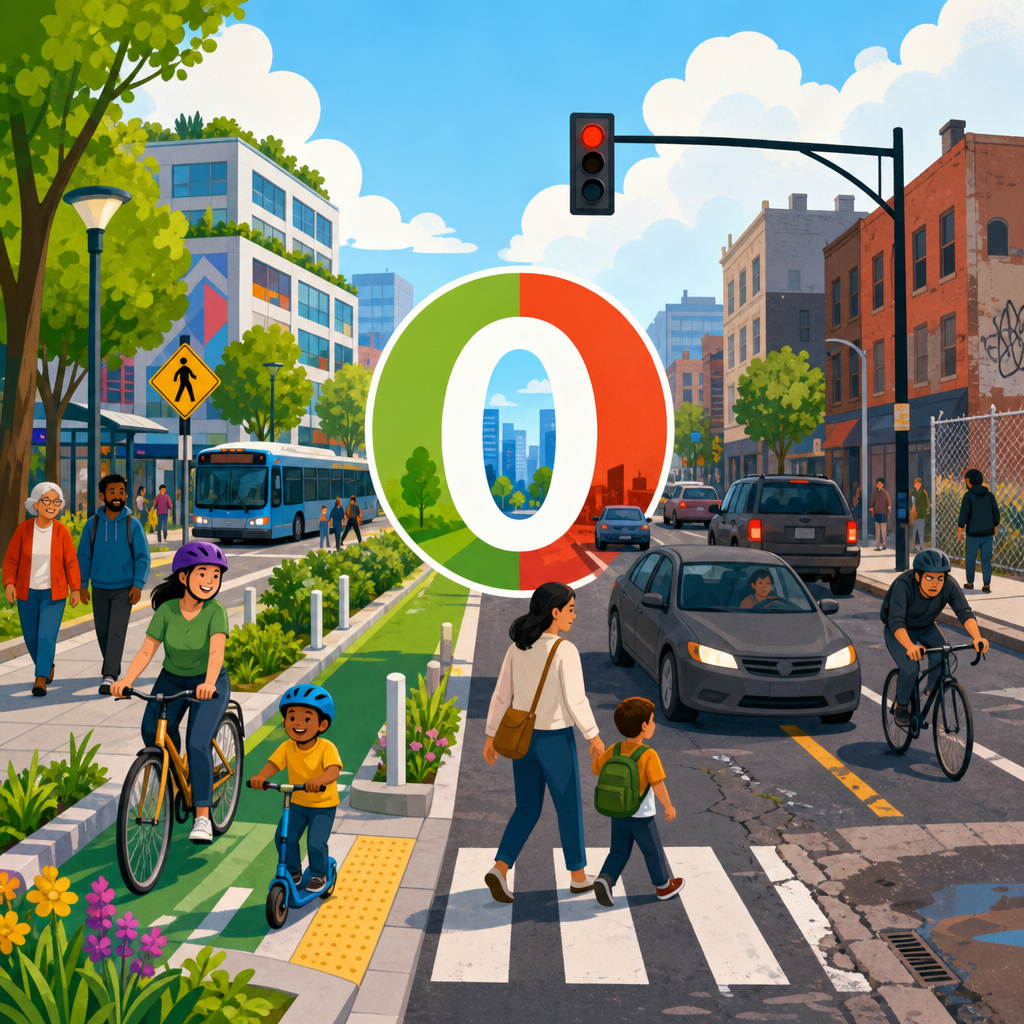
Vision Zero is a road safety strategy built on a simple premise: no death or serious injury in the transportation system is acceptable. Originating in Sweden in the late 1990s, it reframed crashes not as unavoidable accidents but as preventable failures of design, policy, and enforcement. In practice, Vision Zero asks cities to design streets, vehicle rules, and institutional processes around human vulnerability. People make mistakes; the system must keep those mistakes from becoming fatal. That shift matters because traffic violence remains one of the leading causes of premature death in urban areas, especially for pedestrians, cyclists, older adults, and residents of lower-income neighborhoods exposed to fast, dangerous roads.
I have worked on street redesign and safety audits where the pattern became obvious within minutes: wide lanes, long crossings, permissive turning radii, poor lighting, and signal timing that prioritized vehicle throughput over human survival. After a serious crash, agencies often focused on driver behavior alone. Vision Zero demands a fuller diagnosis. It links speed management, roadway geometry, vehicle standards, post-crash care, land use, and data governance. It also changes the metric of success. A city can no longer celebrate reduced congestion if serious injuries rise. The relevant question becomes direct: are streets forgiving enough that an error does not kill someone?
That question matters politically as much as technically. Traditional traffic engineering often optimized for level of service, moving cars quickly through intersections and corridors. Vision Zero instead prioritizes kinetic energy thresholds the human body can survive. A pedestrian struck at 20 miles per hour has a far better chance of survival than one struck at 40. For cyclists, turning conflicts and speed differentials are critical. For transit riders, the safety of the walk to and from the stop is inseparable from the service itself. Once a city accepts those realities, familiar design choices look different. Slip lanes, free right turns, and oversized arterials are no longer neutral features; they are known risk multipliers.
Understanding what cities get right and wrong is essential because Vision Zero has spread widely, yet results are mixed. Some places have cut deaths through protected bike lanes, lower default speed limits, daylighting, automated enforcement, and serious crash review teams. Others adopted the language without changing capital priorities, police practices, or agency accountability. This article explains the core principles, the tools that work, the common implementation failures, and the signs that a city is treating Vision Zero as a measurable operating system rather than a branding exercise.
What Vision Zero Actually Means in City Practice
At its core, Vision Zero rests on five operational ideas. First, death and serious injury are preventable. Second, humans are fallible and will make mistakes. Third, the human body has limited tolerance to crash forces. Fourth, responsibility is shared among system designers, policymakers, fleet operators, and road users. Fifth, safety should be proactive, not dependent on waiting for a fatality before acting. These ideas separate Vision Zero from conventional safety programs that rely heavily on education campaigns and spot enforcement after tragedies.
In city practice, that means building a Safe System. The street network is classified by function, then matched to safe speeds and protective design. A local main street with shops, buses, and school traffic cannot safely operate like a suburban arterial. Agencies identify high-injury networks, usually the small share of streets where most severe crashes occur, then concentrate redesign funds there. New York City, for example, has repeatedly found that a minority of corridors accounts for a majority of traffic deaths and serious injuries. Focusing on those corridors yields more benefit than scattering small fixes evenly across every district.
It also means changing internal process. The strongest programs create mayoral leadership, interagency governance, and public reporting. Transportation, public health, police, schools, emergency medicine, and planning departments share data and agree on targets. Serious crash review boards investigate not just what one driver did, but why the environment allowed lethal conditions. When this is done well, findings lead to design changes such as hardened centerlines, leading pedestrian intervals, raised crossings, protected intersections, and truck side guards.
One practical distinction is important: Vision Zero is not the same as a generic road safety campaign. The difference is systems accountability. If repeated speeding occurs on a corridor, a Vision Zero response is to narrow lanes, lower the posted speed, install cameras where lawful, and retime signals. It does not stop at reminding people to be careful. Cities that understand this move beyond slogans quickly.
What Cities Get Right When Vision Zero Works
Cities succeed when they treat speed as the primary design variable. Speed determines both crash likelihood and injury severity, so serious programs start there. Helsinki and Oslo reached years with zero pedestrian deaths by combining low urban speeds, strong walking infrastructure, and targeted network changes. Their achievement was not magic or culture alone. It reflected street geometry, compact land use, and policy choices that made high-speed urban driving difficult. When cities reduce operating speeds, fatality risk falls even before every corridor is fully rebuilt.
They also get corridor selection right. The best programs use injury severity, exposure, and equity data to target investment. That often reveals uncomfortable truths. High-injury streets frequently run through neighborhoods that have endured disinvestment, truck traffic, poor sidewalks, and dangerous crossings for decades. A city that allocates funds by political convenience instead of risk will underperform. London’s direct vision standards for heavy vehicles and its focus on dangerous vehicle classes show another strength: matching interventions to specific crash mechanisms rather than treating all crashes as equivalent.
Good programs pair quick-build projects with permanent reconstruction. Paint, flexible posts, daylighting, curb extensions with modular materials, and signal timing changes can reduce risk in months. Permanent concrete protection, drainage work, and intersection rebuilding take longer but deliver lasting safety gains. I have seen quick-build curb extensions cut turning speeds immediately, buying time for capital teams to deliver permanent curb realignment. This sequencing matters because waiting for perfect reconstruction often means accepting years of preventable harm.
Another success factor is measurement discipline. Cities that improve publish serious injury data, not just deaths, and they review progress regularly. They track speeding rates, failure-to-yield behavior, emergency response times, and project delivery on the high-injury network. They distinguish between output metrics, such as miles of protected lanes installed, and outcome metrics, such as fewer severe crashes. Without that distinction, agencies can claim success from construction volume even while trauma remains unchanged.
| What effective cities do | Why it works | Typical example |
|---|---|---|
| Set lower safe speeds | Reduces crash energy and stopping distance | 20 mph downtown limits with camera enforcement |
| Target the high-injury network | Concentrates funds where severe harm is greatest | Major arterial redesigns before low-risk local streets |
| Use quick-build first | Delivers immediate protection while capital projects advance | Posts, paint, and signal changes at dangerous intersections |
| Publish transparent data | Creates accountability across agencies and election cycles | Monthly dashboards for deaths, serious injuries, and project status |
| Design for vulnerable users | Protects pedestrians, cyclists, children, and older adults | Raised crossings, refuge islands, and protected bike lanes |
Where Cities Commonly Get Vision Zero Wrong
The most common failure is adopting the rhetoric without reallocating street space or funding. A city launches a Vision Zero plan, but its capital budget still prioritizes roadway widening, parking preservation, and signal progression for higher vehicle speeds. In that situation, the policy is internally contradicted. If the transportation department measures success by delay reduction while the mayor announces a zero-death target, engineers receive mixed instructions and the safer choice often loses.
Another mistake is overemphasizing individual behavior. Education has value, and dangerous driving should have consequences, but behavior-only strategies cannot overcome unsafe design. Wide travel lanes, long sight lines, and permissive turn geometry invite speed. If a corridor reliably produces speeding and severe crashes, the corridor is sending the wrong cues. Vision Zero fails when agencies know this but continue relying on sporadic police enforcement, especially when that enforcement raises civil rights concerns and does not produce durable speed reduction.
Cities also stumble by treating every neighborhood the same. Safety needs differ by land use, demographics, and street type. A school zone, freight route, nightlife district, and transit hub each need tailored solutions. Generic toolkits applied without context can create backlash or limited benefit. For example, bike lanes placed next to fast parking turnover without protection may do little to reduce injury risk. Likewise, flashing beacons on multilane roads can underperform if drivers face long uncontrolled crossing distances. The right intervention must fit the conflict pattern.
Data practice is another weak point. Many agencies undercount serious injuries, rely on incomplete police reports, or fail to integrate hospital trauma data. That distorts priorities. If bike crashes are underreported or pedestrian falls on poor infrastructure are excluded, decision-makers miss important risk. Exposure data matter too. Rising walking volumes can coincide with fewer injuries per trip even if raw counts appear flat. Strong programs invest in data quality because weak diagnosis leads to weak treatment.
Finally, some cities set unrealistic timelines, then lose credibility when deaths do not fall immediately. Vision Zero is ambitious by design, but network change takes sustained political effort. The honest path is to set near-term milestones tied to specific interventions while keeping the long-term zero-death standard. Overpromising and underbuilding is worse than moving steadily with transparent accountability.
The Street Design and Policy Tools That Matter Most
Street design is where Vision Zero becomes tangible. Proven tools include road diets that remove excess lanes, protected bike lanes that separate cyclists from moving traffic, median refuge islands on multilane crossings, raised intersections, tighter curb radii, leading pedestrian intervals, accessible curb ramps, and transit stop islands that reduce conflicts between buses and bikes. On urban arterials, the most important change is often reducing effective width and simplifying conflicts. A five-lane road diet can cut speeding, shorten crossings, and reduce rear-end and left-turn crashes by organizing movement more predictably.
Speed management policy is equally important. Lower statutory speed limits help, but posted numbers alone are weak without self-enforcing design and reliable compliance tools. Automated speed enforcement has one of the strongest evidence bases for reducing dangerous driving, particularly near schools and on high-injury corridors. Where allowed, it outperforms intermittent officer presence because it is consistent and scalable. Pairing cameras with transparent placement criteria and income-sensitive fine structures can improve legitimacy.
Vehicle policy matters more than many city plans admit. Larger vehicles with tall front ends create severe blind zones and transfer greater force in crashes. Municipal fleets can lead by specifying safer procurement, including direct-vision trucks, intelligent speed assistance, side underrun protection, telematics, and mandatory driver training. Freight management also matters. Delivery windows, loading zones, and designated truck routes can reduce conflict in dense commercial districts. A city serious about Vision Zero does not ignore the role of vehicles simply because federal standards control some aspects of design.
Land use and transit policy complete the picture. Compact, mixed-use development shortens trip distances and supports slower street environments. Reliable transit reduces car dependency, but only if walking and cycling access are safe. In practice, some of the highest-value safety projects are humble: sidewalk gap closure, bus stop relocation to the far side of intersections, or better night lighting at crossings serving senior housing. These measures rarely dominate headlines, yet they prevent severe injury where daily exposure is highest.
How to Judge Whether a City Is Serious About Vision Zero
A serious program shows up in budgets, standards, and timelines. Start with the transportation improvement program and capital plan. Are high-injury corridors receiving reconstruction funds? Are resurfacing projects required to add safety upgrades, or are they simple repaving jobs that lock in dangerous geometry for another decade? Good cities institutionalize safe design through manuals and checklists so progress does not depend on one champion inside city hall.
Next, look at governance. There should be a named lead office, regular public reporting, and a crash review process with authority to recommend changes. If police, transport, and public health agencies publish conflicting numbers or meet only after fatalities, coordination is weak. Community engagement should happen early and repeatedly, especially in neighborhoods with historic underinvestment. Residents usually know where near-misses occur long before official data trigger action. The best cities combine that lived knowledge with formal analysis, not one instead of the other.
Also examine project mix. A credible portfolio includes quick-build fixes, school safety work, arterial redesign, automated enforcement where lawful, fleet safety reforms, and maintenance practices that support visibility and accessibility. It does not rely exclusively on one tool. If nearly every announced action is a public awareness campaign, the city is not serious. If every project is downtown while suburban arterials continue producing fatalities, the city is not serious. And if leaders suspend safety projects whenever parking or travel lane objections appear, the policy lacks institutional backbone.
Vision Zero works when cities accept a hard truth: traffic deaths are a design problem before they are a communications problem. The cities that get it right align speed, street geometry, vehicles, and accountability around human limits. They focus on the high-injury network, act quickly with interim materials, rebuild permanently where needed, and report results honestly. The cities that get it wrong keep dangerous defaults in place while promising safer outcomes.
For anyone evaluating a local program, the test is simple. Look past the slogan and follow the evidence: budgets, design standards, injury data, camera policy, fleet rules, and the condition of the streets where serious crashes keep happening. If those elements are changing, Vision Zero is real. If they are not, it is only branding. Use that test to push for safer streets, stronger accountability, and a transportation system that protects every trip, on every block, every day.
Frequently Asked Questions
What is Vision Zero, and how is it different from traditional traffic safety approaches?
Vision Zero is a road safety strategy built on the idea that no death or serious injury on the transportation network is acceptable. That may sound simple, but it represents a major shift from traditional traffic safety thinking. Older approaches often treated crashes as unfortunate but inevitable side effects of mobility, placing most of the responsibility on individual road users to behave perfectly at all times. Vision Zero starts from a different premise: people will make mistakes, and the transportation system must be designed so those mistakes do not lead to death or life-altering harm.
In practical terms, that means focusing on safe street design, safer vehicle speeds, better intersection treatments, more predictable roadway layouts, and policies that account for human vulnerability. A person walking, biking, using a wheelchair, or riding a motorcycle has far less physical protection than someone inside a car, so system design matters enormously. Vision Zero also emphasizes shared responsibility. Individuals are expected to follow the rules, but governments, planners, engineers, fleet operators, and enforcement agencies are expected to build and manage a system that reduces the consequences of inevitable human error.
This is why Vision Zero is often described as a systems-based approach rather than a behavior-only campaign. It is less about telling people to “be careful” and more about changing the conditions that make routine mistakes deadly. Lower design speeds, shorter crossing distances, protected bike lanes, traffic calming, safer vehicle standards, and data-driven interventions are all examples of that mindset in action.
What do cities get right when they successfully implement Vision Zero?
Cities that make genuine progress with Vision Zero usually get several fundamentals right. First, they treat safety as a measurable policy priority rather than a branding exercise. That means setting clear goals, identifying where severe injuries and deaths are happening, and directing resources to the highest-risk corridors and intersections. The most effective cities use crash data, speed data, and street design analysis to focus on the places where intervention can save the most lives.
Second, successful cities understand that speed management is central. The risk of death rises sharply as vehicle speed increases, especially for people outside cars. Cities that take Vision Zero seriously lower speed limits where appropriate, redesign streets to encourage slower driving, and avoid relying only on signs or public messaging. Narrower lanes, raised crossings, curb extensions, protected turn phases, median islands, and road diets are examples of changes that influence driver behavior in a lasting way.
Third, effective cities build safety into street design instead of treating crashes as isolated incidents. They look for recurring patterns: wide arterials with fast turning traffic, long pedestrian crossings, missing sidewalks, unprotected bike routes, poor nighttime visibility, and intersections that create conflict between vehicles and vulnerable users. Rather than waiting for more tragedies, they proactively redesign these environments.
Finally, cities that get Vision Zero right typically coordinate across departments. Transportation, public works, law enforcement, public health, schools, and transit agencies need to work from the same safety framework. When leadership is consistent and accountability is clear, Vision Zero becomes more than a slogan. It becomes a decision-making standard that shapes budgets, project design, enforcement priorities, and long-term planning.
Where do cities often get Vision Zero wrong?
One of the most common mistakes is adopting the language of Vision Zero without embracing its core principles. Some cities announce a Vision Zero initiative, create a website, and publish a plan, but fail to make the difficult policy and design changes required to reduce fatalities. If high-speed roads remain unchanged, dangerous intersections stay in place for years, and safety projects are repeatedly delayed, the program may exist more on paper than on the street.
Another frequent problem is overemphasizing education and enforcement while underinvesting in street redesign. Public awareness campaigns can help, and fair enforcement can play a role, but neither can compensate for a road that is engineered for dangerous speeds or conflict-heavy movements. If a street consistently invites speeding, unsafe turning, and long pedestrian exposure, the design itself is part of the problem. Vision Zero is weakened when cities treat infrastructure changes as optional or secondary.
Cities also get it wrong when they measure success by activity instead of outcomes. Holding meetings, publishing dashboards, or installing a small number of pilot projects can be useful, but they are not the same as reducing deaths and serious injuries. A strong Vision Zero effort asks harder questions: Are fatalities going down? Are the most dangerous corridors changing quickly enough? Are resources reaching communities that face the greatest risk?
Another weakness is inequitable implementation. Traffic violence often falls disproportionately on lower-income neighborhoods, communities of color, older adults, and people who rely on walking, biking, or transit. If a city improves already well-served areas while leaving high-injury networks largely untouched, it is missing a core part of the Vision Zero mission. Real progress requires targeting danger where it is concentrated, not just where projects are easiest to deliver politically.
Is Vision Zero mainly about stricter enforcement and blaming drivers?
No. In fact, one of the defining features of Vision Zero is that it moves away from a simplistic blame-based framework. It recognizes that unsafe behavior matters, but it does not assume that perfect compliance is a realistic foundation for public safety. People speed, misjudge gaps, get distracted, fail to yield, or make poor decisions while walking or cycling. The question Vision Zero asks is not just who made the mistake, but why the system allowed that mistake to become fatal.
Enforcement can be part of Vision Zero, especially when it addresses high-risk behaviors such as dangerous speeding, impaired driving, or failure to yield in severe-conflict locations. But enforcement is not supposed to be the centerpiece. If a city depends primarily on tickets while leaving road geometry unchanged, it is not fully applying the Vision Zero model. Sustainable safety comes from designing streets so that safer behavior is more natural and dangerous behavior is harder to sustain.
There is also an important equity dimension. Traditional traffic enforcement has often raised concerns about bias, over-policing, and disproportionate impacts on certain communities. Because of that, many cities are rethinking how enforcement fits into Vision Zero, including the use of automated speed enforcement, clearer roadway self-enforcement through design, and stronger transparency around where and why enforcement occurs. The broader goal is to reduce harm without reproducing other forms of injustice.
So while drivers do bear responsibility for their choices, Vision Zero is not fundamentally about blaming individual road users. It is about building a transportation environment where ordinary mistakes do not carry catastrophic consequences. That is a deeper and more durable safety strategy than enforcement alone.
Can Vision Zero actually work, or is it just an idealistic goal?
Vision Zero is intentionally ambitious, but that does not make it unrealistic. Its value lies partly in setting a moral and policy standard: traffic deaths are preventable, and governments should not treat them as routine. That standard helps cities move beyond incrementalism and forces decision-makers to ask whether the status quo is acceptable. In that sense, Vision Zero is both a philosophy and a practical framework for action.
There is strong evidence that elements associated with Vision Zero can work when implemented seriously and at scale. Lower speeds reduce crash severity. Protected bike infrastructure reduces conflicts. Better pedestrian crossings improve visibility and shorten exposure time. Safer intersection design reduces turning crashes. Median barriers, road diets, daylighting, signal timing changes, and traffic calming all have documented safety benefits when matched to the right context. Cities and countries that have consistently invested in these strategies have shown that fatalities can be reduced.
At the same time, results depend on execution. Vision Zero does not work because a city adopts the name. It works when leaders make sustained choices that prioritize safety over vehicle throughput, convenience, or political hesitation. That often requires redesigning major corridors, accepting slower travel speeds in urban areas, funding safety improvements before reconstruction cycles, and using data to guide rapid action. These are not always easy decisions, but they are the decisions that make the strategy credible.
So yes, Vision Zero can work, but only if cities treat it as an operating model rather than a public relations slogan. The goal of zero deaths may be aspirational, yet the interventions behind it are concrete, measurable, and proven. The real question is not whether the idea is too idealistic. It is whether cities are willing to follow through on what the idea demands.