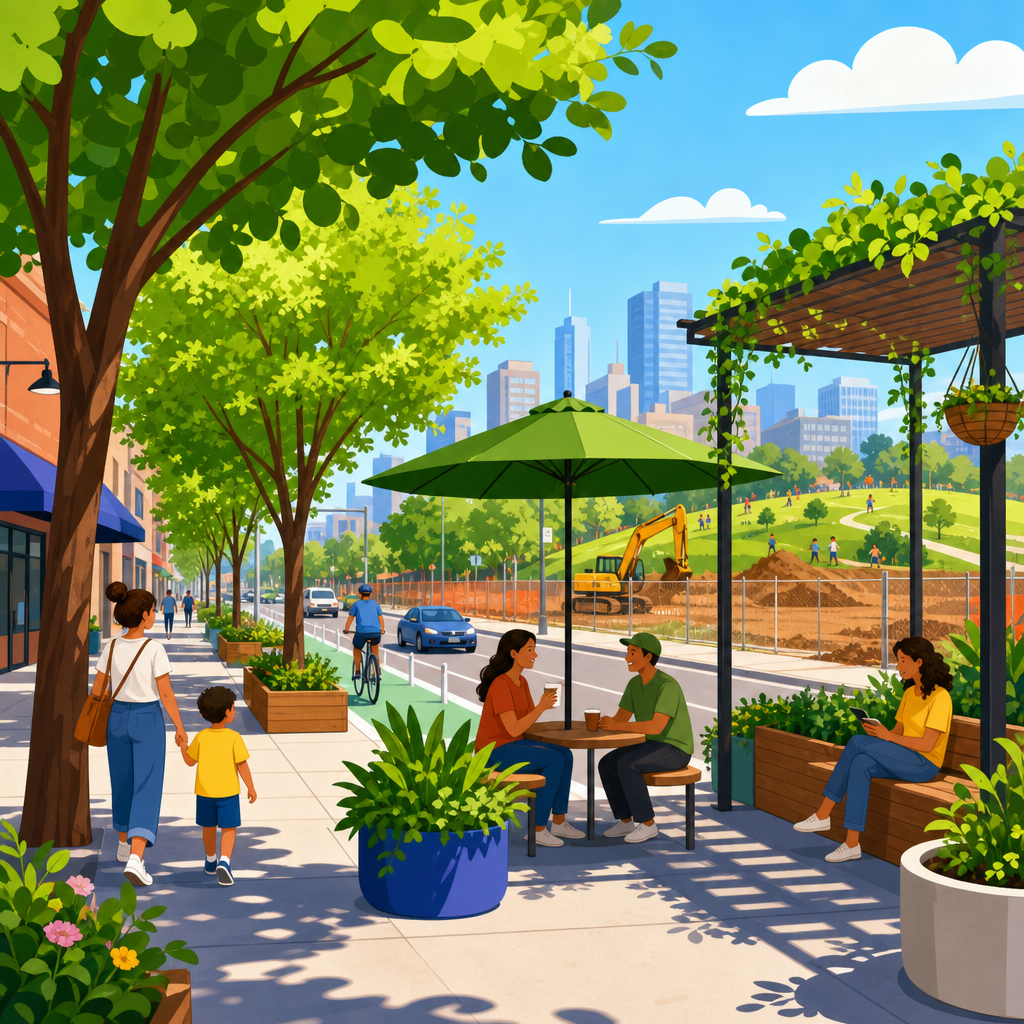
City governments do not need to wait for a decade-long park project to reduce dangerous heat on streets, sidewalks, bus stops, school routes, and commercial corridors. Shade can be added quickly through targeted urban design, temporary installations, policy changes, and maintenance practices that protect people now while larger parks, greenways, and capital projects move through funding, design, land acquisition, and construction. In this context, shade means any intervention that blocks direct solar radiation at the places where people walk, wait, cycle, play, work, and gather. Fast shade includes street trees planted in the right locations, tensile canopies, shade sails, transit shelters, awnings, pergolas, solar-panel structures, and tactical curbside projects that cool public space immediately.
I have worked with city teams that faced the same constraint: residents needed relief in the next hot season, but the official park pipeline was measured in years. That gap matters because urban heat is not evenly distributed. Asphalt, dark roofs, wide roadways, limited canopy cover, and sparse public amenities create hotter neighborhoods, especially in lower-income areas and industrial districts. The health effects are concrete. Heat raises the risk of dehydration, heat exhaustion, heat stroke, worsened heart and lung disease, and disrupted sleep. It also changes daily behavior. Parents avoid playgrounds, older adults shorten walking trips, transit riders wait in full sun, and local businesses lose foot traffic during the hottest hours.
Adding more shade fast is therefore not a cosmetic upgrade. It is a public health response, a transportation improvement, and a climate adaptation strategy. Well-placed shade can reduce surface temperatures dramatically and lower mean radiant temperature, which is often the variable people feel most strongly outdoors. A shaded bench, crosswalk approach, or bus stop can be the difference between a tolerable trip and a dangerous one. The practical question for cities is not whether shade helps. It is how to deliver it quickly, fairly, and at a scale residents can notice before the next summer arrives.
Start with heat risk mapping and prioritize places where people already spend time
The fastest shade programs begin with a simple principle: shade the hottest essential routes and waiting areas first. That means mapping heat exposure, pedestrian activity, and social vulnerability together. Many cities already have pieces of this information in separate departments. Public works has pavement and right-of-way data. Transportation has sidewalk networks, bike routes, and transit stop inventories. Public health tracks heat illness, age vulnerability, and chronic disease burdens. Planning departments often maintain tree-canopy assessments and equity indexes. The work is to combine these layers and identify priority shade gaps.
In practice, the highest-value sites are rarely random. They include bus stops with heavy boarding and no shelter, school walking routes with long unprotected blocks, commercial streets where people queue outdoors, senior centers and clinics, playground edges, libraries, public housing campuses, and intersections with long signal wait times. A city can use thermal imagery, on-the-ground temperature walks, or mobile sensors, but even a basic desk review can produce a strong shortlist if it is tied to observed use. I have seen cities waste scarce funds on decorative installations where few people linger. The better approach is to ask where people are exposed by necessity, not preference.
Speed also depends on choosing interventions matched to each site. A narrow sidewalk above utilities may not support large-canopy trees immediately, but it can often accommodate a shade sail between poles, a modular transit shelter, or an adjacent curb extension with planters and a lightweight canopy. A schoolyard may benefit from shade structures over blacktop play areas while tree establishment continues around the perimeter. A plaza with strong sun exposure can gain relief quickly from temporary umbrellas and movable seating, then transition to permanent pergolas and trees during a later capital phase. The goal is layered delivery, not a single perfect fix.
Use a fast shade toolkit instead of relying on one solution
Cities move faster when they treat shade as a toolkit rather than a tree-only program. Trees are essential because they cool through both shading and evapotranspiration, improve air quality, and create long-term neighborhood value. But they require soil volume, irrigation during establishment, pruning cycles, and time to mature. Fast shade programs balance long-term planting with structures that provide immediate relief. Transit shelters can be upgraded with larger roofs, side panels designed for airflow, and seating placed fully under cover. Shade sails work well in playgrounds, small plazas, and schoolyards where foundations can be installed quickly. Pergolas can support vines in some climates, though vines do not replace a proper roof where instant shade is needed.
Private buildings also matter. Awnings, arcades, recessed storefronts, and overhangs often deliver excellent pedestrian shade with relatively low public cost if zoning and design rules allow them. Cities can revise frontage standards, streamline permits, and offer façade improvement grants to encourage property owners to add shaded walkways. Parking lots are another immediate opportunity. Solar canopies over municipal lots, libraries, and recreation centers provide shade, generate electricity, and visibly connect heat resilience with energy strategy. They cost more upfront than fabric canopies, but they often pencil out over time where electricity demand and incentive programs align.
Materials and orientation affect performance. A canopy that looks generous on paper may fail at noon or late afternoon if its geometry ignores the sun path. In hot climates, west-facing exposure is especially punishing. Structures should be designed to shade the actual occupied zone, not simply the object beneath them. At bus stops, for example, the queue often extends beyond the shelter footprint. At crosswalks, people stand at corners, not centered in a planted median. Good shade design starts with observed behavior and solar angle, then adds durable materials that can withstand wind, vandalism, and maintenance demands.
| Intervention | Typical deployment speed | Best locations | Main strengths | Key limitations |
|---|---|---|---|---|
| Street trees | Months for planting; years for full canopy | Sidewalks, medians, school routes | Long-term cooling, habitat, aesthetics | Root space, utilities, watering, establishment time |
| Transit shelter upgrades | Weeks to months | High-ridership bus stops | Immediate benefit for captive users | Procurement, ADA clearance, maintenance |
| Shade sails | Weeks | Playgrounds, plazas, schoolyards | Fast installation, flexible footprint | Fabric lifespan, wind loads, periodic replacement |
| Pergolas or pavilions | Months | Parks, public squares, waiting areas | Durable, can integrate seating and lighting | Higher capital cost, permitting |
| Solar canopies | Months to a year | Parking lots, civic facilities | Shade plus energy generation | Higher cost, electrical interconnection |
Design for the pedestrian experience, not just canopy coverage statistics
Canopy percentage is useful for citywide benchmarking, but residents experience heat at eye level and walking speed. A neighborhood can post decent canopy numbers while leaving bus riders, wheelchair users, and children on school routes fully exposed where they most need protection. Fast shade programs therefore need site standards that focus on lived conditions. I recommend measuring shade at specific times on the hottest days, especially over seating, corners, crossings, play equipment, and the through-zone of sidewalks. This is where performance-based design beats simple asset counts.
Good pedestrian shade works with other heat-response basics. Seating should be under cover, not adjacent to it. Drinking fountains or bottle fillers should be nearby in high-use civic spaces. Pavement selection matters because shaded dark asphalt can still radiate significant heat after storing energy all day. Light-colored, high-albedo materials can help, though glare must be managed. Misters are useful in some dry climates and less effective in humid conditions. Ventilation is equally important. I have seen shelters that technically provide shade but trap hot air because side panels and roof shape were chosen for appearance rather than comfort.
Accessibility is nonnegotiable. Shade structures must preserve clear sidewalk width, maintain detectable edges where needed, and avoid creating obstacles for people with low vision or mobility devices. Tree pits and planters should not pinch the pedestrian through-zone. At transit stops, shelter placement must align with boarding needs and real queue behavior. Equitable shade means more than putting something on a map. It means making sure a parent with a stroller, an older adult with a walker, or a worker carrying bags can actually use it without detouring into the sun or stepping into the roadway.
Fix the delivery system: permits, procurement, and maintenance decide speed
The biggest barrier to fast shade is usually not design imagination. It is process. Cities often treat every small shade project like a custom capital build, which introduces long reviews, fragmented approvals, and preventable delays. The fastest programs create preapproved standard details for common conditions such as playground sails, bus stop shelters, curbside canopies, and modular seating with integrated shade. They also maintain on-call contracts so departments can issue task orders instead of starting procurement from scratch each time. Standardization does not mean generic outcomes. It means shortening the path from need identification to installation.
Maintenance planning should be built in from the first sketch. Trees need watering, staking checks, mulching, and pruning schedules. Fabric structures need inspections for tension, tears, UV degradation, and hardware corrosion. Shelters need cleaning, lighting maintenance, and graffiti response. If maintenance budgets are missing, installations deteriorate quickly and public trust drops with them. A useful rule is to fund several years of upkeep at approval, not as an afterthought. Some cities partner with business improvement districts, school districts, transit agencies, or park conservancies, but accountability should remain explicit. Residents notice when a shade promise becomes a broken sail and a locked fountain.
Permitting can be streamlined without lowering standards. Building, transportation, parks, and utilities staff should agree on a concise review path for small shade projects in the public realm. Utility conflicts deserve special attention because they often derail tree planting and footing placement late in design. Early potholing, utility maps, and species selection based on mature root behavior save months. So does using modular systems sized for transport and repeat installation. When every district engineer or facilities manager has to reinvent the approach, the city loses the speed it needs most.
Fund shade as heat resilience infrastructure and measure what it changes
Shade competes better for money when cities classify it correctly. This is not merely beautification. It is resilience infrastructure with public health, mobility, energy, and economic benefits. That framing opens more funding sources: transportation safety programs for school routes and transit access, climate adaptation funds, public health grants, utility partnerships, and capital maintenance budgets tied to civic facilities. Hospitals and health insurers have also shown interest in upstream heat-risk reduction where preventable emergency visits are rising. The case is strongest when cities present shade as a cost-effective measure protecting vulnerable residents during recurring extreme heat events.
Measurement should go beyond counting trees or structures installed. Cities should track where shade was added, who benefits, and whether conditions improved during peak heat. Useful metrics include shaded waiting area at transit stops, percentage of priority school-route blocks with midday shade, surface and air temperature changes, pedestrian counts before and after installation, and resident satisfaction. For longer-term tree programs, survival rates matter as much as planting totals. A thousand saplings with poor irrigation are not a success. In my experience, the most persuasive data combines technical readings with observed behavior: more people using a plaza at 3 p.m., shorter waits in direct sun, and stronger walking activity on formerly avoided corridors.
Communication matters too. Residents should know which sites are phase one, which are temporary, and which will transition into permanent greener streets as larger park projects advance. That builds confidence that quick-build shade is not a substitute for deeper investment. It is the first layer of protection. Cities that publish simple dashboards, before-and-after photos, and maintenance contacts usually earn more public support because people can see progress and understand the sequence. When larger parks finally open, the neighborhoods that needed relief most should already be safer and more comfortable, not left waiting through another series of dangerous summers.
Cities can add more shade fast if they stop treating heat relief as a single future park project and start managing it as an immediate, place-based public service. The core strategy is straightforward: map heat risk, target the spaces people must use every day, deploy a mix of trees and built shade, design for actual pedestrian comfort, and remove procedural delays that slow simple installations. This approach works because it matches the timeline of heat exposure. Residents need protection before long-range capital plans are complete, not after.
The most effective programs are practical and layered. They plant trees for lasting canopy, but they also upgrade bus stops, cover playgrounds, support shaded storefronts, and use modular structures where utilities or soil constraints make trees slow. They measure results at the human scale by asking whether people can sit, wait, cross, and walk safely during peak sun. They budget for maintenance, because a dead tree or damaged sail does not build resilience. And they communicate clearly so communities understand what is temporary, what is permanent, and what comes next.
For leaders in sustainable urban development, the lesson is simple: fast shade is one of the quickest visible wins available to a city facing hotter summers. It protects health, supports transit and walking, and delivers relief residents can feel immediately. Review your hottest public spaces, identify the biggest shade gaps, and launch a short list of quick-build projects before the next heat season arrives.
Frequently Asked Questions
What does it mean for a city to add shade quickly, and why does it matter before larger parks are built?
Adding shade quickly means using practical, near-term tools to reduce direct sun exposure in the places people use every day, rather than waiting years for a major park, greenway, or capital project to be completed. In this context, shade includes any intervention that blocks direct sunlight and lowers heat exposure on streets, sidewalks, bus stops, school walking routes, playground edges, public plazas, commercial corridors, and other hardscaped areas. That can include fast-growing or newly planted street trees where feasible, shade sails, canopies, covered transit shelters, pergolas, awnings, cooling structures, temporary installations, and design changes that prioritize shade where people stand, walk, and wait.
This matters because heat risk is immediate, not theoretical. Residents are exposed now while commuting, waiting for buses, crossing large intersections, walking to school, running errands, or working outdoors. Even short periods in unshaded spaces can become dangerous during heat waves, especially for older adults, children, people with disabilities, transit riders, outdoor workers, and households without reliable air conditioning. Large parks provide major long-term benefits, but they typically require land assembly, funding approvals, environmental review, design, procurement, and construction. Quick shade measures help cities bridge that gap by protecting public health in the hottest locations right away.
Fast shade strategies also give local governments a chance to act with precision. Instead of treating heat as a citywide average, officials can focus on the exact places where people face the most exposure: long bus queues, routes to schools, senior centers, clinic entrances, curbside pickup zones, and retail corridors with wide sidewalks but little tree canopy. These smaller, targeted interventions can often be planned and installed faster, for less money, and with fewer legal or engineering hurdles than a large park project. In many cases, they also build public support for broader heat resilience investments by showing visible results quickly.
What are the fastest shade solutions cities can install on streets, sidewalks, and bus stops?
The fastest solutions are usually the ones that rely on existing public right-of-way, simple construction methods, and standard products that do not require years of planning. Upgraded bus shelters are one of the clearest examples. Many transit stops still have little or no overhead protection, even in very hot corridors. Installing larger shelters, adding side panels where appropriate, extending roof overhangs, and orienting shelters to block the strongest sun angles can provide immediate relief for riders. Cities can also add standalone shade structures at high-ridership stops where full shelter reconstruction would take too long.
On sidewalks and commercial corridors, cities can move quickly with modular shade canopies, shade sails, pergolas, and pilot installations over seating areas, curb extensions, pickup zones, and public gathering spots. In some districts, temporary materials can be used first to test placement, demand, durability, and pedestrian flow before permanent construction is funded. This tactical approach is especially useful in downtowns, school zones, and event streets where people spend time waiting, walking, and standing in exposed conditions.
Another fast option is to make it easier for private property owners and businesses to contribute shade that benefits the public realm. Streamlined permits for awnings, sidewalk-facing canopies, arcade improvements, and façade-mounted shade features can expand coverage along retail streets much faster than a city acting alone. If local codes currently make these improvements slow or expensive, policy reform can be one of the quickest heat-response tools available.
Cities should also look at maintenance and retrofit opportunities. Sometimes “adding shade fast” means repairing what already exists: replacing damaged shelter roofs, restoring neglected trellises, pruning trees correctly so they provide canopy over pedestrian space, or reconfiguring seating and waiting areas to align with existing shade patterns. In the near term, the best strategy is often a mix of temporary, permanent, public, and private measures deployed where heat exposure is highest and foot traffic is greatest.
How can cities decide where quick shade interventions should go first?
The best approach is to prioritize places where heat exposure, pedestrian activity, and vulnerability overlap. Cities should begin with a heat-risk lens rather than an even geographic distribution. That means identifying the corridors and public spaces where people are most likely to be outdoors during hot periods and least likely to have protection. High-priority locations typically include bus stops with heavy ridership, routes to schools, childcare centers, senior housing, health clinics, public housing, libraries, parks without canopy, and commercial corridors in neighborhoods with low tree cover and high surface temperatures.
Data can make this process much more effective. Cities can combine tree canopy maps, land surface temperature data, sidewalk and transit usage, crash and safety data, and demographic indicators such as age, income, disability, and car ownership. But data alone is not enough. Field audits are critical because they show how places actually function. A bus stop may look acceptable on a map but may offer no protection during the hottest hours of the day. A school route may technically have sidewalks but no usable shade where children wait to cross. On-the-ground observation helps cities identify the exact points of exposure that residents feel most intensely.
Community input should be treated as operational intelligence, not just public engagement. Residents know where the “heat traps” are, where elders rest on the way to the store, where students walk home in full sun, and which transit stops are unbearable in summer. Short surveys, pop-up engagement, and collaboration with schools, public health agencies, transit agencies, and neighborhood groups can uncover needs quickly. This helps cities avoid spending money on highly visible but low-impact locations while missing the places with the most urgent human need.
Finally, cities should set clear prioritization criteria and publish them. That creates accountability and helps the public understand why one block, stop, or corridor moves first. A strong framework typically weighs exposure, population served, vulnerability, feasibility, cost, and installation speed. When those criteria are transparent, quick shade programs are more likely to be equitable, defensible, and effective.
Are temporary shade structures and fast policy changes really effective, or are they just short-term fixes?
They are absolutely effective when they are used intentionally. Temporary and fast-track measures should not be viewed as cosmetic substitutes for long-term investment. They are a core part of a layered heat resilience strategy. The reality is that cities need both immediate protection and permanent canopy growth. A mature urban forest delivers broad environmental benefits over time, but a shade sail over a school pickup zone or a larger shelter at a busy bus stop can reduce dangerous exposure this season, not ten years from now.
Temporary structures are especially valuable in places where cities need to move fast, test concepts, or respond to urgent seasonal heat. They can protect people while engineering, utility coordination, or capital design work is still underway. They can also help agencies learn what works. A pilot canopy program might reveal where pedestrians naturally gather, what materials hold up to wind and vandalism, or how much shade is needed at different times of day. That information improves later permanent investments.
Policy changes can be just as powerful as physical installations. If a city updates zoning, design standards, transit shelter requirements, encroachment rules, or permit processes to encourage more awnings, covered walkways, and shade-producing streetscape elements, the public realm can improve much faster and at greater scale. For example, allowing easier installation of shade features in outdoor dining areas, storefront frontages, school grounds, and redevelopment projects can generate immediate practical results across many sites.
The key is not to stop at temporary action. Quick shade measures work best when cities treat them as the first phase of a larger program: immediate relief now, stronger standards next, and long-term canopy and public-space investment over time. In other words, short-term does not mean unimportant. It means cities are responding to present risk while building toward permanent change.
What should cities keep in mind to make fast shade investments durable, equitable, and effective over time?
First, cities should focus on function, not just appearance. A shade intervention is successful if it protects people where and when they need it most. That requires attention to orientation, time of day, seasonal sun angles, wind, visibility, accessibility, and the way people actually use a space. A structure that looks attractive but fails to shade a waiting area during peak afternoon heat will not deliver much public health value. Good design starts with understanding exposure patterns and pedestrian behavior, not simply placing a structure wherever it is easiest to install.
Second, maintenance must be planned from the start. Shade fails when trees are not watered, shelters are not repaired, fabric structures are not inspected, or responsibilities are unclear between agencies, business districts, contractors, and property owners. Fast installation is only half the job. Cities need a maintenance plan, a funding source, and clear ownership for inspection, cleaning, repair, replacement, and tree establishment. Otherwise, quick interventions can deteriorate and lose public trust.
Third, equity should guide every stage of implementation. Wealthier or higher-profile districts often have more political visibility and stronger capacity to advocate for improvements, but the neighborhoods facing the highest heat burden may have the least shade and the greatest health risk. Cities should be deliberate about serving communities with low canopy, high exposure, and high vulnerability first. That means using objective criteria, public health data, and community partnerships to