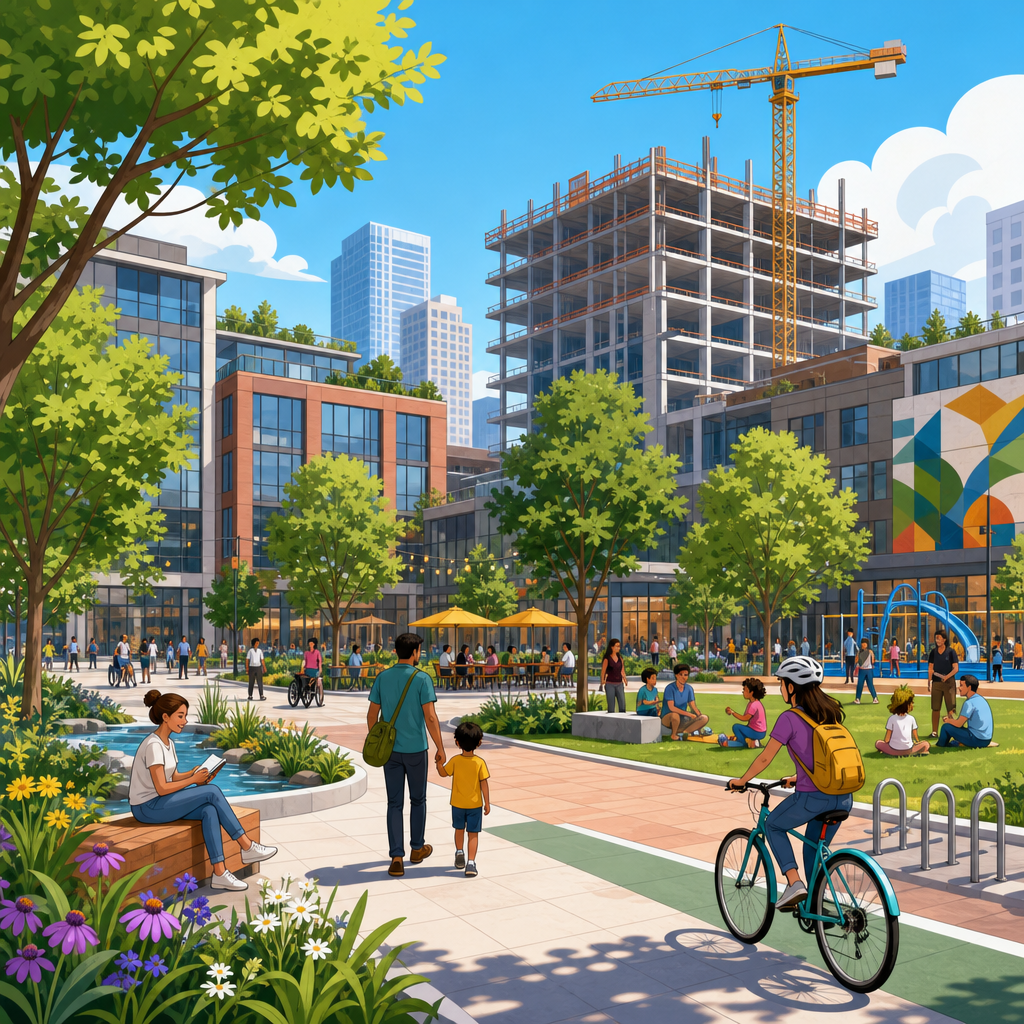
Public space mitigation requirements for large redevelopment projects shape how cities absorb growth without sacrificing the streets, parks, plazas, sidewalks, and civic amenities that make dense urban life workable. In practice, mitigation means the measures a developer must provide, fund, or construct to offset project impacts on shared public environments. I have worked through entitlement packages where a single mixed-use proposal triggered sidewalk widening, new street trees, park in-lieu fees, transit stop upgrades, stormwater features, and public access easements, all because the project intensified demand on common space. These requirements matter because redevelopment can create clear benefits such as housing, jobs, and tax revenue, yet it also adds pressure on circulation networks, open space capacity, shade, drainage systems, and neighborhood usability. When cities set mitigation rules well, they translate private investment into public value. When they set them poorly, they create legal disputes, delay approvals, and deliver amenities that look good on paper but fail in daily use. Understanding the full landscape of public space mitigation is therefore essential for developers, planners, design teams, lenders, and community groups evaluating large redevelopment projects.
What public space mitigation requirements include
Public space mitigation requirements are conditions of approval or negotiated obligations tied to a redevelopment project’s expected effects on publicly used environments. They usually arise during zoning review, environmental review, subdivision approval, development agreements, planned unit development approvals, design review, or site plan approval. The core idea is proportionality: if a project increases population, foot traffic, stormwater runoff, curb demand, or pressure on parks and sidewalks, the applicant may be required to mitigate those impacts through physical improvements, dedications, fees, or operating commitments.
Common mitigation categories include streetscape improvements, open space provision, mobility upgrades, accessibility enhancements, and environmental performance measures with a public-facing benefit. Streetscape requirements often cover sidewalk widening, curb extensions, ADA-compliant curb ramps, street lighting, benches, transit shelters, bike racks, wayfinding, and street trees. Open space mitigation may require on-site plazas, publicly accessible private open space, pocket parks, greenways, rooftop access subject to public easements, or in-lieu contributions to park acquisition funds. Mobility mitigation frequently includes crosswalk upgrades, signal timing, transit pass programs, loading management plans, protected bike lanes, traffic calming, and transportation demand management measures.
Environmental components are increasingly important. Redevelopment can be required to add bioswales, permeable paving, tree-canopy replacement, flood-resilient landscape design, heat-island reduction measures, and green infrastructure that supports public comfort while meeting stormwater standards. In districts with strong heritage or downtown design controls, mitigation may also include maintaining mid-block connections, preserving view corridors, reconstructing arcades, or providing setbacks that expand the public realm. In waterfront areas, agencies often require shoreline access, habitat buffers, and continuous public esplanades.
Not every requirement is a capital project. Cities also use operational obligations such as maintenance agreements, security staffing for public access areas, programming commitments for plazas, snow removal plans, or long-term funding mechanisms through special assessment districts. The most effective requirements define who builds the improvement, who accepts it, who maintains it, what standard applies, and when delivery occurs relative to occupancy permits.
How cities determine required mitigation
Mitigation requirements are usually derived from a combination of statutory authority, local ordinance standards, adopted plans, and project-specific impact analysis. In the United States, a city cannot simply ask for whatever it wants. It generally needs a clear nexus between the project and the impact being addressed, plus rough proportionality between the burden created and the mitigation imposed. Those principles are well known from exactions law and they influence how planning departments, city attorneys, and developers negotiate conditions.
In practical review work, the process often starts with baseline documents: the comprehensive plan, parks master plan, complete streets policy, downtown public realm plan, climate action plan, and zoning code. Staff then compares the proposed redevelopment against measurable standards such as open space ratios, block length rules, frontage design requirements, transportation level-of-service policies, multimodal impact thresholds, or stormwater retention requirements. Environmental review adds another layer by identifying direct, indirect, and cumulative effects. For large projects, agencies commonly request traffic studies, pedestrian counts, curb management analyses, shadow studies, wind studies, tree surveys, and park demand assessments.
A well-prepared applicant team does not wait for comments. It maps likely impact areas early, inventories adjacent public assets, and tests mitigation options before formal submission. I have seen entitlement schedules shorten dramatically when developers bring preliminary cross-sections, canopy calculations, and park fee assumptions into pre-application meetings instead of debating impacts after community opposition hardens. Cities also favor mitigation packages that align with adopted capital plans because those improvements are easier to permit, inspect, and maintain.
Because large redevelopment projects vary widely, mitigation is never one-size-fits-all. A warehouse district conversion to residential lofts may focus on sidewalks, trees, and parks. A hospital expansion may emphasize transit access, curb management, and plaza circulation. A suburban mall redevelopment into a mixed-use district may trigger a full network rethink with new streets, public squares, drainage corridors, and school-adjacent safety improvements.
Typical requirements by impact area
The table below summarizes the public space mitigation requirements cities most often impose on large redevelopment projects and the impact each measure is intended to address.
| Impact area | Typical mitigation requirement | Why it is required | Example in practice |
|---|---|---|---|
| Pedestrian circulation | Sidewalk widening, curb extensions, raised crossings, frontage setbacks | Handles higher foot traffic and improves safety | A mixed-use tower dedicates five extra feet along the block face to expand a crowded downtown sidewalk |
| Parks and open space | On-site plaza, pocket park, mid-block open space, park in-lieu fee | Offsets increased demand from new residents and workers | A former industrial site includes a one-acre public green and pays into the municipal park acquisition fund |
| Transit access | Bus stop upgrades, shelters, real-time information, transit pass programs | Reduces vehicle trips and improves multimodal access | An office redevelopment funds a sheltered stop and signal priority improvements on an adjacent corridor |
| Urban heat and stormwater | Street trees, bioswales, permeable paving, shaded seating | Improves comfort and meets runoff requirements | A campus expansion installs bioretention planters that intercept runoff from both the project and part of the public street |
| Public access continuity | Easements, arcades, through-block passages, waterfront esplanades | Maintains connectivity through large sites | A redevelopment of superblocks creates publicly accessible passages open from early morning to late evening |
| Bicycle infrastructure | Protected lanes, racks, repair stations, secure parking | Supports mode shift and reduces curb conflicts | A residential project reconstructs its frontage to complete a planned protected bike corridor |
These requirements are most defensible when they are measurable. A city should specify linear feet of widened sidewalk, the number and caliper size of trees, seating counts, public access hours, maintenance standards, and acceptance criteria. Ambiguous conditions create post-approval disputes, especially when value engineering begins.
Design standards, approvals, and delivery timing
Even when the policy rationale is strong, public space mitigation fails if design standards are unclear. Large redevelopment projects usually move through several review tracks at once, and each track may affect the public realm. Public works agencies review street geometry, drainage, utilities, and construction sequencing. Planning staff focuses on frontage quality, access, and compliance with adopted design guidelines. Parks departments evaluate ownership, programming, and maintenance. Transit agencies may require separate permits for stop relocation, shelters, or lane changes. Utility conflicts, especially around street tree placement and underground vaults, routinely reshape approved concepts.
For that reason, successful mitigation packages tie each improvement to a specific standard. Sidewalks may need to meet Americans with Disabilities Act requirements, local complete streets manuals, and fire access clearances. Stormwater features may need to satisfy state or municipal low-impact development standards. Public plazas may be reviewed against privately owned public space guidelines, including minimum dimensions, seating ratios, visibility from the street, grade limits, and restrictions on ornamental barriers. Landscape plans should define species diversity, soil volume, irrigation assumptions, and root-zone protection. If the city expects public dedication, the construction documents must reflect municipal materials and maintenance tolerances rather than a purely private specification.
Timing is equally important. Many municipalities require frontage improvements before a certificate of occupancy, while larger off-site improvements may be bonded and delivered in phases. This is sensible because a project can create immediate impacts long before every block in a master plan is completed. In phased redevelopments, I usually advise tying each phase to threshold triggers such as dwelling-unit counts, office square footage, or parking supply changes. Without those triggers, later mitigation is vulnerable to delay if market conditions weaken.
Construction management is another often overlooked requirement with real public-space consequences. Cities may require pedestrian detour plans, temporary lighting, sidewalk sheds, noise controls, truck routing, and dust suppression. These are mitigation obligations too, and they matter because major redevelopments can disrupt public space for years before the finished improvements appear.
Financing, legal structure, and common disputes
Paying for public space mitigation is rarely simple. Some requirements are direct build obligations by the developer. Others are fee-based, such as park impact fees, transportation impact fees, or downtown streetscape assessments. Still others are split among public agencies, tax increment financing districts, infrastructure banks, special service areas, or development agreement reimbursements. The financial structure should match the improvement type. A curb extension on the project frontage is usually best delivered by the developer. A districtwide greenway connection may require pooled funding from multiple parcels because no single project can construct a coherent network alone.
Legal documentation needs equal care. Development agreements, subdivision plats, public access easements, maintenance covenants, reciprocal easement agreements, and recorded conditions all play a role. If a plaza is publicly accessible but privately maintained, the governing documents should define access hours, allowed restrictions, event permits, insurance, repair cycles, and enforcement authority. If improvements will be dedicated to the city, acceptance procedures and warranty periods must be explicit. I have seen expensive delays caused by a simple mismatch between approved landscape details and the city’s standard maintenance specification for tree grates and irrigation controllers.
The most common disputes arise around proportionality, timing, and long-term maintenance. Developers may argue that requested improvements solve preexisting neighborhood deficiencies rather than project-specific impacts. Community groups may contend that in-lieu fees are inadequate compared with physical open space on site. Agencies may worry that privately owned public spaces will become heavily programmed, poorly signed, or subtly exclusionary. These disputes are not trivial. They determine whether mitigation is experienced as a real civic benefit or merely a compliance exercise. The best way to reduce conflict is to document impacts clearly, use adopted plans as the basis for improvements, quantify obligations, and align approvals with enforceable delivery milestones.
Public space mitigation requirements work best when cities define impacts rigorously and redevelopment teams respond with specific, buildable solutions. The strongest programs connect legal standards, urban design, engineering, and operations rather than treating mitigation as a last-minute checklist. For large redevelopment projects, the practical questions are straightforward: what public burdens will this project create, what improvements will offset them, who pays, who maintains them, and when will people actually experience the benefit. Answering those questions early improves entitlement certainty, community trust, and project value because well-designed public space raises walkability, resilience, retail performance, and neighborhood acceptance at the same time.
The key takeaway is that mitigation is not separate from development quality. Sidewalk width, tree canopy, transit access, plaza design, drainage performance, and public access rights are core parts of whether a redevelopment project succeeds over decades. Teams that inventory public-space impacts early, test options against adopted standards, and memorialize obligations in precise documents avoid many of the delays that undermine major urban projects. If you are planning, reviewing, or financing a large redevelopment, audit the public realm first and make mitigation a central design decision, not an afterthought.
Frequently Asked Questions
What are public space mitigation requirements in large redevelopment projects?
Public space mitigation requirements are the conditions, improvements, or financial contributions a developer must provide to address the added pressure a large redevelopment project places on shared public environments. These requirements are meant to ensure that new growth does not overwhelm the surrounding sidewalks, streets, parks, plazas, transit access points, bike facilities, street trees, lighting systems, or other civic amenities that existing residents, workers, and visitors already rely on. In practical terms, mitigation is how a city translates a project’s external impacts into concrete obligations tied to approval.
For large redevelopment projects, mitigation often goes far beyond a simple fee. A project may be required to widen sidewalks, improve curb ramps, upgrade crosswalks, install pedestrian lighting, add street trees and landscaping, contribute to nearby park improvements, build publicly accessible open space, fund wayfinding, enhance bus stops, or deliver frontage improvements that meet current design standards. In some jurisdictions, these measures are negotiated through entitlement conditions, development agreements, specific plan compliance, environmental review findings, or impact fee programs. In others, they are triggered by a combination of zoning code requirements, subdivision regulations, transportation studies, and parkland dedication ordinances.
The core idea is proportionality. Cities generally try to connect the scale of mitigation to the scale and type of project impact. A mixed-use redevelopment with hundreds of residential units and substantial retail space will likely generate more pedestrian activity, more demand for park space, and more strain on nearby intersections than a small infill building. Because of that, a larger project may face a more extensive mitigation package. The purpose is not only to offset harm but also to make the project function better within the neighborhood by improving the public realm that supports daily urban life.
What types of public space improvements are typically required as mitigation?
The most common mitigation requirements fall into a few broad categories: pedestrian improvements, streetscape upgrades, open-space contributions, mobility enhancements, and maintenance or funding obligations. Pedestrian improvements often include sidewalk widening, reconstruction of deteriorated pavement, new curb ramps, high-visibility crosswalks, pedestrian refuge islands, bulb-outs, accessibility upgrades, and safer driveway designs. Streetscape upgrades may include street trees, irrigation, lighting, benches, bike racks, planters, trash receptacles, protective barriers, and frontage treatments intended to improve walkability and comfort.
Open-space mitigation can take several forms depending on the site and local code. A developer may dedicate land for a park, build an on-site public plaza, improve an existing neighborhood park, or pay an in-lieu fee when land dedication is impractical. Some cities also require publicly accessible private open space that functions as an extension of the street network, especially in dense districts where formal park acquisition is difficult. In transit-oriented or downtown locations, mitigation may also include transit shelters, loading management measures, bicycle parking, micromobility infrastructure, passenger pickup zones, and better pedestrian connections to nearby stations or bus corridors.
In more complex redevelopment settings, mitigation can be highly customized. If a project removes mature trees, blocks an informal pedestrian route, intensifies use near a constrained plaza, or adds heavy foot traffic to a commercial corridor, the city may require project-specific responses. That could mean replacing canopy trees at a higher ratio, creating a mid-block paseo, expanding a corner plaza, funding maintenance for a public space improvement district, or phasing infrastructure delivery ahead of occupancy. The exact package depends on local standards, environmental findings, neighborhood conditions, and the evidence in project impact studies. The key point is that mitigation is not limited to beautification; it is often about safety, capacity, durability, accessibility, and long-term usability of the public realm.
How do cities determine which mitigation measures a developer must provide?
Cities usually determine mitigation requirements through a layered review process that combines adopted regulations with project-specific analysis. The starting point is often the municipal code, general plan, specific plan, streetscape manual, parkland dedication ordinance, or impact fee schedule. Those documents establish baseline obligations such as frontage improvements, landscaping standards, transportation fees, or open-space ratios. From there, staff and consultants evaluate the proposed redevelopment in greater detail to understand how it will affect nearby public facilities and spaces.
That evaluation can include transportation impact studies, pedestrian circulation analysis, park service assessments, environmental review documents, utility and infrastructure reports, and design review comments. If the project is large enough, the city may assess not only vehicle trips but also foot traffic, curb demand, loading activity, transit usage, bike movement, and the way the building massing interacts with the street. Existing conditions matter a great deal. A project on a narrow sidewalk next to a transit stop in an already crowded district may trigger different mitigation than the same square footage on a wide boulevard with underused infrastructure.
Policy priorities also shape outcomes. A city focused on active transportation may prioritize wider sidewalks, protected bike facilities, and safer crossings. A park-deficient neighborhood may generate stronger open-space requirements. Historic districts, downtown cores, waterfronts, and station areas often have their own design expectations, which can influence both the form and quality of mitigation improvements. In many cases, requirements are refined through hearings, agency coordination, and negotiation during entitlement. The final conditions of approval usually reflect both legal requirements and discretionary judgments about what improvements are necessary to keep growth from eroding public-space function and quality.
Can a developer satisfy public space mitigation requirements by paying fees instead of building improvements?
Sometimes yes, but it depends heavily on the jurisdiction, the type of impact, and whether an on-site or nearby physical improvement is considered essential. Many cities allow in-lieu fees for certain categories of mitigation, particularly parkland dedication, regional transportation impacts, or standardized development impact programs. In those cases, the city collects a fee and uses it to fund larger capital improvements elsewhere in the service area. This approach can be efficient when a single project cannot reasonably deliver a meaningful standalone improvement or when coordinated public investment will produce better long-term results.
However, fee payment is not always enough. Cities frequently require direct construction of frontage and access improvements because those measures are integral to making the project site safe and functional from day one. Sidewalk reconstruction, curb ramps, street trees, lighting, and driveway modifications are commonly treated as non-negotiable on-site obligations. A city may also insist on physical improvements when a project’s impacts are immediate and localized, such as overcrowding at a corner, lack of pedestrian clearance, deficient crossings, or missing public open space in a dense redevelopment district. In those situations, writing a check may not solve the practical problem the project creates.
Large redevelopment approvals often end up with a hybrid structure: the developer builds certain improvements directly, dedicates easements or land where needed, and also pays impact or in-lieu fees for broader system needs. The rationale is that some impacts are site-specific and must be addressed in place, while others are cumulative and can be mitigated through pooled public investment. From a developer’s perspective, the important issue is understanding early whether the jurisdiction prefers constructed improvements, fee-based compliance, or a combination of both. That affects project budgeting, engineering scope, scheduling, and the feasibility of the overall redevelopment program.
Why are public space mitigation requirements so important for redevelopment approvals?
These requirements are important because large redevelopment projects do not operate in isolation. They intensify how people use surrounding streets, sidewalks, parks, transit stops, and civic infrastructure. Without mitigation, growth can erode the very qualities that make urban neighborhoods workable and attractive: safe walking conditions, usable open space, shade, seating, visibility, accessibility, and room for people to move comfortably through shared environments. Public space mitigation is the mechanism cities use to make sure redevelopment contributes to urban capacity instead of simply consuming it.
They also matter from a legal and political standpoint. Approval bodies often need evidence that project impacts have been addressed in a defensible, proportional, and enforceable way. Well-crafted mitigation conditions help support environmental findings, planning consistency determinations, and public-interest conclusions. They can reduce conflicts during entitlement by showing nearby communities that redevelopment will not merely add bulk and activity, but will also deliver tangible public benefits. In many contentious projects, the quality of the public realm package can significantly influence how a proposal is received by staff, commissioners, elected officials, and neighborhood stakeholders.
Just as importantly, mitigation requirements shape project quality over the long term. A redevelopment that includes wider sidewalks, better crossings, street trees, public seating, open-space contributions, and improved pedestrian connections usually performs better economically and socially than one that treats the public realm as an afterthought. Retail frontage benefits from stronger foot traffic. Residents benefit from safer and more comfortable daily movement. Cities benefit from infrastructure that supports density more effectively. In that sense, public space mitigation is not simply a compliance burden; it is one of the main tools for turning redevelopment into durable, functional city-building.