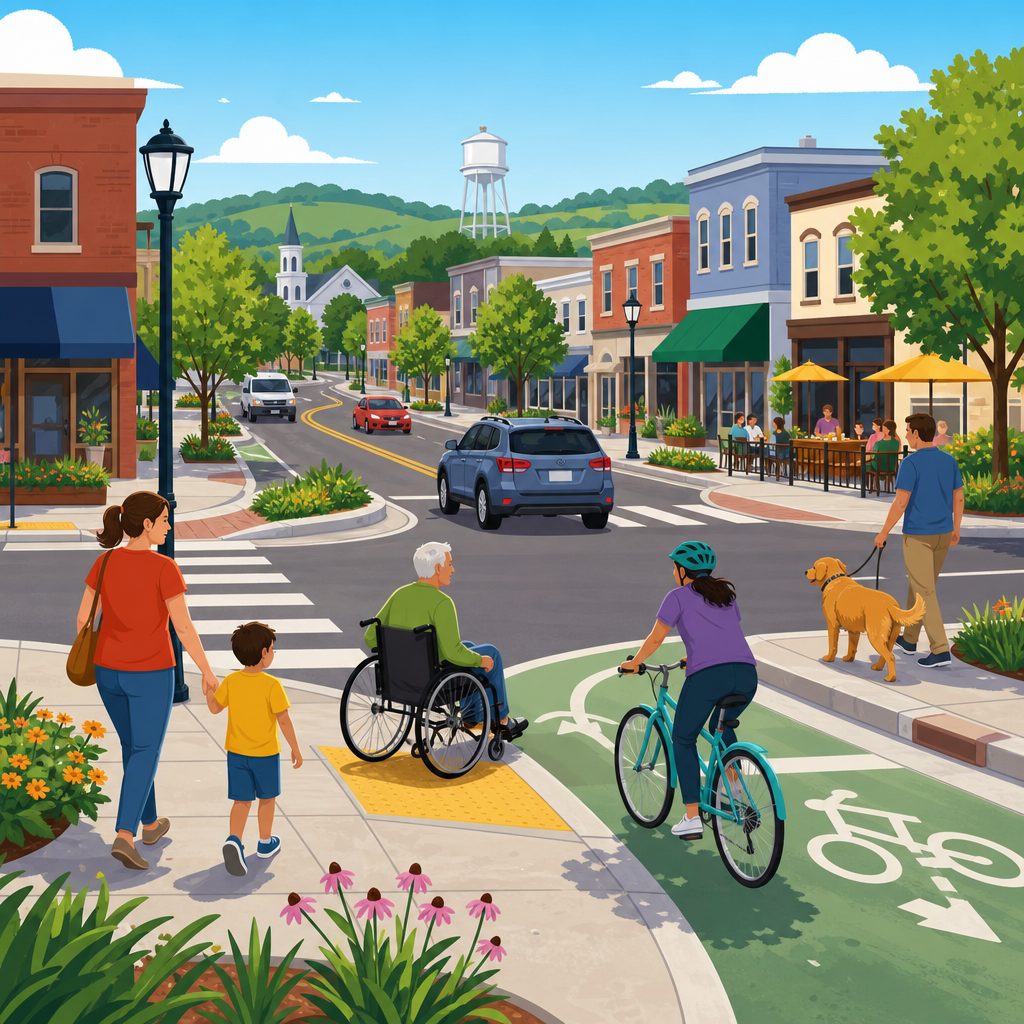
Complete Streets for small cities start with a simple idea: roads should safely serve everyone, not only people driving cars. In practice, that means designing and operating streets for people walking, biking, rolling with mobility devices, taking transit, loading freight, parking, and driving. For small cities, the concept matters even more because a single corridor often carries school traffic, downtown shoppers, emergency vehicles, and regional commuters at the same time. When I have worked with smaller municipalities, the hardest part was rarely agreeing with the goal. The real challenge was deciding where to begin when budgets, staff capacity, and political attention were limited.
A Complete Streets approach is not one project type. It is a policy and implementation framework that guides resurfacing, reconstruction, signal timing, sidewalk repair, crossings, curb management, transit stops, and land use coordination. Small cities often assume the model belongs to large metros with rail systems and big transportation departments. That is incorrect. In fact, smaller places can move faster because they have fewer lane miles, shorter decision chains, and clearer knowledge of local pain points. A dangerous crossing near a school, a state highway cutting through downtown, or a missing sidewalk to a clinic can often be identified within one field visit.
Starting first matters because early choices shape public trust and future funding. If a city launches with an expensive redesign on the wrong corridor, skepticism hardens. If it starts with a visible, measurable safety fix, residents see direct value. The best first steps align three things: demonstrated risk, community benefit, and near-term deliverability. That usually means focusing on high-injury locations, schools, main streets, transit access, and routine maintenance projects already in the capital pipeline. When these are tied to a written policy, a project checklist, and a short list of priority corridors, Complete Streets becomes an operating practice rather than a slogan.
For small cities asking where to start first, the answer is straightforward: begin with policy, data, and a corridor that can show results within one construction season. Then build from that win. The sections below explain how to choose that corridor, which projects belong at the front of the line, how to coordinate with state departments of transportation, and how to pay for improvements without waiting years for a perfect master plan.
Adopt a policy that changes everyday decisions
The first move is a Complete Streets policy adopted by council or embedded in transportation, comprehensive, or public works plans. A useful policy defines users, applies to new construction and resurfacing, sets exceptions, assigns departmental responsibilities, and requires documented consideration during project development. The National Complete Streets Coalition has long emphasized that effective policies are specific, not symbolic. In small cities, this detail is critical because staff turnover can erase informal practices overnight. A written policy protects continuity.
Policy alone does not stripe a crosswalk, but it changes default decisions. I have seen small public works teams deliver major safety gains simply because resurfacing projects began with a checklist: Are sidewalks continuous? Are crossings ADA compliant under current Public Right-of-Way Accessibility Guidelines practice? Can lane widths be narrowed? Is there a transit stop lacking a pad, bench, or crossing? Does observed vehicle speed exceed the target speed for a mixed-use street? Once those questions become standard, each paving season becomes an implementation program.
Strong policies also clarify exceptions. There are cases where a separated bike lane is infeasible, a freight route needs larger turning geometry, or right-of-way is constrained by historic buildings. The solution is not to waive multimodal design casually. It is to require documented justification approved at a senior level and to identify alternative accommodations nearby. That discipline improves transparency and reduces the perception that safety features disappear whenever tradeoffs get uncomfortable.
Find the first corridor by using risk, not intuition
Small cities usually know the streets that “feel bad,” but the first corridor should be selected with a repeatable method. Start with crash history from the state crash database, police reports, or a regional metropolitan planning organization if one exists. Map fatal and serious injury crashes first. Then add generators of vulnerable users: schools, parks, senior housing, clinics, libraries, downtown retail, and transit stops. Finally, layer speeding evidence using radar feedback signs, portable counters, or tube counts. The corridor that ranks high across several layers is your strongest candidate.
Do not wait for perfect data. Smaller jurisdictions often have sparse bicycle and pedestrian counts and underreported near misses. Supplement with field audits, school travel tallies, maintenance complaints, and emergency medical response observations. I have found that a two-hour walk audit with engineering, police, planning, and disability advocates can reveal more actionable detail than weeks of desk analysis. Missing curb ramps, long crossing distances, faded stop bars, poor nighttime lighting, and bus stops stranded in ditches become obvious immediately.
The best first corridors share four traits: they connect destinations, show a documented safety problem, have a project window within one to three years, and allow low-cost changes before full reconstruction. A downtown main street scheduled for resurfacing is ideal. So is a school corridor where a road diet, raised crosswalks, daylighting near corners, and upgraded signs can be installed quickly. By contrast, a politically charged arterial controlled entirely by the state may still matter most, but it may not be the place to prove the program first.
| Starting point | Why it works in small cities | Typical first actions |
|---|---|---|
| School corridor | Clear public support, predictable peak periods, direct child safety benefit | High-visibility crossings, speed management, sidewalk gap closure, pickup zone redesign |
| Downtown main street | Supports local business, tourism, and civic identity | Lane narrowing, curb extensions, shorter crossings, parking management, street trees |
| Transit access route | Improves access for non-drivers and essential workers | Bus stop pads, shelters, ADA ramps, crosswalks, lighting |
| Paving project corridor | Uses existing capital schedule and lowers marginal cost | Restriping, road diet, buffered bike lanes, signal retiming, curb updates |
Prioritize low-cost safety fixes before full reconstruction
Many small cities delay action because they think Complete Streets means expensive reconstruction with curb relocation and utility work. That is only one delivery path. The strongest early programs use quick-build methods to test changes and reduce risk. Paint, posts, modular curb elements, rubber speed cushions, daylighting at intersections, leading pedestrian intervals, and bus stop boarding pads can often be installed with local crews or modest contracts. These tools are not cosmetic when applied correctly. They are operational changes that influence speed, sight lines, and crossing safety.
Road diets are among the highest-value interventions for smaller cities with four-lane undivided roads carrying moderate volumes. The Federal Highway Administration has repeatedly documented safety benefits, especially through reduced conflict points and more predictable turning movements. On many corridors under roughly 20,000 vehicles per day, though local context matters, converting from four through lanes to one lane each direction with a center turn lane can create space for bike lanes, median refuges, or wider buffers while calming traffic. The key is traffic analysis, including peak-hour turning volumes and freight needs, not blanket application.
Sidewalk gap closure is another early win. In smaller communities, a missing 300-foot sidewalk segment can sever access to an entire school, senior center, or shopping street. Because these projects seem minor, they are often postponed behind larger roadway work. That is a mistake. Gap closures produce outsized accessibility gains, especially when paired with compliant curb ramps and safe crossings at the ends. If the city has limited funds, start where a gap prevents access to an essential destination rather than where it simply interrupts a recreational path.
Crossings deserve particular attention. Marked crosswalks alone are not enough on multilane roads or higher-speed approaches. Effective first-phase packages combine high-visibility markings with daylighting, refuge islands, rectangular rapid flashing beacons where warranted, tighter curb radii, and lighting aimed at the crossing zone. Near schools, timed speed management and crossing guard operations should be reviewed together. A crossing is only as safe as the speeds approaching it.
Coordinate land use, maintenance, and state highways
Complete Streets succeeds in small cities when it is not confined to the engineering office. Planning, public works, police, schools, transit providers, parks, and economic development all affect street performance. Land use is especially important. If zoning allows apartments, clinics, or neighborhood retail on a corridor but the street lacks sidewalks and crossings, the city is effectively creating demand without safe access. Aligning street standards with future development prevents expensive retrofits later.
Maintenance cycles are equally powerful. I often advise small cities to review the next three years of paving, utility cuts, sidewalk repair, and signal replacement before drafting a project list. If a corridor will already be touched, that is the moment to add lane reallocation, curb ramp upgrades, or stop consolidation. The incremental cost of redesign during resurfacing is usually far lower than building the same changes as a stand-alone project. This is one of the most practical ways a resource-constrained city can accelerate implementation.
State highways running through town are a common obstacle. Main Street may function as a local commercial street, but if it is signed as a state route, local goals can be overridden by regional mobility standards. The solution is early coordination backed by data, not confrontation alone. Use speed studies, crash patterns, business access concerns, school walking routes, and adopted plans to make the case. Many state DOTs now have context-sensitive design guidance, safety programs, and main street revitalization tools. Small cities that bring a defined corridor concept, not a vague complaint, tend to get farther.
Enforcement and operations also matter. If speeding is chronic, design should lead, but targeted enforcement during rollout can reinforce the new street function. Snow clearance, sweeping, and debris removal must be planned for bike lanes and curb extensions. Transit agencies should confirm stop spacing and accessibility. A beautiful pilot that cannot be maintained through winter will lose credibility quickly.
Fund the first projects and measure what changed
Funding strategy should begin with what the city already controls. Local paving budgets, sidewalk programs, utility coordination, tax increment financing districts, downtown improvement funds, and subdivision exactions can all support Complete Streets elements. Then look outward to state safety funds, Safe Streets and Roads for All grants, Transportation Alternatives, Highway Safety Improvement Program funds, Community Development Block Grants where eligible, and regional discretionary sources. The mistake many small cities make is chasing a single large grant before they have a mature project concept. Grant programs reward readiness.
Readiness means having a policy, a prioritized corridor list, concept drawings, cost ranges, letters of support, and a before-condition narrative grounded in safety and access. A city that can say, “This corridor links two schools, downtown, and the clinic; it has three severe crashes in five years, no continuous sidewalk on the east side, and a resurfacing contract next spring,” is far more competitive than one offering general aspirations. Even if the first phase is locally funded quick-build work, that pilot can strengthen later grant applications by showing commitment and a public engagement record.
Measurement should be built in from the start. Count speeds, crossing compliance, yielding behavior, transit stop accessibility, sidewalk continuity, and business or school feedback before and after installation. If possible, collect video-based turning movement counts and pedestrian volumes at key times. Serious injury reduction is the core outcome, but it takes time and can be statistically noisy in small places. Leading indicators like lower 85th percentile speeds, shorter crossing distances, and increased foot traffic provide earlier evidence that the design is working.
Public communication matters as much as engineering. Show residents the problem, the proposed fix, and the result in plain language. Use photos from the exact location, not stock imagery from another city. Explain tradeoffs honestly, including changes to parking, travel time, or maintenance routines. When people understand that a lane reallocation reduced speeding next to a school or that a curb extension improved visibility for older pedestrians, support becomes durable rather than temporary.
Complete Streets for small cities do not begin with a massive buildout. They begin with a disciplined first step: adopt a policy, choose a high-need corridor, and deliver visible safety improvements through the projects already on the calendar. The most effective starting places are school routes, downtown main streets, transit access connections, and resurfacing corridors where low-cost changes can be installed quickly and evaluated carefully.
The central lesson is practical. Start where risk is documented, where people already walk or need to walk, and where the city has enough control to act. Use quick-build tools to test ideas, integrate upgrades into maintenance cycles, and coordinate across planning, public works, schools, transit, and state partners. Small cities do not need a large staff to make meaningful change, but they do need a repeatable process and a willingness to treat every paving season as an opportunity to improve safety and access.
If you are building a sustainable urban development agenda, this is one of the highest-return places to begin. Pick one corridor, document existing conditions this month, and prepare a short action plan for the next construction season. A successful first project will give your city the evidence, public confidence, and momentum to expand Complete Streets from a policy goal into standard practice.
Frequently Asked Questions
What does “Complete Streets” actually mean for a small city?
In a small city, Complete Streets means planning, designing, operating, and maintaining roads so they work safely and comfortably for everyone who uses them, not just people driving cars. That includes people walking, biking, using wheelchairs or other mobility devices, waiting for transit, making deliveries, parking, responding to emergencies, and driving through or across town. The small-city difference is important: one main street or arterial often has to do many jobs at once. It may serve as a school route in the morning, a downtown shopping street during the day, a truck or delivery corridor in the afternoon, and a regional commuter route during peak hours. Because there are fewer parallel streets and less redundancy in the network, each corridor has to perform multiple functions well.
That does not mean every street must include every possible feature. A Complete Streets approach is not a one-size-fits-all template. Instead, it is a decision-making framework. The question is not, “How do we fit everything everywhere?” but rather, “Who uses this street today, who needs to use it safely, and what design choices best support that real-world mix?” On one corridor, the answer may be better crosswalks, lower speeds, and ADA-compliant sidewalks. On another, it may be marked bike lanes, bus stop improvements, curb management, or safer turn movements at intersections. For small cities with limited budgets, that practical mindset is what makes Complete Streets achievable.
Where should a small city start first with a Complete Streets strategy?
The best place to start is usually not with a citywide rebuild, but with a short list of priority corridors and intersections where safety concerns, community need, and implementation potential overlap. In most small cities, that means beginning with places people already rely on heavily: routes to schools, downtown main streets, corridors serving parks or civic buildings, and streets that connect neighborhoods to jobs, stores, and services. If there is a location where residents already feel unsafe walking across the street, where speeds are consistently too high, or where crashes or near-misses keep happening, that is often the right starting point.
A good first step is to do a quick existing-conditions review. Look at traffic speeds, crash history, sidewalk gaps, crossing distances, transit stops, truck activity, school access, parking demand, and the presence of older adults or people with disabilities who may need safer and more predictable street conditions. Then compare that information with community feedback. In small cities, local knowledge is especially valuable because residents, school officials, business owners, public works staff, police, and emergency responders often know exactly where the trouble spots are. When data and lived experience point to the same locations, you have a strong starting list.
From there, choose one or two early projects that are visible, useful, and realistic. Quick-build improvements such as high-visibility crosswalks, curb extensions using flexible materials, speed feedback signs, lane re-striping, daylighting corners, or pedestrian refuge islands can show progress without requiring a full reconstruction project. Starting with a manageable project helps city leaders build confidence, test ideas, and demonstrate that Complete Streets is about solving practical local problems, not importing a big-city agenda.
How can a small city prioritize projects when money and staff capacity are limited?
Small cities should prioritize Complete Streets projects by focusing on the highest-value improvements first: the changes that reduce risk, serve the most people, and can be delivered with available staff time and funding. A simple scoring process works well. Evaluate each corridor or intersection based on factors such as crash history, vehicle speeds, proximity to schools and senior housing, sidewalk or crossing gaps, access to downtown or transit, demand from residents and businesses, and whether the project can be coordinated with already planned paving or utility work. That last point matters a great deal. The most affordable Complete Streets projects are often the ones added to work the city is already paying for.
Another smart approach is to separate projects into tiers. Tier 1 might include low-cost operational changes such as restriping, signage, signal timing updates, crosswalk upgrades, and curb management changes. Tier 2 could cover moderate-cost projects like refuge islands, curb extensions, bus stop pads, and short sidewalk connections. Tier 3 would include full capital projects such as intersection reconstruction, drainage improvements, or corridor redesigns. Organizing projects this way keeps the plan grounded in reality and prevents the city from waiting years for one perfect project while smaller fixes remain undone.
It also helps to be honest about maintenance. A project is only successful if the city can keep it functioning over time. Snow removal, pavement markings, sign upkeep, sweeping bike lanes, and maintaining accessible curb ramps all matter. In small cities, a practical, maintainable design is usually better than an ambitious concept that staff cannot support. The strongest prioritization process balances safety, cost, timing, and long-term operations.
Do Complete Streets slow traffic too much or hurt downtown business in small cities?
That concern comes up often, but in many small-city settings, well-designed Complete Streets improvements do not “ruin traffic.” They usually make traffic more predictable, improve safety, and create a better environment for local commerce. The goal is not to stop movement; it is to manage speed and conflict so the street works better for the mix of users it actually serves. On a downtown corridor, for example, slightly slower vehicle speeds can improve sight lines, shorten stopping distances, make turning movements safer, and help drivers notice shops, restaurants, and on-street parking more easily. That can support business activity rather than reduce it.
It is also important to distinguish between mobility and speed. A street can move people efficiently without maximizing vehicle speed at every moment. In small cities, a corridor that feels unsafe for walking or crossing can discourage customers, especially families, older adults, and visitors unfamiliar with the area. Safer crossings, clearer parking organization, calmer turning movements, and more comfortable sidewalks can increase the number of people willing to spend time downtown. For business districts, that often matters more than shaving a few seconds off travel time through the corridor.
The most effective way to address concerns is to use local evidence. Before making changes, document current conditions: travel times, parking occupancy, pedestrian activity, crashes, and business access needs. After improvements, measure again. Many fears fade when communities see that deliveries still happen, emergency access is maintained, parking is managed more clearly, and the street feels more inviting overall. In short, Complete Streets is not anti-car and not anti-business. In small cities, it is usually about finding a better balance so the street supports commerce, safety, and daily life at the same time.
What are the most effective early Complete Streets improvements a small city can implement?
The most effective early improvements are usually the ones that solve common safety problems quickly and visibly. High-visibility crosswalks at key crossings, ADA-compliant curb ramps, shorter crossing distances, better pedestrian lighting, and clearer stop bar placement can make an immediate difference. If speeding is a problem, lane narrowing through restriping, edge line adjustments, gateway treatments at entries to downtown or neighborhoods, and targeted curb extensions can help bring speeds closer to what the setting requires. These are often among the highest-impact, most cost-effective changes available to small cities.
Another strong category is connection fixes. Short sidewalk gap closures, safer school walking routes, bus stop access improvements, and better links between neighborhoods and main destinations often provide more real benefit than large but isolated projects. In small cities, a missing 300-foot sidewalk segment or one dangerous crossing can break the entire network for someone walking or using a mobility device. Solving those small but critical gaps can dramatically improve access.
Intersections also deserve early attention. Many serious conflicts happen where people cross, turn, merge, or queue. Simple changes such as leading pedestrian intervals where signals exist, improved corner radii, daylighting near crosswalks, protected left-turn timing where warranted, and median refuge islands on wider roads can reduce risk substantially. If the city wants to build public support, pairing one or two quick-build projects with clear before-and-after communication is especially effective. Residents are more likely to support a Complete Streets program when they can see that it addresses specific local problems in a practical, measurable way.