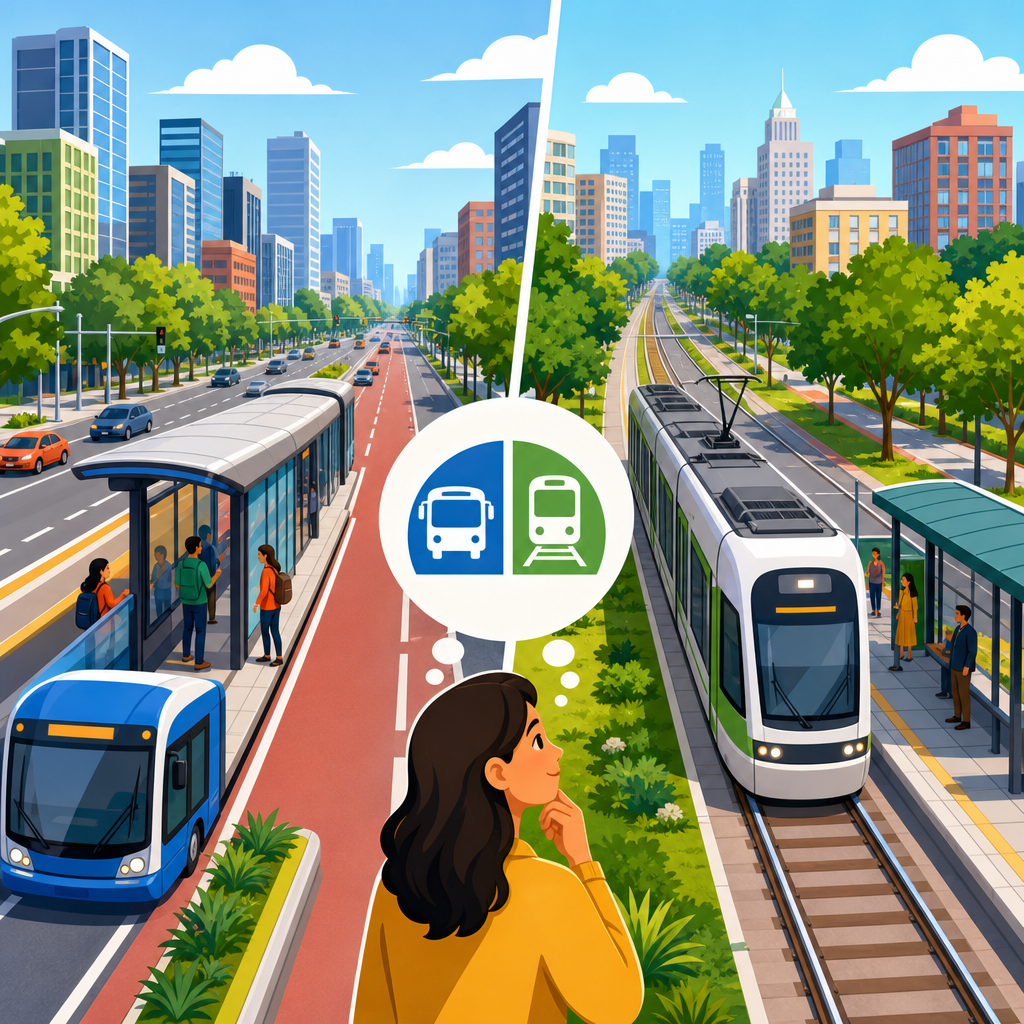
Bus rapid transit and light rail are often presented as rivals, but in practice they are corridor tools, and the right question is not which mode is universally better but which corridor conditions favor which investment. In transportation planning, a corridor is the travel shed linking major origins and destinations along a linear path, usually defined by right of way, land use, travel demand, and network connections. Bus rapid transit, or BRT, uses buses with rail-like features such as dedicated lanes, off-board fare payment, level boarding, and signal priority. Light rail transit, or LRT, uses electric rail vehicles on tracks, typically in exclusive or semi-exclusive lanes, with higher permanence and larger vehicles.
This choice matters because corridor investments shape ridership, emissions, public budgets, street design, and urban growth for decades. I have worked through alternatives analyses where an early mode preference collapsed once the team mapped stop spacing, turning conflicts, utility relocation, and transfer penalties. The strongest projects start with corridor function rather than ideology. A dense avenue with constrained width, high bus volumes, and many short trips may reward a well-designed BRT. A corridor with sustained all-day demand, strong redevelopment potential, and room for protected rail right of way may justify light rail. Cities that ignore this fit often spend heavily yet underperform on speed, reliability, or capacity.
For decision makers, the core issue is matching mode characteristics to actual operating conditions. Capacity, speed, capital cost, operating cost, construction disruption, energy use, accessibility, and urban development effects all matter, but they do not matter equally everywhere. A suburban radial line serving long trips from park-and-ride lots is different from an inner-city crosstown route feeding hospitals, universities, and neighborhood retail. Climate goals also raise the stakes. Transportation is a major urban emissions source, and high-performing transit corridors can reduce vehicle miles traveled when they are reliable, frequent, and integrated with zoning and walking access. The mode decision therefore sits at the intersection of engineering, finance, and city building.
This article explains which corridors favor bus rapid transit and which favor light rail, using plain terms and practical examples. It covers demand thresholds, street geometry, station design, construction realities, operating patterns, land use effects, and the common mistakes that skew comparisons. The takeaway is straightforward: BRT usually wins where flexibility, phased delivery, and lower initial cost are decisive, while light rail usually wins where corridors need very high sustained capacity, smooth electric operation, and a durable signal of long-term urban investment. The best outcomes come from disciplined corridor analysis, not mode branding.
Start with corridor function, not vehicle type
The first screen should be corridor purpose. Is the route primarily a trunk carrying heavy demand into the center, a crosstown distributor tying together multiple activity centers, or a redevelopment spine intended to reshape land use over twenty to thirty years? Those functions point toward different service plans and therefore different modes. In my experience, weak studies start by comparing buses and trains as technologies. Strong studies start with passenger flows by segment, transfer markets, trip lengths, intersection delay, and whether the corridor must support through-running branches. A technology only succeeds when it serves a coherent operating plan.
BRT is favored in corridors that need operational flexibility. Because buses can leave the guideway and continue on local streets, agencies can offer one-seat rides from outlying neighborhoods into the main trunk. This is powerful in metropolitan areas with dispersed origins or political pressure to preserve direct trips. Cleveland HealthLine is a useful example of a median-running BRT corridor that improved a major avenue while remaining part of a larger bus network. Bogotá’s TransMilenio shows the high end of busway performance, using passing lanes at stations and very high frequencies. These systems work best where buses can be managed intensively and where stations are designed for fast boarding and clear passenger circulation.
Light rail is favored when the corridor benefits from permanence, high passenger throughput, and a simpler operating pattern. Tracks and overhead power limit flexibility, but they also support larger vehicles, smoother rides, and lower marginal labor needs as ridership rises. Portland’s MAX and Calgary’s CTrain demonstrate how rail trunks can anchor regional travel and shape station-area growth. Rail also performs well where there is a protected right of way, such as former freight corridors, medians wide enough for dedicated tracks, or downtown transit malls. If the corridor needs a strong civic commitment visible to developers, institutions, and riders, light rail often carries more weight.
Demand, capacity, and stop spacing decide more than politics
Passenger demand is the most important technical divider. A moderate-demand corridor may not justify rail’s higher capital cost, while a very high-demand corridor can overwhelm bus operations if too many vehicles are required to carry the peak load. Capacity is usually measured in passengers per hour per direction. Well-executed BRT with exclusive lanes, large stations, multiple doors, and platooned service can exceed 10,000 passengers per hour per direction, and the most intensively managed systems can go higher. Typical North American BRT projects, however, operate far below that because they lack fully separated lanes or off-board payment. Light rail commonly serves corridors in the 3,000 to 12,000 range comfortably, and with long trains, strong signal priority, and protected alignment, it can exceed that.
Stop spacing changes the equation. Close stop spacing improves access but reduces line-haul speed and magnifies dwell time penalties. BRT can tolerate somewhat closer spacing when routes branch and when stations are cheaper to build. Light rail generally benefits from wider spacing, often around half a mile in urban settings and more in suburban segments, because each stop adds braking, acceleration, and boarding time. If the corridor’s demand pattern comes from many short trips with frequent turnover, BRT may match the market better. If demand is concentrated in fewer major nodes with longer average trip lengths, light rail’s speed and higher vehicle capacity gain an advantage.
| Corridor characteristic | Mode usually favored | Why |
|---|---|---|
| Moderate demand, many branches, need for one-seat rides | BRT | Buses can through-run beyond the trunk and serve dispersed origins without forced transfers |
| High sustained all-day demand on a single spine | Light rail | Larger vehicles and coupled trains move more riders with fewer operators |
| Narrow street, frequent intersections, limited capital budget | BRT | Can be phased, uses simpler civil works, and avoids track and power installation |
| Protected right of way and strong redevelopment goals | Light rail | Rail permanence supports transit-oriented development and reliable travel times |
| Need for very fast implementation | BRT | Construction is usually quicker and utility relocation is often less extensive |
Frequency and vehicle size also matter. Suppose a corridor has a peak demand of 4,500 passengers per hour per direction. If a BRT line uses 120-passenger articulated buses, it may need roughly thirty-eight buses per hour before recovery time and uneven loading are considered. That can be operationally workable, but station berths, passing opportunities, and bus bunching become serious design issues. A light rail line using two-car trains carrying 400 passengers each would need about twelve trains per hour, simplifying station operations. In contrast, if demand is 1,500 passengers per hour per direction and origins are spread across multiple branches, forcing everyone onto a rail spine may create unnecessary transfers, making BRT the more rider-friendly solution.
Street geometry, right of way, and construction risk often determine feasibility
Many mode debates are settled by the street itself. Corridor width, block length, curb access needs, grades, bridge load limits, and utility density often matter more than abstract mode rankings. BRT is usually easier to fit into constrained streets because lanes can sometimes be reallocated without full-depth reconstruction. Center-running BRT with island platforms can reduce conflicts with right turns and curbside loading, but it still needs careful pedestrian access and enforcement. Light rail requires track structure, power systems, substations, and often more extensive drainage and utility work. If the corridor sits over aging water mains, telecom ducts, and combined sewers, rail construction risk rises quickly.
Intersections deserve special attention. BRT can secure major travel time gains through transit signal priority, queue jumps, and stop consolidation even when full lane dedication is politically difficult. Light rail also benefits from signal priority, but rail is less forgiving when intersections are poorly designed or when mixed traffic intrudes into the guideway. Turning movements are a recurring problem. A median rail line on a commercial avenue may require banning left turns at many intersections to protect reliability and safety. That can be acceptable on some boulevards and unacceptable on others. Busways can sometimes navigate constrained junctions more flexibly, though flexibility should not be confused with immunity to congestion.
Construction impacts differ in both scale and visibility. BRT projects usually involve pavement reconstruction, station installation, fare equipment, and streetscape work. Light rail adds rails, special trackwork, traction power, substations, and vehicle maintenance facilities. This longer construction period can hurt merchants and delay benefits, especially on corridors with weak business resilience. However, once complete, rail infrastructure can deliver a stronger perception of permanence. That perception is not magic; it rests on the reality that tracks are expensive to remove and therefore signal long-term public commitment. In corridors where private investors are waiting for that signal before financing housing or office projects, rail can change market behavior in ways enhanced bus service often does not.
Cost, operations, and long-term value must be compared honestly
Capital cost dominates headlines, but operating cost and lifecycle cost shape long-run performance. BRT usually has lower initial cost per mile, especially when it uses existing pavement and simpler stations. Yet low-cost BRT can become a false economy if it omits the elements that make rapid transit actually rapid: continuous dedicated lanes, all-door boarding, off-board fare collection, platform-level boarding, and strong signal priority. A painted bus lane with ordinary stops is not the same product. Light rail has higher upfront cost, but it can provide lower operating cost per passenger on very busy corridors because each operator can move more riders. Electric traction also brings lower local emissions and smoother acceleration, though power supply costs and rail maintenance are significant.
Vehicle life is another important difference. Heavy-use transit buses may need replacement after around twelve years under Federal Transit Administration assumptions, though actual service life varies with duty cycle and climate. Light rail vehicles often remain in service for twenty-five to thirty years with midlife overhaul. Track and power assets also have long lifespans if maintained properly. This means a fair comparison should use discounted lifecycle costing rather than only opening-day budgets. Agencies that compare a basic BRT package against a fully featured rail line are not comparing equivalent service. Likewise, advocates who assume rail-oriented development will automatically pay for the rail line are overstating the case. Development depends on zoning, financing, market demand, and public realm quality, not tracks alone.
Operating pattern complexity can tip the balance. BRT can branch efficiently into a trunk, but branch operations complicate headway management and passenger information. Light rail works best with a clean trunk line and coordinated feeders. Transfers are not inherently bad when they are timed, sheltered, and frequent, but badly designed transfers destroy ridership. This is why network design matters as much as mode. A city may choose light rail for the main spine and redesign bus routes to feed stations every five to ten minutes. Another city may choose BRT precisely to avoid forcing transfers from lower-density areas. The correct answer depends on whether riders value direct trips more than a simple high-capacity trunk.
Land use, rider experience, and climate goals shape the final recommendation
Corridors do not exist only to move vehicles; they organize urban growth and daily life. Light rail has a stronger track record of influencing land use where governments pair it with upzoning, parking reform, and station-area planning. Developers often view rail as a durable amenity because stations are fixed and service is less likely to be rerouted. This effect is visible in places such as Charlotte’s Blue Line corridor and parts of Portland, where station areas attracted housing and mixed-use projects after rail investment. BRT can also support development, particularly when stations are substantial, lanes are exclusive, and the city treats the corridor as permanent infrastructure. Eugene’s EmX and parts of Bogotá show that bus-based corridors can reshape urban form, but the development signal is usually weaker unless reinforced by policy.
Rider experience is more than image. Rail is quieter, smoother, and easier for many occasional riders to understand because tracks make the path obvious. Accessibility can be excellent on both modes when platforms are level and boarding gaps are tightly controlled. BRT can suffer when station design is compromised, curb friction slows buses, or fare collection remains onboard. Electric buses narrow the environmental gap, but battery range, charging logistics, and vehicle weight still influence operations. Light rail’s electric power delivers zero tailpipe emissions consistently and can be fed by a cleaner grid over time. If a city’s climate strategy values electrified high-capacity corridors and reduced bus volumes downtown, light rail gains strategic appeal.
The best recommendation usually emerges from a disciplined checklist. Favor BRT when the corridor has moderate demand, multiple branches, constrained capital funds, and urgency for near-term delivery. Favor light rail when the corridor has a strong single spine, high all-day demand, room for dedicated right of way, and explicit goals for redevelopment and electric high-capacity service. In either case, insist on complete street design, safe pedestrian access, frequent service, integrated fares, and realistic operating plans. Those fundamentals determine whether a corridor becomes true rapid transit or just a costly compromise. If you are evaluating a transit investment, start with corridor data, test operations carefully, and choose the mode that fits the street, the market, and the city you intend to build.
Frequently Asked Questions
What does it mean to say BRT and light rail are “corridor tools” rather than direct competitors?
Calling bus rapid transit and light rail “corridor tools” shifts the discussion from ideology to fit. In transportation planning, the central question is not whether one mode is always superior, but whether a specific corridor’s travel demand, land use pattern, right of way constraints, network role, and investment goals align better with one technology or the other. A corridor is more than a street segment. It is the broader travel shed that links major origins and destinations along a linear path, including residential districts, job centers, schools, hospitals, transfer hubs, and regional connections. When planners evaluate a corridor, they are examining how people move through that specific geography, how much space is available, how reliably vehicles can operate, and what kind of long-term urban development the public wants to support.
In that context, BRT and light rail serve different strengths. BRT can often be introduced more flexibly, sometimes incrementally, and can perform very well in corridors where dedicated lanes, strong stations, all-door boarding, signal priority, and frequent service can be provided at a lower cost than rail. Light rail may be favored where very high ridership, large stop-to-stop passenger volumes, strong development intent, and a permanent dedicated guideway justify the greater capital investment. So rather than asking, “Which mode wins?” the more useful question is, “What is this corridor trying to accomplish, and which mode best delivers that outcome?” That is why many regions successfully use both modes, each in corridors that match their operational and urban design strengths.
Which corridor conditions usually favor bus rapid transit over light rail?
BRT tends to be favored in corridors where speed and reliability can be significantly improved without the full cost or physical demands of rail construction. This often includes corridors with moderate to strong demand, but not necessarily demand so high that rail capacity is required from day one. BRT can be especially attractive where an agency needs to improve service across a long corridor quickly, where funding is limited, or where the alignment benefits from route flexibility. If buses can operate in fully dedicated lanes or in substantial stretches of exclusive right of way, BRT can deliver many of the core benefits people associate with rail: faster trips, more reliable arrivals, clear stations, level boarding, and a more legible, premium rider experience.
Corridors with complex street networks or multiple branch patterns can also lean toward BRT. Because buses can enter and exit a trunk corridor more easily than trains, BRT can support one-seat rides from outer areas into a main rapid transit segment, reducing transfers for riders. BRT may also fit corridors where right of way is constrained and rail infrastructure would be difficult or disruptive to install, or where local conditions require phased implementation. In many cities, planners use BRT where the goal is to upgrade a high-ridership bus corridor into a more rapid, higher-quality service while preserving flexibility to adjust service patterns as land use and demand evolve. However, the key caveat is that true BRT requires real transit priority. A bus line running mostly in mixed traffic is not the same thing as a high-performing BRT corridor.
What types of corridors are more likely to favor light rail?
Light rail is often favored in corridors with sustained high ridership potential, strong all-day activity, and a clear case for long-term, fixed-guideway investment. These are typically corridors connecting major downtowns, dense mixed-use districts, universities, medical centers, and regional destinations where passenger volumes are high enough to justify larger vehicles and more robust infrastructure. Light rail can be particularly effective when the corridor either already has, or can feasibly create, a dedicated right of way that allows trains to avoid congestion and operate at consistent speeds. When many passengers are boarding at the same stops and traveling along the same trunk segment, the greater carrying capacity of trains can become a meaningful advantage.
Light rail also tends to gain support in corridors where permanence matters for city-building goals. Because tracks, stations, power systems, and maintenance facilities represent a visible and durable public commitment, light rail is often seen as a strong anchor for transit-oriented development. That does not mean BRT cannot shape land use, because it can, especially when designed well and backed by supportive zoning. But in some markets, rail’s permanence can influence investor confidence, public perception, and long-range redevelopment strategies. Light rail may also be preferable where agencies want a mode that can scale to heavy trunk demand without requiring very high bus volumes through constrained downtown streets. In short, corridors that favor light rail usually combine high demand, available or creatable dedicated right of way, and a policy choice to make a long-term structural investment in both mobility and urban form.
How do capacity, speed, reliability, and cost compare when choosing between BRT and light rail for a corridor?
These four factors are central to corridor selection, but they should be evaluated together rather than in isolation. Capacity depends not only on the vehicles themselves but also on station design, dwell times, service frequency, lane or track exclusivity, signal priority, and terminal operations. Light rail generally offers higher ultimate capacity per operator because a train can carry more passengers than a single bus, especially when multiple rail vehicles are coupled together. That can be a major advantage in busy trunk corridors. But BRT can also provide substantial capacity when it has dedicated lanes, off-board fare payment, level boarding, frequent service, and well-designed stations. In many corridors, BRT capacity is more than sufficient for current and medium-term demand.
Speed and reliability depend heavily on right of way protection. A fully separated BRT corridor can outperform a rail line that still faces intersections and street-running delays, while a well-designed light rail line with strong signal priority and dedicated alignment can deliver excellent travel times and consistency. The mode alone does not determine performance; the infrastructure and operating design do. Cost is where differences often become decisive. BRT usually has a lower capital cost and can be implemented faster, making it attractive where agencies need broad network improvement under budget constraints. Light rail generally requires higher upfront investment for tracks, power systems, vehicles, and maintenance facilities, but that investment may be justified in high-demand corridors where long-term capacity, ride quality, and development objectives are priorities. The smartest corridor decisions come from matching cost to expected benefit over time, rather than assuming cheap is always better or expensive is always more transformative.
Can a corridor start with BRT and later convert to light rail, and when does that make sense?
Yes, a corridor can begin with BRT and later transition to light rail, but that path only makes sense when it is planned deliberately. In some cases, BRT is used as an interim or staged investment because it can deliver meaningful mobility improvements sooner, build ridership, and establish the corridor as a priority while funding and political support for rail continue to develop. This can be a practical strategy in growing regions where immediate needs are urgent but long-term demand may eventually exceed what bus operations can comfortably handle. If the corridor is designed with future conversion in mind, agencies may preserve right of way, place stations strategically, and avoid investments that would be difficult to adapt later.
That said, conversion is not automatically the best outcome, and it should not be treated as inevitable. In some corridors, high-quality BRT remains the appropriate long-term solution because it meets demand effectively, supports the surrounding land use pattern, and offers operational flexibility rail would not. In other corridors, ridership growth, development intensity, and increasing pressure on bus throughput can make light rail the better next step. The important planning principle is to define clear thresholds and objectives: What future conditions would justify conversion? Is the corridor expected to reach train-scale passenger volumes? Would rail materially improve downtown operations, rider experience, or land use outcomes? A staged approach works best when the initial BRT investment is strong enough to stand on its own while also fitting into a larger corridor strategy. Done well, that avoids the trap of underbuilding in the short term or overbuilding before the corridor is ready.