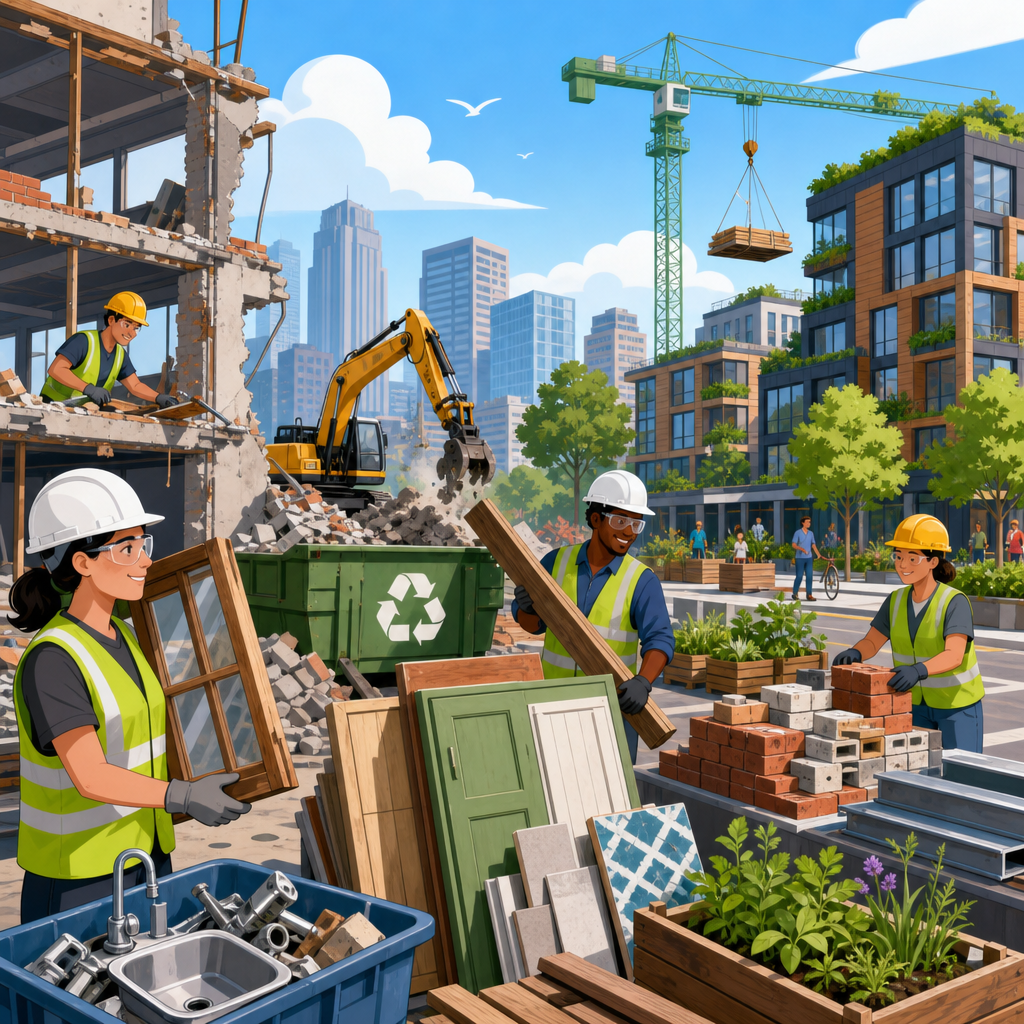
Urban mining and material reuse in redevelopment projects turn existing buildings, streets, and infrastructure into resource banks, reducing waste, cutting embodied carbon, and lowering dependence on virgin extraction. In practice, urban mining means identifying recoverable materials already embedded in the built environment, then harvesting, testing, processing, and redeploying them in new construction or renovation. Material reuse is the broader strategy of keeping products, components, and raw inputs in circulation at their highest feasible value, whether through direct reuse, refurbishment, remanufacturing, or recycling. For cities facing climate targets, volatile commodity prices, landfill constraints, and aging building stock, these approaches matter now. I have worked on redevelopment planning teams where demolition was once treated as a routine clearing exercise; once material audits were introduced, the same site became a source of steel sections, brick, timber, glazing, crushed aggregate, and even fixtures with resale value.
The logic is straightforward. Conventional redevelopment often follows a linear model: extract, manufacture, build, demolish, dispose. Urban mining replaces that with a circular model that begins before demolition permits are issued. Teams map what exists, assess condition and contamination risk, estimate salvage yields, and redesign project scopes around what can be retained or reused. This changes procurement, sequencing, contracts, and design decisions. It also changes economics. Reclaimed structural steel can avoid the emissions associated with blast furnace production. Reused brick can preserve local character while reducing transport impacts. Crushed concrete can substitute for virgin sub-base. When done well, urban mining supports cost control, supply resilience, and heritage-sensitive redevelopment. It is not a niche sustainability gesture; it is an operational discipline that sits at the intersection of architecture, engineering, demolition, waste management, logistics, and public policy.
What Urban Mining Includes in Redevelopment
Urban mining in redevelopment covers more than salvaging a few doors or light fittings. It begins with pre-demolition audits, sometimes called resource inventories or material passports, that document quantities, dimensions, connection types, age, and likely reuse pathways. Typical target materials include structural steel, aluminum curtain wall frames, copper wiring, clay brick, timber joists, raised access floors, pavers, sanitary fixtures, suspended ceilings, and mechanical equipment. On infrastructure-heavy sites, teams may also recover asphalt millings, rails, granite kerbs, ductile iron pipe, and precast concrete units. The key distinction is between direct reuse and lower-value recovery. A steel beam reused as a beam retains far more value than steel sent for melting, even though both avoid disposal.
The highest-value opportunities usually come from designing deconstruction rather than demolition. Mechanical fasteners, modular systems, and accessible joints make disassembly faster and less damaging than cast-in or adhesive-bound assemblies. In one mixed-use redevelopment review, we found that a 1980s warehouse scheduled for demolition had bolted portal frames and standard purlin sizes. By sequencing strip-out carefully and using temporary weather protection, the contractor salvaged sections for reuse in a nearby logistics extension. That outcome would have been impossible under a conventional demolition package priced only on speed and disposal tonnage. Urban mining therefore depends on timing, documentation quality, and market matching as much as on the physical material itself.
Why Material Reuse Matters for Carbon, Waste, and Cost
The strongest case for material reuse is usually embodied carbon reduction. Operational energy has improved in many buildings through efficient systems and tighter envelopes, so the emissions associated with materials now account for a larger share of whole-life carbon. Steel, cement, aluminum, and glass are particularly energy intensive. Reusing components avoids much of the extraction and manufacturing burden attached to new products. Industry guidance from organizations such as the World Green Building Council and standards like EN 15978 for building life cycle assessment have pushed developers to quantify these impacts earlier. Where local policy requires whole-life carbon reporting, retaining structures or reusing major components can materially improve project performance.
Waste reduction is the second major benefit. Construction and demolition waste represents one of the largest waste streams in many countries. Landfill taxes, disposal fees, and transport costs make business-as-usual demolition increasingly expensive. Reuse diverts materials from landfill, but it also reduces demand on recycling facilities that may downcycle products into lower-grade outputs. The cost picture is nuanced. Salvage is not automatically cheaper because labor for careful dismantling, testing, storage, and certification can be substantial. However, savings emerge when teams avoid disposal charges, reduce purchases of new materials, shorten lead times for hard-to-source items, or capture resale value. In volatile markets, reused materials can also hedge against price spikes and supply disruption.
How Redevelopment Teams Plan an Urban Mining Strategy
Successful urban mining starts during feasibility, not after demolition tenders are awarded. The first step is a desktop review of as-built drawings, asset registers, prior refurbishments, and hazardous materials surveys. The second step is a site-based material audit led by specialists who understand salvage potential, contamination issues, and secondary market demand. Quantities should be tied to reuse pathways: on-site reuse, off-site project reuse, resale through reclamation networks, remanufacturing, or recycling. Teams then test materials where performance or compliance matters. Structural steel may need section verification and grade assessment. Timber may require moisture, species, and strength checks. Facade elements need weathering and sealant evaluation.
Project governance matters as much as technical analysis. Employers need procurement routes that reward recovery outcomes, not just lowest demolition cost. Designers must allow enough time to incorporate reclaimed dimensions and tolerances into drawings. Quantity surveyors should compare reuse scenarios using whole-life cost, not only capital cost. Legal teams need clear allocation of liability for reused products, especially where warranties differ from new materials. Municipal approvals may require evidence that recovered materials meet fire, structural, acoustic, and accessibility requirements. Digital tools increasingly help. Building information modeling can host material inventories, while product-level databases and material passport platforms improve traceability. Without traceability, reuse remains a bespoke effort; with it, reuse becomes scalable.
| Project stage | Key urban mining action | Main decision point | Typical risk if skipped |
|---|---|---|---|
| Feasibility | Desktop resource review and salvage screening | Whether retention or deconstruction is viable | Late discovery of high-value reusable assets |
| Pre-design | Detailed material audit and testing plan | What can be reused on site or off site | Overstated recovery assumptions |
| Design | Incorporate reclaimed dimensions and specifications | How design adapts to available stock | Design locks in new materials unnecessarily |
| Procurement | Write salvage targets into contracts | Who owns performance and logistics risk | Contractor incentives favor rapid disposal |
| Construction | Sequenced deconstruction, storage, and tracking | Material quality preservation | Damage, contamination, and lost traceability |
Materials with the Highest Reuse Potential
Not all materials offer the same redevelopment value. Structural steel is one of the best candidates because sections can often be recovered intact, tested, re-certified where required, and reused in buildings or temporary works. Several European projects have demonstrated practical pathways, including reuse through steel stockholder networks and design around available reclaimed sections. Brick is another strong candidate, especially in districts where planning authorities value continuity of appearance. Carefully cleaned bricks can be reused for facades, landscaping walls, or repairs. Heavy timber and engineered timber elements are promising, but condition assessment is critical because hidden moisture damage, not visible wear, usually determines performance.
Concrete sits in a different category. Whole precast elements may be reusable when dimensions align and lifting points remain sound, but cast-in-place concrete is more often crushed for aggregate than reused as an element. That still has value, particularly for capping layers, road base, and non-structural applications, yet it should be recognized as lower-order recovery. Windows, doors, partitions, ceiling grids, and fixtures can work well in fit-out projects if dimensions match and codes are met. Mechanical and electrical equipment is highly case specific; chillers, switchgear, and pumps may have resale markets, but efficiency standards, refrigerant phaseouts, and maintenance history can limit reuse. The best urban mining targets combine recoverability, code compatibility, stable demand, and manageable storage requirements.
Common Barriers and How Projects Overcome Them
The most common barrier is uncertainty. Developers worry that reclaimed materials will delay schedules, fail inspections, or create liability. Engineers worry about missing test data. Contractors worry about labor intensity and storage space. Insurers and lenders often default to familiar products with standard warranties. These concerns are valid, but they can be managed. The first control is evidence: robust surveys, testing protocols, photographic documentation, and chain-of-custody records. The second is scope discipline: prioritize a handful of high-value materials rather than trying to salvage everything. The third is market coordination: line up reuse destinations before strip-out begins. Salvaged components lose value quickly when they sit unprotected on site without an identified buyer or project use.
Policy and standards can either hinder or accelerate adoption. Waste definitions in some jurisdictions inadvertently classify reusable products as waste too early, complicating transport and resale. By contrast, public procurement rules that recognize whole-life carbon and circularity can create strong demand for reused materials. Certification pathways are improving. Structural reuse protocols, deconstruction guidance, and product documentation standards make approval less ad hoc than it was a decade ago. Training also matters. Demolition crews are skilled at safe removal, but deconstruction requires different sequencing, labeling, and handling habits. On projects where I have seen the best results, the turning point was not a new technology; it was early alignment among the client, design team, contractor, and salvage specialists around measurable recovery targets.
Best Practices for Cities, Developers, and Design Teams
Urban mining works best when redevelopment is treated as material stewardship from day one. Cities can support this by requiring pre-demolition audits for significant projects, allowing salvage staging areas, and publishing local directories of reuse outlets and approved processors. Developers should ask at acquisition stage what existing assets can be retained, not simply what can be cleared. Design teams should practice design for adaptation and future disassembly so today’s new building becomes tomorrow’s material bank rather than tomorrow’s waste problem. Specifications should define acceptable reclaimed content, testing requirements, and documentation formats. Tender packages should include salvage schedules, handling instructions, and responsibility matrices.
Measurement is essential. Track salvage rates by mass, value, and carbon impact. Distinguish direct reuse from recycling so performance is not overstated. Compare scenarios using life cycle assessment tools and quantity takeoff data, then feed lessons into future projects. Communication is equally important because reclaimed materials can raise concerns about aesthetics or quality. In reality, many reused products perform as well as new ones when selected correctly, and they often add character that new materials cannot replicate. For organizations building a sustainable urban development strategy, urban mining is one of the clearest ways to connect climate action, waste reduction, procurement reform, and local economic activity. Start with one redevelopment pipeline, audit the existing stock, set recovery targets, and build repeatable processes that make material reuse a normal part of project delivery.
Urban mining and material reuse in redevelopment projects deliver practical value because they turn existing urban fabric into a managed resource instead of a disposal problem. The core principles are clear: identify recoverable materials early, preserve the highest-value reuse pathways, test and document what you plan to keep, and align design and procurement around real salvage opportunities. When teams do this, they reduce embodied carbon, limit landfill waste, improve supply resilience, and often uncover economic value hidden in structures slated for demolition. The most effective programs focus on materials with proven reuse potential, such as steel, brick, timber, fixtures, and selected precast elements, while treating lower-value recovery honestly rather than inflating claims.
The larger benefit goes beyond individual projects. Cities that normalize pre-demolition audits, deconstruction planning, and material traceability build local markets for reclaimed products and create a stronger foundation for circular construction. Developers gain better risk visibility. Designers gain a richer palette of materials and a clearer understanding of future adaptability. Contractors gain new service lines in selective dismantling, testing, storage, and resale coordination. The built environment becomes less dependent on constant virgin extraction and less vulnerable to supply shocks. If you are shaping a redevelopment program, the next step is simple: review your upcoming sites, commission a material audit before demolition decisions are fixed, and turn reuse targets into project requirements from the start.
Frequently Asked Questions
What is urban mining in redevelopment projects, and how is it different from standard demolition?
Urban mining is the process of treating existing buildings, roads, utilities, and other parts of the built environment as valuable material stocks rather than waste. Instead of tearing down a structure and sending most of the debris to landfill or low-value recycling, project teams identify what can be recovered before demolition or major renovation begins. That may include structural steel, brick, concrete, timber, paving, glass, architectural metals, fixtures, mechanical equipment, and even interior finishes if they still have useful life. The goal is to extract these materials in a way that preserves as much value as possible, then test, process, and reuse them in the same project or another nearby development.
The key difference from standard demolition is intent and method. Conventional demolition is focused on speed, clearance, and disposal. Urban mining is focused on inventory, selective deconstruction, recovery logistics, and material quality. It often starts with a pre-demolition audit that documents quantities, conditions, dimensions, contamination risks, and reuse potential. From there, teams can decide whether materials should be reused directly, refurbished, remanufactured, or recycled into new inputs. This shift can significantly reduce construction waste, lower embodied carbon, and decrease reliance on newly extracted raw materials. In redevelopment projects, that is especially important because existing sites often contain large amounts of recoverable value already embedded in their structures and infrastructure.
What types of materials can realistically be reused or recovered during redevelopment?
A wide range of materials can be recovered, but the best candidates are those that retain performance, can be safely verified, and have a practical path back into use. Structural steel is one of the strongest examples because it can often be removed, tested, and reused with relatively high retained value. Brick and stone can also be recovered, especially when careful deconstruction allows cleaning and sorting for reuse in facades, paving, or landscape features. Heavy timber, wood flooring, doors, windows, ceiling systems, raised access floors, cabinetry, metal cladding, and certain mechanical or electrical components may also be strong candidates depending on age, condition, and code requirements.
Concrete is another major opportunity, although it is often reused differently. In some cases, precast elements or slabs can be repurposed directly, but more commonly concrete is crushed and processed for aggregate, sub-base, or fill applications. Asphalt, curbs, pavers, utility covers, guardrails, and site furnishings can also be harvested from roads and public realm upgrades. In redevelopment districts, even excavated soil, pipe, rail, and foundation elements may have reuse value if properly assessed. The realistic reuse potential depends on factors such as contamination, durability, dimensions, disassembly method, local regulations, transportation distance, and market demand. The most successful projects match material recovery plans to actual design needs and supply chain capabilities rather than assuming everything can or should be saved.
How does material reuse help reduce embodied carbon and overall environmental impact?
Material reuse reduces embodied carbon because it extends the life of products and components that have already required energy, extraction, manufacturing, and transportation. When a redevelopment project reuses steel beams, reclaimed brick, salvaged timber, or existing paving instead of buying new materials, it avoids much of the carbon associated with producing replacement products from virgin resources. That matters because embodied carbon is front-loaded in construction: emissions occur before a building is occupied, during extraction, processing, fabrication, and delivery. Reusing what already exists can therefore produce immediate climate benefits.
The environmental value goes beyond carbon. Urban mining and reuse reduce construction and demolition waste, ease pressure on landfill capacity, and limit the ecological disruption associated with mining, quarrying, logging, and industrial processing. They can also reduce water use and air pollution tied to manufacturing new materials. In dense urban areas, keeping materials circulating locally can shorten transport distances and support a more regional circular economy. That said, environmental benefits are strongest when recovery is planned intelligently. Excessive transport, energy-intensive reprocessing, or salvaging materials with no realistic reuse outlet can erode gains. This is why lifecycle thinking is essential. The best redevelopment strategies compare reuse, recycling, and new procurement options using practical data on performance, logistics, and carbon impacts.
What are the biggest challenges to implementing urban mining and material reuse on redevelopment sites?
The biggest challenges are usually timing, coordination, quality assurance, and market readiness. Many redevelopment projects move on tight schedules, and salvage planning has to begin early to be effective. If teams wait until demolition is underway, valuable materials are often damaged, mixed, contaminated, or simply removed too quickly to recover properly. Another common obstacle is incomplete information about what is inside an existing building or infrastructure system. Older properties may lack accurate drawings, material records, or maintenance histories, making it harder to predict reuse potential and compliance requirements.
Quality assurance is another major issue. Reused materials must still meet structural, fire, health, and performance expectations, which may require testing, certification, cleaning, repair, or engineering review. Concerns about liability, code approval, insurance, warranties, and procurement specifications can slow adoption if they are not addressed upfront. There are also practical constraints around storage, transportation, inventory management, and matching recovered materials to design timelines. A project may successfully salvage components but still struggle if there is no place to store them or no buyer or internal use case lined up. Finally, the supply chain for reused materials is still developing in many markets. That means designers, contractors, demolition teams, and local authorities may not yet have standard processes for valuation, documentation, and redeployment. Successful projects overcome these barriers through early audits, clear recovery targets, digital material inventories, stakeholder alignment, and contracts that explicitly support deconstruction and reuse.
How can developers, designers, and contractors build a successful material reuse strategy into a redevelopment project?
A successful strategy starts as early as possible, ideally before schematic design and well before demolition. The first step is a thorough pre-redevelopment material audit that identifies what is present, what condition it is in, and what recovery pathways are realistic. This should include quantities, dimensions, material grades where possible, hazardous material screening, disassembly considerations, and estimated residual value. Once that inventory exists, the project team can prioritize materials based on carbon savings, cost, reuse potential, and alignment with the future design. High-value opportunities might include retaining parts of the existing structure, reusing steel sections, incorporating reclaimed masonry, or redeploying site materials such as pavers and curbs.
The next step is integrating that inventory into design and procurement decisions. Designers should specify where reused materials will be used and allow some flexibility for dimensions, finishes, and supply variability. Contractors and deconstruction specialists need clear sequencing plans so materials can be removed safely and preserved for reuse. Developers should also establish documentation requirements for testing, traceability, code compliance, and chain of custody. In many cases, working with local salvage yards, material marketplaces, recyclers, fabricators, and third-party certifiers helps create reliable outlets and reduces logistical risk. It is also smart to evaluate financial performance broadly. Material reuse can produce direct savings on disposal and procurement, but it may also deliver value through carbon reduction targets, sustainability certifications, community benefits, and stronger ESG outcomes. The most effective redevelopment projects treat urban mining not as an afterthought but as a core part of project planning, design, demolition, and construction strategy.