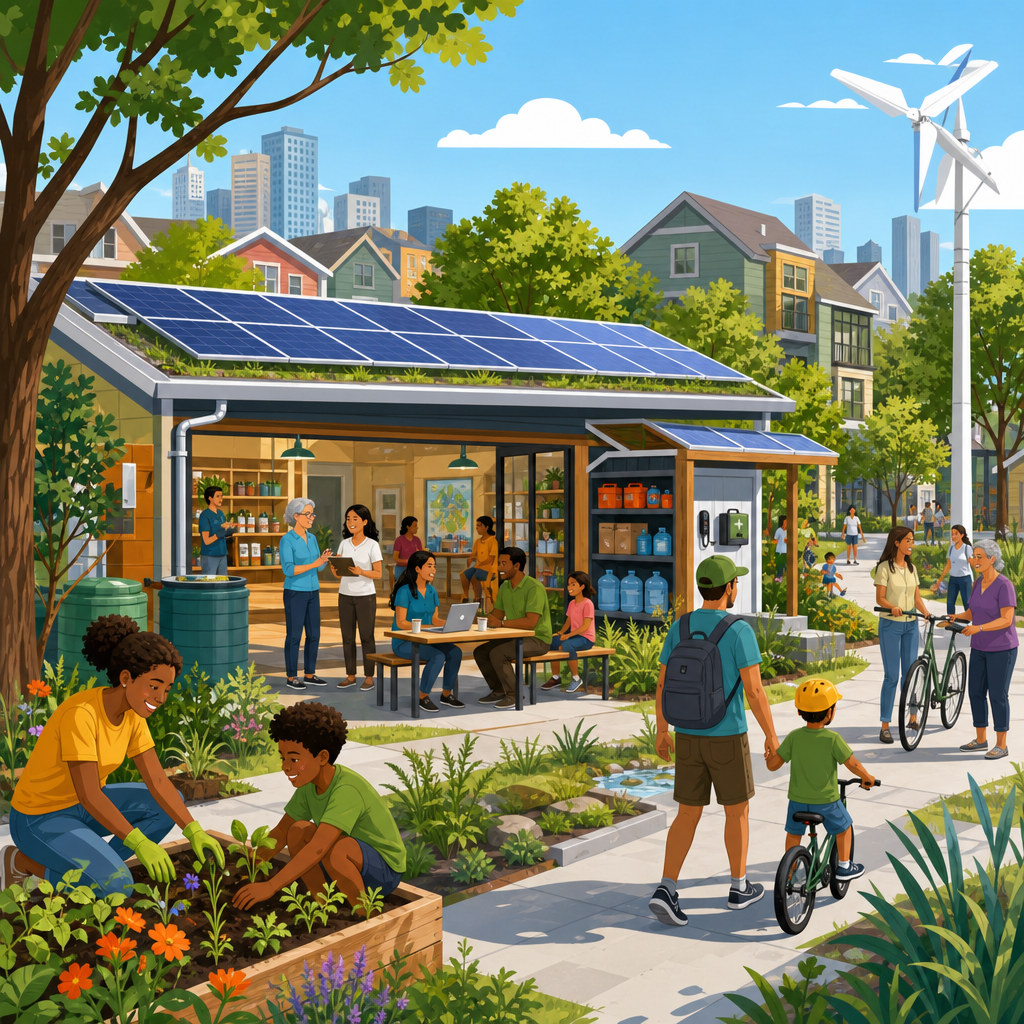
Resilience hubs are neighborhood-scale facilities designed to help residents prepare for, withstand, and recover from shocks such as heat waves, floods, power outages, and poor air quality, while also supporting everyday community needs. In sustainable neighborhood planning, they function as both emergency assets and long-term social infrastructure. A well-designed resilience hub can provide backup power, cooling or clean-air shelter, communications, food distribution, charging stations, and trusted local coordination. It can also host workforce training, health services, public meetings, and mutual aid programs when no disaster is underway. That dual role is why resilience hubs have moved from a niche idea to a core planning strategy in cities facing climate risk, aging infrastructure, and deep social inequities. After working with neighborhood plans and emergency preparedness programs, I have seen the same lesson repeatedly: places recover faster when support is already embedded in familiar community spaces. Sustainable planning is not only about reducing emissions or adding green buildings. It is also about ensuring that residents, especially older adults, renters, low-income households, and people with disabilities, can access safety and essential services close to home when systems fail.
The term resilience hub is sometimes used loosely, so it helps to define it carefully. A resilience hub is usually a school, library, recreation center, community center, faith-based facility, or affordable housing site upgraded to operate during disruptions. Core features often include solar photovoltaic panels paired with battery storage, high-efficiency HVAC, passive survivability measures, ADA-accessible design, emergency communications tools, water and sanitation provisions, and trained local staff or volunteers. Some hubs also include microgrids, medical device charging capacity, refrigerated medicine storage, and multilingual risk communication. What distinguishes a hub from a standard public building is operational readiness and neighborhood integration. The facility is planned around specific hazards, mapped vulnerable populations, and established service partnerships. This matters because climate impacts are increasingly localized. One block may flood repeatedly while another suffers dangerous heat exposure due to tree loss and pavement. Neighborhood planning that includes resilience hubs creates a practical layer between household preparedness and citywide response, making sustainable urban development more concrete, equitable, and durable.
Why resilience hubs belong in neighborhood planning
Resilience hubs belong in neighborhood planning because climate adaptation succeeds or fails at the local level. Citywide emergency plans are necessary, but residents experience disruptions through neighborhood conditions: walkability, building quality, transit access, social networks, and the availability of safe public space. A resilience hub turns those conditions into a coordinated strategy. Instead of treating disasters as rare interruptions, planners use hubs to address chronic stressors and acute events together. For example, the same site that serves as a cooling center during extreme heat can provide internet access, food assistance enrollment, after-school programming, and energy bill counseling year-round. That continuous use increases trust, and trust is what determines whether people actually come during an emergency.
Neighborhood planning also requires place-based investment decisions. Planners must decide where public dollars create the most protection per square foot and per resident served. Resilience hubs often outperform single-purpose facilities because they combine climate adaptation, public health support, social services, and community engagement in one asset. In practice, this can mean retrofitting an existing recreation center in a low-canopy, high-heat neighborhood rather than building a new emergency shelter elsewhere. It can mean placing battery-backed refrigeration in a clinic serving insulin-dependent patients or adding indoor air filtration near communities affected by wildfire smoke or truck traffic. These are not abstract sustainability goals. They are targeted interventions that reduce mortality risk, shorten service interruptions, and strengthen everyday neighborhood function.
Core components of an effective resilience hub
An effective resilience hub is built around five components: facility performance, energy resilience, public health capacity, community governance, and operational planning. Facility performance starts with the building envelope. Insulation, shading, efficient windows, reflective roofing, and ventilation strategies allow passive survivability, meaning the building remains safer for occupants even when power fails. Energy resilience usually includes on-site solar generation and battery storage sized for critical loads such as lighting, refrigeration, outlets for charging, internet equipment, ventilation, and limited HVAC. In some cases, a microgrid allows the hub to island from the larger grid during outages.
Public health capacity includes cooling rooms, clean-air spaces with MERV-13 or higher filtration where appropriate, potable water access, sanitation supplies, and space for clinical outreach. Community governance is equally important. The most successful hubs are not imposed from the top down; they are co-designed with residents, local nonprofits, emergency managers, and facility operators. Operational planning translates design into action. That means staffing plans, memoranda of understanding, supply inventories, security protocols, communication trees, backup fuel policies where applicable, and regular drills. Without operations, a technically advanced building may fail when the neighborhood needs it most.
| Component | What it includes | Why it matters |
|---|---|---|
| Building readiness | Weatherization, insulation, shaded entries, accessible restrooms, durable materials | Keeps occupants safer longer during outages and extreme weather |
| Backup energy | Solar PV, batteries, critical load panels, optional microgrid controls | Maintains lighting, communications, refrigeration, and device charging |
| Health protection | Cooling space, air filtration, water, sanitation, medicine storage | Reduces heat illness, smoke exposure, and treatment disruption |
| Operations | Staff training, partner agreements, supplies, drills, multilingual outreach | Ensures the site functions reliably in real events |
| Community role | Programs, meetings, benefits access, mutual aid, trusted local leadership | Builds daily relevance and stronger emergency participation |
How cities choose sites and prioritize neighborhoods
Site selection should be data-driven and community-informed. In my experience, the most defensible approach starts with a layered vulnerability analysis. Planners map flood exposure, urban heat island intensity, outage frequency, air quality burdens, language isolation, disability prevalence, housing cost burden, and access to transit or walkable routes. They then compare these indicators with the location and condition of public or nonprofit facilities that could be upgraded. Tools such as FEMA flood maps, CDC Social Vulnerability Index variables, local heat mapping campaigns, utility outage records, and health department data help identify need. The result is not simply a list of risky places. It is a shortlist of feasible sites that can serve the greatest number of residents under realistic operating conditions.
Good site selection also accounts for who can reach the hub without a car. During emergencies, transportation systems often degrade first. A resilience hub within a fifteen-minute walk for nearby residents is far more useful than a larger site that requires crossing a highway or relying on disrupted transit. Planners should assess ADA access, route safety, drainage around entrances, proximity to affordable housing, and whether the surrounding public realm supports queuing, deliveries, and information sharing. Schools and libraries are often strong candidates because they are already recognized public destinations, but ownership, union rules, hours of operation, and security constraints must be resolved early. A smaller neighborhood facility with stronger local partnerships may outperform a larger but less flexible building.
Design strategies that connect resilience and sustainability
Resilience hubs work best when climate adaptation and decarbonization are planned together. High-efficiency all-electric retrofits, heat pumps, demand management controls, and battery storage can cut emissions while improving emergency performance. Passive design measures reduce the amount of backup power needed, which lowers capital cost and extends operating duration during outages. Exterior trees, cool pavements, shade structures, and stormwater features such as bioswales improve the site itself while lowering heat exposure and flood risk in the surrounding neighborhood. These measures support sustainability goals beyond the hub’s walls.
Water strategy matters as much as energy strategy. In flood-prone areas, critical equipment should be elevated above projected flood levels, not just historical records. In drought-prone regions, planners may incorporate low-flow fixtures, rainwater harvesting for nonpotable use where regulations allow, and landscaping suited to future climate conditions. Indoor environmental quality is another design priority. During smoke events, a designated clean-air room with monitored filtration can provide immediate protection. During heat events, thermal zoning helps preserve comfort in a smaller area if the whole building cannot be cooled. The point is straightforward: sustainable neighborhood planning becomes stronger when resilience hubs are treated as high-performance civic infrastructure rather than emergency add-ons.
Governance, partnerships, and neighborhood trust
A resilience hub is only as strong as the relationships behind it. Physical upgrades matter, but governance determines whether the facility is trusted, staffed, and activated appropriately. Effective hubs usually have a lead operator, an emergency management liaison, local nonprofit partners, and resident advisors with clear roles. Formal agreements should define who opens the site, who manages supplies, who communicates with the public, and how costs are reimbursed. I have seen promising hub concepts stall because these basics were left vague. During an actual outage, ambiguity turns into delay.
Trust is built before an emergency through regular use and visible value. A hub that hosts job fairs, tenant clinics, food distributions, neighborhood planning workshops, and youth programs is more likely to attract residents when conditions become dangerous. This matters especially in communities with language barriers, immigration concerns, or justified distrust of government institutions. Trusted messengers, including community health workers, faith leaders, and tenant organizers, often do more to increase hub utilization than any hardware investment. Multilingual signage, culturally competent staffing, and published activation criteria further reduce uncertainty. Sustainable planning depends on participation, and participation depends on trust.
Funding models and implementation challenges
Funding a resilience hub usually requires stacking sources rather than relying on one grant. Common capital sources include federal hazard mitigation funds, energy incentives, community development funds, state climate programs, utility programs, philanthropy, and municipal capital budgets. Operating funds are harder to secure, yet they are what keep a hub functional over time. Staffing, maintenance, battery replacement, training, insurance, and community programming all require recurring support. In project reviews, I advise cities to treat operations as core infrastructure cost, not an optional extra.
Implementation challenges are predictable. Older buildings may need expensive electrical upgrades before solar and storage can be installed. Landmark rules can limit exterior changes. Public procurement can slow delivery. Insurance and liability questions may complicate public access during emergencies. There are also equity risks. If a city invests only in showcase hubs downtown while leaving high-risk neighborhoods underserved, the program can widen disparities. The fix is disciplined planning: prioritize highest-need areas, publish selection criteria, phase improvements transparently, and measure actual service coverage. A modest, well-run hub network beats a small number of architecturally impressive but operationally weak sites.
How to measure performance and long-term value
Resilience hubs should be evaluated with practical metrics tied to both emergency function and neighborhood benefit. During disruptions, key indicators include hours of backup power delivered, number of residents served, indoor temperature stability, air quality performance, device charging sessions, refrigeration continuity, and communication reach. Over the long term, planners should track program attendance, partner participation, reduced energy use, avoided outage costs, and resident awareness of hub services. Surveys can assess whether people know where the nearest hub is, how to get there, and what it offers. If they do not, the hub is underperforming no matter how advanced the equipment is.
There is also a broader planning value that standard cost-benefit analyses often miss. Resilience hubs strengthen social cohesion, and social cohesion is one of the most reliable predictors of survival and recovery after disasters. Researchers studying heat emergencies, hurricanes, and earthquakes have repeatedly found that neighborhoods with stronger local networks fare better than equally exposed places with weaker connections. A resilience hub gives those networks a physical anchor. It becomes the place where information, supplies, care, and local leadership come together. That is why resilience hubs should be treated as a core part of sustainable neighborhood planning, not a side initiative. Cities, community organizations, and developers should assess existing facilities, identify service gaps, and build a phased hub strategy that residents can see, use, and trust.
Frequently Asked Questions
What is a resilience hub, and why is it important in sustainable neighborhood planning?
A resilience hub is a neighborhood-based facility that helps residents prepare for, respond to, and recover from disruptions such as extreme heat, flooding, smoke events, grid outages, and other climate- or infrastructure-related emergencies. What makes resilience hubs especially valuable in sustainable neighborhood planning is that they are designed to serve people both during crises and in everyday life. Instead of sitting idle until a disaster occurs, a resilience hub can function year-round as a trusted community space that supports public health, social connection, information sharing, workforce development, and access to essential services.
In practical terms, a resilience hub often includes features such as backup power, battery storage, solar energy, cooling or clean-air shelter, charging stations, communications equipment, food storage and distribution capacity, and spaces for coordination and mutual aid. During non-emergency periods, the same facility may host classes, neighborhood meetings, health outreach, or community programs. This dual purpose makes resilience hubs a strong fit for sustainable planning because they maximize public investment, strengthen local networks, and improve a neighborhood’s ability to adapt over time.
From a planning perspective, resilience hubs also help shift sustainability from a narrow focus on buildings or emissions toward a broader focus on people, equity, and continuity. A sustainable neighborhood is not only efficient and low-carbon; it is also capable of protecting residents when systems fail. Resilience hubs support that goal by creating reliable, local places where people can access resources, stay informed, and receive support close to home.
How do resilience hubs support communities during emergencies such as heat waves, floods, or power outages?
Resilience hubs support communities by providing a dependable, local point of assistance when normal services are disrupted. During heat waves, a hub may operate as a cooling center with air-conditioned space, drinking water, seating, and health monitoring resources for vulnerable residents such as older adults, children, and people with chronic illnesses. During poor air quality events, the same space can serve as a clean-air shelter equipped with filtration systems that reduce smoke and particulate exposure. When power outages occur, resilience hubs can offer electricity for medical devices, refrigeration for medicines, charging for phones, internet access, lighting, and emergency communications.
In flood events or major storms, resilience hubs can also function as coordination points for distributing food, water, supplies, and trusted public information. They may support check-ins for isolated residents, connect households to local aid organizations, and provide a place where neighbors can gather safely while response efforts are underway. Because they are embedded within neighborhoods, hubs can often respond faster and more effectively than distant centralized facilities, especially in communities where transportation access is limited.
One of the most important benefits is that resilience hubs reduce dependence on a single fragile system. If the electrical grid fails, a hub with solar plus storage can keep critical services running. If digital communication is disrupted, the hub can become a physical information node. If supply chains are stressed, it can support local distribution and coordination. In this way, resilience hubs are not just shelters; they are operational centers for continuity, public safety, and neighborhood-scale recovery.
What features should a well-designed resilience hub include?
A well-designed resilience hub should combine physical infrastructure, social services, and operational planning. On the infrastructure side, common features include backup power systems, ideally paired with solar panels and battery storage; efficient heating and cooling; indoor air filtration; potable water access; refrigeration; lighting; charging stations; and communications tools such as Wi-Fi, radios, or public information systems. Depending on local risks, a hub may also include flood protection measures, accessible entrances, durable building materials, and flexible interior space that can be reconfigured for emergency use.
Just as important is the human-centered design of the facility. A strong resilience hub should be easy to reach by foot, bike, transit, and car, and it should comply with accessibility standards so people with disabilities can use it safely and comfortably. Clear signage, multilingual communication, restrooms, seating, storage, and spaces for families, elders, and service providers all improve usability. The hub should also be designed with local hazard conditions in mind. In a hot climate, cooling and shaded outdoor areas may be essential; in wildfire-prone regions, advanced filtration and sealed indoor environments may be a priority; in flood-prone areas, elevation and waterproofing may be critical.
Operational readiness is another core feature. A resilience hub is only as effective as its staffing, partnerships, and maintenance plan. That means having defined protocols, trained personnel, strong ties with community-based organizations, and a funding model that supports ongoing operations rather than one-time installation. The best resilience hubs are integrated into daily neighborhood life, so residents already know where they are, trust the people who run them, and understand what services are available before an emergency happens.
How do resilience hubs advance equity and community well-being, not just emergency preparedness?
Resilience hubs advance equity by directing resources to the neighborhoods that often face the greatest climate, health, and infrastructure risks while having the fewest safety buffers. Many communities experience overlapping challenges such as high energy burdens, poor housing quality, limited green space, language barriers, underinvestment, and reduced access to transportation or healthcare. A resilience hub can help address these conditions by delivering practical support close to where people live and by creating a consistent, trusted local institution rather than a temporary response effort.
Outside of emergencies, resilience hubs can host programs that strengthen long-term well-being and social cohesion. Examples include public health clinics, food access initiatives, job training, digital access support, emergency preparedness education, youth programming, elder services, and community organizing. These everyday functions matter because resilience is not built only through equipment; it is built through relationships, trust, skills, and access to reliable services. When neighbors know one another and know where to turn for help, the entire community is better positioned to withstand shocks.
Equity also depends on who shapes the hub. The most effective resilience hubs are planned with local residents, community leaders, and frontline organizations, not simply placed into a neighborhood from the outside. Community input helps determine which services are most needed, what cultural considerations matter, what hours are useful, and how information should be communicated. This participatory approach makes the hub more relevant, more trusted, and more likely to produce durable benefits. In sustainable neighborhood planning, that combination of procedural equity and practical support is what turns resilience hubs into lasting social infrastructure.
How can cities and planners successfully integrate resilience hubs into neighborhood plans?
Successful integration begins with identifying neighborhood-level risks and assets. Planners need to understand where heat vulnerability, flood exposure, outage risk, health disparities, and service gaps overlap, and then determine which existing facilities could function as resilience hubs or where new investment is needed. Libraries, schools, recreation centers, faith-based buildings, community centers, and affordable housing sites are often strong candidates because they are already familiar and accessible to residents. Site selection should also consider transit access, walkability, building condition, utility reliability, and whether the location is itself protected from major hazards.
Beyond choosing a site, cities need to connect resilience hubs to broader planning goals. That means aligning them with climate adaptation strategies, sustainability targets, emergency management plans, capital improvement programs, public health initiatives, and community development efforts. A hub should not exist as a stand-alone project with unclear ownership. It works best when responsibilities for operations, communications, maintenance, staffing, and emergency activation are clearly assigned across departments and partner organizations. Long-term funding is also essential, including support for both infrastructure upgrades and ongoing program delivery.
Community partnership is the final ingredient. Cities and planners should collaborate with neighborhood organizations, local nonprofits, utilities, health agencies, and resident leaders from the beginning. This helps ensure the hub is responsive to local needs, culturally competent, and trusted before any crisis occurs. Measuring outcomes is equally important. Planners should track not only emergency activation capacity, but also everyday use, service reach, participation, and benefits for vulnerable populations. When resilience hubs are planned as part of a larger neighborhood strategy, they can strengthen sustainability, improve public trust, and create a more durable foundation for both daily life and disaster recovery.