Sustainable stormwater design for streets, sidewalks, and plazas turns everyday public space into active infrastructure that captures, cleans, slows, and reuses rain where it falls. In practical terms, it means shaping pavements, soils, plants, utilities, and drainage details so urban surfaces no longer rush runoff directly into pipes and waterways. I have worked on corridor retrofits where one curb line handled only traffic before redesign and, after reconstruction, managed peak flow, reduced ponding, and supported street trees that finally survived summer heat. That shift matters because urban hardscape occupies a large share of city land, and when it is designed conventionally, it amplifies flooding, water pollution, heat stress, and maintenance costs. Streets, sidewalks, and plazas are often rebuilt on long cycles, so each capital project is a rare opportunity to improve hydrology for decades.
Stormwater is rainfall or snowmelt that runs off roofs, roads, and paved ground instead of soaking into soil. Sustainable stormwater design uses low impact development, green infrastructure, and source control principles to mimic natural water balance. Common techniques include bioretention planters, permeable pavement, infiltration trenches, stormwater trees, curb extensions with soil cells, slot drains, forebays, and cisterns. The goal is not simply to move water away fast; it is to match predevelopment conditions as closely as site constraints allow. That usually means reducing runoff volume, lowering peak discharge, improving water quality, and creating visible public amenities. For municipalities, these systems can also help meet permit obligations under programs such as the National Pollutant Discharge Elimination System, total maximum daily load requirements, and local combined sewer overflow control plans.
The topic matters now because climate patterns are shifting while cities continue to add impervious cover. More intense short duration storms can overwhelm inlets and undersized pipes, yet longer dry spells increase the need for shade, evapotranspiration, and resilient planting. Public expectations have changed as well. Residents want safer crossings, cleaner rivers, cooler sidewalks, and attractive plazas, not hidden drainage that fails during every cloudburst. Well designed stormwater streetscape projects can support all of those goals at once. They also align transportation, parks, utilities, and economic development agendas, which is why this subject functions as a hub within sustainable urban development. If a city understands how to integrate hydrology into public realm design, it gains a foundation for flood resilience, water quality compliance, urban forestry, and more durable civic space.
Core principles of sustainable stormwater design
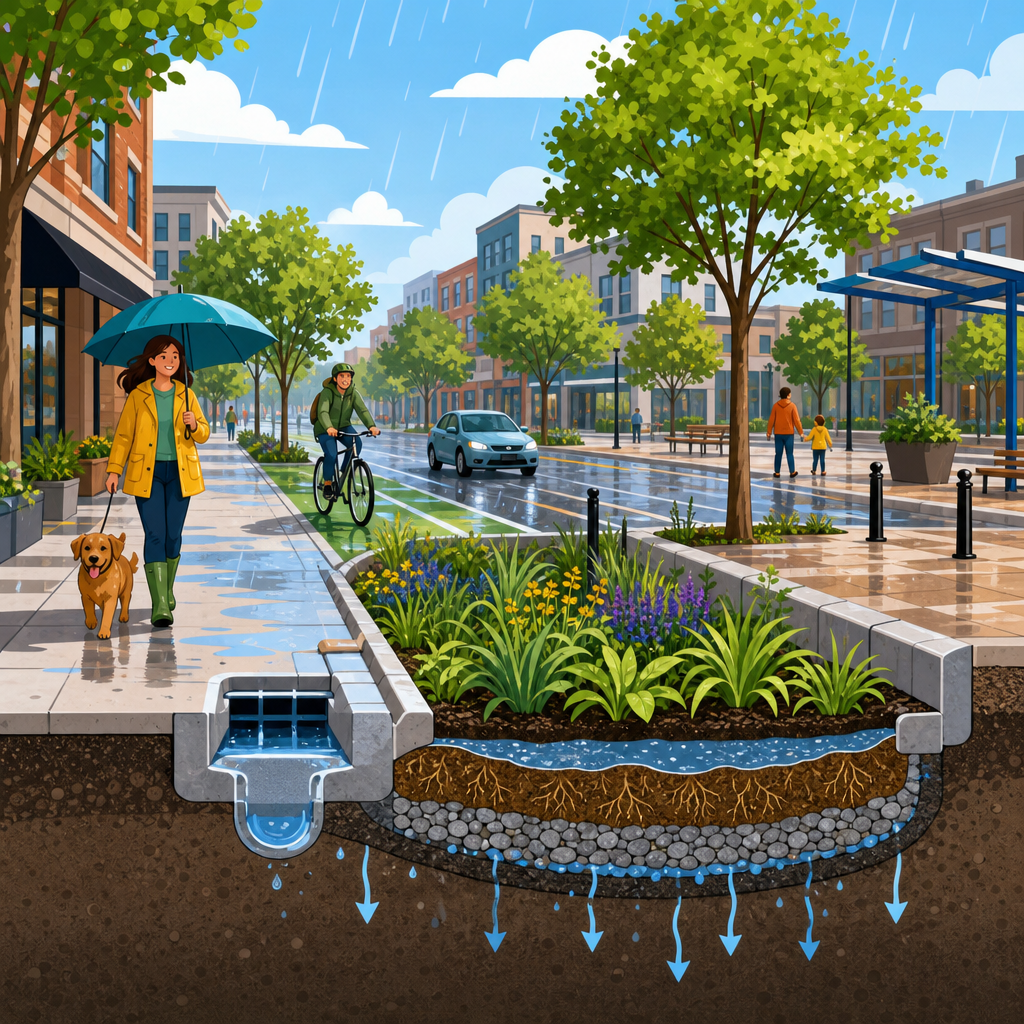
The first principle is to manage runoff as close to the source as possible. Instead of collecting water from an entire district and sending it to one oversized pipe, designers distribute storage and treatment across the street section. A curbside bioretention cell can receive flow from a limited drainage area, filter sediment, and infiltrate or underdrain the excess. A permeable parking lane can detain water temporarily within its stone reservoir. A plaza can be subtly graded to direct sheet flow toward planted depressions rather than low points that create nuisance ponding. This distributed approach reduces burden on trunk infrastructure and creates redundancy if one element clogs or underperforms.
The second principle is the treatment train. Pollutants in urban runoff include sediment, nutrients, trash, tire wear particles, hydrocarbons, metals such as zinc and copper, and bacteria in certain land uses. No single best management practice removes everything equally well. Effective projects combine pretreatment, filtration, biological uptake, infiltration, and controlled conveyance. In a commercial street retrofit I helped review, curb inlets first intercepted coarse debris, a sump and stone forebay settled sediment, engineered soil provided filtration, and an underdrain with an upturned elbow created detention within the media. That layered sequence improved both water quality and maintenance access.
The third principle is designing for complete streets and public use, not treating stormwater as a technical add on. Drainage features must work with pedestrian desire lines, transit stops, loading zones, utilities, and emergency access. Planting beds cannot block door swings or create trip hazards. Overflow routes must be intentional so that during larger storms water bypasses safely to inlets, gutters, or designated spread zones instead of entering storefronts or basement stairs. Good stormwater design is therefore geometric, hydraulic, horticultural, and operational at the same time. When those disciplines are coordinated early, sustainable systems look intentional rather than squeezed into leftover space.
How streets can become stormwater infrastructure
Streets offer the largest connected public surface in most cities, making them the most powerful place to improve runoff performance. Typical interventions include green curb extensions, median bioretention, permeable parking lanes, tree trenches, and narrowed travel lanes that free room for planted swales. Even where infiltration capacity is poor, these features can provide detention and filtration before water enters the storm drain. Along arterials, raised medians with underdrained bioretention often work better than curbside cells because they avoid conflicts with driveways and bus operations. On neighborhood streets, curb extensions can calm traffic while capturing the first flush from the pavement.
Street projects succeed when hydrologic calculations are tied to realistic drainage areas and street operations. Designers usually start with a water quality storm or local capture target, then check larger conveyance events separately. Many jurisdictions require retention or treatment of the 85th or 90th percentile storm, while roadway drainage still must pass a ten year or larger event without unsafe spread. In practice, that means sizing inlets, curb cuts, and ponding depths carefully. A cell may be designed to pond six to twelve inches for water quality storage, but the bypass inlet must prevent lane flooding during high intensity rainfall. If snow is stored curbside, designers also need to protect planting and account for deicing salt exposure.
Utility coordination is often the deciding factor. Water lines, gas mains, electric duct banks, signal conduits, and telecom occupy the same narrow corridor as roots, underdrains, and structural soil. On constrained streets, suspended pavement systems such as Silva Cells or similar modular soil cells can support sidewalks while preserving rooting volume and temporary stormwater storage. This approach is especially effective for stormwater trees because healthy canopy depends on generous uncompacted soil, not small isolated pits. Cities such as Philadelphia, Portland, and Seattle have shown that when tree trench systems are maintained, they can reduce runoff, improve tree survival, and make reconstructed corridors noticeably cooler in summer.
Sidewalk strategies that protect pedestrians and water quality
Sidewalks are often treated as too narrow or too utility constrained for meaningful stormwater management, but careful detailing proves otherwise. The most reliable sidewalk strategies include permeable unit pavers, narrow bioretention strips between curb and clear path, trench drains connected to planter inlets, and tree pits linked below grade into continuous soil volumes. The essential rule is preserving accessible circulation. The clear pedestrian zone must meet local accessibility standards for width, cross slope, and surface stability, and inlets cannot create cane detection problems or lip edges that catch wheels. When these basics are ignored, even technically effective systems generate justified complaints.
Permeable pavement on sidewalks works best where sediment loads are moderate and winter maintenance teams understand the material. Permeable interlocking concrete pavers are easier to lift and repair after utility work than porous asphalt or pervious concrete, which makes them attractive in downtown settings. They also provide visible joints that communicate intentional drainage to the public. However, they are not maintenance free. Vacuum sweeping is necessary to preserve infiltration, and adjacent landscape beds must be stabilized so mulch and fines do not wash onto the surface. In heavy pedestrian zones with food service, grease and litter can shorten performance unless operations staff are involved from the start.
Stormwater tree design deserves special emphasis because sidewalks and street trees often fail together when each is designed in isolation. Small tree pits surrounded by compacted subgrade produce stunted roots, heaved pavement, and poor canopy. Continuous soil trenches, root paths under pavement, and curb inlets that distribute runoff to multiple trees create better long term outcomes. The soil mix must balance drainage and plant health; standard bioretention media that is too sandy may drain well but hold insufficient moisture for urban trees in dry periods. Species selection matters as well. London plane tree, swamp white oak, bald cypress, and certain elm cultivars tolerate urban stress better than ornamental species that decline after repeated inundation or salt exposure.
Designing plazas to store, filter, and celebrate water
Plazas pose a different challenge because they are expected to host events, dining, markets, and daily social use while remaining elegant and durable. Sustainable stormwater design in plazas relies on microtopography, subbase storage, slot drainage, integrated planting, and carefully controlled overflow. Unlike a roadway, a plaza can visibly express water without confusing users, provided the design is legible. Shallow runnels, flush channels, and rain gardens can turn rainfall into a civic feature rather than a problem. The key is balancing delight with risk management so that surfaces remain slip resistant, accessible, and easy to maintain.
One of the strongest approaches is to treat the plaza as a sequence of high and low zones. High zones accommodate primary pedestrian activity, furniture, and emergency access. Low zones accept sheet flow during rain and may include planted basins or permeable fields over open graded aggregate. At Tanner Springs Park in Portland and at several waterfront spaces in Copenhagen, designers used visible water edges and planted depressions to make stormwater processes understandable to the public. Even in harder urban plazas, the same logic applies. A central paved area can drain to perimeter planters that detain the first inches of runoff, while a concealed underdrain and overflow structure protect adjacent buildings during larger storms.
| Space type | Typical stormwater tools | Primary benefit | Main limitation |
|---|---|---|---|
| Street corridor | Bioretention curb extensions, tree trenches, permeable parking lanes | Runoff capture plus traffic calming and shade | Utility conflicts and vehicle loading |
| Sidewalk zone | Permeable pavers, linear planters, connected tree pits | Water quality treatment without losing pedestrian function | Narrow widths and accessibility constraints |
| Public plaza | Subbase storage, slot drains, rain gardens, cistern reuse | Visible water management and flexible public space | Higher detailing demands and event coordination |
Material selection in plazas deserves more scrutiny than many specifications receive. Joint widths, slip resistance, freeze thaw durability, and replacement logistics all affect stormwater performance. For example, large format stone with tight joints may look refined but shed water rapidly and reveal settlement if subgrades stay wet. Clay pavers can be durable yet may vary in permeability depending on bedding and jointing. Resin bound surfaces offer smooth access but require strict installation quality and may not suit heavy service vehicles. In every case, mockups and maintenance planning are worth the cost. The most beautiful stormwater plaza is unsuccessful if drains clog during leaf drop or if replacement materials are unavailable five years later.
Technical decisions that determine performance over time
The most important technical decisions are often hidden below finish grade. Soil media depth, reservoir stone thickness, underdrain elevation, geotextile use, and overflow control determine whether a system infiltrates, detains, or simply becomes a soggy planter. In many climates, bioretention media between eighteen and thirty inches deep provides a workable balance of filtration and rooting volume, but local standards vary. Underdrains should generally be cleanable, and observation wells should be placed where crews can inspect drawdown after storms. I have seen installations fail because the outlet invert was set too high, causing standing water for days, and because inlet aprons were omitted, allowing scour to expose mulch and clog the surface.
Hydraulic conductivity must be verified, not assumed. Native soil infiltration rates can change dramatically across a single block because of fill, compaction, utility trench backfill, or legacy contamination. Field testing with double ring infiltrometers or approved local methods is essential before claiming infiltration credit. Where infiltration is limited by clay soils, shallow bedrock, or groundwater separation requirements, underdrained systems still provide value through filtration and detention. Designers should also consider pollutant hotspots. Runoff from fueling areas, heavy industrial frontages, or high traffic metal roofs may require pretreatment or may be unsuitable for direct infiltration under local regulations.
Maintenance planning is the final design task, not a postscript. Every public works team asks the same practical questions: who cleans inlets, who replaces plants, where does sediment accumulate, and can a vacuum truck or hand crew reach the feature safely? Sustainable stormwater systems perform well when these questions are answered on the drawings and in the operations manual. That means specifying sediment forebays where feasible, limiting proprietary parts unless supply chains are dependable, selecting hardy plant palettes, and showing access routes for equipment. Asset management software, inspection checklists, and post construction monitoring are now standard practice in leading cities because they reduce the common gap between design intent and field reality.
Building a resilient public realm through integrated stormwater design
Sustainable stormwater design for streets, sidewalks, and plazas works best when cities treat public space as green blue infrastructure rather than leftover drainage area. The central lesson is straightforward: capture water near where it lands, move it through a treatment train, and integrate every detail with accessibility, utilities, safety, and maintenance. Streets can calm traffic and cut runoff at the same time. Sidewalks can support tree health, pedestrian comfort, and water quality together. Plazas can become flexible civic rooms that manage rainfall visibly and safely instead of relying only on buried pipes.
The biggest benefit is compounded value. A well designed curb extension, tree trench, or permeable plaza does not solve one problem in isolation. It can reduce flooding frequency, lower pollutant loads, extend pavement life by moderating runoff, support urban canopy, and improve the daily experience of public space. There are limits, and not every site can infiltrate deeply or host large planting areas. Still, nearly every reconstruction project can detain, filter, or reuse more water than the conventional baseline if the right questions are asked early enough.
Use this hub as the starting point for every stormwater conversation in sustainable urban development. Review your standards, map your constraints, and look closely at the next street, sidewalk, or plaza project in design. If rain is already touching that surface, it is already infrastructure. The opportunity is to make it perform better.
Frequently Asked Questions
What does sustainable stormwater design mean in streets, sidewalks, and plazas?
Sustainable stormwater design means treating public right-of-way and civic hardscape as working environmental infrastructure rather than as surfaces that simply shed water into inlets and underground pipes. In streets, sidewalks, and plazas, that usually involves shaping grades, curbs, paving systems, planting areas, and soil profiles so rainfall is captured, slowed, filtered, infiltrated, evapotranspired, or stored for reuse close to where it lands. Instead of allowing runoff to accelerate across impervious surfaces and overload drainage networks, the design intentionally redistributes water into features such as bioretention planters, stormwater tree trenches, permeable pavements, infiltration zones, vegetated curb extensions, and subsurface detention systems.
In practice, this approach is both technical and spatial. It affects cross slopes, curb openings, pavement section design, utility coordination, underdrains, overflow structures, and maintenance access. A curb line that once served only traffic movement can be redesigned to provide peak-flow management, water-quality treatment, and urban greening at the same time. When done well, sustainable stormwater design improves resilience during intense rain events, reduces pollutant loads entering waterways, supports healthier street trees and planting, lowers localized flooding risk, and often makes public space more attractive and comfortable for people. The key idea is simple: rain becomes a design resource to manage intelligently, not just a waste stream to move off-site as fast as possible.
What are the most effective stormwater strategies for urban corridors and public plazas?
The most effective strategies are usually integrated systems rather than a single product or detail. For streets and sidewalks, common high-performing approaches include bioretention curb extensions, continuous soil trenches for street trees, permeable interlocking concrete pavers, permeable asphalt or concrete in selected zones, stormwater planters, vegetated swales, and median bioswales where geometry allows. In plazas, designers often combine permeable surface zones with trench drains, subsurface storage layers, structured soils, slot drains directing runoff to planting beds, and cisterns or storage chambers for reuse in irrigation or water features. These systems can be designed to target runoff volume reduction, peak flow attenuation, pollutant removal, or all three depending on project goals and regulatory requirements.
The best solution depends on local soils, groundwater conditions, utility conflicts, maintenance capacity, winter operations, pedestrian traffic, and desired public-space character. For example, a dense commercial sidewalk with many utilities may be better served by lined bioretention cells with underdrains and carefully placed curb inlets, while a plaza with deeper structural section and fewer conflicts may support larger infiltration reservoirs below permeable paving. Projects also perform better when pretreatment is built in. Sediment forebays, sump structures, cleanouts, filter strips, and accessible inlets help preserve long-term function. A successful design is not just hydrologically sound on paper; it is buildable, maintainable, safe, and coordinated with the realities of urban infrastructure.
How does sustainable stormwater design improve water quality and reduce flooding?
It improves water quality by intercepting runoff before it enters conventional storm drains and by passing that runoff through systems that remove pollutants physically, chemically, and biologically. Urban runoff commonly carries sediment, metals, hydrocarbons, trash, nutrients, and heat from pavements and traffic areas. When runoff enters bioretention soil, permeable aggregate beds, planted systems, and engineered media, suspended solids can settle or be filtered out, pollutants can bind to soil particles, and plant-root and microbial processes can help break down or transform contaminants. Even where full infiltration is not possible, detention and filtration significantly improve the quality of water leaving the site.
Flood reduction comes from slowing runoff and reducing the volume that reaches downstream pipes during peak storm periods. Conventional hardscape sheds water rapidly, which creates sharp peak flows and contributes to surcharging of local drainage systems. Sustainable stormwater features spread the timing of runoff by temporarily storing water at the surface or below grade, allowing some portion to infiltrate into soil, evaporate, or be taken up by vegetation. That delay can be extremely important in streets and plazas, especially during short, intense storms that overwhelm conventional systems. By managing water in multiple small distributed locations instead of relying entirely on downstream conveyance, these designs help reduce nuisance flooding, limit ponding at intersections, and improve the overall resilience of urban districts.
What design challenges should be considered before adding green stormwater infrastructure to streetscapes?
The biggest challenges are usually below the surface and at the edges of disciplines. Existing utilities, limited right-of-way width, driveway access, ADA requirements, emergency vehicle operations, sight lines, snow storage, and subsurface soil limitations all influence what can realistically be built. Soil infiltration rates may be too low for unlined systems, groundwater may be too shallow, contamination may restrict infiltration, and utility corridors may fragment planting or storage zones. In retrofit conditions, grades are often fixed by adjacent buildings and entrances, which means the stormwater strategy must work within tight elevation tolerances. Tree-root space, pavement support, overflow routing, and maintenance access also need to be resolved early rather than treated as afterthoughts.
Another major challenge is balancing hydrologic performance with durability and operations. A detail that looks excellent in a concept sketch may fail if it clogs easily, creates trip hazards, conflicts with street sweeping equipment, or is hard for maintenance crews to access. Winter cities, for example, require careful thinking about deicing materials, freeze-thaw cycles, and snowplow impacts on curb cuts and planted edges. Successful projects rely on multidisciplinary coordination among civil engineers, landscape architects, transportation planners, utility teams, and maintenance staff. The strongest designs are those that acknowledge constraints honestly and use them to shape practical solutions, such as lined systems with underdrains where infiltration is limited, modular detailing where access is frequent, or distributed smaller interventions where one large facility is not feasible.
How should sustainable stormwater features be maintained to ensure long-term performance?
Long-term performance depends as much on maintenance planning as on design quality. Sustainable stormwater systems are not “install and forget” infrastructure. They need routine inspection, sediment and trash removal, vegetation care, periodic replenishment of mulch or surface stone where applicable, and monitoring of inlets, outlets, overflow structures, and underdrains. Permeable pavements require vacuum sweeping to prevent clogging. Bioretention areas need plant establishment care, pruning, weeding, and occasional media assessment. Curb openings and pretreatment zones should be checked after major storms to confirm they are not obstructed. If irrigation or stormwater reuse is part of the system, those components also need seasonal servicing and operational review.
The most effective maintenance programs start in design and construction. Details should be easy to understand, accessible with available equipment, and supported by clear maintenance manuals and ownership responsibilities. During construction, protecting systems from sediment loading is critical; many failures begin before the site even opens because runoff from unfinished areas fills media and aggregate voids with fine material. After installation, municipalities and property owners benefit from inspection schedules tied to seasons and storm events, especially in the first one to two years while vegetation establishes. When maintenance expectations are realistic and funded, these systems can remain highly effective for decades while continuing to deliver drainage, water-quality, heat-island, and public-realm benefits.