Urban heat adaptation plans that go beyond planting a few trees are now essential because cities are warming faster than nearby rural areas, extreme heat is lasting longer, and the human costs are no longer abstract. In practice, urban heat adaptation means a coordinated set of design, public health, infrastructure, housing, and governance measures that reduce heat exposure and protect residents during hot weather. Trees matter, but they are only one tool within a much larger system. I have worked on city climate and resilience planning projects where early discussions fixated on canopy targets, yet the most effective plans paired greening with cool roofs, shaded transit access, emergency communications, building retrofits, and neighborhood-level heat risk mapping. That broader approach matters because heat is the deadliest weather-related hazard in many countries, often exceeding deaths from floods, storms, or cold snaps. The World Health Organization, the U.S. Environmental Protection Agency, the European Environment Agency, and major public health departments all recognize extreme heat as a growing urban threat intensified by dense construction, limited vegetation, waste heat from vehicles and air conditioning, and social inequality. A strong urban heat adaptation plan defines who is at risk, where exposure is highest, which assets fail first, and what interventions provide the most protection per dollar. It also links capital projects with emergency operations, because a cooler street or safer apartment building prevents harm long before a heatwave triggers an alert.
Understanding the urban heat problem starts with key terms. The urban heat island effect describes how built-up areas retain and re-radiate heat, especially after sunset, making nights dangerously warm. Surface temperature and air temperature are related but different; a dark roof can reach temperatures far above the surrounding air, while residents experience health impacts primarily through air temperature, humidity, radiant heat, and indoor conditions. Heat vulnerability combines exposure, sensitivity, and adaptive capacity. An older adult living alone in an uninsulated top-floor apartment near a treeless arterial road faces a different risk profile than an office worker in a mechanically cooled building. This is why heat adaptation cannot be reduced to landscaping. Effective plans identify hotspots using land surface temperature, tree canopy, impervious cover, housing quality, health burden, and access to cooling. They then prioritize interventions where benefits overlap: lower heat, lower energy use, reduced air pollution, safer walking routes, and fewer emergency room visits. Cities that treat heat as a planning issue rather than a seasonal inconvenience make better decisions about zoning, street design, housing codes, parks, transit, and public services. The result is not just a cooler city, but a healthier and more resilient one.
Why tree planting alone is not an urban heat strategy
Tree planting is valuable, but by itself it does not constitute a complete urban heat adaptation strategy. Trees take years to mature, need water and maintenance, and can fail in compacted soils or drought conditions. In many dense districts, underground utilities, narrow sidewalks, overhead lines, and limited rooting volume constrain where large-canopy trees can survive. I have seen cities announce ambitious planting campaigns without budget lines for irrigation, pruning, mortality replacement, or species diversification, only to watch early gains disappear within a few summers. Even when urban forestry programs succeed, canopy distribution is rarely equitable. Higher-income neighborhoods often start with more shade, while low-income renters on heat-exposed corridors wait longest for benefits. Trees also do little for indoor overheating in poorly insulated homes if roofs, walls, and ventilation remain unchanged. During heat emergencies, a sapling planted in spring does not protect a resident trapped in a top-floor apartment in July.
A better question is not whether to plant trees, but where trees fit within a portfolio of measures. The best plans match interventions to urban form and time horizon. Trees and parks provide long-term cooling, habitat, stormwater management, and mental health benefits. Cool roofs and reflective pavements can reduce surface temperatures much faster. Exterior shading, operable windows, insulation, and passive cooling features can dramatically improve indoor safety. Transit shelters, schoolyards, and public plazas need immediate shade because people use them daily. Hospitals, warehouses, public housing, and nursing homes need facility-specific heat protocols because exposure patterns differ. A complete plan therefore combines nature-based solutions, material choices, building retrofits, social outreach, and emergency response. Cities such as Phoenix, Paris, Barcelona, and Singapore have moved in this direction by integrating heat into design standards, public health planning, and neighborhood investment rather than treating it as a single departmental program.
The core components of a comprehensive urban heat adaptation plan
A comprehensive urban heat adaptation plan starts with risk assessment and ends with implementation details. First, a city needs a heat baseline: historical weather data, projections for extreme heat days, and hotspot mapping using satellite imagery, mobile sensor campaigns, or neighborhood monitoring. Heat Watch campaigns coordinated in several North American cities have shown how block-by-block variations reveal inequities invisible in citywide averages. Second, planners should identify vulnerable populations using age, income, health conditions, housing tenure, disability, language, and access to transportation. Third, the city must inventory assets and failure points: schools without cooling, bus stops without shade, substations prone to overload, public housing towers with overheating complaints, and clinics located far from the hottest neighborhoods.
From there, adaptation measures should be organized across physical design, buildings, services, and governance. Physical design includes street trees, shade structures, high-albedo materials, water-sensitive landscape design, and park improvements. Buildings require cool roofs, better insulation, solar shading, ventilation, resilient backup power, and minimum thermal safety standards for rental housing. Services include heat early warning systems, cooling centers, employer protections, outreach to unhoused residents, and coordination with health agencies. Governance means assigning lead departments, budget sources, timelines, performance indicators, and maintenance responsibilities. Without those operational details, plans stall after publication. The strongest municipal plans also align heat measures with capital improvement programs, hazard mitigation plans, sustainability strategies, and public health initiatives so projects can actually be funded and delivered.
| Intervention | Primary benefit | Typical timeframe | Key limitation |
|---|---|---|---|
| Street trees and urban forestry | Shade, evapotranspiration, public realm quality | Medium to long term | Needs water, space, and ongoing maintenance |
| Cool roofs | Lower roof temperature and indoor heat gain | Short to medium term | Performance varies by climate and roof condition |
| Exterior shading and retrofits | Direct indoor comfort and lower cooling load | Short to medium term | Upfront capital costs for building owners |
| Shade at transit stops and schools | Immediate protection in daily-use spaces | Short term | Requires coordinated siting and maintenance |
| Heat warning and outreach systems | Rapid risk reduction during events | Immediate | Depends on trust, communication, and staffing |
Cooling the public realm through design, materials, and infrastructure
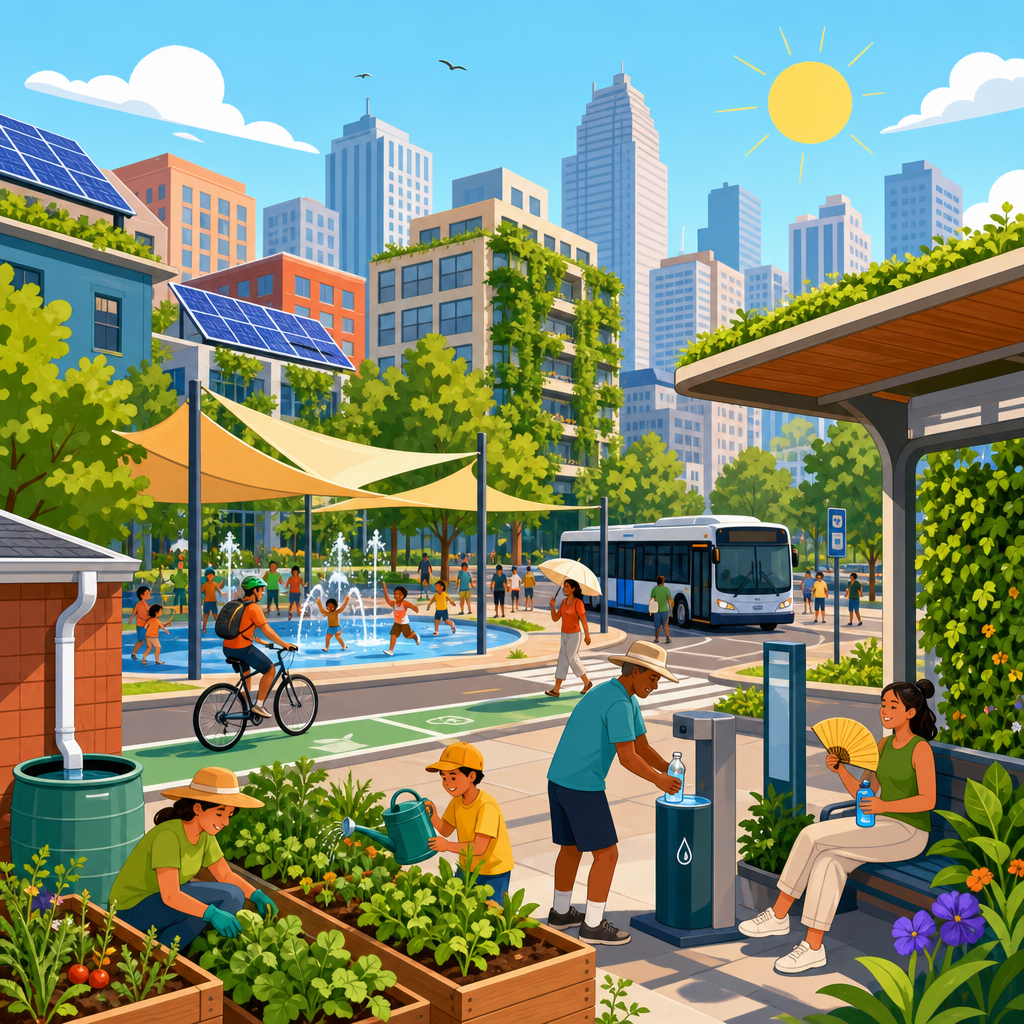
Public-space design is one of the fastest ways to reduce daily heat exposure, especially for residents who walk, wait for transit, work outdoors, or lack reliable home cooling. Shade is usually the first priority because it lowers radiant heat exposure immediately. Cities can add shade through canopy trees, pergolas, solar canopies, arcade requirements, or tensile structures in places where trees will struggle. Transit stops deserve special attention. A metal bench under direct sun on an asphalt corridor is not an amenity in a heatwave. Agencies that redesign shelters with full roof coverage, side panels that preserve airflow, water access nearby, and route information visible in glare conditions make transit safer and more usable. Schoolyards are another high-value target. Programs in Paris and several U.S. districts have converted asphalt-heavy yards into shaded, permeable, and publicly accessible cooling spaces, improving both daytime comfort and neighborhood resilience after hours.
Materials also matter. Cool roofs and reflective coatings can significantly lower surface temperatures, though the effect on ambient air varies by street geometry, climate, and scale. Cool pavements can help in some settings, but they must be evaluated carefully because high reflectance without shade may increase mean radiant temperature for pedestrians. That is why urban heat planning should use thermal comfort metrics such as UTCI or PET, not surface temperature alone. Water infrastructure can support cooling when used strategically: drinking fountains, misting features in dry climates, irrigation for high-value canopy, and stormwater systems that sustain planted areas. However, water-intensive cooling is not suitable everywhere, particularly in drought-prone regions. The practical standard is simple: design each corridor, plaza, and park for how people actually experience heat, during the hottest hours, using combinations of shade, ventilation, material selection, and access to water.
Housing and buildings are where heat risk becomes a health emergency
Most serious heat harm happens indoors, not in parks. That fact changes the entire planning agenda. Older multifamily buildings, top-floor units, manufactured housing, informal dwellings, and poorly insulated homes can become dangerously hot even at night, when the body needs relief. In many cities, tenants cannot install window units, cannot afford rising electricity bills, or hesitate to run air conditioning because of cost. Building-focused heat adaptation therefore needs to address both structure and affordability. Cool roofs, attic insulation, exterior shutters, window films, cross-ventilation, ceiling fans, airtightness improvements paired with controlled ventilation, and heat pump retrofits all reduce indoor overheating. Passive measures are especially important because they continue to work during power disruptions, unlike air conditioning alone.
Codes and standards play a major role. Several jurisdictions now use overheating analysis in building design, while organizations such as ASHRAE and CIBSE provide methods for thermal comfort and resilience. Rental housing policy is equally important. If a city treats winter heating as a legal necessity but leaves summer heat unregulated, vulnerable tenants remain exposed. I have advised clients to treat maximum safe indoor temperature as a housing quality issue, with targeted retrofit funding for affordable housing providers and mandatory response plans for senior facilities, schools, and healthcare buildings. Public buildings should model best practice by combining cool roofs, deep shade, efficient HVAC, backup power, and accessible cooling rooms. When housing and building measures are neglected, every other heat intervention is forced to compensate for unsafe indoor environments that should have been fixed at the source.
Public health, equity, and emergency response determine who is protected
Urban heat is a public health issue as much as a design problem. Heat illness risk increases with age, chronic disease, pregnancy, disability, certain medications, dehydration, social isolation, and outdoor work. Air pollution can worsen impacts, and hot nights are particularly dangerous because they prevent physiological recovery. Effective plans therefore use health data, not just temperature maps. Excess mortality analysis, ambulance call records, emergency department visits, and neighborhood-level chronic disease burdens help cities target interventions where they will save the most lives. Equity must be explicit. Historically redlined neighborhoods in the United States often have less canopy and more pavement, and similar patterns of underinvestment appear globally in informal settlements, industrial districts, and low-income rental areas. If a city distributes cooling resources evenly instead of proportionally to risk, it will reinforce existing disparities.
Emergency response is the short-term layer that supports long-term adaptation. Good heat action plans define triggers, roles, communication channels, and outreach protocols before summer begins. They include multilingual alerts, welfare checks, transportation to cooling centers, modified schedules for outdoor municipal work, and coordination with utilities, school systems, employers, and homelessness services. Cooling centers need realistic operating models: extended hours, disability access, pet accommodation where possible, and locations near the people most at risk. During recent heat events, some cities learned that a library with limited evening hours was less useful than a network of community centers and faith-based sites embedded in neighborhoods. Trusted messengers matter too. Residents are more likely to respond when information comes through local health workers, tenant associations, and community organizations rather than a generic city alert alone.
How cities can fund, govern, and measure urban heat adaptation
Heat plans fail most often in implementation, not diagnosis. The governance question is straightforward: who owns the problem between heat seasons? In successful cities, a chief resilience office, planning department, public health agency, or mayoral task force coordinates action across parks, housing, transportation, emergency management, and utilities. The plan should identify lead agencies for each measure, annual budget needs, procurement pathways, and maintenance responsibilities. Funding usually comes from a mix of capital budgets, housing programs, hazard mitigation grants, public health funds, utility incentives, and climate or infrastructure finance. For private buildings, rebates, low-interest loans, and performance standards can move the market faster than voluntary guidance alone.
Measurement is equally important. Cities should track outputs such as trees planted, cool roofs installed, shaded bus stops added, and cooling centers opened, but they must also track outcomes: lower indoor temperatures, reduced heat-related illness, fewer transit wait times in exposed locations, and more equitable access to cooling. Remote sensing, on-the-ground sensors, building energy data, and resident surveys all have value. I recommend publishing annual scorecards with neighborhood breakdowns, because transparency improves accountability and reveals whether investments are reaching the hottest and most vulnerable communities. The central benefit of going beyond planting a few trees is that cities stop treating heat as a symbolic greening issue and start managing it as a measurable urban system. If your community is updating its sustainability, housing, or capital plan, make heat adaptation a core requirement now, before the next extreme summer turns a known risk into avoidable loss.
Frequently Asked Questions
Why can’t cities rely on planting more trees alone to solve urban heat?
Trees are one of the most valuable heat adaptation tools cities have, but they are not a complete strategy by themselves. A healthy tree canopy can cool streets and buildings through shade and evapotranspiration, improve air quality, and make outdoor spaces more comfortable. The problem is that urban heat is caused by several interacting factors at once: dark roofs and pavement absorb and store heat, buildings trap warm air, waste heat comes from vehicles and air conditioners, and many neighborhoods lack housing quality, public cooling access, and health protections. Planting a few trees does not fix those broader conditions.
There is also a time and maintenance issue. Trees take years to mature, and their cooling benefits depend on species selection, soil volume, irrigation, and long-term care. In the hottest and most underserved neighborhoods, survival rates can be low if planting programs are not matched with funding for watering and maintenance. Some streets have underground utilities, narrow sidewalks, or heavily built conditions that limit where trees can realistically go. In other words, trees matter enormously, but they work best as part of a layered plan that also includes cool roofs, reflective and permeable surfaces, shade structures, heat-resilient housing, emergency response systems, and targeted public health measures.
What does a strong urban heat adaptation plan include beyond trees and landscaping?
A serious urban heat adaptation plan is coordinated across design, infrastructure, public health, housing, labor, and emergency management. On the physical design side, cities often combine expanded tree canopy with cool roofs, high-albedo pavements, bus stop shade, covered playgrounds, building retrofits, better ventilation in homes, and updated zoning or building standards that reduce heat gain. These measures help lower surface and indoor temperatures, which is critical because many of the most dangerous heat exposures happen inside poorly insulated homes and apartments rather than only outdoors.
Public health measures are just as important. Effective plans identify who is most at risk, including older adults, outdoor workers, people with chronic illness, renters in substandard housing, unhoused residents, and communities with limited access to air conditioning or transportation. Cities may establish cooling centers, mobile cooling options, wellness checks, multilingual heat alerts, utility shutoff protections, hydration stations, and partnerships with schools, libraries, clinics, and community groups. A strong plan also uses neighborhood-level temperature and vulnerability data so that investments go first where the need is greatest. The key idea is that urban heat adaptation is not a beautification effort. It is a risk-reduction system designed to prevent illness, deaths, service disruptions, and widening inequality during extreme heat.
How do cities identify which neighborhoods need heat adaptation investments first?
The best plans do not spread resources evenly without context; they target the areas facing the highest heat burden and the fewest resources to cope with it. Cities usually start by combining land surface temperature data, local air temperature measurements, canopy coverage, building conditions, energy burden, public health records, and demographic indicators such as age, disability, income, and housing status. This produces a clearer picture of where residents are exposed to dangerous heat both outdoors and indoors. A neighborhood with low tree cover, lots of asphalt, old housing stock, high asthma rates, and many elderly residents may need intervention much sooner than a cooler, wealthier area with better infrastructure.
Community input is essential because maps alone do not tell the full story. Residents can identify bus stops with no shade, apartment buildings that become unsafe at night, streets where children cannot play in summer, or areas where people avoid cooling centers because of distance, language barriers, or distrust. The strongest cities pair technical analysis with resident experience, then use that combined information to prioritize investments. This approach helps make adaptation more equitable, since urban heat is rarely distributed randomly. It often reflects decades of planning decisions, disinvestment, and unequal access to quality housing, green space, and public services.
How does housing policy fit into urban heat adaptation?
Housing is central to urban heat adaptation because extreme heat becomes most dangerous when people cannot cool down at home. Many city residents live in buildings that absorb heat during the day and release it slowly at night, which means indoor temperatures can stay dangerously high even after the sun goes down. Poor insulation, older roofs, inadequate ventilation, sealed windows, overcrowding, and lack of air conditioning all increase health risks. For renters, the problem can be even worse if they have little control over building upgrades or face high electricity costs that make cooling unaffordable.
That is why effective adaptation plans include housing standards and assistance programs, not just outdoor improvements. Cities can update building codes, require or incentivize cool roofs and better insulation, support weatherization and retrofits, create heat protections for tenants, expand emergency repair programs, and offer utility assistance during heat waves. Some jurisdictions also define maximum safe indoor temperatures or require landlords to address dangerous heat conditions, similar to how they address winter heating. This is one of the clearest examples of why urban heat adaptation must go beyond trees: without safer housing, many residents remain at high risk no matter how much shade exists on nearby streets.
What makes an urban heat adaptation plan effective over the long term?
Long-term effectiveness depends on governance, funding, measurement, and accountability. A city can launch a promising heat initiative, but if it is not embedded into budgets, capital planning, public health operations, and agency responsibilities, it often remains temporary or fragmented. Strong plans assign clear roles across departments such as planning, transportation, parks, housing, public health, and emergency management. They also establish measurable goals, such as increased canopy in priority areas, lower indoor temperatures in retrofitted homes, more shaded transit stops, fewer heat-related emergency calls, or better access to cooling resources within a short travel distance.
Ongoing evaluation matters because climate conditions, infrastructure needs, and community risks change over time. Cities need to track what is working, what is not, and whether benefits are reaching the residents who need them most. That means monitoring temperatures, health outcomes, maintenance performance, and community feedback, then adjusting programs accordingly. It also means planning for operations, not just construction. Trees need care, cooling centers need staffing, public alerts need trusted communication channels, and building retrofit programs need stable funding. The most effective urban heat adaptation plans treat extreme heat as a recurring civic challenge that deserves the same seriousness as flooding, storms, or other major hazards.