District energy systems for mixed-use neighborhoods are centralized heating and cooling networks that serve multiple buildings from shared energy plants, and they are becoming one of the most practical tools for lowering urban emissions while improving resilience. In simple terms, instead of every apartment tower, office block, hotel, school, and shop operating its own boiler or chiller, a district system produces thermal energy in one or more central facilities and moves it through insulated pipes to connected buildings. For mixed-use neighborhoods, where demand varies by hour and season, that shared approach creates major efficiencies that standalone equipment cannot match.
A mixed-use neighborhood combines residential, commercial, institutional, and often light civic functions within a compact area. That blend matters because energy loads are diverse. Apartments typically peak in the morning and evening, offices during business hours, hotels around the clock, and restaurants often in late afternoon and evening. I have worked on planning studies where those differences made the business case: when one building needed cooling and another needed heating, a shared loop could recover energy that would otherwise be rejected. This load diversity is the core advantage of district energy for urban districts.
The term district energy usually covers district heating, district cooling, or both. Some systems distribute steam, but most modern projects favor hot water and chilled water because they are efficient, controllable, and safer to operate at neighborhood scale. Fifth-generation systems go further by using ambient temperature loops and heat pumps in buildings, allowing simultaneous heating and cooling with lower distribution losses. Fuel sources also vary. A system might use electric heat pumps, combined heat and power, biomass, geothermal wells, sewer heat recovery, lake water cooling, data center waste heat, or a hybrid mix that changes over time.
Why does this matter in sustainable urban development? Buildings account for a large share of city energy use and carbon emissions, and dense neighborhoods are difficult to decarbonize one building at a time. District systems let cities shift from isolated fossil fuel equipment to coordinated infrastructure that can be upgraded as the grid gets cleaner. They also reduce rooftop clutter, free up rentable floor area, improve local air quality by consolidating combustion, and simplify long-term maintenance. For developers and municipalities, the appeal is strategic as much as environmental: district energy can support zoning goals, resilience planning, and phased growth across an entire neighborhood.
How district energy systems work in mixed-use neighborhoods
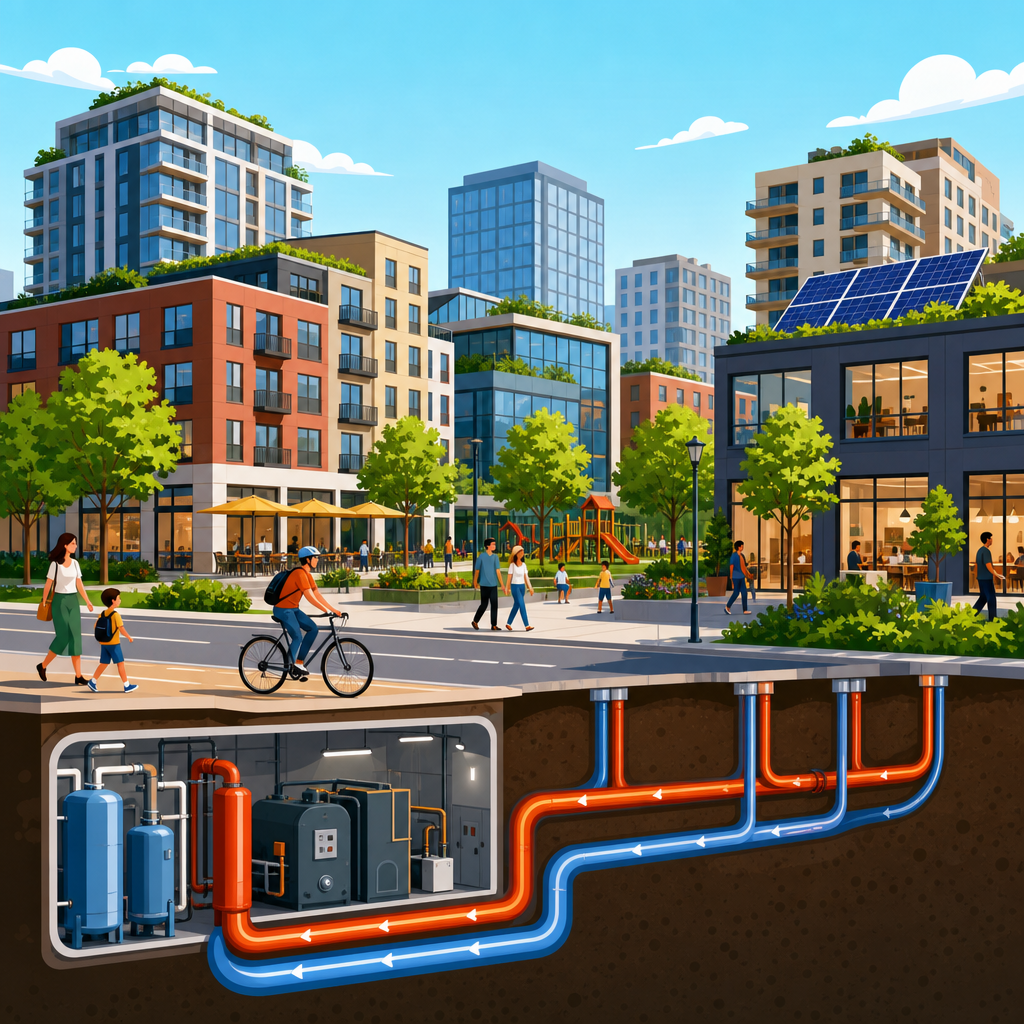
A district energy system has three basic parts: energy generation, thermal distribution, and building interface equipment. Generation occurs in a central plant or in multiple satellite plants. Thermal energy is then carried through supply and return pipes buried under streets or utility corridors. At each building, a heat exchanger or energy transfer station connects the network to the building’s internal mechanical systems without mixing fluids. That separation protects the network, allows better metering, and lets different building types connect without redesigning the district loop itself.
In mixed-use neighborhoods, the technical design begins with a load profile, not with a preferred technology. Engineers model annual heating and cooling demand, peak loads, hourly coincidence, domestic hot water use, and future build-out phases. They also study street rights-of-way, utility conflicts, soil conditions, and building mechanical room locations. In one downtown redevelopment project, the deciding factor was not plant efficiency but trench routing: two blocks of congested water and telecom infrastructure made one alignment too costly, so the network had to be re-phased around a different street spine.
The operating principle is straightforward. A heating plant might produce hot water at 65 to 95 degrees Celsius and circulate it to connected buildings for space heating and hot water production. A cooling plant might supply chilled water at about 4 to 7 degrees Celsius for air conditioning. More advanced ambient loops run much closer to ground temperature and rely on distributed heat pumps. Regardless of the approach, controls are critical. Variable-speed pumps, thermal storage tanks, weather compensation, and building-level metering allow operators to match production with demand and avoid wasting energy.
Because mixed-use districts have overlapping but different load patterns, central plants can be sized more efficiently than the sum of individual building systems. Diversity lowers coincident peak demand, so fewer total boilers and chillers are needed. Redundancy is also easier to provide. Rather than every building carrying expensive backup capacity, the network can be designed to N+1 standards at the plant level. That does not eliminate risk, but it concentrates expertise, simplifies operations, and gives owners a clearer pathway for maintenance, replacement, and performance monitoring over decades.
Key technologies, energy sources, and design choices
There is no single best district energy configuration for every mixed-use neighborhood. The right choice depends on density, climate, local energy prices, existing infrastructure, carbon policy, and how fast the area will be built. In cold climates, district heating often delivers the strongest economics because heating demand dominates. In warm, humid cities, district cooling can be more attractive, especially for campuses, waterfront districts, airports, and high-rise clusters. In many new urban neighborhoods, dual systems that combine heating and cooling deliver the highest long-term value.
Combined heat and power, also called cogeneration, has historically been a common anchor technology because it generates electricity and captures useful heat from the same fuel input. Well-designed CHP can reach total efficiencies above 70 percent, significantly better than conventional generation plus separate boilers. However, its climate value depends on fuel type and grid emissions. A natural gas CHP plant may reduce emissions compared with old boilers in some locations, but it is not a zero-carbon endpoint. Many cities now treat CHP as a transitional option rather than a permanent decarbonization strategy.
Electric heat pumps are increasingly central to modern district energy. Water-source and ground-source heat pumps can move heat rather than create it through combustion, often achieving coefficients of performance between 3 and 5 under favorable conditions. That means one unit of electricity can deliver several units of thermal energy. When paired with ambient loops, sewage heat recovery, geothermal borefields, or surface water, heat pumps allow neighborhoods to harvest low-grade heat that conventional systems would ignore. This is especially valuable in mixed-use areas where cooling-heavy buildings can become heat sources for residential hot water and heating loads.
Thermal storage adds flexibility and often improves project economics. Chilled water tanks or ice storage can shift cooling production to off-peak hours, reducing electrical demand charges. Hot water storage can smooth boiler and heat pump operation, lower cycling losses, and provide limited backup during outages or equipment maintenance. Waste heat recovery is another powerful lever. Cities including Vancouver, Paris, and Stockholm have used sewer heat, metro tunnels, data centers, and industrial processes as neighborhood-scale energy sources. The technical challenge is less about whether recovery is possible and more about temperature, distance, and dependable year-round availability.
| Option | Best Fit | Main Advantage | Main Limitation |
|---|---|---|---|
| Hot water district heating | Cold or mixed climates | Efficient, mature, scalable | Requires dense heat demand |
| District cooling | High-rise, cooling-dominant districts | Reduces building equipment and peak load | Pipe network can be capital intensive |
| Ambient loop with heat pumps | Mixed-use areas with simultaneous loads | Enables heat recovery and electrification | Needs strong controls and building integration |
| CHP-based system | Sites needing power resilience and heat | High total fuel efficiency | Carbon benefit depends on fuel and grid mix |
Benefits, limitations, and economics for developers and cities
The strongest case for district energy in mixed-use neighborhoods is that it aligns infrastructure efficiency with urban form. Dense, walkable districts concentrate demand, shorten pipe runs per unit of load, and improve plant utilization. That directly affects economics. A district network has high upfront capital cost but can offer lower lifecycle cost when enough buildings connect early and remain connected. Developers benefit by avoiding large in-building boiler and chiller plants, reducing roof congestion, and reclaiming usable floor area. Cities benefit from lower emissions, fewer combustion points, and infrastructure that can be decarbonized over time.
Reliability is another material benefit. Centralized systems can be designed with multiple boilers, chillers, pumps, and power feeds, which often makes them more robust than isolated building equipment managed by separate owners. During extreme weather, a professional operator can optimize the entire network instead of relying on dozens of fragmented maintenance teams. In practice, though, reliability depends on governance and operations, not just engineering. A neglected district system can underperform just as badly as neglected building equipment. Long-term service agreements, transparent performance reporting, and preventive maintenance are therefore essential.
The limitations are real and should be stated plainly. District energy only works where density and load diversity justify network investment. Low-density subdivisions rarely pencil out. Existing neighborhoods can be difficult because streets are crowded with utilities, and connecting older buildings may require expensive internal retrofits. Customer acquisition is also a commercial risk. If anchor loads such as hospitals, universities, supermarkets, or major residential towers do not sign up, project financing becomes harder. I have seen technically sound schemes stall because phasing assumptions were optimistic and too much load was expected too early.
Economically, district energy projects are judged on capital expenditure, operating cost, tariff design, customer connection rates, and avoided building-level costs. Analysts usually compare the levelized cost of thermal energy against decentralized alternatives over twenty to thirty years. Financing models vary: municipal utility ownership, private concession, special-purpose energy service company, or public-private partnership. Tariffs may include a fixed capacity charge and a variable energy charge, often indexed to fuel or electricity costs. Clear pricing matters. Building owners accept long-term thermal service contracts when rates are predictable, metering is accurate, and performance obligations are enforceable.
Planning, governance, and implementation best practices
Successful district energy starts with integrated planning before streets, parcels, and buildings are locked in. The most effective projects reserve utility corridors, coordinate plant sites with land-use plans, and require building connection readiness through development agreements or design standards. A neighborhood energy master plan should map current and future loads, identify anchor customers, evaluate energy center locations, and compare supply options under multiple carbon and price scenarios. Without that front-end discipline, projects often suffer from oversized plants, stranded pipe capacity, or building designs that are awkward to connect after construction.
Governance determines whether a district system remains affordable and adaptable over decades. Some cities operate district energy through municipal utilities, which can align infrastructure decisions with climate policy and public accountability. Others use concession agreements that assign design, build, finance, operation, and maintenance responsibilities to private specialists. Neither approach is automatically superior. Public ownership can lower financing costs but may move slowly. Private operators can execute quickly and bring technical expertise but require strong contract oversight. The critical point is to define service standards, expansion rights, tariff review methods, carbon performance targets, and customer protections from the start.
Implementation usually happens in phases. Phase one should secure the highest-confidence loads and size initial infrastructure for realistic expansion, not aspirational build-out. Hospitals, campuses, civic buildings, affordable housing, hotels, and large multifamily projects often make strong anchors because their loads are relatively stable and they hold property for the long term. Building interface standards should be standardized early so future connections are straightforward. Commissioning also deserves more attention than it usually gets. Poor balancing, inadequate controls integration, and metering errors can erase modeled savings long before anyone notices.
Policy tools can materially improve feasibility. Cities use franchise zones, clean heat standards, carbon caps, expedited permitting, density bonuses, low-interest infrastructure finance, and mandatory connection requirements in selected districts. Case studies from Copenhagen, Toronto, and Amsterdam show that district energy expands fastest where land-use policy and utility policy support each other. For project teams, the practical next step is simple: start with a neighborhood-scale thermal feasibility study, test multiple energy sources, and evaluate governance alongside engineering. District energy is not a universal solution, but in the right mixed-use neighborhood it is one of the clearest pathways to lower-carbon, more resilient urban growth.
District energy systems give mixed-use neighborhoods a way to treat heating and cooling as shared urban infrastructure rather than isolated building equipment. That shift matters because compact districts have diverse loads, rising decarbonization pressures, and limited space for redundant mechanical plants. A well-designed network can capture load diversity, recover waste heat, improve resilience, and create a platform that evolves from transitional fuels to low-carbon and fully electric energy sources over time. For cities pursuing sustainable urban development, it is one of the few strategies that links building performance, infrastructure planning, and neighborhood growth in a single framework.
The main lesson is that district energy succeeds when planning, technology, economics, and governance are aligned. Density alone is not enough. Projects need credible anchor loads, realistic phasing, careful routing, transparent tariffs, and long-term operational discipline. They also need technology choices that match local conditions. In some places, hot water district heating is the logical foundation. In others, district cooling, ambient loops, heat pumps, or waste heat recovery will provide the strongest result. The best systems are not defined by one device but by how effectively they connect energy sources, buildings, and policy goals.
For developers, property owners, and municipalities, the benefit is practical: lower lifecycle emissions, better use of urban land, and infrastructure that can improve instead of becoming obsolete. For residents and businesses, the benefit is quieter roofs, cleaner local air, and more reliable comfort. If you are shaping a new mixed-use neighborhood or retrofitting a growing district, begin with a thermal master plan and ask whether shared energy infrastructure can outperform building-by-building solutions. That first study often reveals opportunities that conventional project boundaries hide.
Frequently Asked Questions
1. What is a district energy system, and how does it work in a mixed-use neighborhood?
A district energy system is a centralized network that produces heating, cooling, or both in one or more shared energy plants and distributes that thermal energy to multiple buildings through a network of insulated underground pipes. In a mixed-use neighborhood, this means apartments, offices, hotels, retail spaces, schools, and other properties can all receive reliable thermal service from the same coordinated system rather than each building relying on its own separate boilers, furnaces, or chillers.
The basic concept is straightforward. A central plant creates hot water, steam, or chilled water, depending on the needs of the neighborhood. That energy is then circulated through supply pipes to connected buildings. Inside each building, heat exchangers transfer the heating or cooling to the building’s own internal systems without mixing the district loop water with the building’s private plumbing. After the energy is transferred, the water returns to the plant through return pipes to be reheated or recooled and sent back out again.
What makes district energy especially effective in mixed-use districts is load diversity. Different buildings use energy differently over the course of a day and across seasons. Offices often peak during daytime hours, residential buildings tend to have stronger morning and evening demand, hotels operate more continuously, and retail usage may rise at specific times. Because these patterns do not all peak at the same moment, the central system can often be sized and operated more efficiently than a collection of independent building systems. In practice, that can reduce wasted capacity, improve equipment performance, and support lower emissions when cleaner energy sources are integrated.
Modern district energy systems can be powered by a range of technologies, including high-efficiency boilers, electric chillers, heat pumps, combined heat and power units, geothermal systems, wastewater heat recovery, industrial waste heat, and renewable electricity. That flexibility is one of the main reasons they are increasingly viewed as a practical urban decarbonization strategy. Instead of retrofitting every building one by one with different mechanical solutions, cities and developers can create shared infrastructure that scales across an entire neighborhood.
2. Why are district energy systems considered a strong option for reducing emissions in urban areas?
District energy systems are widely recognized as a strong emissions-reduction strategy because they allow heating and cooling to be delivered more efficiently and with cleaner energy sources than many individual building systems can achieve on their own. In urban areas, space constraints, aging building stock, and fragmented ownership often make building-by-building upgrades difficult, expensive, and slow. A district approach addresses this challenge by centralizing thermal production and enabling decarbonization at the neighborhood scale.
One of the biggest advantages is efficiency. Large central plants generally operate more efficiently than many smaller, isolated systems scattered across a district. Equipment can be selected for optimal performance, staged more precisely, and maintained more consistently. In addition, district systems can take advantage of load diversity, meaning they can serve a broad range of buildings with different operating patterns without having to oversize equipment for every building’s individual peak load.
Another major benefit is fuel flexibility. A district network can transition over time from fossil-fuel-based equipment to lower-carbon or zero-carbon thermal sources without requiring every connected building to undergo major mechanical replacement. For example, a system might begin with efficient natural gas equipment and later add electric heat pumps, geothermal exchange, sewer heat recovery, river or lake water cooling, biomass in some regions, or recovered waste heat from data centers and industrial facilities. That adaptability is valuable because urban decarbonization is usually a multi-decade process, and energy infrastructure needs to evolve with grid conditions, technology costs, and climate policy.
District systems can also reduce refrigerant-related emissions and improve total system performance by replacing numerous standalone chillers and rooftop units with more centralized and optimized cooling infrastructure. In some cases, they support thermal storage as well, allowing chilled water or hot water to be produced when electricity is cleaner or cheaper and then used later when demand rises. This helps manage grid stress and can align neighborhood energy use with broader clean energy goals.
Most importantly, district energy creates a platform for long-term carbon reduction. Once the pipe network is in place, the neighborhood has the backbone needed to incorporate cleaner thermal sources over time. That makes it not only an emissions strategy for today, but also an infrastructure investment that supports future resilience and climate performance.
3. What are the main benefits of district energy for residents, businesses, and property owners in mixed-use developments?
The benefits of district energy extend well beyond lower emissions. For residents, businesses, and property owners, one of the most immediate advantages is reliability. Central plants are typically designed with redundancy, professional operations, and robust maintenance programs, which can improve service continuity compared with building-level systems that may be older, undersized, or inconsistently maintained. In mixed-use neighborhoods where comfort is critical for homes, workplaces, hospitality, and retail operations, that reliability has real day-to-day value.
District energy can also free up usable space inside buildings. Without the need for large boiler rooms, cooling towers, chillers, or extensive rooftop mechanical equipment, developers and owners may gain more leasable area, more architectural flexibility, and fewer maintenance burdens within individual properties. In dense urban projects, where every square foot matters, that can be a meaningful financial and design advantage.
From an operational perspective, district systems can simplify lifecycle planning. Rather than each property facing its own major capital replacement cycle for heating and cooling equipment, thermal service can be delivered as part of a long-term utility model. This can reduce exposure to sudden equipment failure costs and help owners plan budgets more predictably. For tenants and occupants, that can translate into more stable comfort, better indoor environmental performance, and fewer disruptions tied to mechanical retrofits.
Businesses often benefit from improved energy resilience and potentially lower operational risk. Hotels, medical offices, grocery stores, and commercial tenants with continuous heating or cooling needs may value the professionalized operation of a district system, especially where backup capacity and diversified energy sources are part of the design. In some neighborhoods, district cooling can also reduce rooftop noise and vibration by minimizing building-specific cooling equipment.
For developers, district energy can be a strategic tool for meeting sustainability targets, complying with local building performance standards, and differentiating a project in the market. For municipalities, it can support broader goals such as lowering emissions, improving local air quality, reducing energy infrastructure duplication, and creating a more coordinated approach to neighborhood growth. In short, the appeal of district energy is not just that it heats and cools buildings differently, but that it can improve the way an entire district is planned, operated, and upgraded over time.
4. What challenges should be considered before planning a district energy system for a mixed-use neighborhood?
While district energy offers major advantages, it is not automatically the right fit for every project, and successful implementation depends on careful planning. One of the most important considerations is upfront infrastructure cost. Building a central plant and installing a network of insulated underground distribution pipes requires significant capital investment, especially in built-up urban areas where existing utilities, traffic management, and excavation conditions can complicate construction.
Another key issue is density and load profile. District energy works best where there is enough concentrated thermal demand to justify the network. A compact neighborhood with multiple building types and year-round heating and cooling needs is often a strong candidate. By contrast, low-density areas or districts with highly intermittent demand may struggle to support the economics of a shared thermal system. This is why early feasibility analysis usually focuses on building mix, annual energy use, peak demand, phasing plans, and opportunities for future expansion.
Ownership and governance also matter. District systems often involve multiple stakeholders, including developers, utilities, local governments, institutions, and private building owners. Questions about who finances the infrastructure, who owns the plant and pipes, how rates are set, how future customers connect, and how performance standards are enforced all need clear answers. Without a strong commercial and regulatory framework, even technically sound projects can stall.
Construction timing can be another challenge, particularly in neighborhoods that will be built in phases. A district system must often be designed to perform efficiently before full buildout occurs, which may require modular equipment strategies or interim operating plans. Coordination with street reconstruction, utility work, transit planning, and building delivery schedules is also critical to avoid unnecessary cost and disruption.
Finally, project teams need to think seriously about long-term decarbonization strategy. A district system should not simply centralize fossil fuel use without a roadmap for cleaner thermal supply. The strongest projects are designed from the beginning with future energy transitions in mind, such as lower-temperature networks, compatibility with heat pumps, thermal storage integration, or access to waste heat and renewable sources. When these issues are addressed early, district energy becomes much more than a mechanical utility decision; it becomes a durable piece of neighborhood infrastructure.
5. How do district energy systems improve resilience and support the future of sustainable neighborhood design?
District energy systems can significantly improve neighborhood resilience because they create a coordinated thermal infrastructure platform rather than leaving each building to manage heating and cooling independently. In practical terms, resilience means the system is better able to withstand equipment failures, fuel disruptions, extreme weather, and changing energy conditions over time. Central plants can be designed with redundant equipment, backup power strategies, multiple energy inputs, and sophisticated controls that help maintain service even when individual components are