Climate adaptation and climate mitigation in city planning are related but distinct strategies, and understanding the difference is essential for any municipality trying to protect residents, infrastructure, and budgets. Mitigation focuses on reducing the greenhouse gas emissions that drive climate change, while adaptation focuses on preparing cities for the impacts that are already happening or are now unavoidable. In practice, city leaders need both. A coastal city installing sea walls is adapting. That same city electrifying buses, tightening building energy codes, and expanding transit is mitigating. Confusing the two leads to poor plans, misallocated funding, and projects that solve one problem while worsening another.
In municipal work, I have seen this confusion surface in capital planning meetings, zoning updates, and resilience workshops. Staff may call a heat emergency response plan a mitigation measure, even though it does not cut emissions. Others may label a new light rail line as adaptation, even though its primary purpose is to lower car dependence and emissions. The distinction matters because the timelines, performance metrics, financing tools, and equity implications are different. Adaptation asks how a city withstands heat waves, flooding, drought, wildfire smoke, and infrastructure stress. Mitigation asks how a city lowers carbon dioxide, methane, and other emissions from buildings, transport, waste, and industry.
City planning sits at the center of both challenges because urban areas account for most global energy use and produce a large share of emissions, while also concentrating people, assets, and risk. The Intergovernmental Panel on Climate Change has shown that cities are key to keeping warming in check, but cities are also where extreme heat kills, drainage systems fail, and vulnerable residents are exposed first. Planning departments influence street design, land use, housing form, public facilities, and long-term infrastructure investment. Those choices shape whether neighborhoods become more efficient, more resilient, or, ideally, both.
For a sustainable urban development strategy, the goal is not to pick adaptation or mitigation. It is to understand when each applies, where they overlap, and how to sequence actions so one strengthens the other. This hub article explains the core difference, shows how the two approaches work in real city planning decisions, and outlines the tradeoffs that planners, developers, and public officials need to manage.
What climate mitigation means in city planning
Climate mitigation in city planning means reducing the emissions that cause climate change. At the city scale, the biggest sources are usually buildings, transportation, electricity use, solid waste, and, in some regions, industrial activity. Planning tools that support mitigation include compact land use, transit-oriented development, mixed-use zoning, bicycle infrastructure, electrification policies, urban tree protection tied to cooling demand, and building performance standards. The objective is measurable emissions reduction over time, typically aligned with a baseline inventory and a target year such as 2030, 2040, or net zero by 2050.
A simple way to identify mitigation is to ask whether the action lowers greenhouse gas output. Upzoning around a rail station can be mitigation if it shifts travel from private vehicles to transit and supports lower per-capita energy use. Replacing diesel buses with electric fleets is mitigation because it cuts tailpipe emissions and often improves local air quality. Retrofitting municipal buildings with heat pumps, insulation, and smart controls is mitigation because it reduces fossil fuel combustion. Many cities use community-wide greenhouse gas inventories based on the Global Protocol for Community-Scale Greenhouse Gas Emissions Inventories to track these effects consistently.
Mitigation is often long horizon work, but it should not be abstract. Copenhagen’s cycling investments, Vancouver’s building emissions policies, and New York City’s Local Law 97 all show how municipal planning decisions can create direct carbon reductions. The key point is that mitigation addresses causes. It aims upstream at the systems producing emissions, not downstream at the damages those emissions create.
What climate adaptation means in city planning
Climate adaptation in city planning means adjusting the built environment, public services, and governance systems so communities can function under changing climate conditions. It responds to hazards such as extreme heat, sea level rise, heavier rainfall, drought, wildfire, smoke, and power disruptions. If mitigation is about causes, adaptation is about consequences. The question is not whether a project lowers emissions, but whether it reduces vulnerability and increases resilience. Common city planning examples include revised floodplain regulations, cooling centers, permeable streets, backup power for critical facilities, drought-tolerant landscaping, elevated infrastructure, and updated stormwater design standards.
Adaptation starts with risk assessment. Planners map where hazards intersect with exposure and vulnerability. A low-income neighborhood with little tree canopy, older housing, and high rates of respiratory illness faces far greater heat risk than a wealthier area with parks and air conditioning. A district with combined sewers and a history of basement flooding may need green infrastructure and pipe upgrades even if annual rainfall totals do not change, because short, intense storms are becoming more common. Tools such as FEMA flood maps, NOAA sea level rise projections, and local heat vulnerability indices help cities prioritize interventions.
Rotterdam’s water plazas are a useful example. These public spaces function as recreation areas in dry weather and temporarily store stormwater during heavy rain. They do not reduce global emissions. They reduce local flood damage. Likewise, Ahmedabad’s Heat Action Plan in India, one of the most cited urban heat adaptation models, coordinates early warnings, public messaging, health system readiness, and emergency response to reduce heat mortality. Adaptation addresses impacts that residents experience directly and immediately.
Key differences: goals, metrics, timelines, and funding
The clearest difference between climate adaptation and climate mitigation in city planning is purpose. Mitigation seeks to prevent future warming by cutting emissions. Adaptation seeks to reduce harm from climate impacts. Because the purposes differ, cities evaluate success differently. Mitigation is measured through greenhouse gas inventories, vehicle miles traveled, building energy intensity, renewable energy share, and emissions per capita. Adaptation is measured through reduced flood losses, fewer heat-related illnesses, lower outage risk, faster recovery time, insurance outcomes, and continuity of essential services.
Timelines also differ. Mitigation usually delivers global climate benefits over a longer period, though local co-benefits such as cleaner air can appear quickly. Adaptation often produces immediate local benefits, especially where hazards are already intensifying. Funding logic follows the same pattern. Mitigation projects may be supported by energy savings, carbon targets, utility incentives, clean transportation grants, and green bonds. Adaptation projects often rely on hazard mitigation grants, stormwater fees, resilience funds, disaster recovery programs, and insurance-driven capital upgrades.
| Dimension | Climate Mitigation | Climate Adaptation |
|---|---|---|
| Main objective | Reduce greenhouse gas emissions | Reduce vulnerability to climate impacts |
| Typical city sectors | Buildings, transport, energy, waste | Stormwater, public health, emergency management, infrastructure |
| Core metrics | CO2e reduction, energy use, mode shift | Risk reduction, avoided damage, service continuity |
| Planning horizon | Medium to long term | Immediate to long term |
| Example project | Electrified bus network | Flood-resilient waterfront design |
There are overlaps, but cities should not blur accountability. If a plan promises resilience, it needs hazard-specific outcomes. If it promises decarbonization, it needs credible emissions reductions. Strong city planning documents separate these categories clearly, then show where integrated actions can deliver both.
Where adaptation and mitigation overlap in urban design
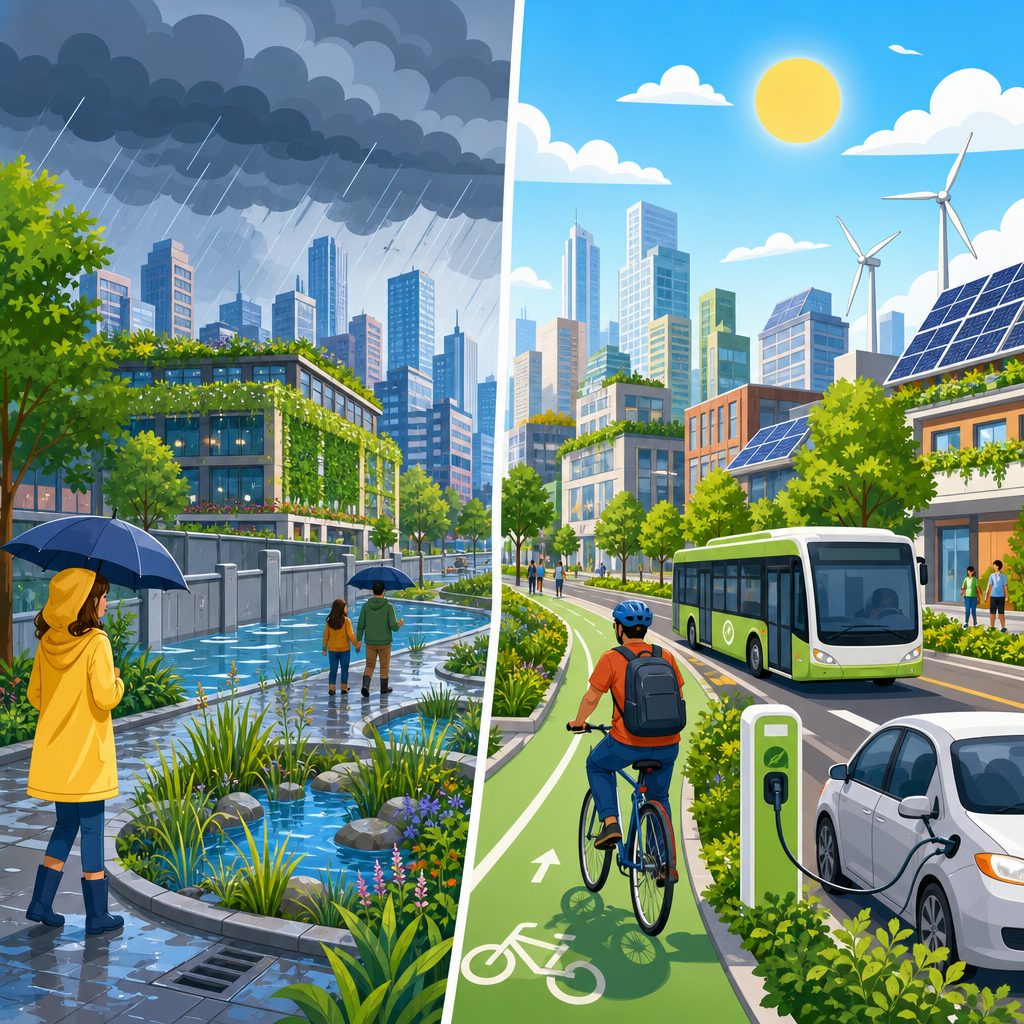
Some planning measures support both adaptation and mitigation, and these are often the highest-value investments. Urban trees are a good example. They sequester some carbon, though usually modestly compared with citywide emissions, but their larger urban benefit is reducing surface and air temperatures, shading pedestrians, and lowering building cooling demand. Green roofs can manage stormwater, reduce heat gain, and extend roof life. Transit-oriented development lowers car dependence while making it easier to provide cooling centers, clinics, and emergency services efficiently. Wetland restoration can buffer floods and also store carbon in soils.
Still, planners need precision because not every dual-benefit claim holds up. Tree planting in arid regions can increase water demand if species selection is poor. Dense development can support mitigation, but if it is built in flood-prone zones without resilient design, it may increase exposure. Air conditioning protects residents during heat waves, yet if powered by fossil-fueled grids and inefficient equipment, it can raise emissions and strain peak electricity demand. The better approach is paired planning: efficient buildings, passive cooling design, reflective surfaces, shade, ventilation, district energy where appropriate, and grid upgrades that support clean electrification.
Paris, Medellín, and Melbourne illustrate this integrated approach differently. Paris has expanded cycling, reduced road space for cars, and added greening to cool streets. Medellín’s green corridors reduced urban heat while improving public space and biodiversity. Melbourne’s urban forest strategy addresses canopy loss and heat vulnerability while supporting broader sustainability goals. The lesson is that overlap exists, but it must be designed intentionally, not assumed.
How city planners turn strategy into policy and projects
The difference between adaptation and mitigation becomes practical when cities write comprehensive plans, zoning codes, capital improvement programs, and infrastructure standards. A strong planning process usually begins with two diagnostics: an emissions inventory and a climate risk assessment. The first identifies where emissions come from. The second identifies what hazards threaten people and assets. From there, cities can assign actions to the right departments. Planning, transportation, housing, public works, parks, utilities, and public health all have distinct roles.
For mitigation, planners can revise parking minimums, allow mixed-use infill, require electric vehicle charging readiness, support transit priority lanes, and coordinate building decarbonization standards with housing goals. For adaptation, they can restrict development in high-risk flood areas, require higher freeboard elevations, update street tree standards for heat, expand green stormwater infrastructure, and protect critical facilities with microgrids or backup power. Capital projects should then be screened for both emissions impact and climate risk. I have found this dual-screening approach especially useful because it prevents cities from approving assets that lock in carbon or fail under future climate conditions.
Implementation also depends on governance. Cities that move fastest usually have a climate action plan linked to the budget, a resilience strategy linked to infrastructure management, and clear performance dashboards. Without that linkage, climate goals remain advisory. The most effective municipal teams translate broad targets into procurement rules, design manuals, permit review criteria, and neighborhood-level project lists that residents can actually see.
Common mistakes cities make when addressing both
The most common mistake is treating adaptation and mitigation as interchangeable labels. This weakens grant applications, confuses stakeholders, and produces vague plans. Another error is prioritizing visible projects over risk-based ones. Cities may invest in signature waterfront amenities while underfunding culvert upgrades, cooling outreach, or emergency communications that save more lives. A third mistake is ignoring distributional impacts. Climate planning that overlooks renters, informal workers, older adults, or neighborhoods with historic disinvestment will miss the people facing the highest risk and the greatest energy burden.
There are also technical mistakes. Emissions baselines may be inconsistent, making mitigation progress look larger than it is. Adaptation plans may rely on historical weather data even when design standards need future climate projections. Some cities overestimate the carbon value of tree planting and underestimate the maintenance required for survival. Others harden shorelines for flood defense without considering habitat loss, induced development, or long-term retreat options. Good planning acknowledges uncertainty, uses scenarios, and updates assumptions regularly.
Finally, cities sometimes separate departments so rigidly that opportunities for integrated action disappear. Public health teams may lead heat planning without planning department support on land use and shade. Transportation agencies may pursue mode shift without assessing flood exposure on key corridors. The solution is coordinated governance, not merged terminology.
City planning works best when climate adaptation and climate mitigation are treated as complementary disciplines with different jobs. Mitigation reduces the drivers of future climate change by cutting emissions from transport, buildings, energy, and waste. Adaptation reduces present and future harm by preparing neighborhoods, infrastructure, and public systems for heat, flooding, drought, wildfire smoke, and other climate stresses. Both are necessary because even aggressive emissions reductions cannot eliminate near-term risks, and adaptation alone cannot stop worsening long-term impacts.
For sustainable urban development, the practical takeaway is straightforward. Start with clear definitions. Measure emissions and climate risk separately. Build plans, zoning updates, and capital investments that assign the right tools to each challenge. Look for projects that deliver both benefits, but verify the tradeoffs instead of assuming them. The strongest cities do not ask whether they should adapt or mitigate. They decide how to do both, in the right order, with the right metrics, and with the most vulnerable residents at the center.
If you are building or updating a city strategy, use this article as the hub for the topic and map every future policy, project, and neighborhood investment back to one simple question: does it reduce emissions, reduce risk, or do both well?
Frequently Asked Questions
What is the difference between climate adaptation and climate mitigation in city planning?
Climate mitigation and climate adaptation are closely connected, but they solve different parts of the climate challenge. Mitigation is about addressing the cause of climate change by reducing greenhouse gas emissions. In city planning, that can include expanding public transit, improving building energy efficiency, electrifying municipal vehicle fleets, supporting renewable energy, updating zoning to encourage compact development, and reducing dependence on fossil fuels. The goal is to limit how severe future climate change becomes.
Adaptation, by contrast, is about managing the effects of climate change that are already happening or are now difficult to avoid. In city planning, adaptation can include upgrading stormwater systems for heavier rainfall, raising roads in flood-prone areas, planting urban trees to reduce extreme heat, strengthening building standards, protecting drinking water supplies, and preparing neighborhoods for wildfire, coastal flooding, drought, or other local hazards. The goal is to reduce harm to people, infrastructure, public health, and local budgets.
A simple way to think about it is this: mitigation reduces future climate risk, while adaptation reduces current and near-term climate vulnerability. A city that installs sea walls, cool roofs, and emergency heat plans is adapting. A city that shifts to clean energy and designs neighborhoods that reduce car use is mitigating. Most municipalities need both strategies at the same time because even aggressive emissions cuts will not eliminate the impacts cities are already experiencing.
Why do cities need both climate adaptation and climate mitigation instead of choosing one approach?
Cities need both because mitigation and adaptation work on different timelines and address different risks. Even if a city aggressively cuts emissions today, it will still face climate impacts linked to past and current global emissions. Heat waves, stronger storms, sea-level rise, and changing precipitation patterns are already affecting many communities. That means adaptation is essential to protect residents, infrastructure, and public services right now.
At the same time, adaptation alone is not enough. If cities only focus on protecting themselves from climate impacts without reducing emissions, those impacts will continue to worsen over time. The costs of flood control, heat response, infrastructure repair, insurance, public health emergencies, and disaster recovery can rise dramatically if the underlying drivers of climate change are left unaddressed. Mitigation helps limit future damage, lowers long-term risk, and supports broader sustainability and air quality goals.
From a planning perspective, relying on only one strategy can also create inefficiencies. A city might spend heavily to adapt assets to future conditions that become much more severe if mitigation fails. Or it might reduce emissions while neglecting vulnerable neighborhoods that need immediate protection from flooding or heat. The strongest local climate plans integrate both approaches, using mitigation to reduce long-term climate pressures and adaptation to improve resilience in the present. This balanced approach is usually the most practical way to protect people, stabilize budgets, and make infrastructure investments last.
What are some examples of climate mitigation and climate adaptation in city planning?
Examples of climate mitigation in city planning typically focus on reducing emissions from buildings, transportation, land use, and energy systems. A city may adopt stricter energy codes for new construction, retrofit older public buildings for efficiency, install solar on municipal facilities, transition buses to electric power, improve bike and pedestrian networks, modernize traffic systems to reduce idling, or revise zoning rules to support mixed-use neighborhoods where residents can live closer to jobs and services. Preserving urban forests and encouraging low-carbon materials in construction can also support mitigation goals.
Examples of climate adaptation focus on helping the city function safely under changing conditions. In flood-prone areas, that might mean expanding drainage capacity, restoring wetlands, elevating critical infrastructure, limiting development in high-risk zones, or constructing protective barriers. In hotter regions, adaptation can include increasing tree canopy, creating cooling centers, using reflective paving and roofing materials, and adjusting emergency response plans for extreme heat. In wildfire-prone communities, adaptation may involve vegetation management, defensible space requirements, and more fire-resistant building standards. Water conservation planning, backup power systems for critical facilities, and climate-informed public health preparedness are also common adaptation measures.
Some projects can deliver both benefits. For example, urban tree planting can help absorb carbon, which supports mitigation, while also lowering neighborhood temperatures and reducing heat stress, which supports adaptation. Transit-oriented development can reduce emissions while making communities less vulnerable to fuel price shocks and transportation disruptions. These “dual-benefit” projects are especially valuable in city planning because they help local governments make the most of limited funding and create broader resilience across multiple systems.
How can city planners decide whether a project is adaptation, mitigation, or both?
City planners can start by asking a straightforward question: is the project primarily intended to reduce greenhouse gas emissions, to reduce harm from climate impacts, or to do both? If the main purpose is cutting emissions, it is generally a mitigation project. If the main purpose is protecting people, assets, or services from flooding, heat, drought, storms, or other climate effects, it is generally an adaptation project. If it clearly advances both goals, it can be treated as a dual-benefit initiative.
For example, replacing diesel buses with electric buses is primarily mitigation because it reduces emissions, although it may also improve local air quality and public health. Expanding flood storage basins is primarily adaptation because it helps the city handle heavier rainfall. A green roof program may qualify as both if it reduces building energy demand and lowers urban heat while also absorbing stormwater. The key is to evaluate the project’s core function, measurable outcomes, and local context rather than relying only on broad labels.
In practice, planners often use climate action plans, hazard mitigation plans, capital improvement programs, and resilience frameworks together to classify projects and set priorities. Good evaluation includes emissions impact, exposure reduction, equity implications, lifecycle cost, maintenance needs, and co-benefits such as public health improvement or neighborhood revitalization. This kind of structured review helps cities avoid confusion, communicate clearly with residents and funders, and build portfolios of projects that strengthen both sustainability and resilience over time.
Why is understanding the difference between adaptation and mitigation important for municipal budgets and long-term planning?
Understanding the distinction matters because each strategy affects budgeting, infrastructure design, policy timing, and funding opportunities in different ways. Mitigation investments often focus on long-term emissions reductions and operational savings. For example, efficient buildings, electrified fleets, and renewable energy systems may require upfront capital but can reduce fuel and energy costs over time. Adaptation investments, meanwhile, are often tied to risk reduction, asset protection, emergency readiness, and avoiding future repair and recovery costs. A larger stormwater system or heat response program may not directly reduce emissions, but it can prevent expensive failures and protect lives.
The distinction also helps municipalities plan more realistically. Infrastructure built today may last for decades, so cities need to account for future climate conditions as well as emissions goals. If planners treat adaptation and mitigation as interchangeable, they may underinvest in resilience or miss opportunities to reduce long-term operating costs and environmental impacts. Clear definitions help local governments sequence projects correctly, apply for the right grants, coordinate across departments, and set performance metrics that match each investment’s purpose.
Perhaps most importantly, understanding the difference improves public decision-making. Residents, elected officials, and agency leaders can have more productive conversations when they know whether a proposal is meant to prevent future warming, protect the community from current risks, or achieve both. That clarity supports smarter tradeoffs, stronger accountability, and more durable climate strategies. For municipalities facing tight budgets and growing climate pressures, being precise about adaptation versus mitigation is not just a technical exercise; it is a practical foundation for better planning.