Urban forestry plans often fail when success is reduced to one easy number: how many trees were planted. Tree counts are useful, but they are not a complete measure of urban forest performance, public value, or long-term resilience. An urban forestry plan is a policy and management framework that guides how a city plants, protects, maintains, and equitably distributes trees and other woody vegetation across streets, parks, campuses, housing areas, and watershed corridors. The urban forest includes not only mature canopy trees, but also young plantings, understory vegetation, soils, planting sites, and the maintenance systems that keep them alive.
I have worked with municipal inventories, maintenance contracts, canopy analyses, and capital planning teams, and the same pattern appears repeatedly: cities celebrate planting targets, then struggle with low survival rates, poor species selection, uneven canopy distribution, and maintenance backlogs. A city can plant ten thousand trees and still lose canopy in heat-vulnerable neighborhoods if removals outpace growth or if new trees die within three summers. That is why modern urban forestry plans must track metrics that connect directly to outcomes such as canopy cover, public health, stormwater interception, cooling, biodiversity, safety, equity, and lifecycle cost.
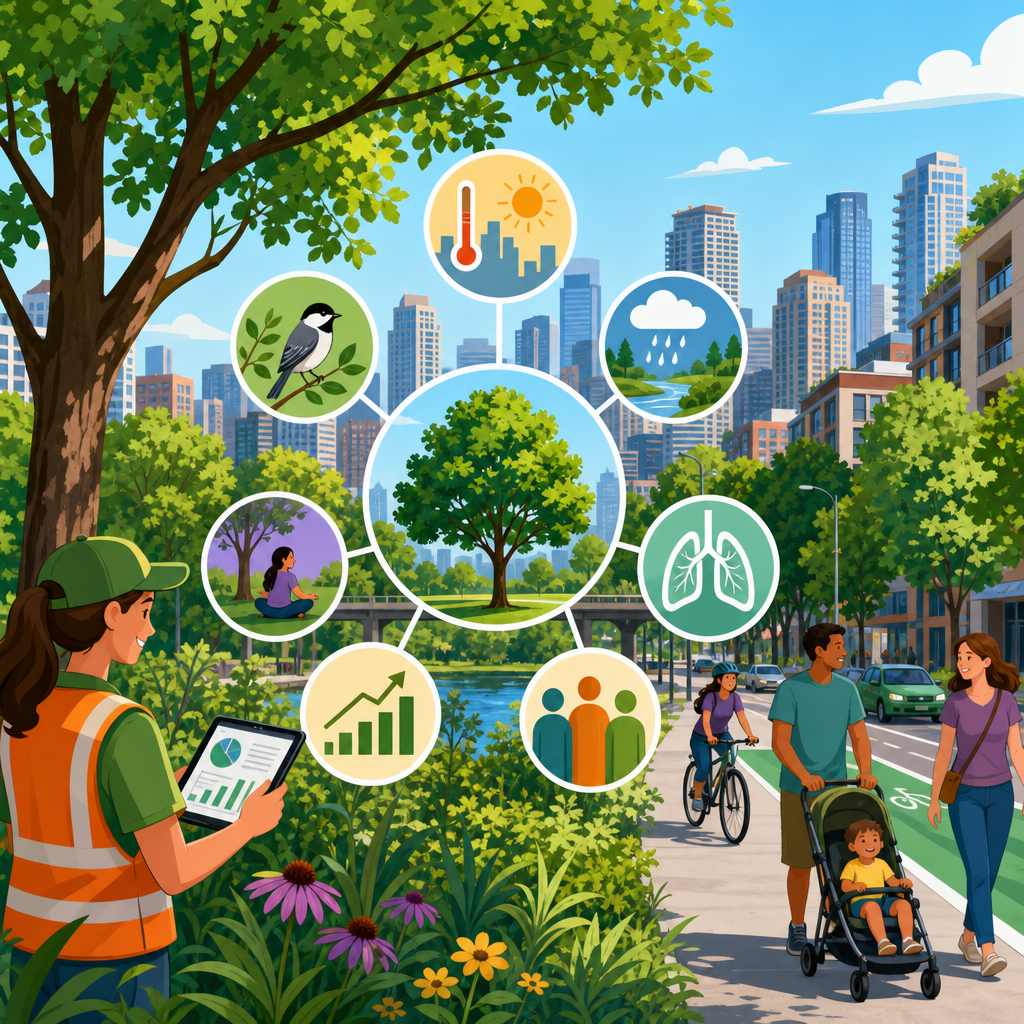
This matters because urban trees are infrastructure. They reduce surface and air temperatures, intercept rainfall, slow runoff, filter pollutants, store carbon, increase property values, improve walkability, and make streets more humane. The U.S. Forest Service, American Public Works Association, International Society of Arboriculture, and many city forestry divisions now treat trees as assets that require risk management, preventative maintenance, and performance measurement. When cities choose better metrics, they make better budgeting decisions, defend programs more effectively, and deliver benefits where residents actually need them most.
This hub article explains the metrics that matter beyond tree counts and shows how they fit into a rigorous urban forestry plan. It defines the most important measures, explains how practitioners collect and interpret them, and highlights the tradeoffs that shape real projects. If you are building a sustainable urban development strategy, these are the indicators that deserve attention at policy, portfolio, and neighborhood scale.
Canopy Cover, Canopy Change, and Where Trees Actually Exist
The most important citywide metric is canopy cover: the percentage of land area shaded by tree canopy when viewed from above. Canopy cover matters because it reflects cumulative benefits from tree size, crown spread, survival, and age distribution. A mature oak contributes far more cooling, habitat, and stormwater interception than a newly planted sapling, so canopy cover tells a more meaningful story than planting totals alone. Cities typically estimate canopy using aerial imagery, LiDAR, or classified satellite data, then verify results with field sampling.
Canopy change is even more informative. A static canopy snapshot cannot reveal whether a city is gaining or losing tree cover over time. Comparing land cover analyses across five- or ten-year intervals shows whether planting programs are offsetting removals from development, pests, storms, drought, or deferred maintenance. Washington, D.C., Melbourne, and Toronto have all used repeat canopy assessments to identify neighborhoods where gains stalled despite active planting campaigns. In practice, this metric often uncovers an uncomfortable truth: preserving existing mature trees usually delivers more near-term value than planting large numbers of replacements.
Distribution matters as much as the average. A citywide canopy target can conceal severe neighborhood disparities. Wealthier districts often have larger lots, established trees, and more private landscape investment, while lower-income districts may have greater impervious cover, fewer planting sites, and higher heat exposure. For that reason, strong urban forestry plans map canopy alongside land use, zoning, sidewalk width, pavement percentage, and vacancy patterns. The goal is not simply more canopy somewhere; it is appropriate canopy in the places where people live, walk, wait for transit, and face the highest environmental burdens.
Tree Survival, Establishment, and Maintenance Backlog
A planted tree only creates value if it survives establishment and continues growing. Survival rate is therefore a core operational metric. Most municipal programs should track one-year, three-year, and five-year survival by species, nursery stock type, contractor, planting season, and site condition. In my experience, survival below 90 percent after the first year signals either weak planting standards, insufficient watering, poor stock quality, or unrealistic site selection. By year three, failures often trace back to compacted soil, inadequate rooting volume, mower damage, vandalism, or neglected watering agreements.
Establishment metrics should include growth rate, crown condition, trunk damage, mulch condition, and watering compliance, not just alive versus dead status. A tree that survives but stagnates in a three-foot pit surrounded by reflective pavement may never deliver the intended benefits. Cities using inventory platforms such as ArcGIS Urban Forestry, TreeKeeper, or OpenTreeMap can record inspection cycles and maintenance histories at the individual tree level. That creates a feedback loop between planning and field operations, allowing urban foresters to identify which specifications actually produce durable outcomes.
Maintenance backlog is another metric that reveals program health. Pruning cycles, stump removal delays, vacant planting sites, inspection response times, and deferred young-tree care all affect safety and performance. When backlog grows, risk increases and public confidence falls. A city may boast a strong planting program while quietly accumulating thousands of overdue pruning requests. That is not a successful urban forestry plan; it is an underfunded asset portfolio. Good plans tie planting targets to realistic maintenance capacity, staffing levels, equipment, and contracted service budgets.
Species Diversity, Age Structure, and Resilience to Pests and Climate Stress
Urban forests fail catastrophically when too many trees share the same vulnerabilities. Species diversity is one of the clearest resilience metrics because it reduces the chance that a single pest, pathogen, or climate stressor will erase large portions of canopy. The old guideline of avoiding overreliance on any one species, genus, or family remains useful because cities that ignored diversity learned costly lessons from Dutch elm disease, emerald ash borer, and Asian longhorned beetle. Diversity targets should be measured across citywide inventories and within individual districts, not just systemwide totals.
Age structure is equally important. A healthy urban forest includes a balanced mix of young, maturing, mature, and veteran trees. If most of a city’s canopy is concentrated in aging cohorts planted decades ago, future decline is predictable. Conversely, a city with mostly young trees may show strong planting numbers but weak current benefits. Age distribution can be estimated from diameter classes, species growth characteristics, and planting records. Forestry plans should use these data to prevent synchronized losses and to schedule succession planting before canopy gaps become severe.
Climate resilience adds another layer. Species selection should match projected heat, drought, flooding, salinity, and storm conditions rather than historical norms alone. I have seen cities continue specifying species that perform poorly in hotter curbside conditions simply because they are familiar or available from local nurseries. Better plans test species diversity in pilot blocks, monitor performance over multiple years, and adjust approved lists based on evidence. Native species often provide strong habitat value, but native status by itself does not guarantee urban tolerance, so plans must balance ecological fit with site realities.
| Metric | What it measures | Why it matters | Typical tools |
|---|---|---|---|
| Canopy cover | Percent of land shaded by tree canopy | Shows actual citywide benefit delivery | LiDAR, aerial imagery, GIS |
| Survival rate | Percent of planted trees alive after set intervals | Tests planting quality and aftercare effectiveness | Field inspections, inventory software |
| Species diversity | Share of trees by species, genus, family | Reduces pest and disease vulnerability | Street tree inventory, asset database |
| Maintenance backlog | Overdue pruning, removals, inspections, vacancies | Reveals operational capacity and risk exposure | Work order systems, CMMS |
| Equity index | Canopy and service levels in priority neighborhoods | Targets benefits where need is highest | GIS overlays, demographic data |
Equity, Heat, Public Health, and Access to Benefits
Urban forestry plans must measure who receives benefits, who bears risk, and who gets overlooked. Equity metrics combine canopy data with income, race, age, health burdens, impervious cover, transit use, and heat exposure to identify priority areas. Tools such as the federal Climate and Economic Justice Screening Tool, CDC Social Vulnerability Index, and local heat mapping campaigns help cities move beyond generic service provision. The practical question is simple: are cooling, shade, cleaner air, and calmer streets reaching residents who need them most?
Heat is one of the strongest outcome measures because it links trees to immediate human experience. Surface temperature mapping and air temperature studies consistently show that streets with extensive canopy can be several degrees cooler than nearby treeless corridors, especially during heat waves. In Phoenix, Los Angeles, and many European cities, thermal inequity closely tracks historical disinvestment. A good urban forestry plan therefore measures canopy near schools, bus stops, senior housing, public housing, and commercial walking routes, not only in parks where exposure patterns differ.
Public health indicators provide additional evidence. Tree-rich neighborhoods are associated with reduced heat stress, more physical activity, better mental well-being, and lower exposure to some air pollutants, although local outcomes depend on species, street geometry, traffic, and maintenance. Plans should be careful not to claim that trees solve every health disparity. The strongest approach is to connect tree investment with walkability programs, safe routes to school, green stormwater infrastructure, and extreme heat response plans. Trees perform best when they are integrated into broader public realm policy rather than treated as isolated beautification projects.
Stormwater, Carbon, Air Quality, and Asset Value
Environmental performance metrics translate urban forestry into language understood by utilities, finance officers, and climate planners. Stormwater interception is especially useful because many cities face regulatory pressure, flood risk, and expensive drainage upgrades. Models such as i-Tree Eco, i-Tree Hydro, and city-specific hydrologic tools estimate how canopy, leaf area, and species traits affect rainfall interception and runoff reduction. The key is to use these estimates carefully. Benefits vary by storm size, antecedent soil moisture, season, and maintenance condition, so modeled numbers should inform decisions, not replace field observation.
Carbon storage and annual sequestration are often requested metrics, but they should be presented with nuance. Large, healthy trees store significant carbon over time, yet urban forestry is not a substitute for emissions reduction in buildings, transport, or energy systems. Carbon estimates also change when trees are removed, decay, or are replaced with smaller stock. In climate action planning, the most defensible forestry message is that preserving mature canopy and growing resilient tree cover supports adaptation and contributes measurable, but limited, mitigation value.
Air quality metrics can strengthen the case for investment, particularly along busy corridors, but species selection and site design matter. Trees can capture particulate matter and influence microclimate, yet dense planting in narrow street canyons may also affect pollutant dispersion. Urban forestry plans should rely on local context, not generic assumptions. Asset valuation methods, including replacement cost and ecosystem service valuation, help compare trees with other infrastructure. While valuation can never capture all social meaning, it does make deferred maintenance visible in budget terms and improves capital planning discipline.
Governance, Data Quality, and How to Build a Practical Metric Framework
The best metrics fail if governance is weak. Every urban forestry plan needs clear ownership of data collection, update intervals, quality control, and reporting. Inventories should define required fields, condition ratings, inspection protocols, and species nomenclature standards. Canopy assessments should specify imagery date, resolution, and classification methods. Without these basics, year-to-year comparisons become unreliable and political debates replace evidence. I have seen cities report canopy gains that were actually artifacts of better imagery rather than real biological change.
A practical framework starts with a small set of lead and lag indicators. Lead indicators include planting site readiness, watering completion, inspection frequency, species diversity in procurement, and budgeted maintenance hours. Lag indicators include canopy change, survival after three years, reduction in priority heat exposure, and backlog trends. This distinction matters because lag indicators improve slowly, while lead indicators tell managers whether current practices are likely to succeed. Reporting should occur at citywide and neighborhood scale so decision-makers can see both portfolio performance and place-based outcomes.
Finally, metrics should guide action, not just dashboards. If survival is low, revise specifications and aftercare contracts. If canopy is declining in redevelopment areas, strengthen tree protection ordinances and soil volume requirements. If heat-vulnerable neighborhoods lack planting opportunities, redesign streets, medians, and parking layouts to create rootable space. Strong urban forestry plans connect every metric to a management response, a responsible department, and a funding path. That is how tree data become sustainable urban development policy rather than annual public relations material.
Urban forestry plans are strongest when they measure performance, resilience, and fairness instead of celebrating tree counts in isolation. Canopy cover, canopy change, survival, maintenance backlog, species diversity, age structure, heat reduction, public health access, stormwater benefit, and asset value all reveal whether a city’s urban forest is actually working. These metrics also expose tradeoffs. Planting more trees without maintenance funding can weaken the system. Chasing canopy targets without equity analysis can reinforce existing disparities. Favoring a narrow species palette can increase long-term risk.
The main benefit of using better metrics is better decisions. Cities can prioritize preservation of mature canopy, target investments to heat-vulnerable neighborhoods, design planting sites that support growth, and defend budgets with evidence that finance and infrastructure teams understand. They can also create accountability by linking policy goals to measurable outcomes over five, ten, and twenty years. That is what turns urban forestry from a symbolic program into a durable component of sustainable urban development.
If you are updating an urban forestry plan, start by auditing your current metrics and asking one practical question: do they describe activity, or do they prove value? Build a framework that tracks both operations and outcomes, publish it clearly, and use it to shape capital projects, maintenance budgets, and neighborhood priorities. When the right metrics are in place, tree counts become the beginning of the conversation, not the end.
Frequently Asked Questions
Why are tree counts not enough to evaluate an urban forestry plan?
Tree counts are a useful starting point because they are easy to track, simple to communicate, and helpful for documenting planting activity. However, they say very little about whether an urban forest is actually delivering long-term environmental, social, and economic value. A city can plant thousands of trees and still fail to improve shade coverage, reduce heat risk, expand canopy in underserved neighborhoods, or support long-term survival if those trees are poorly sited, under-maintained, or concentrated in areas that already have high canopy.
A stronger urban forestry plan looks beyond how many trees went into the ground and asks what those trees are doing over time. Are they surviving past the first few years? Are they growing into healthy, structurally sound canopy? Are they reducing stormwater runoff, improving air quality, cooling heat-vulnerable corridors, and making streets more walkable? Are they distributed equitably across neighborhoods, or are investments reinforcing existing disparities? These are the kinds of questions that turn a planting program into a true performance-based urban forest strategy.
In practical terms, tree counts measure activity, not outcomes. The most effective urban forestry plans combine planting data with metrics such as canopy cover change, survival rates, maintenance completion, species diversity, age diversity, condition assessments, heat mitigation benefits, and access to shade. That broader framework helps cities understand whether they are building a resilient urban forest or simply reporting a large number that sounds impressive but misses the real purpose of urban forestry.
What metrics matter most beyond the number of trees planted?
The most meaningful metrics are the ones that connect urban forest management to public benefit and long-term resilience. One of the most important is canopy cover, because canopy is what produces many of the benefits people actually experience, including shade, temperature reduction, rainfall interception, habitat value, and visual quality. A plan should track not just total canopy, but where canopy is increasing or declining, especially in neighborhoods exposed to extreme heat, flooding, or poor air quality.
Survival and establishment rates are also essential. Planting a tree is only the beginning. If newly planted trees are not surviving through the first three to five years, the city is not getting a return on its investment. Related metrics such as maintenance response time, watering compliance, pruning cycles, and condition ratings help show whether the urban forest is being supported well enough to mature.
Diversity is another key category. That includes species diversity, genus diversity, and age-class diversity. Overreliance on a narrow palette can make an urban forest vulnerable to pests, disease, and climate stress. A resilient plan monitors whether the tree population is balanced enough to avoid large-scale losses from a single threat. Equity metrics matter just as much. Cities should measure who benefits from urban forestry investments by tracking canopy distribution, shade access near homes, schools, bus stops, and sidewalks, and whether historically underserved areas are receiving sustained attention rather than one-time planting campaigns. Together, these metrics create a more honest and useful picture of performance than tree counts alone.
How should cities measure equity in an urban forestry plan?
Equity in urban forestry should be measured by outcomes, not just intent. It is not enough to say that all neighborhoods are eligible for tree planting. A city needs to determine whether residents in lower-canopy, higher-heat, lower-income, or historically underinvested communities are actually receiving the benefits of urban forest investment. That means using spatial analysis to compare canopy cover, shade access, heat exposure, flood vulnerability, health burdens, and planting or maintenance activity across neighborhoods.
Strong equity metrics often include canopy cover by census tract or block group, percentage of residents within walking distance of shaded routes or treed public spaces, shade availability at schools and transit stops, and maintenance service levels across districts. Cities can also track how often permit enforcement, removals, pruning, inspections, and replacement planting occur in different areas. If one neighborhood receives frequent planting but poor follow-up care, while another receives both planting and sustained maintenance, the plan is not delivering equitable results.
Community participation is another important indicator. Equitable planning includes residents in decision-making about tree species, planting locations, maintenance concerns, and tradeoffs involving sidewalks, utilities, lighting, and safety. Metrics such as participation rates, language access, representation in planning meetings, and responsiveness to community requests can help show whether the program is inclusive in practice. In the best urban forestry plans, equity is embedded into target setting, budgeting, implementation, and reporting so that canopy expansion and care are aligned with community need rather than political visibility or planting convenience.
Why do maintenance and survival rates matter more than many planting campaigns acknowledge?
Maintenance and survival rates are where many urban forestry plans succeed or fail. Planting receives public attention because it is visible, celebratory, and easy to quantify. Maintenance is quieter and less politically appealing, but it is what determines whether a newly planted tree becomes a long-lived asset or a short-term expense. Without watering, mulching, structural pruning, pest monitoring, and protection from damage, many young trees never establish well enough to provide meaningful canopy or ecosystem services.
That is why survival should be treated as a core performance indicator. A city that plants fewer trees but keeps a very high percentage alive and healthy may be achieving far more than a city that plants aggressively and loses a large share within a few seasons. Tracking one-year, three-year, and five-year survival rates provides a much clearer understanding of program effectiveness. It also helps agencies identify what is going wrong, whether the issue is species selection, planting quality, contractor performance, irrigation gaps, or poor site design.
Maintenance metrics can also reveal whether the urban forestry plan is financially realistic. If the planting pipeline grows faster than the city’s ability to inspect, water, prune, and replace trees, the plan is likely overpromising. Good plans align planting targets with workforce capacity, maintenance budgets, and asset management systems. They treat trees as long-term infrastructure that require lifecycle care, not one-time installations. That shift in thinking leads to better outcomes, more public trust, and a healthier urban forest over time.
How can an urban forestry plan show real public value beyond ecological benefits?
An effective urban forestry plan should demonstrate public value in terms that matter to residents, decision-makers, and partner agencies. Ecological metrics such as carbon storage, stormwater interception, and habitat quality are important, but they should be paired with measures that reflect everyday urban life. For example, cities can evaluate how trees improve pedestrian comfort, reduce surface and air temperatures along walking routes, increase shade in schoolyards and parks, calm traffic visually, support neighborhood business districts, and improve the usability of public space during hot weather.
Public health and quality-of-life indicators are especially powerful. Trees can contribute to heat risk reduction, mental well-being, neighborhood attractiveness, and access to safer, more comfortable outdoor environments. Urban forestry plans can track shade near senior housing, clinics, playgrounds, and transit corridors, as well as tree presence in areas where residents have limited access to cooling resources. Some cities also connect urban forestry metrics to capital planning by showing how trees protect pavement, reduce building cooling demand, or complement green infrastructure investments.
Just as important, a plan should communicate value in a way that is understandable and accountable. Instead of reporting only how many trees were planted, it should explain how many residents gained access to shade, how much canopy was added in heat-vulnerable neighborhoods, how many young trees reached establishment benchmarks, and how maintenance performance improved across the system. When urban forestry is measured this way, it becomes easier to see it as a public service and resilience strategy rather than a symbolic greening effort defined by tree counts alone.