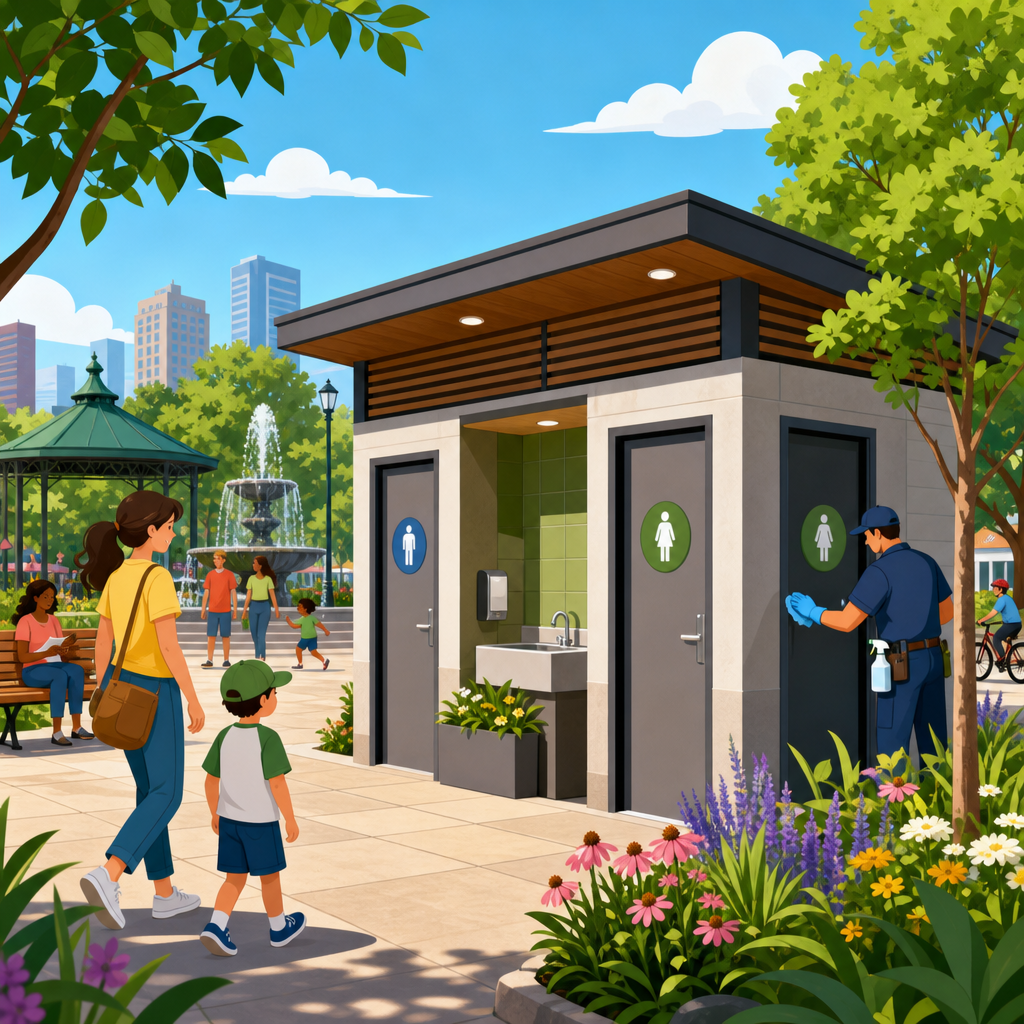
Public restrooms in parks and plazas sit at the intersection of public health, urban design, maintenance economics, and civic dignity. They are often treated as minor support facilities, yet in practice they determine whether a public space is usable for families, older adults, tourists, street vendors, runners, and people with medical needs. When I have worked on park operations reviews, restroom complaints consistently ranked with lighting and safety as the most frequent source of public frustration. A beautiful plaza without a reliable toilet is not fully functional public infrastructure. For cities pursuing sustainable urban development, public restrooms are not an afterthought; they are a core service.
The design and operations question is simple to state and difficult to solve: what type of restroom should a city build, where should it place it, how should it maintain it, and how can it keep the facility clean, safe, accessible, durable, and financially sustainable over time. Design refers to the physical layout, materials, fixtures, ventilation, access control, visibility, and relationship to surrounding uses. Operations refers to staffing, cleaning schedules, consumables, repairs, security response, opening hours, data tracking, and budget management. The two cannot be separated. A restroom that looks efficient on an architect’s plan can fail quickly if custodial workflows, vandal resistance, or plumbing serviceability were ignored. Likewise, an excellent maintenance team can be undermined by blind corners, poor drainage, or fragile finishes.
This matters because public restroom access shapes who can comfortably remain in public space. Parents with young children need changing areas. Menstruating users need disposal bins and reliable water. People with Crohn’s disease, colitis, incontinence, pregnancy-related urgency, or prostate conditions may avoid parks entirely if toilets are unavailable. Accessible facilities are essential under standards such as the Americans with Disabilities Act in the United States and comparable design codes elsewhere. Public toilets also influence sanitation outcomes, reduce inappropriate waste disposal, support public events, and affect nearby business districts. In dense urban neighborhoods, they can ease pressure on private retailers that otherwise become de facto providers. When cities get restroom design and operations right, parks and plazas become more inclusive, healthier, and easier to manage.
Why public restroom provision is a core urban service
Public restrooms are basic urban infrastructure in the same category as drinking fountains, lighting, seating, and waste bins. The difference is that restrooms combine health requirements, privacy, mechanical systems, and social management in one small building. In practical terms, they extend dwell time. A plaza designed for markets, performances, or lunchtime use loses much of its value if visitors need to leave after thirty minutes to find a toilet. In major park systems, restroom availability directly affects attendance patterns. Operators see this during festivals, youth sports, and weekend peaks, when insufficient toilet capacity creates lines, unsanitary conditions, and negative reviews that can reshape public perception of an entire site.
There is also a public health case. The World Health Organization and UNICEF frame sanitation access as fundamental to healthy communities, and while their global guidance often focuses on household and institutional sanitation, the same principles apply in public settings: safe containment of waste, handwashing, and hygienic maintenance matter. During the COVID-19 period, operators paid renewed attention to touchpoints, ventilation, and hand hygiene, but the broader lesson remained consistent: sanitation infrastructure must be planned as a system, not improvised after complaints arrive. In city centers, lack of public toilets often results in street urination, damage to landscaping, and more intensive cleaning demands elsewhere. The cost does not disappear; it merely shifts.
Equity is another reason provision matters. Many users can purchase access in cafes or shops, but not everyone can. A sustainable city cannot assume that private businesses will absorb the burden. Well-run public restrooms support inclusive access to civic life. They help children, caregivers, delivery workers, bus drivers on breaks, unhoused individuals, and visitors unfamiliar with the area. Good policy recognizes that universal public space requires universal basic amenities.
Design decisions that determine long-term performance
The best public restroom design begins with the service model. A neighborhood park comfort station used mostly during daylight hours requires a different approach than a downtown plaza restroom serving commuters, events, and evening activity. Capacity planning should be based on actual occupancy patterns, not rough assumptions. Operators often underestimate peak demand by sizing for average use, then discover that queues form during concerts, farmers markets, or playground rush periods. Separate calculations for daily use, peak hour use, and event surge are essential. Fixture counts should consider gender-neutral layouts, family rooms, and accessible stalls rather than relying only on older binary formulas.
Site placement is equally important. Restrooms should be easy to find but not isolated. In my experience, the safest and cleanest facilities are visible from active circulation routes, near staff presence or concession activity, and close enough to utilities that maintenance access is straightforward. A hidden building behind dense planting may seem discreet, but it often creates security problems and complicates servicing. Clear sightlines to entrances, good exterior lighting, and intuitive wayfinding reduce both misuse and user anxiety. Placing restrooms near playgrounds, sports fields, transit stops, or food kiosks usually aligns access with demand.
Inside the building, durable materials make an operational difference. Floor drains, integral coved bases, anti-graffiti coatings, stainless steel hardware, phenolic partitions, and moisture-resistant wall systems reduce lifecycle cost. Touchless fixtures can improve hygiene, but only when they are robust and maintainable. Cheap sensors fail quickly in high-use settings. Mechanical ventilation should be sized for odor control and moisture removal, and service chases should allow plumbers and electricians to reach valves and wiring without demolishing finishes. Full-height partitions increase privacy, but they require careful detailing to maintain airflow and facilitate emergency access when needed.
Accessibility cannot be handled as a compliance checkbox. A truly usable restroom includes barrier-free routes, turning radii, reachable accessories, grab bars correctly placed, accessible lavatories, and adequate maneuvering clearances at doors. Adult changing tables are increasingly relevant in large parks and civic plazas because children are not the only users who need assisted changing support. Inclusive design also means considering stroller space, coat hooks, shelves for bags, menstrual product dispensers, and family or all-gender rooms that reduce waiting and better serve caregivers. These details shape whether the facility works in real life.
Operating models, staffing, and cleaning standards
Operations determine reputation. Users judge a restroom less by its architectural drawings than by whether it is open, stocked, odor-free, and safe at the moment of need. The strongest model I have seen ties cleaning frequency to use intensity rather than fixed clocks alone. A small neighborhood park may need morning and afternoon checks, while a central plaza may require an attendant, hourly inspections, and event-based surge cleaning. Written standards should define acceptable conditions for floors, fixtures, mirrors, consumables, waste bins, and odor. Without clear standards, contractors and city crews default to inconsistent practices.
Staffing choices vary. Some cities rely on mobile custodial teams covering several sites. Others use dedicated attendants in flagship parks. Attendants cost more, but they often reduce vandalism, improve user confidence, and provide immediate reporting of plumbing failures or unsafe behavior. Hybrid models can work well: attendants during peak times, mobile cleaning overnight, and remote monitoring of door status or supply levels. What fails most often is the unfunded mandate, where a city opens a restroom without adding custodial labor, then closes it intermittently as conditions deteriorate.
Consumables management deserves more attention than it usually gets. Soap, toilet tissue, paper towels, menstrual products, and liners are not minor details; stockouts destroy trust quickly. Standardized dispensers, locked janitorial storage, and simple inventory routines reduce downtime. Many operators now use QR codes or work-order platforms such as Cityworks, Maximo, or asset modules within municipal enterprise systems to log issues and track response times. This creates data that can justify budget increases and identify repeat failures, such as one faucet model that constantly clogs or one site that needs redesigned waste receptacles.
| Operating element | Best practice | Why it matters |
|---|---|---|
| Cleaning schedule | Match frequency to peak use and events | Prevents overload and visible decline |
| Staff presence | Use attendants at high-volume sites | Reduces vandalism and speeds reporting |
| Supplies | Standardize dispensers and restocking logs | Minimizes stockouts and waste |
| Maintenance | Track assets and recurring failures digitally | Supports faster repairs and capital planning |
| Security | Coordinate custodial and ranger response | Improves safety without overdesign |
Opening hours should reflect actual use patterns, not administrative convenience alone. Dawn-to-dusk service is common in parks, but transit-adjacent plazas and nightlife districts may need extended hours. Automatic locking systems can support scheduling, yet they should never become a substitute for management. If a restroom closes too early, surrounding spaces bear the consequences. The operating plan must be aligned with how the public space truly functions.
Safety, misuse prevention, and the dignity tradeoff
Every city confronts the same tension: how to prevent vandalism, drug use, and unsafe behavior without making public restrooms hostile, overly restrictive, or inaccessible. The answer is not a single anti-vandal fixture or a punitive design gimmick. It is layered management. Good exterior visibility, durable hardware, tamper-resistant fasteners, blue-light-free lighting, emergency call capability where appropriate, and routine staff presence are more effective than fortress-like environments that communicate distrust. CPTED principles help, but they work only when paired with active operations.
Single-user automated toilet units can be useful in tight urban sites because they limit simultaneous occupancy and may self-clean between users. However, they often have high maintenance complexity, long cycle times, and poor throughput during busy periods. I have seen cities install them as a technological fix only to discover that downtime, part replacement delays, and queue frustration undercut the investment. Conventional multi-stall restrooms usually provide better capacity and lower cost per use when staffing and cleaning are adequate. There is no universal winner; context matters.
Policy also matters. Clear rules on occupancy time, prohibited behavior, and reporting channels should be posted in plain language. Security response must be calibrated. Over-policing can deter legitimate users, especially youth and marginalized groups, while no enforcement invites unmanaged conditions. The better model is coordinated stewardship among parks staff, custodians, outreach teams, and public safety personnel. In districts with high social-service needs, restroom planning should connect to broader homelessness and behavioral health strategies rather than pretending a toilet building can solve those issues alone.
Sustainability, cost control, and measuring success
Sustainable urban development requires looking beyond first cost. A restroom built with low-grade finishes may be cheaper on opening day and far more expensive within three years. Lifecycle costing should include water use, energy demand, fixture replacement rates, coating renewal, janitorial labor, and expected vandal repair. High-efficiency toilets and faucets can reduce utility consumption, but they must still perform under heavy use and variable water pressure. In some climates, freeze protection, low-flow balancing, and hose bib management are critical details. Solar power can support lighting or controls in remote sites, yet grid reliability and maintenance skills still govern success.
Water and waste management strategies should be selected carefully. Composting or waterless systems can work in remote parks where sewer connections are impractical, but they require disciplined maintenance and user education. In dense urban plazas, conventional sewered systems remain the most dependable option. Material selection also affects environmental performance. Long-life products with repairable components often outperform trendy finishes that need frequent replacement. Procurement teams should ask for parts availability, warranty terms, and local service support, not just catalog appearance.
Measuring success means tracking more than complaint volume. Useful metrics include uptime, response time to work orders, consumables stockout rate, custodial labor hours per site, water use per fixture, repeat vandalism incidents, and user satisfaction from intercept surveys or digital feedback. Cities with strong programs review these numbers regularly and tie them to capital planning. If one restroom closes repeatedly because floor drains back up, the answer may be a plumbing redesign, not more cleaning. If another site has high evening misuse, the answer may be revised hours, lighting, or staff deployment. Data turns anecdotes into management decisions.
Public restrooms in parks and plazas succeed when cities treat them as essential civic infrastructure with equal attention to design, operations, and long-term stewardship. The central lesson is straightforward: build for the way people actually use public space, not for an idealized plan set. Site restrooms where demand is visible, design them for durability and accessibility, fund staffing and supplies realistically, and measure performance with operational data. Facilities that are easy to clean, easy to repair, and easy to find will outperform stylish but impractical buildings every time.
For sustainable urban development, the benefit is larger than sanitation alone. Reliable public toilets extend dwell time, support inclusion, reduce pressure on private businesses, improve public health conditions, and strengthen trust in public space. They make parks and plazas work for more people, for longer periods, with fewer conflicts and lower lifecycle waste. If you are planning, redesigning, or auditing a public space, put restroom strategy near the top of the agenda. Start with demand, operations, accessibility, and maintenance reality, then design from there. That is how public amenities become durable civic assets.
Frequently Asked Questions
Why do public restrooms in parks and plazas matter so much to the overall success of a public space?
Public restrooms are not peripheral amenities; they are core infrastructure that determine whether a park or plaza can function as an inclusive, all-day public environment. A space may have excellent landscaping, seating, shade, programming, and walkability, but if visitors cannot reliably access a clean, safe restroom, the practical usefulness of that space drops quickly. Families with young children, older adults, pregnant visitors, people with disabilities, runners, tourists, transit users, maintenance crews, street vendors, and people managing medical conditions all depend on predictable restroom access. In that sense, restrooms directly influence who can stay, for how long, and under what level of comfort and dignity.
They also shape public perception in ways that city agencies sometimes underestimate. Restroom complaints often become shorthand for larger concerns about neglect, disorder, staffing, safety, and basic municipal competence. When restrooms are closed, dirty, vandalized, poorly lit, or difficult to find, users often conclude that the entire site is poorly managed. By contrast, a well-run restroom signals care, stewardship, and social trust. It tells people that the space was designed for actual human use, not just visual appeal.
From an operations standpoint, restrooms affect everything from dwell time and event capacity to visitor satisfaction and equity outcomes. If a public square is intended to support markets, festivals, food concessions, play areas, recreation loops, and casual social use, restroom availability becomes a prerequisite for successful programming. In many cases, the question is not whether a park can afford to provide restrooms, but whether it can afford the reduced accessibility, shorter visits, and negative user experience that result when restroom service is absent or unreliable.
What makes a public restroom in a park or plaza well designed?
A well-designed public restroom balances visibility, privacy, durability, accessibility, ease of maintenance, and user comfort. The first design question is location. Restrooms need to be easy to find without being placed in a way that creates security concerns or overwhelms nearby activity areas. Good siting usually means placing them along clear pedestrian routes, near major destinations such as playgrounds, sports areas, transit edges, event lawns, or food zones, and within sight of regular foot traffic. A restroom hidden behind dense landscaping or tucked into an isolated corner may appear more discreet on paper, but in practice it often creates fear, misuse, and avoidable maintenance problems.
Inside the building, successful design starts with durability and clear circulation. Fixtures, wall surfaces, partitions, floors, hardware, lighting, and ventilation systems should be selected for heavy use, easy cleaning, moisture resistance, and vandal resistance. Layout matters just as much. Users should be able to understand the room quickly, move through it easily, and access sinks, stalls, and exits without confusion or congestion. Touchpoints should be minimized where practical, and custodial access should be built into the layout so staff can service the room efficiently.
Accessibility must be treated as foundational, not optional. That includes code-compliant accessible stalls and routes, but it should also include family-friendly and caregiver-friendly design decisions such as adequate turning space, hooks, shelves, changing stations, clear signage, and doors that are easy to operate. Many jurisdictions are also moving toward more inclusive approaches such as all-gender individual stalls or mixed configurations that improve flexibility and reduce wait imbalances. Good restroom design also depends on lighting, acoustics, visibility at entries, and exterior conditions. A restroom can be technically compliant yet still feel unsafe or unusable if the entrance is dark, the path is hidden, or the surrounding area lacks activity and oversight. In public settings, design quality is inseparable from operational reality.
How should cities and park operators balance cleanliness, safety, and operating costs?
The most effective approach is to stop treating cleanliness, safety, and cost as competing goals and instead manage them as part of one operating system. Public restrooms become expensive when they are poorly designed, under-serviced, hard to supervise, and only addressed after complaints escalate. By contrast, facilities that are designed for durability, staffed or monitored appropriately, and cleaned on predictable schedules usually perform better and cost less over time than facilities that cycle through closure, damage, emergency repair, and public dissatisfaction.
Cleaning frequency should reflect actual demand patterns rather than a generic citywide standard. A restroom near a playground, athletic field, tourism node, transit transfer point, or weekend market may need significantly more service than one in a lightly used passive park. Operators should rely on usage data, event schedules, seasonal patterns, and complaint trends to set service levels. That may include scheduled cleaning rounds, rapid-response protocols for spills or vandalism, supply checks, and periodic deep cleaning. Consumables such as soap, toilet paper, paper towels, and waste liners should be managed proactively because stockouts undermine user trust almost immediately.
Safety is strengthened through design and presence more than through punitive measures alone. Clear sightlines to the building, visible entrances, strong lighting, durable hardware, occupancy indicators where appropriate, and nearby staff or concession activity can all reduce misuse. Some cities use attendants in the highest-use locations, while others rely on mobile crews, security patrols, sensors, or remote monitoring for maintenance alerts. The right model depends on use intensity, local conditions, and budget. The central lesson is that operating costs should be evaluated against the value created: longer visits, broader access, better event support, reduced complaints, and stronger public confidence. Restrooms are not merely a maintenance expense; they are a service platform that helps the entire public space function.
What are the most common reasons public park restrooms fail, and how can those problems be prevented?
Most restroom failures come from a predictable combination of design mistakes, insufficient operating support, and unrealistic policy assumptions. One common failure is poor siting. If a restroom is hidden, isolated, or disconnected from primary activity areas, it may feel unsafe to ordinary users while becoming harder for staff to monitor. Another frequent problem is specifying materials and fixtures that look attractive at installation but do not hold up under heavy public use. When finishes stain easily, partitions loosen, drains clog, or hardware breaks repeatedly, maintenance costs rise and closures become more frequent.
A second major cause of failure is underestimating the importance of routine service. Public restrooms cannot be maintained effectively through occasional attention or complaint-driven response alone. Facilities that are cleaned too infrequently, checked only at the beginning and end of the day, or operated without clear accountability often deteriorate quickly. Small issues such as leaks, odor, graffiti, missing supplies, poor ventilation, or broken locks compound into broader perceptions of disorder. Once users expect a restroom to be dirty or unsafe, usage patterns shift, complaints rise, and political pressure often leads to reduced hours or closure rather than operational improvement.
Prevention requires planning for the full life cycle of the facility from the beginning. That means integrating operators, maintenance staff, risk managers, and accessibility perspectives into the design process rather than treating the restroom as a late-stage building component. It also means setting realistic budgets for staffing, consumables, repair, and replacement. Clear performance standards help: acceptable downtime, cleaning frequency, response times for repairs, inspection routines, and public reporting mechanisms. In successful systems, restrooms are managed as essential service assets with measurable expectations, not as incidental buildings left to absorb whatever resources remain.
What policies and management strategies lead to more equitable and dependable public restroom access?
Equitable restroom access begins with recognizing that the need for a restroom is universal, but the consequences of not having access are not evenly distributed. People with chronic illnesses, parents with small children, older adults, menstruating visitors, people with disabilities, outdoor workers, unhoused individuals, and people who spend long periods in public space are affected most directly by closures, restricted hours, or hard-to-use facilities. An equitable policy framework therefore asks not only whether a restroom exists, but whether it is open when people need it, located where they can reasonably reach it, accessible in practice, and operated with dignity.
Dependability usually comes from a combination of clear standards and flexible management. Cities and park operators should establish posted hours that match actual park use, maintain transparent closure protocols, and provide backup options during renovations, events, or emergencies. Signage should be easy to understand, multilingual where appropriate, and consistent across the park system. Digital maps, wayfinding, and public reporting tools can also improve access, especially in large parks or downtown plaza networks. Where demand is high, agencies may need a portfolio approach that includes permanent restroom buildings, seasonal units, extended-hours facilities, staffed sites, and partnerships with nearby institutions or concessions.
Management strategies should also emphasize dignity in both design and enforcement. Policies that treat all users as potential problems tend to produce fortress-like facilities that are unpleasant for everyone and still difficult to manage. Better results usually come from combining durable design, regular upkeep, visible stewardship, and humane rules. In some settings, attendants or nearby staff presence can improve cleanliness and safety while also helping users navigate the facility. Ultimately, equitable restroom policy is a public health and civic inclusion issue. A city that wants its parks and plazas to serve the broad public has to provide restroom access as a basic condition of participation in urban life.