Nighttime public space design for safety without over-policing is a practical urban design approach that reduces harm, supports belonging, and keeps streets, parks, plazas, and transit areas usable after dark through environment, operations, and community stewardship rather than defaulting to constant enforcement. In city work, I have seen the same pattern repeatedly: when nighttime safety is treated only as a policing problem, public space becomes tense, unevenly accessible, and less trusted by the people who most need it. When safety is designed into the space itself, behavior changes, legitimate activity increases, and fear drops without making every corner feel surveilled.
The core terms matter. Nighttime public space includes sidewalks, squares, bus stops, greenways, schoolyards used after hours, waterfronts, and commercial corridors active between dusk and dawn. Safety includes both actual risk, such as assault, traffic injury, or falls, and perceived safety, which shapes whether people will use a place at all. Over-policing means relying on aggressive presence, stops, exclusion, or disorder enforcement in ways that can intimidate residents, especially youth, unhoused people, migrants, and racialized communities. Design for safety instead draws on lighting, visibility, maintenance, staffing, programming, mobility access, and community governance to lower opportunity for harm while preserving dignity and freedom of movement.
This matters because nighttime access is an equity issue, an economic issue, and a public health issue. Shift workers, caregivers, women, older adults, disabled people, and teenagers often move through public space at hours when services are thinner and risks feel higher. Well-designed evening environments can increase transit use, support local business, reduce crashes, and encourage social connection. Poorly designed ones create dead zones, avoidance, and dependence on private cars or private security. The best cities treat nighttime design as part of sustainable urban development: lower-energy lighting, mixed uses, eyes on the street, inclusive operations, and measurable outcomes that improve safety without turning public life into a controlled perimeter.
Start with risk, not fear
Effective nighttime public space design begins with a blunt question: what specific harms are happening here, to whom, at what time, and under what environmental conditions? Fear is real, but design must respond to evidence rather than headlines. In practice, that means mapping incidents by type, hour, season, and micro-location; walking routes after dark with residents; and comparing official crime data with near misses, complaints, transit ridership patterns, crash reports, and maintenance logs. A plaza with low violent crime but high levels of harassment, hidden corners, and broken lighting needs a different intervention from a nightlife strip with conflict around bar close.
One of the most useful distinctions is between target-hardening and comfort-building. Locks, cameras, and barriers may reduce some opportunities, but they do not automatically make ordinary users feel welcome or in control. Comfort-building measures do. Clear sightlines, understandable wayfinding, active ground floors, visible help points, staffed kiosks, and routes that do not force people past blank walls all change behavior. In several corridor audits I have run, the strongest predictor of perceived safety was not the number of officers nearby but whether a person could see an open destination ahead, understand where to go, and expect other legitimate users to be present. Safety improves when people can read the space instantly.
Use lighting as social infrastructure
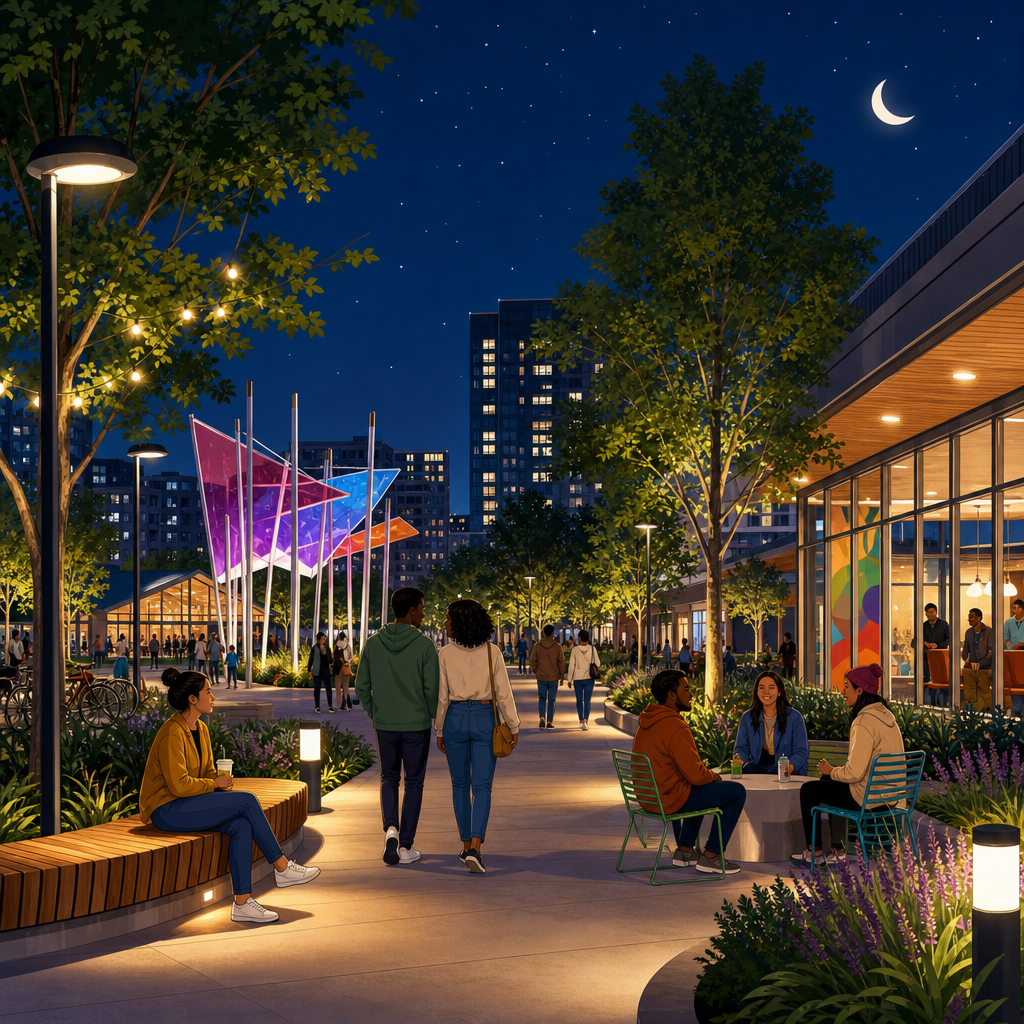
Lighting is the most discussed nighttime design tool and the most commonly mishandled. Brighter is not always safer. Uniformity, color rendering, glare control, maintenance, and placement matter more than raw intensity. Good lighting helps people recognize faces, detect movement, read signs, and see trip hazards without washing out the surroundings or creating deep contrast that hides risk. The Illuminating Engineering Society guidance is useful here: prioritize vertical illumination at eye level, avoid dark gaps between fixtures, and match light levels to use, speed, and conflict points.
In a park path, for example, low bollards alone often create islands of light and leave faces unreadable, while overly tall high-output fixtures can produce glare that reduces visibility and disturbs nearby housing. A better solution may combine shielded pedestrian-scale poles, lit entrances, reflective edge details, and selective tree pruning. At bus stops, backlit ad panels frequently outshine the waiting area; moving the brightest source away from the shelter opening and lighting the boarding zone improves both comfort and safety. Smart controls can dim when activity is low and raise output when pedestrians or cyclists approach, reducing energy use while preserving legibility. The point is not theatrical brightness. The point is a calm, readable nighttime environment.
Create visibility, access, and legitimate activity
Nighttime safety improves when public spaces support steady, ordinary use by diverse people. This is the logic behind natural surveillance, but it only works when combined with access and purpose. Empty plazas bordered by shuttered frontages rarely feel safe, even with cameras. By contrast, spaces near late-opening cafes, libraries, recreation centers, food kiosks, or transit interchanges benefit from regular foot traffic and informal guardianship. In mixed-use districts, setbacks, transparent frontages, and frequent doors matter because they produce visual exchange between interior and exterior space.
Design details accumulate. A path that aligns with desire lines will be used; one that forces a detour behind service yards will be avoided. Seating that faces circulation routes supports passive supervision; seating hidden behind planting can encourage concealment. Accessible ramps, curb cuts, handrails, and tactile guidance are safety features at night, not just compliance items, because they reduce falls and route confusion for many users. Public toilets, drinking water, and visible operating hours also shape safety. People lingering because they are waiting for transport, resting, or caring for children need basic amenities. If those needs are ignored, the space becomes stressful, conflict rises, and enforcement pressure follows.
| Design issue | Common enforcement-heavy response | Design-led response | Likely result |
|---|---|---|---|
| Harassment at bus stops | Periodic patrols | Improve lighting, sightlines, seating layout, real-time information, staffed kiosk | Higher comfort, better reporting, steadier use |
| Conflict at park entrances | Fencing and dispersal | Active edge uses, clear entry sequence, attendants, visible rules, late programming | More legitimate activity, less ambiguity |
| Fear on walking routes | Camera expansion alone | Continuous lighting, open frontages, maintenance, wayfinding, emergency call points | Improved readability and route confidence |
| Late-night traffic danger | Traffic stops only | Raised crossings, tighter radii, lower speeds, daylighted corners, refuge islands | Fewer severe crashes and safer crossings |
Design for gender, age, and disability realities
A public space can meet technical standards and still fail the people most likely to feel unsafe after dark. Women and girls often evaluate routes according to escape options, visibility, and the likelihood of unwanted attention. Older adults prioritize even surfaces, places to rest, and confidence that help is nearby. Disabled users may depend on predictable lighting transitions, audible information, tactile cues, and obstruction-free paths. Teenagers need places to gather without being treated as a problem by default. Designing for nighttime safety without over-policing means treating these realities as baseline criteria rather than special interests.
Vienna’s long-running gender mainstreaming work offers a useful lesson: when planners studied how different groups used parks and paths, they redesigned circulation, entrances, and activity zones to reduce domination by a single user group and improve visibility. Similar lessons apply elsewhere. A skate spot near transit can be positive nighttime activity if edges are visible and noise is managed; if pushed into a hidden leftover space, it may feel threatening to everyone. For blind or low-vision users, contrast markings at stairs, consistent curb alignment, and audible crossing signals support independent movement at night. For wheelchair users, a route blocked by cafe furniture or uneven temporary cables is more than inconvenient; it can force a dangerous detour into traffic.
Program, staff, and maintain the space
Design alone cannot carry nighttime safety. Operations determine whether a space remains legible and inviting after the ribbon cutting. Maintenance is one of the clearest trust signals a city can send. Broken lights, overflowing bins, graffiti on wayfinding, unrepaired paving, and dead landscaping tell users that oversight is weak and problems may go unaddressed. Clean, functioning, well-managed spaces do not eliminate crime, but they reduce uncertainty and increase willingness to use the space normally.
Programming matters just as much. Night markets, outdoor film nights, supervised sports, library evening hours, cultural festivals, and food vendors extend legitimate activity into times that would otherwise be empty. The strongest examples pair programming with trained civilian staff such as park stewards, station assistants, ambassadors, or outreach workers. These workers answer questions, de-escalate conflict, report hazards, and connect people to services. They are visible, approachable, and distinct from armed enforcement. In several downtown pilots across North America and Europe, ambassador programs improved perceived safety and cleanliness while generating better issue reporting because users were more willing to speak with them than with police. Staffing is not a cosmetic add-on; it is part of the safety system.
Limit surveillance and enforcement to clear, accountable roles
Safety without over-policing does not mean pretending serious crime never occurs. It means using enforcement narrowly, lawfully, and proportionately while letting design and operations do the everyday work. Cameras can help investigate incidents in some contexts, but they should not be treated as a substitute for staffing, maintenance, or social infrastructure. Their value depends on placement, monitoring capacity, retention rules, privacy safeguards, and whether they address the actual risk. A camera overlooking a dark underpass does little if the underpass remains poorly lit and isolated.
The same principle applies to police presence. Focused response to violence, threats, or high-risk events may be necessary, but routine saturation patrols in ordinary public space can suppress harmless use and deepen mistrust. Cities should define who handles what: maintenance teams fix hazards, ambassadors assist users, outreach workers respond to welfare concerns, transport staff manage stations, and police address criminal matters that clearly require them. Publicly posted service standards and transparent complaint channels help residents understand these roles. When accountability is visible, people are less likely to experience safety measures as arbitrary control.
Measure outcomes and build a nighttime strategy
The strongest nighttime public space design programs are measured, iterative, and citywide. A single upgraded plaza will not solve a corridor of unsafe links. Municipalities need nighttime strategies that connect transport, parks, public works, cultural affairs, business districts, and community organizations. Start with a baseline: lighting audits, user surveys by demographic group, crash data, incident data, maintenance response times, occupancy counts, and route choice observations. Then test changes, measure again, and publish results.
Good metrics go beyond headline crime numbers. Track whether more women use the route after dark, whether disabled users report fewer barriers, whether retail vacancy drops, whether bus waiting times feel safer, and whether lighting faults are fixed quickly. Include displacement checks so a problem is not simply pushed to the next block. Seasonal variation matters too; winter darkness, summer heat, and event nights change behavior. The long-term benefit of this approach is resilience. Cities that institutionalize nighttime design standards create safer, more inclusive public spaces without relying on constant coercion. For sustainable urban development, that is the right bargain: lower harm, stronger public life, and a nighttime city that belongs to everyone. Audit one evening route this month, identify three design fixes, and turn nighttime safety into a design brief rather than an enforcement reflex.
Frequently Asked Questions
What does nighttime public space design for safety without over-policing actually mean?
Nighttime public space design for safety without over-policing means creating streets, parks, plazas, sidewalks, transit stops, and other shared places that feel safe, welcoming, and usable after dark through design, maintenance, programming, staffing, and community presence rather than relying primarily on constant police enforcement. The core idea is that people are often safer when public spaces are easy to see through, well lit, active, cared for, legible, and supported by trained non-police personnel and local stewardship. In practice, this includes better lighting placement, clear sightlines, comfortable seating, visible entrances and exits, accessible wayfinding, dependable transit information, staffed amenities, late-night activities, clean and functioning facilities, and rapid response to maintenance issues.
This approach does not ignore real risks or suggest that enforcement is never needed. Instead, it starts from the evidence that many safety problems are shaped by environmental conditions and operations. Dark corners, long inactive frontages, broken lighting, confusing layouts, isolated waiting areas, poor maintenance, and a lack of trusted help can all increase fear and vulnerability. Over-policing, by contrast, can make some users feel surveilled, excluded, or unfairly targeted, especially young people, unhoused people, and communities that have experienced disproportionate enforcement. A well-designed nighttime environment reduces harm while preserving dignity, access, and the everyday freedom to occupy public space after dark.
How can urban design improve safety at night without making public spaces feel controlled or hostile?
Urban design improves nighttime safety by making public spaces more understandable, observable, and actively used. Good lighting is one of the most important tools, but it is not just about brightness. Effective lighting helps people recognize faces, read paths, identify entrances, and see potential hazards without creating glare, deep shadows, or an institutional feel. Lighting should support comfort and visibility along walking routes, at crossings, near seating, at transit stops, around restrooms, and in transition zones where people may otherwise feel isolated. Beyond lighting, clear sightlines matter. Trimming overgrown landscaping, reducing hidden recesses, opening up views into and through a space, and placing kiosks or amenities where they increase activity can all help people feel less vulnerable.
Hostile design should be avoided because it often shifts problems rather than solving them and can make public space less humane for everyone. Safety does not require spikes, excessive barriers, unnecessarily loud surveillance messaging, or furniture designed to prevent basic human use. Instead, cities can focus on durable materials, intuitive circulation, visible help points, comfortable gathering areas, active edges with late-night businesses or community uses, and programming that keeps spaces populated by a mix of users. A place with regular legitimate activity tends to feel safer than one that is technically controlled but empty, tense, or unwelcoming. The goal is not to make public space feel monitored at all times, but to make it feel cared for, legible, and shared.
What are the most important design and operational features for safer parks, plazas, and transit areas after dark?
The strongest nighttime safety strategies usually combine physical design with day-to-day operations. On the design side, priorities often include layered lighting, open sightlines, readable entrances, visible circulation routes, accessible paths, seating located where people can see and be seen, working restrooms where feasible, emergency communication options, and landscaping that supports visibility rather than creating concealment. In transit environments, reliable arrival information, sheltered waiting areas, platform visibility, active frontages, staffed or monitored customer service points, and safe pedestrian connections to surrounding streets are especially important. In parks and plazas, it also helps to create distinct zones so users can quickly understand where to walk, gather, wait, or seek assistance.
Operationally, maintenance is just as critical as design. Burned-out lights, overflowing trash, broken fixtures, vandalized signs, and inaccessible paths quickly signal neglect and reduce trust. Regular cleaning, quick repairs, and predictable opening and closing practices communicate that a place is managed and supported. Staffing also matters. Trained ambassadors, attendants, custodians, outreach workers, park staff, and transit personnel can provide assistance, de-escalate issues, offer directions, and connect people to services without creating the atmosphere that comes from constant enforcement. Programming is another powerful tool. Evening markets, performances, recreation, food vendors, and community events increase natural presence and create positive reasons for people to be there. The safest nighttime spaces are rarely those with only a single intervention; they are the ones where design, operations, and human support reinforce one another consistently.
Why can relying too heavily on policing make nighttime public spaces less safe or less trusted?
When nighttime safety is framed only as a policing problem, cities often overlook the actual conditions that contribute to risk. A dark transit stop with no seating, poor visibility, and infrequent service will not become meaningfully safer simply because enforcement is increased nearby. People may still feel stranded, confused, or vulnerable. At the same time, heavy police presence can create a different set of harms: some users may avoid the space altogether, limit their movements, or feel they are being watched rather than supported. This is especially true for people who have historically experienced uneven enforcement, including Black and brown residents, youth, LGBTQ+ people, street vendors, migrants, and unhoused individuals. A space that feels safe to one group because it is tightly controlled may feel unsafe to another because it signals scrutiny and exclusion.
Trust is a major part of public safety. If people expect to be questioned, displaced, or treated unfairly, they are less likely to use the space, ask for help, or view local institutions as legitimate caretakers of the public realm. Emptying out public space through fear or exclusion can reduce the everyday social presence that helps keep places safe in the first place. That is why cities increasingly look at a broader safety toolkit: design improvements, ambassador programs, outreach teams, mental health response options, late-night transportation support, community-led stewardship, and strong maintenance practices. These measures address underlying conditions while preserving public space as a shared civic environment rather than turning it into an enforcement zone.
How should cities measure whether a nighttime public space strategy is working?
Cities should measure success using more than crime statistics alone. Reported incidents matter, but they do not capture the full picture of whether people actually feel safe, welcome, and able to use a place after dark. A strong evaluation should include user perception surveys, intercept interviews, observational studies, maintenance response times, lighting audits, pedestrian counts, transit ridership, dwell time, and data on who is using the space at night. It is especially important to understand differences across groups. Women, older adults, disabled people, shift workers, teenagers, and marginalized communities may experience the same space very differently. If one group feels newly comfortable but another feels pushed out, the strategy may be improving order for some while undermining equitable access for others.
Qualitative feedback is also essential. Residents, business owners, transit riders, park users, vendors, and community organizations can often identify specific conditions that formal metrics miss, such as confusing routes, intimidating staff behavior, poorly located lighting, or times of night when support drops off. Cities should test interventions, review results regularly, and adjust rather than assuming one redesign or staffing model will solve everything permanently. The clearest sign that a strategy is working is not simply fewer incidents on paper, but a healthier nighttime public realm: more people using the space appropriately, broader community trust, faster resolution of environmental problems, improved comfort, and a sense that public space remains open and usable without depending on constant force or surveillance.