Designing playgrounds for inclusion, risk, and child development requires more than choosing bright equipment and meeting a minimum safety checklist. A strong playground is a public health asset, a learning environment, and a social commons that supports children with different bodies, abilities, temperaments, and cultural backgrounds. In practice, the best designs balance access with challenge, freedom with supervision, and durability with ecological responsibility. When I have reviewed playground plans with landscape architects, school leaders, and municipal parks teams, the most successful projects started by defining what children should be able to do there, not simply what equipment should be installed.
In this context, inclusion means more than wheelchair access. It includes physical access, sensory comfort, cognitive clarity, social participation, and the dignity of choice. Risk does not mean danger; it means manageable uncertainty that lets children test balance, strength, judgment, and confidence. Child development refers to the interconnected growth of motor skills, executive function, language, emotional regulation, and peer relationships. These three ideas belong together. If a playground is safe but boring, children disengage. If it is exciting but exclusionary, many children are left out. If it is accessible but overcontrolled, it can limit exploration that is essential for healthy development.
This hub article explains how to design playgrounds that serve all three goals at once. It covers the core principles, planning process, equipment choices, landscape strategies, and maintenance practices that shape lasting results. It also connects playground design to sustainable urban development, because well-planned play spaces increase neighborhood livability, support active transportation, extend the life of public investments, and create resilient green infrastructure. For planners, educators, developers, and community groups, the central question is straightforward: what kind of environment helps more children play well, together, every day?
Why inclusion must be designed, not assumed
Inclusive playground design begins with the recognition that equal provision is not equal participation. Installing the same equipment in every park does not create fairness if many children cannot reach it, understand it, tolerate it, or join the play it encourages. I have seen projects labeled inclusive because they added one transfer platform and a rubber path, while the main play value remained concentrated in elevated structures that demanded climbing, queuing, and fast-moving social coordination. Children who process sensory input differently, use mobility aids, or prefer parallel play were technically present but practically sidelined.
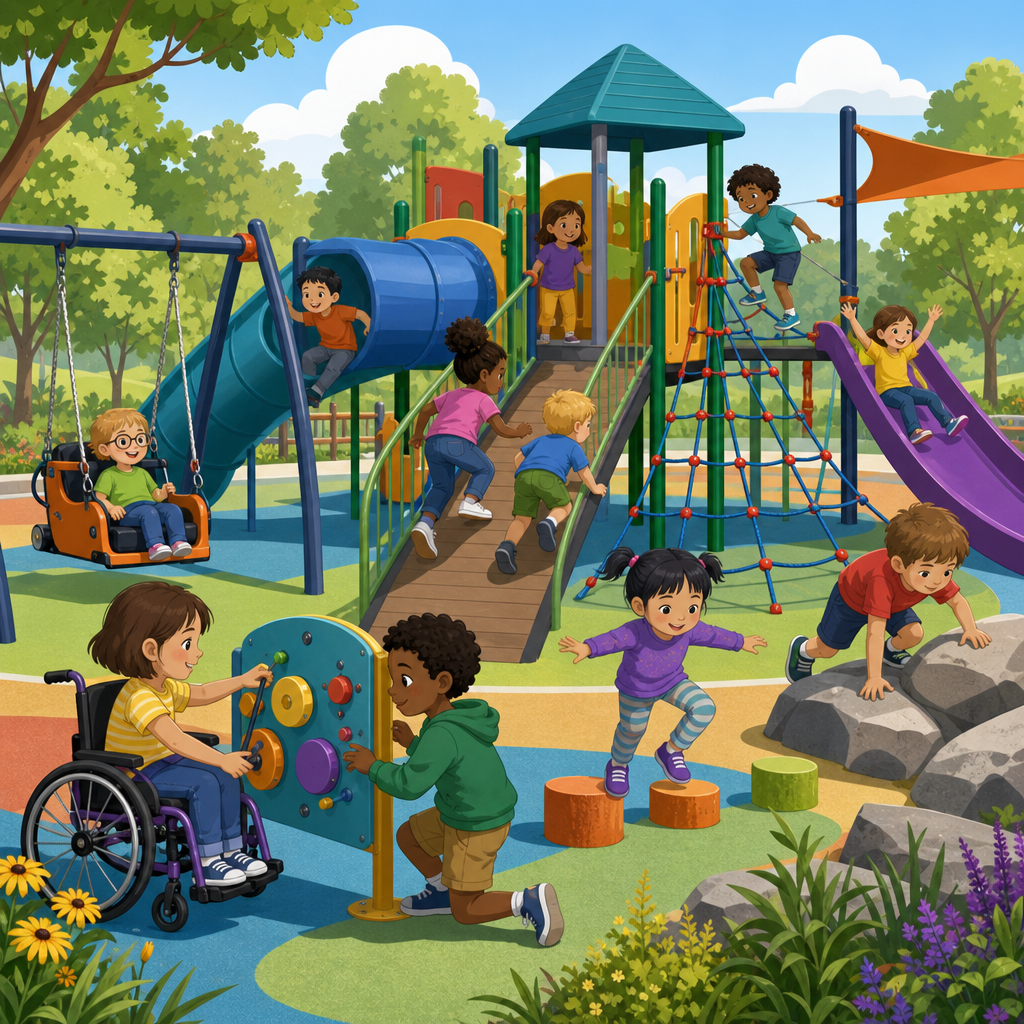
Real inclusion works across five dimensions. Physical inclusion addresses routes, surfacing, transfers, clear widths, turning space, and reach ranges. Sensory inclusion addresses noise, glare, texture, opportunities for retreat, and the availability of both stimulating and calming experiences. Cognitive inclusion supports legibility through clear sequencing, recognizable landmarks, and intuitive navigation. Social inclusion provides different ways to join play, including side-by-side, cooperative, dramatic, and solitary options. Cultural inclusion recognizes that caregivers supervise differently, language access matters, and community identity should appear in the design narrative.
Standards matter here. In the United States, ADA requirements establish legal access obligations, while ASTM and CPSC guidance shape surfacing, use zones, entrapment prevention, and other safety details. Those standards are necessary, but they are not sufficient. Universal design principles push the conversation further by asking whether a child can use the space with dignity, independence, and meaningful choice. For example, an accessible route to a platform is helpful, but a ground-level play zone with equivalent social and imaginative value is often more inclusive because it avoids segregation by design.
Risk is essential for learning when it is managed well
One of the most damaging mistakes in playground planning is treating all risk as a defect. Children need opportunities to assess height, speed, movement, grip, and social negotiation. These experiences build proprioception, vestibular processing, frustration tolerance, and decision-making. Research in child development and playwork has repeatedly shown that risk-rich play supports resilience, confidence, and self-regulation. The key distinction is between acceptable risk and hidden hazard. Acceptable risk is visible and understandable to the child, such as deciding whether to cross a wobble bridge. A hazard is something the child cannot reasonably predict, such as a loose fastener, an entrapment gap, or a surfacing failure.
Designers can support positive risk by creating graduated challenge. Instead of one intimidating climbing feature, provide a sequence: low boulders, net climbers with multiple routes, higher platforms with good sightlines, and overhead elements that require more coordination. This lets children progress according to ability rather than age label. Loose parts, nature play, and topographic variation are also powerful because they allow children to shape their own challenges. A log for one child is a seat; for another, it is a balance beam, a pirate ship, or a negotiating table in an invented game.
Managed risk also reduces conflict between caregivers and operators. When challenge is intentional, visible, and age-appropriate, adults can understand why it exists. Signage and communication help, but layout matters more. Clear supervision lines, differentiated zones for toddlers and older children, and obvious fall zones make a play space feel legible. In projects I have evaluated after opening, complaints about “unsafe” equipment often reflected poor communication or chaotic arrangement rather than a real safety failure. Good design makes challenge look purposeful instead of accidental.
How playgrounds support physical, cognitive, and social development
A playground should function like a layered developmental landscape. Gross motor development is the most obvious dimension: climbing builds upper-body strength, swinging supports vestibular input, balancing improves core stability, and running on varied terrain trains coordination. But the strongest playgrounds do more than exercise muscles. They invite planning, experimentation, and social problem-solving. A child deciding how to move across stepping elements is practicing sequencing and adaptive thinking. A group organizing turns on a spinner is negotiating rules, fairness, and timing. A child using a sand and water area is testing causality, fine motor control, and early scientific reasoning.
Developmental value increases when a site offers open-ended play. Highly scripted equipment can be useful, especially for younger users, but too much single-outcome play narrows imagination. A tower with one ladder and one slide creates a limited loop. Compare that with a mixed zone containing mounds, plantings, loose natural materials, a small stage, and movable seating. Children can construct stories, invent social roles, and shift between active and reflective states. This matters because child development is not linear. Children return to the same environment seeking different experiences depending on age, mood, confidence, and peer group.
Intergenerational design also strengthens developmental outcomes. Caregivers who can sit comfortably near play, move easily through the site, and understand what children are doing stay longer and supervise better. Features such as perimeter seating, shade, stroller parking, drinking fountains, and toilets are not amenities added after the fact; they directly affect whether families can use the park consistently. Repetition matters. A brilliant playground that families can only tolerate for twenty minutes will produce less developmental benefit than a well-designed one that invites daily, extended visits.
Core design strategies that improve inclusion and play value
At the planning stage, start with user groups rather than product catalogs. Define who needs to be served: toddlers, school-age children, siblings with age gaps, autistic children, children with low vision, grandparents, after-school groups, and caregivers with strollers. Then map play experiences against those users. Most design failures happen when teams jump straight to equipment selection without identifying missing experiences such as quiet retreat, social gathering, sensory play, or route-based exploration. Site analysis should cover sun, prevailing wind, drainage, slope, surrounding traffic, tree canopy, and existing desire lines, because these conditions shape comfort and access as much as equipment does.
Zoning is the next major decision. Strong layouts provide overlapping but distinct areas: active challenge zones, imaginative and social zones, sensory-rich nature zones, and calm spaces for retreat. Children should be able to move between these without crossing dangerous bottlenecks. Surfacing should support both accessibility and play quality. Poured-in-place rubber can provide reliable routes, but it becomes hot in full sun and needs disciplined installation and maintenance. Engineered wood fiber is often cost-effective and lower in embodied carbon, but it requires frequent topping up and careful route design to remain accessible. Hybrid strategies often work best.
| Design element | Inclusion benefit | Risk and development benefit | Common design caution |
|---|---|---|---|
| Topographic mounds | Multiple ways to move, sit, observe, and join play | Builds balance, route choice, and confidence | Watch drainage, erosion, and accessible path grades |
| Net climbers | Different entry points and challenge levels | Supports strength, coordination, and problem-solving | Avoid layouts with only one difficult access route |
| Sand and water play | Invites parallel and cooperative play across abilities | Develops fine motor skills and cause-effect learning | Needs drainage, hygiene planning, and shade |
| Quiet nooks | Helps children regulate sensory and social load | Supports self-awareness and return-to-play transitions | Keep sightlines for supervision and safety |
Material selection should align with use intensity and climate. Metal slides overheat in direct sun; dark rubber increases surface temperatures; untreated timber can splinter or decay quickly in wet conditions. Native planting can reduce irrigation demand and strengthen local identity, but plant palettes must be vetted for toxicity, thorns, maintenance burden, and visibility impacts. Durable design is inclusive design because closures and broken components disproportionately affect families with fewer alternative play options.
Nature play, sustainability, and the urban context
Playgrounds are part of urban systems, not isolated amenities. In dense neighborhoods, they can reduce heat stress, manage stormwater, support biodiversity, and encourage walking by making parks more useful destinations. This is where sustainable urban development and playground design meet directly. Shade trees lower surface temperatures and extend dwell time. Permeable surfaces and bioswales reduce runoff. Reused materials, FSC-certified timber, and low-toxicity finishes can lower lifecycle impacts when specified carefully. Even the layout of entrances matters: a playground connected to sidewalks, bike routes, schools, and transit stops serves more families with fewer car trips.
Nature play deserves special attention because it combines inclusion, risk, and development especially well. Logs, boulders, planting, water channels, and changes in landform provide rich sensory input and flexible challenge. They also avoid the repetitive sameness that affects many catalog-driven playgrounds. In one municipal project, replacing part of a conventional structure with a creek-bed play zone and shaded earth mounds increased visit duration and widened the age range of users, because older children stayed to build and experiment while younger children explored at their own pace. The lesson was not that manufactured equipment is bad, but that mixed environments create broader developmental value.
Maintenance planning must be integrated from the start. Naturalized sites fail when owners underestimate staffing, irrigation establishment, litter management, or surfacing replenishment. A sustainable playground is one the operator can actually maintain. That means selecting resilient species, detailing edges that contain loose fill, planning storage for loose parts, and setting inspection routines. The National Recreation and Park Association and major manufacturers consistently emphasize lifecycle thinking for a reason: neglected play spaces lose both trust and function quickly.
Community engagement, evaluation, and long-term success
The most reliable way to improve a playground is to involve the people who will use and manage it. Community engagement should go beyond a single public meeting with a few concept boards. Parents, teachers, disability advocates, maintenance crews, and children themselves notice different issues. Children often reveal circulation problems, missing play choices, and social dynamics that adults overlook. Participatory methods such as model-making, route mapping, sensory preference prompts, and supervised site walks generate better evidence than generic wish lists. In school projects, I have found that student feedback on where they hide, queue, argue, or rest is often more useful than adult assumptions about what they need.
After opening, evaluation should continue. Count not just attendance but diversity of use, dwell time, caregiver satisfaction, independent access, and wear patterns. Observe whether children of different abilities are actually playing together, whether quiet spaces are used as intended, and whether challenge levels are balanced across the site. Post-occupancy evaluation is standard practice in serious design fields, and playgrounds deserve the same discipline. If a spinner is always crowded while a large structure sits empty, the issue may be social usability, not marketing or novelty. Small adjustments in seating, shade, surfacing, or route clarity can significantly improve outcomes.
Designing playgrounds for inclusion, risk, and child development means treating play as essential civic infrastructure. The best playgrounds are accessible without being sterile, challenging without being reckless, and beautiful without sacrificing function. They support physical health, executive function, confidence, sociability, and neighborhood cohesion. They also strengthen sustainable urban development by creating greener, more walkable, more resilient public spaces that families return to repeatedly. If you are planning a new playground or upgrading an existing one, start with user needs, design for meaningful choice, and commit to long-term stewardship. Better playgrounds are built when communities ask not what equipment to buy, but what kinds of childhood they want to support.
Frequently Asked Questions
1. What does it really mean to design a playground for inclusion?
Designing for inclusion means creating a play environment where children with different physical, sensory, cognitive, social, and emotional needs can participate in meaningful ways, not just enter the site. True inclusion goes beyond installing a ramp or a single accessible component. It involves thinking about the full journey: how families arrive, how children move through the space, where they gather, how they regulate sensory input, and whether play choices support different abilities and comfort levels. An inclusive playground should offer multiple ways to engage, including active play, imaginative play, social play, quiet retreat, sensory exploration, and intergenerational interaction.
In practical terms, inclusive design often includes smooth and stable surfacing, accessible routes to elevated and ground-level activities, transfer options, sensory-rich experiences, shaded seating, clear wayfinding, and spaces that support caregivers alongside children. It also means considering children who may be overwhelmed by noise, crowds, or visual complexity. Features such as calm zones, predictable layouts, and varied levels of stimulation can make a significant difference. The strongest inclusive playgrounds are designed with input from disabled people, occupational therapists, educators, maintenance teams, and families, because lived experience often reveals barriers that standard compliance checklists miss.
2. How can a playground include risk without becoming unsafe?
Risk and safety are not opposites in good playground design. Healthy child development depends on opportunities to test limits, build judgment, and experience manageable uncertainty. A playground that removes all challenge may appear safe on paper, but it can limit physical confidence, problem-solving, resilience, and self-regulation. The goal is not to eliminate risk; it is to distinguish beneficial, developmentally appropriate risk from hidden hazards. Beneficial risk includes climbing to a height a child can assess, balancing on uneven elements, moving at speed, or navigating a structure that requires concentration and coordination. Hazards, by contrast, are dangers children cannot reasonably predict, such as entrapment points, poor sightlines, broken equipment, or unsafe surfacing.
Designers can support positive risk by creating graduated challenges for different ages and skill levels. That might mean offering low, medium, and advanced climbing routes, varied swings, boulders or logs with different balance demands, and spaces where children can choose how bold they want to be. Good supervision sightlines, appropriate fall zones, durable materials, and clear maintenance protocols are essential. When challenge is intentionally designed, children gain the chance to develop competence and confidence while caregivers remain reassured that the environment has been thoughtfully managed. In other words, the best playgrounds do not ask children to avoid risk altogether; they help children learn how to engage with risk wisely.
3. Why is playground design so important for child development?
Playgrounds influence child development across nearly every domain: physical, cognitive, social, emotional, and even language development. Physically, they help children build strength, coordination, balance, spatial awareness, and endurance. Activities like climbing, swinging, crawling, spinning, jumping, and balancing support motor planning and core stability, while loose and natural elements can improve dexterity and whole-body movement. But the developmental value of a playground extends far beyond exercise. When children invent games, negotiate turns, test strategies, and explore cause and effect, they are practicing executive function, creativity, and problem-solving in real time.
Playgrounds are also social learning environments. Children learn how to cooperate, read social cues, resolve conflict, take turns, and navigate group dynamics. For some children, shared play builds communication skills and confidence in peer interaction. For others, the ability to observe before joining is just as important. Emotionally, play spaces give children a chance to manage frustration, build resilience, and experience accomplishment. A well-designed playground supports all of this by offering variety rather than a one-note experience. Spaces for movement, role play, nature contact, sensory engagement, challenge, and quiet retreat all contribute to a richer developmental landscape. That is why playground design should be treated as a serious part of public health and child development infrastructure, not as an afterthought in site planning.
4. What design features help serve children with different abilities, temperaments, and cultural backgrounds?
The most effective playgrounds recognize that children do not all play the same way, and they should not have to. Some children seek intense movement, while others prefer observation, repetition, imaginative play, or sensory exploration. Some need social opportunities; others need a little distance before joining in. Designing for this range means including diverse play types and settings rather than relying on one central structure. Features such as wide pathways, quiet nooks, sensory panels, musical elements, nature-based play, group swings, communication supports, varied seating, and play zones with different energy levels can broaden participation. Shade, rest areas, family gathering spaces, and amenities for caregivers also matter because inclusion depends in part on whether the whole family can use the site comfortably.
Cultural responsiveness is equally important. A playground functions as a social commons, so its design should reflect the community it serves. That may influence colors, themes, signage, gathering areas, accessibility priorities, and the kinds of social spaces families value. Community engagement is critical here. Designers should listen carefully to residents, schools, and local organizations to understand how the playground will actually be used and what barriers exist. Materials, symbols, and activities should feel welcoming rather than imposed. When designers account for varied abilities, different sensory profiles, family patterns, and cultural contexts, the result is a space that feels genuinely public and shared rather than technically compliant but socially narrow.
5. How do durability and environmental responsibility fit into modern playground design?
Durability and ecological responsibility are central to good playground design because a play space is only successful if it remains safe, attractive, and usable over time. Materials should be selected not just for appearance, but for maintenance demands, weather performance, replacement cycles, heat retention, and long-term lifecycle cost. High-touch public environments experience heavy wear, so details such as drainage, hardware quality, surfacing transitions, UV resistance, and repair access have a direct impact on safety and operating budgets. A beautiful playground that quickly deteriorates or becomes difficult to maintain can lose both function and community trust.
Environmental responsibility means looking at the site as part of a larger ecological system. Designers can incorporate native planting, shade trees, stormwater management, naturalized play areas, permeable surfaces where appropriate, and materials with lower environmental impact. Reducing summer heat through thoughtful shading and surface choices improves comfort and extends usability, especially in hotter climates. Nature-based play elements can also deepen children’s connection to the environment while supporting sensory and imaginative play. The best approach is balanced: choose materials and systems that are robust, repairable, and suited to local conditions while minimizing unnecessary environmental harm. When durability and sustainability are treated as design fundamentals, playgrounds become stronger community assets that support children, caregivers, and the broader public realm for years to come.