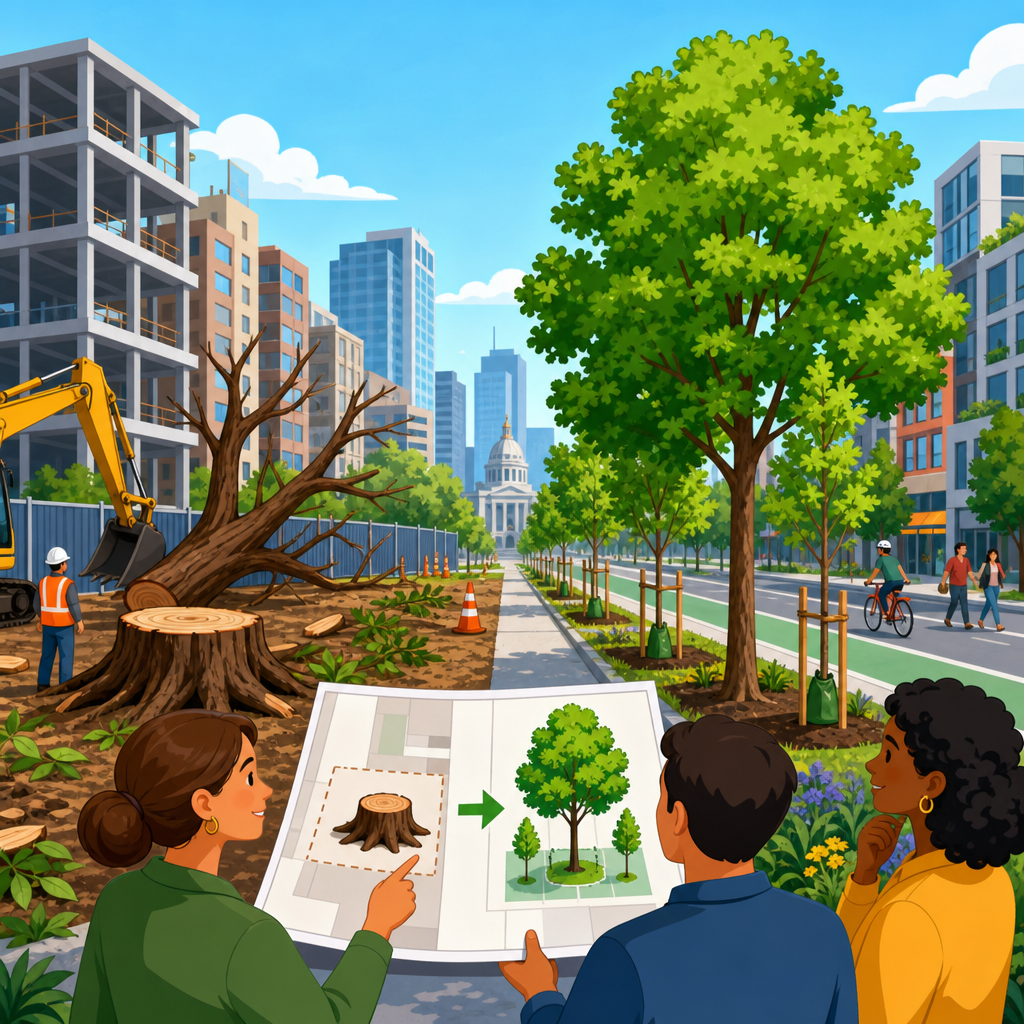
Tree canopy loss and replacement rules shape whether cities stay cooler, healthier, and more resilient as growth accelerates. In practical terms, tree canopy is the layer of leaves, branches, and stems that covers the ground when viewed from above, while replacement rules determine what happens after mature trees are removed for construction, roadwork, utilities, or redevelopment. I have worked with site plans where a single permit erased decades of canopy in one season, and I have also seen ordinances preserve shade, stormwater capacity, and neighborhood character without stopping needed housing. The difference was not rhetoric. It was policy design: clear definitions, measurable targets, enforceable standards, and funding for long-term care. This matters because urban trees are not ornamental extras. They lower surface temperatures, intercept rainfall, store carbon, filter air pollutants, reduce building energy use, calm traffic, support biodiversity, and improve public health outcomes. When canopy disappears and replacement requirements are weak, cities inherit hotter streets, larger drainage burdens, declining habitat, and inequitable exposure to heat. Strong rules can prevent those costs, but only if they account for biology, urban forestry operations, private development economics, and environmental justice.
Any city reviewing tree canopy loss and replacement rules should start from a simple premise: canopy function is not replaced by counting trunks alone. A mature oak removed today cannot be offset by planting one small ornamental tree and declaring no net loss. The ordinance must define protected trees, priority species, critical root zones, and circumstances for removal. It should distinguish preservation from mitigation, because retaining a healthy mature tree almost always delivers more short-term public benefit than planting several saplings. It should also align with related systems such as zoning, stormwater manuals, utility coordination, capital project standards, and landscape maintenance budgets. The most effective policies use geospatial canopy data, parcel-level review, species selection standards, and post-planting survival requirements. They also recognize that replacement is not just a permit condition. It is a long-term management obligation measured in years, not inspection snapshots. For cities trying to balance growth with climate adaptation, the core question is not whether to regulate tree loss. The real question is what cities should require so canopy is protected, replaced credibly, and expanded where need is greatest.
Why cities regulate canopy loss in the first place
Cities regulate canopy loss because urban trees provide public infrastructure benefits that private market decisions usually undervalue. A developer clearing a lot may price excavation, haul-off, and replanting, but the market rarely captures the cooling value to nearby pedestrians, the runoff reduction that eases pressure on storm sewers, or the public health benefit of lower summer heat exposure. That is why strong local rules treat canopy as infrastructure. The U.S. Forest Service has long documented that urban trees reduce energy demand, intercept stormwater, and improve air quality. EPA guidance on green infrastructure also recognizes trees as functional stormwater assets, not only landscape features. In practice, cities that ignore canopy as infrastructure pay later through flood mitigation projects, heat emergency spending, premature pavement degradation, and public dissatisfaction with redevelopment outcomes.
There is also a time-scale problem. Tree loss is immediate, but canopy recovery is slow. Even fast-growing species may take decades to approach the ecological performance of a mature tree. That lag matters in neighborhoods already short on shade. I have seen permitting systems approve mass removals with a promise of replacement planting, only for the public realm to remain exposed for fifteen years. During that gap, sidewalks become less walkable, playgrounds become unusable in summer afternoons, and storefront streets lose foot traffic because thermal comfort falls. A good ordinance addresses the lag directly through preservation priorities, larger-caliper replacement standards where appropriate, off-site planting in high-need areas, and fees calibrated to the real cost of establishment and maintenance.
What a defensible tree protection ordinance should require
A defensible ordinance begins with precise definitions. Cities should define tree canopy, protected tree, heritage tree, specimen tree, invasive species, dead or hazardous tree, dripline, and critical root zone. The American National Standards Institute A300 standards and International Society of Arboriculture terminology provide reliable technical language. Without those definitions, review becomes inconsistent and enforcement collapses under appeals. Thresholds should be tied to diameter at breast height, species value, health condition, and site context. For example, a city may protect all noninvasive trees above a certain diameter, create stricter removal criteria for heritage trees, and exempt dead, dying, or structurally unsound trees confirmed by a qualified arborist.
Cities should also require a tree inventory and preservation plan early in the development process, not after site engineering is effectively complete. The plan should map tree location, species, diameter, condition rating, structural defects, root protection zones, and proposed impacts from grading, trenching, paving, and compaction. If preservation is reviewed only at the landscaping stage, removal becomes a foregone conclusion. Early review allows designers to shift building footprints, reduce curb cuts, cluster utilities, use permeable surfaces, or alter grading to save high-value trees. In successful projects I have managed, one day of coordinated field review among civil engineers, landscape architects, and an arborist preserved more canopy than hundreds of replacement trees could restore quickly.
Protection during construction must be mandatory. Cities should require fencing at the critical root zone, prohibit material storage and equipment traffic within protected areas, and restrict trenching through roots unless approved methods such as air spading, directional boring, or root pruning by qualified personnel are used. Penalties should escalate for unauthorized removal or root damage because most preventable losses occur after permits are issued. A permit without field protection standards is not a tree preservation program. It is paperwork.
How replacement standards should be written so they work
Replacement rules should be based on canopy function, not symbolic planting counts. The strongest ordinances use a hierarchy: first preserve existing healthy trees; if removal is unavoidable, replace on site to the maximum feasible extent; if on-site planting cannot achieve the target, require off-site planting or payment into a dedicated tree fund. The replacement metric can be expressed in several ways: diameter inches replaced, canopy area replaced over time, or a combined formula weighting species, size, and site condition. Diameter-based systems are easy to administer but can distort outcomes if they favor many small trees in poor planting spaces. Canopy-area targets are more closely tied to public benefit, though they require better modeling and monitoring.
Species selection matters as much as quantity. Cities should require climate-appropriate, site-appropriate, noninvasive species with diversity targets that reduce pest vulnerability. The widely used 10-20-30 guideline, popularized in urban forestry practice, recommends limiting any single species to 10 percent of the population, any genus to 20 percent, and any family to 30 percent. While not a rigid law, it remains a useful planning benchmark after losses from Dutch elm disease, emerald ash borer, and other pest outbreaks showed the danger of overreliance on a narrow palette. Replacement rules should also distinguish between utility-conflict sites, narrow planting strips, parking lots, and parks. Planting a large-maturing species beneath primary distribution lines guarantees future topping or removal, undermining the intent of the ordinance.
| Policy element | What cities should require | Why it matters |
|---|---|---|
| Removal threshold | Permit review for protected trees by size, species, and condition | Prevents discretionary loss of high-value canopy |
| Preservation priority | Demonstrate avoidance before mitigation is accepted | Mature trees deliver immediate ecosystem services |
| Replacement metric | Canopy-area or calibrated diameter formula with on-site first | Improves functional replacement, not token planting |
| Planting standards | Minimum soil volume, species diversity, and correct site matching | Raises survival and long-term canopy growth |
| Maintenance period | Three to five years of watering, inspection, and replacement for mortality | Ensures establishment beyond initial installation |
| Fee-in-lieu | Cost based on planting, establishment, and administration | Funds credible off-site canopy restoration |
| Enforcement | Stop-work orders, escalating fines, and withheld certificates | Makes compliance more likely than violation |
Minimum soil volume is one of the most overlooked requirements. A city can mandate dozens of replacement trees, but if those trees are planted in tiny pits surrounded by compacted subgrade, mortality and stunting will be high. Many urban forestry programs now require adequate rooting volume through connected trenches, structural soils, suspended pavements, or planting islands sized for mature growth. This is where ordinance writing must connect to public works specifications. Replacement standards that ignore soil design create the illusion of mitigation while locking in failure.
How to handle fees, off-site planting, and equity
Fee-in-lieu programs are necessary, but they must be structured carefully. A low fee invites removal because paying becomes easier than preserving. A useful fee reflects the full cost of replacing lost public benefit: tree purchase, installation, watering, pruning, inspection, mortality replacement, and administrative oversight. Some cities also adjust fees for tree size or heritage status. The fund should be legally dedicated to urban forestry purposes, with annual public reporting on collections, planting locations, survival, and canopy outcomes. When the money disappears into a general fund, trust evaporates and canopy goals are rarely met.
Off-site planting should prioritize heat-vulnerable and canopy-poor neighborhoods rather than simply the nearest available parcel. This is where equity must be explicit. In many cities, affluent districts enjoy mature streetscapes while lower-income neighborhoods face hotter pavement, fewer parks, and more exposure to traffic pollution. Replacement policy can either reinforce that imbalance or correct it. Requiring geospatial targeting based on canopy cover, land surface temperature, asthma burden, or access to parks helps direct mitigation where public benefit is highest. I have seen this approach transform community support for development because residents can see a clear public return rather than a paper transaction.
Still, off-site mitigation should never become a loophole that normalizes clearing healthy mature trees on every development site. The rule should require proof that on-site preservation and planting were maximized first. Only then should off-site planting or fees be accepted. That ordering matters because neighborhood trees provide hyperlocal shade and character that cannot be fully substituted elsewhere.
Enforcement, monitoring, and the standards that separate strong rules from weak ones
The best ordinance fails without enforcement. Cities should require permit conditions that are visible in the field, not buried in approval letters. Tree protection fencing must be installed before demolition or grading. Inspections should occur at preconstruction, during utility work, during major grading, at planting, and before final acceptance. Developers should post financial security, such as bonds or letters of credit, sufficient to cover unfulfilled planting and maintenance obligations. If certificates of occupancy can be issued before compliance is verified, leverage disappears and replacement rates drop.
Monitoring should extend beyond planting day. A three- to five-year establishment period is realistic because newly planted trees often fail from drought stress, girdling roots, mower damage, poor stock quality, or inadequate maintenance. Cities should require mortality replacement within a defined window and should specify measurable performance standards, such as live crown condition, structural stability, mulch depth, and watering logs. Digital inventories using GIS, QR-coded tree tags, and routine audits make this manageable even for lean departments. What gets mapped gets managed.
Finally, cities should measure outcomes at the canopy level. The point of regulation is not to maximize permit conditions on paper. It is to increase real canopy over time, especially where residents lack shade today. Review annual data by neighborhood, species mix, survival rate, and canopy change from aerial imagery. If losses continue despite planting quotas, revise the ordinance. Strong tree canopy loss and replacement rules are adaptive regulations. Cities should treat them that way.
Tree canopy loss and replacement rules work when they are written as infrastructure policy, not decorative landscaping policy. Cities should require clear definitions, early tree inventories, preservation-first design review, construction protection, realistic replacement metrics, adequate soil volume, long-term maintenance, credible fee-in-lieu programs, and enforceable penalties. They should also target off-site planting to neighborhoods with the greatest heat and canopy deficits while refusing to let off-site mitigation become an easy excuse for avoidable removal. The practical lesson from years of project review is simple: preservation delivers the fastest public benefit, and replacement only succeeds when survival and mature growth are built into the rule.
For city leaders, planners, and public works teams, the payoff is measurable. Strong ordinances protect shade, reduce runoff, improve street comfort, support biodiversity, and build trust that growth will not strip neighborhoods of environmental value. For residents and developers, predictable standards are better than vague discretion because expectations are known early and compliance can be priced accurately. If your city is updating its sustainable urban development policies, start with the canopy code, compare it against these requirements, and close the gaps before the next wave of removals makes recovery slower and more expensive.
Frequently Asked Questions
What are tree canopy loss and replacement rules, and why do they matter so much in growing cities?
Tree canopy loss and replacement rules are the policies that govern how cities track, limit, and offset the removal of trees during development, public works, utility upgrades, road expansions, and redevelopment. Tree canopy itself refers to the layer of leaves, branches, and stems that covers the ground when viewed from above. That overhead cover is not just a visual amenity. It directly affects urban heat, stormwater runoff, air quality, neighborhood comfort, wildlife habitat, and even the long-term durability of streets and buildings exposed to higher temperatures. When mature trees are removed without meaningful replacement standards, cities can lose decades of ecological value in a single construction season.
These rules matter because not all trees provide the same public benefit, and not all replacement programs actually restore what was lost. A large healthy shade tree can deliver far more cooling, rainfall interception, and neighborhood value than several small ornamental trees planted afterward. If a city only requires a one-for-one numerical replacement, it may look strong on paper while still allowing a net decline in canopy cover. Effective rules recognize the difference between preserving mature trees and merely replanting after removal. They also create predictable standards for developers, property owners, and public agencies, which helps reduce conflict and makes permitting clearer.
In fast-growing cities, these policies are especially important because canopy loss tends to happen incrementally and then suddenly becomes visible at the citywide scale. One site plan may remove a handful of significant trees, but hundreds of permits across multiple neighborhoods can lead to hotter streets, more flooding, fewer shaded sidewalks, and reduced resilience during extreme weather. Good replacement rules are therefore not anti-growth. They are a way to manage growth responsibly so that urban development does not steadily strip away the natural systems that make cities livable.
What should cities require when mature trees are removed for construction or redevelopment?
Cities should require a clear hierarchy: avoid removal where possible, protect trees that can remain, and only then allow removal with meaningful replacement or mitigation. That starts with a tree survey and site analysis early in the design process, before a project is largely fixed. If developers can show where high-value trees, specimen trees, and healthy stands exist at the beginning, projects can often be redesigned to preserve the most important canopy. This is usually far more effective than trying to compensate after grading and utility placement have already made preservation impossible.
When removal is unavoidable, cities should require replacement based on canopy value, trunk size, species significance, and site conditions rather than simple tree counts. A diameter-inch replacement standard, canopy-area replacement requirement, or a hybrid model is usually stronger than a flat one-for-one rule. Cities should also distinguish between ordinary removals and the removal of mature, heritage, or protected trees. Larger and more ecologically valuable trees should trigger higher mitigation ratios because the public loss is much greater and recovery takes much longer.
Strong ordinances also need practical implementation standards. These should include minimum tree sizes at planting, approved species lists that prioritize climate-adapted and site-appropriate trees, soil volume requirements, irrigation establishment plans where needed, spacing standards, and maintenance obligations for several years after planting. If on-site replacement is not feasible, cities should define when off-site planting, canopy banking, or fee-in-lieu payments are acceptable and how those alternatives must be used. The best rules do not simply ask whether trees were planted. They ask whether the replacement plan will realistically restore canopy over time and whether it is located where the public benefit is most needed.
How can cities make sure replacement rules restore real canopy instead of just adding small trees that may never compensate for the loss?
The key is to regulate for outcomes, not appearances. Many weak ordinances allow major canopy loss to be offset with a small number of undersized trees planted in difficult conditions. That approach satisfies a paperwork requirement but does little to rebuild shade, cooling, or stormwater benefits. To restore real canopy, cities should measure replacement in terms of expected canopy spread, trunk caliper, diameter inches, or projected ecosystem value rather than relying only on the number of new trees installed.
Site quality is equally important. A replacement tree planted in a narrow strip of compacted soil under utility conflicts is unlikely to survive long enough to provide meaningful canopy. Cities should therefore require minimum soil volumes, rootable space, protection from construction damage, and species-site matching. For example, a large-stature shade tree should only count as such if it is planted in conditions that actually allow it to reach mature size. If a constrained site can only support a small ornamental tree, the ordinance should not treat that planting as equivalent to the removal of a mature canopy tree.
Long-term accountability is what turns a replacement rule into a real restoration policy. Cities should require post-planting inspections, survival benchmarks, replacement of failed trees, and maintenance periods that extend beyond initial installation. It also helps to map where replacement trees are planted and track whether they survive after three, five, and even ten years. Without monitoring, a city may believe it is replacing canopy while actual cover continues to decline. The strongest programs combine preservation incentives, realistic planting standards, and measurable long-term performance so that replacement becomes a durable public asset rather than a short-lived permit condition.
Should cities allow developers to pay a fee instead of planting replacement trees on-site?
Yes, but only under strict conditions and not as the default option. On-site preservation and on-site replacement should almost always come first because they maintain neighborhood shade, reduce the immediate local impact of development, and help spread canopy throughout the city rather than concentrating it elsewhere. However, some sites are genuinely constrained by building footprints, utility corridors, soil contamination, safety setbacks, or limited root space. In those cases, a fee-in-lieu option can be useful if it is structured to produce better long-term canopy outcomes than token on-site plantings that are unlikely to survive.
The problem is that fee programs often fail when the payment is too low, disconnected from actual planting and maintenance costs, or deposited into general funds without a dedicated planting strategy. If cities offer this alternative, the fee should reflect the true cost of replacing lost canopy, including planting, establishment care, maintenance, administration, and mortality replacement. The funds should be restricted to urban forestry purposes and prioritized for neighborhoods with the greatest canopy deficits, heat vulnerability, flooding burdens, or environmental inequities.
Transparency matters here. Cities should publicly report how much money is collected, where trees are planted, what species are used, and how survival is tracked over time. A well-designed fee-in-lieu system can help direct investment to public rights-of-way, parks, schools, and underserved neighborhoods where large-scale canopy gains are possible. A poorly designed one becomes a simple permit surcharge that legitimizes avoidable tree loss. The best policy is to make fee payment a secondary pathway, require proof that on-site options were fully explored, and ensure that off-site mitigation delivers measurable and equitable canopy benefits.
What makes a tree replacement ordinance fair, enforceable, and effective over the long term?
An effective ordinance balances ecological goals with administrative clarity. Fairness begins with clear definitions of protected trees, exempt activities, emergency removals, hazardous conditions, invasive species treatment, and different project types such as single-family lots, commercial development, and public infrastructure work. If rules are vague, they are harder to enforce and easier to challenge. If they are too rigid, they may create unintended barriers without improving canopy outcomes. Cities need standards that are understandable to applicants, consultants, residents, and enforcement staff alike.
Enforceability depends on documentation, inspection, and meaningful consequences. Cities should require pre-construction tree inventories, preservation plans, tree protection fencing, and certified inspections during critical construction phases. Penalties for unauthorized removal should be high enough to deter violations and should scale with the size and significance of the trees lost. It is also important to avoid loopholes that let applicants remove trees in advance of permits or claim damage after the fact. Good ordinances coordinate planning, engineering, and urban forestry review so that tree decisions are not isolated from broader site design and infrastructure choices.
Long-term effectiveness comes from periodic updating and data-driven management. Cities should review canopy trends, permit outcomes, and neighborhood disparities to see whether the ordinance is actually preserving and expanding tree cover. Climate conditions, pest pressures, drought patterns, and development pressures change over time, so species lists, planting specifications, and mitigation formulas should evolve too. The strongest local rules are not just technically sound at adoption. They remain responsive, measurable, and publicly accountable. When cities treat tree canopy as core infrastructure rather than leftover landscaping, replacement ordinances become much more capable of protecting public health, resilience, and livability.