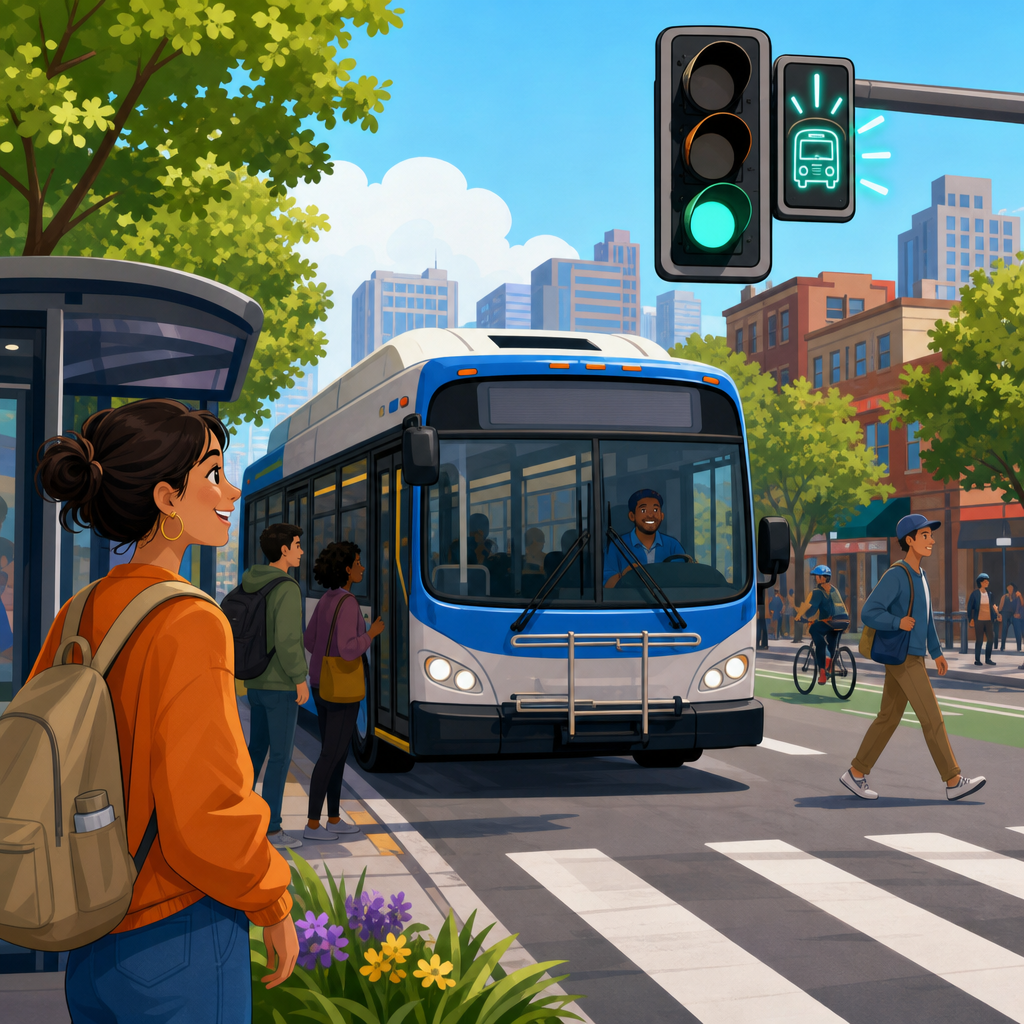
Transit signal priority is one of those transit upgrades most riders never name correctly, yet they feel its effects almost immediately in daily travel. In simple terms, transit signal priority, often shortened to TSP, is a traffic signal strategy that gives buses or streetcars a better chance of getting through intersections by extending a green light, shortening a red phase, or adjusting timing when an eligible vehicle approaches. It is not the same as full preemption, which interrupts normal operations for emergency vehicles or railroad crossings. Instead, TSP works within the signal cycle to improve schedule reliability while limiting disruption for everyone else using the street.
This matters because intersections are where urban transit loses a surprising amount of time. In corridor studies I have worked on, a bus route with modest stop spacing often spent more delay at signals than at passenger boarding points during off-peak periods. Riders do not describe that problem in engineering language. They say the bus hits every red light, creeps downtown, or arrives in bunches after long gaps. TSP addresses those rider-facing failures by reducing avoidable delay where it accumulates most predictably: at signalized intersections.
For cities focused on sustainable urban development, that small operational change has outsized value. Faster, more reliable transit increases the usefulness of existing service without requiring the cost and political complexity of major rail construction. When buses move more consistently, agencies can either reinvest saved running time into better frequency or hold schedules more accurately with the same fleet. That means better passenger experience, lower operating waste, and a stronger case for choosing transit over private car trips. In practice, TSP becomes a service quality tool, a climate tool, and a street management tool at once.
Riders notice results in everyday ways. They see fewer frustrating waits just before the intersection, fewer cases where the bus misses a light after serving a stop, and fewer unexplained schedule swings from one day to the next. They may also notice smoother progression on dedicated transit corridors where buses appear to “catch” coordinated greens. When TSP is designed well, the change feels subtle but consistent. The trip becomes less random, and that predictability is often more valuable to riders than a headline travel time reduction measured only in minutes.
What transit signal priority actually does on the street
At a technical level, TSP depends on three basic components: detection, decision logic, and signal response. Detection identifies an approaching transit vehicle through GPS-based automatic vehicle location, roadside radios, loop detectors, or connected vehicle messages. Decision logic determines whether the vehicle qualifies for priority, often based on lateness, route type, passenger load, or time of day. Signal response then modifies the current or next phase, usually by extending green a few seconds or reducing conflicting phases within pre-set safety bounds. Standards from the National Transportation Communications for Intelligent Transportation System Protocol and controller logic used by suppliers such as Econolite, Siemens, and Yunex support these functions in many North American systems.
In real life, the most common rider benefit comes from conditional green extension. Imagine a bus approaching an intersection just as the green for its direction is about to end. Without TSP, the driver brakes, waits through a full cycle, and loses thirty to ninety seconds depending on the intersection. With TSP, the controller may hold green another five to ten seconds, enough for the bus to clear. That single adjustment does not sound dramatic, but repeated across ten or fifteen intersections, it can materially improve end-to-end reliability. Cities including Portland, Los Angeles, and Toronto have used this type of strategy on bus and streetcar routes with measurable operational gains.
Another common treatment is red truncation, where the bus still faces a red signal, but the system slightly shortens the remaining red time for conflicting movements. This is useful where the transit approach does not currently have green. Riders perceive it as “less sitting,” especially near major cross streets. However, traffic engineers must protect pedestrian minimums, clearance intervals, and coordination plans. TSP is therefore not a free pass at every signal. The best systems respect the larger network while still favoring transit where delay is most harmful. That balanced design is why good TSP usually improves transit performance without triggering major side-street breakdown.
Route context matters. TSP works best where buses encounter recurring signal delay and where intersection spacing gives the system enough opportunities to help. It is less useful on lightly signaled suburban roads or corridors where congestion from double parking, long dwell times, or blocked lanes causes more delay than signals. In those cases, agencies often combine TSP with bus lanes, stop consolidation, all-door boarding, or queue jumps. From experience, the strongest rider outcomes come when agencies treat TSP not as a gadget but as one part of a corridor operating plan.
What riders notice first: reliability, not technology
Most passengers never ask whether a corridor uses green extension, connected vehicle architecture, or central signal software. They notice whether the bus shows up when expected and whether the trip feels steady. Reliability is the first real-world effect because TSP reduces random delay at known bottlenecks. A route that once lost uneven amounts of time at every major intersection starts to behave more consistently, especially in the shoulder periods when a single missed light can disrupt headways for the next hour. Riders describe that improvement as the bus being “less unpredictable.”
Travel time savings are real, but they are often modest at the individual trip level. Many TSP projects report average savings of a few percent corridor-wide, not dramatic double-digit reductions. That does not mean the investment lacks value. A two-minute reduction on a twenty-five-minute trip matters, but the larger benefit is often variance reduction. If a route reliably takes twenty-three to twenty-six minutes instead of anywhere from twenty-one to thirty-two, riders can plan around it. That planning confidence influences mode choice more than many agencies assume. People tolerate a moderate trip if it is dependable; they abandon transit when every trip is a gamble.
Riders also notice fewer situations where the bus serves a near-side stop, pulls out, and immediately misses the green. This is one of the most visible use cases for TSP because it feels especially wasteful from the passenger seat. Effective systems account for stop location and departure timing so the bus can still request priority after boarding activity. On transit malls and rapid bus corridors, this can make service feel intentionally designed rather than chronically unlucky. That perception matters because confidence in the system is built from repeated small moments, not just annual performance reports.
Another visible change is bunching reduction, though TSP alone cannot solve bunching caused by poor dispatching or heavy crowding. When one late bus gets modest help through intersections, it is less likely to fall further behind and less likely to be overtaken by the following vehicle. Agencies in cities such as Chicago and New York have paired corridor signal treatments with active headway management because reliability problems are rarely solved by one intervention. Riders notice the result when the service pattern becomes more even and less erratic across the week.
Where transit signal priority works best and where it falls short
TSP performs best on frequent surface transit routes with significant intersection delay, strong signal system control, and clear policy support for prioritizing transit movement. Urban arterials with many signalized intersections, bus routes carrying high passenger volumes, and corridors already identified for speed and reliability improvements are ideal candidates. Bus rapid transit and streetcar lines also benefit because they have predictable paths and can justify more tailored signal timing plans. In projects I have reviewed, the strongest returns come where agencies first map delay by intersection and then target priority only where recurring losses justify intervention.
It is less effective where the main problem is curb friction rather than signal delay. Double-parked delivery vehicles, ride-hail pickups, narrow stop zones, and slow fare payment can erase any signal benefit. Mixed-traffic streetcars face an additional limitation: if they are trapped behind turning cars or blocked tracks, a favorable signal does not help. Likewise, corridors with severely oversaturated traffic may have little flexibility left in the timing plan. In such cases, a city may need dedicated lanes, turn restrictions, or stop changes before TSP can deliver noticeable passenger gains.
| Street condition | Likely rider experience | TSP impact |
|---|---|---|
| Frequent signals, moderate congestion, bus stop after intersection | Bus clears lights more consistently | High |
| Frequent signals, near-side stops, good detection | Less wasted waiting after boarding | High |
| Heavy double parking and blocked lanes | Bus still gets stuck between signals | Low to moderate |
| Severely congested corridor with little timing flexibility | Small or inconsistent gains | Moderate |
| Low-frequency suburban route with few signals | Minimal visible change | Low |
There are also tradeoffs. Giving transit more green time can slightly increase delay for cross traffic, left turns, or pedestrians if applied aggressively. That is why mature programs use conditional logic rather than blanket priority. Some cities only grant requests when a bus is behind schedule, carrying high loads, or operating on designated transit priority corridors. Others cap how often a signal can grant requests in a cycle window. The goal is not to make every bus dominant at every intersection. The goal is to improve person-throughput and service reliability without undermining safety or creating unacceptable side effects.
How agencies measure success and why riders should care
Agencies and city traffic departments typically judge TSP performance using metrics riders indirectly feel every day: travel time, schedule adherence, headway regularity, and intersection delay. They also monitor cross-street impacts, pedestrian compliance with minimum walk and clearance intervals, and network coordination quality. A well-run evaluation compares before-and-after data by time period rather than relying on corridor averages alone. Morning peak, midday, school dismissal, and evening periods can produce very different outcomes. Good analysis also controls for service changes, roadwork, weather, and seasonal traffic variation so agencies do not overstate the effect.
Automatic vehicle location data has made this easier. Using archived GPS traces, planners can estimate delay distribution at each intersection and identify where requests are frequently granted, denied, or mistimed. That detail matters because a corridor may show weak average savings even while several intersections produce strong localized benefits. Agencies can then retune request thresholds, detection zones, and phase limits. In practice, TSP is rarely perfect on day one. The best programs treat deployment as iterative operations work, with field observation, driver feedback, and controller log review informing continuous adjustment.
Riders should care because these measurements translate directly into service quality and agency efficiency. If a route saves enough running time, transit agencies may reduce recovery time padding, improve schedule accuracy, or add trips without proportional operating cost increases. For high-frequency routes, even small speed gains can lower the number of buses needed to maintain a given headway. That can free vehicles and operators for other lines. In budget terms, intersection seconds become service hours. From a rider’s perspective, that can mean shorter waits, more dependable connections, and fewer cases where a late bus misses a timed transfer that turns a simple commute into an hour-long problem.
What better implementation looks like in a sustainable city
The most successful transit signal priority programs are not standalone technology purchases. They are part of a broader street strategy that aligns traffic engineering, transit operations, accessibility, and land use. A sustainable city uses TSP where it supports corridors with high bus ridership, dense destinations, and strong pedestrian activity. It connects signal priority to bus lanes, transit-supportive zoning, safer crossings, and stop design that reduces dwell time without compromising accessibility. When those elements are coordinated, the rider experiences a system that is faster because the city has decided transit should move people efficiently, not because a signal controller happened to be upgraded.
Implementation quality also depends on institutional cooperation. Traffic departments often own the signals, while transit agencies own the vehicles and operational data. When those groups share objectives, projects move from pilot status to corridor standards. I have seen the difference firsthand: corridors perform better when engineers, schedulers, and field supervisors jointly review intersection logs and on-board data instead of treating timing and service planning as separate worlds. The practical outcome is better calibration, clearer rules for when priority should be granted, and faster fixes when riders report persistent trouble spots.
For cities building their subtopic coverage around sustainable urban development, TSP is a strong hub subject because it touches mobility, emissions, equity, and public realm performance at once. Reliable buses improve access to jobs and services for riders who depend on transit most. Better speeds can reduce idling and operating waste. Stronger surface transit also supports compact growth by making dense corridors function better before expensive capital expansion arrives. If your city is evaluating bus improvements, start by identifying signal delay hot spots, reviewing stop placement, and asking a practical question riders ask every day: where does the bus lose time for no good reason?
The answer often leads straight to the intersection. Transit signal priority will not fix every transit problem, but it consistently improves one of the most common rider frustrations: needless waiting at red lights. When deployed on the right streets, with careful signal logic and clear performance tracking, it makes service feel steadier, smarter, and more worth using. That is what riders notice in real life. If you plan, manage, or advocate for better urban mobility, make TSP part of your next corridor review and judge it by the experience passengers actually have.
Frequently Asked Questions
What is transit signal priority, and how is it different from changing all traffic lights for transit?
Transit signal priority, or TSP, is a traffic signal strategy that helps buses and streetcars move through intersections with fewer unnecessary stops. When an eligible transit vehicle approaches a signal, the system can make a small timing adjustment, such as extending a green light for a few extra seconds or shortening a red phase so the vehicle does not sit through a full cycle. The goal is not to stop all other traffic on demand, but to give transit a better chance of staying in motion and staying on schedule.
That distinction matters because TSP is often confused with full signal preemption. Preemption is much more disruptive and is typically reserved for emergency vehicles like fire trucks, where the signal changes immediately to clear a path. TSP is more measured. It works within the normal signal plan and usually applies only under specific conditions, such as when a bus is behind schedule, carrying a transponder, or operating on a corridor where transit reliability is a priority. For riders, the practical difference is simple: TSP usually feels like a smoother, quicker trip, not like the whole street has been halted to favor one vehicle.
What do riders actually notice in real life when transit signal priority is working?
Most riders do not identify TSP by name, but they often notice the results right away. The most obvious effect is fewer frustrating stops at intersections where the bus or streetcar seems to miss the light by only a second or two. With TSP in place, vehicles are more likely to glide through signals that otherwise would have turned red just before arrival. That means less stop-and-go motion, fewer abrupt brake-and-accelerate cycles, and a trip that feels more continuous.
Riders also notice that travel times become more predictable. Even if the total time savings on one trip is modest, saving a little time at several intersections adds up across a route. This can make service feel more dependable, especially on corridors with frequent lights. A rider may not say, “The green extension improved schedule adherence,” but they will notice that the bus arrives more consistently, connects better with transfers, and spends less time stuck at the same intersections every day. In other words, the rider experience improves not because one intersection changes everything, but because many small delays are reduced across the full trip.
Does transit signal priority make a big difference in travel time, or is it mostly about reliability?
In most real-world applications, TSP helps with both travel time and reliability, but reliability is often the bigger win. A few seconds saved at one signal may not sound dramatic on its own, yet a route that encounters dozens of signals can gain meaningful time over the course of a trip. More importantly, TSP reduces the randomness of delays. Transit systems perform better when buses and streetcars can move through intersections in a more consistent way rather than getting trapped by red lights that break up spacing and throw off schedules.
For riders, reliability often matters more than raw speed. A trip that takes 28 minutes every day is usually easier to plan around than a trip that might take 22 minutes one day and 35 the next. TSP helps narrow that uncertainty. It can reduce bunching, improve on-time performance, and make service feel less erratic. That is why agencies often view TSP as a practical operations tool rather than just a speed booster. Riders may appreciate the shorter trip, but they often value even more the sense that the vehicle will arrive and move the way it is supposed to.
Does giving priority to buses and streetcars make traffic worse for everyone else?
In most well-designed systems, TSP does not dramatically worsen conditions for other road users because the timing changes are limited and carefully controlled. A green may be held a little longer, or a red may be shortened slightly, but these are usually small adjustments rather than major interruptions. Traffic engineers typically set rules that limit how often priority can be granted, which vehicles qualify, and how signals recover to normal timing afterward. The idea is to improve transit performance without causing unacceptable disruption to cross traffic, pedestrians, or corridor coordination.
It is also important to remember that transit carries many people in a relatively small amount of street space. Helping one full bus clear an intersection more efficiently can benefit dozens of riders at once. On busy corridors, that can be a strong public value proposition even if drivers occasionally experience a minor change in signal timing. In practice, the impact on general traffic often depends on the street design, the volume of transit service, and how aggressively the system is configured. When implemented thoughtfully, TSP is less about making cars suffer and more about reducing avoidable delay for high-capacity transit in a balanced way.
Why do some transit routes feel much better after signal upgrades even if riders cannot point to one major change?
That is because TSP works as a cumulative improvement. Riders often expect transit upgrades to be obvious, like a new bus lane, a bigger station, or brand-new vehicles. Signal priority is different. It improves the experience in small, repeated moments across the route. A bus catches one more green at a busy cross street, avoids one long red near a transfer point, and gets through another intersection before traffic backs up. None of those moments may seem dramatic on their own, but together they make the trip feel smoother, calmer, and less wasteful.
This is one reason TSP can be so valuable from a rider perspective. It addresses the daily friction that makes transit feel slow and unreliable even when distances are short. Riders may not see a visible piece of infrastructure, but they feel the reduced idling, the fewer missed lights, and the more stable pacing of the trip. Over time, that changes perception. A route starts to feel less frustrating and more usable, especially for commuters who take it regularly and know exactly where delays used to happen. In real life, that is often how successful transit improvements show up: not as a single dramatic moment, but as a steady reduction in little annoyances that used to define the ride.