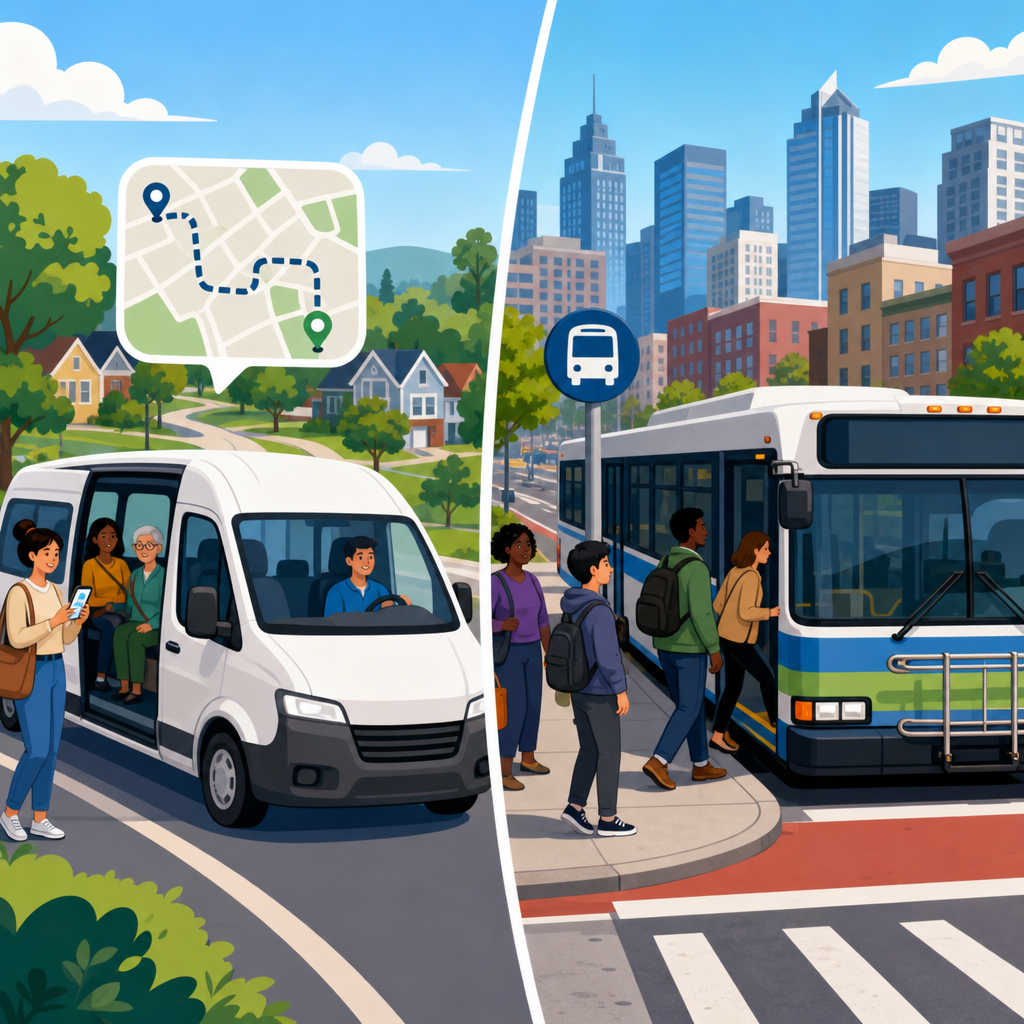
Microtransit sits at the intersection of public transit, demand-responsive technology, and urban policy, offering shared rides that flex by time and location instead of following a fixed timetable along a fixed route. In practical terms, microtransit usually means app-booked vans, shuttles, or small buses that group nearby passenger requests and adjust paths dynamically. Fixed-route transit, by contrast, runs on predetermined corridors and schedules, from local buses and bus rapid transit to trams and metro feeders. The debate is not whether one mode should replace the other. The real question is where microtransit works best, where fixed routes still win decisively, and how agencies can combine both without weakening network performance, equity, or climate goals.
That distinction matters because many cities are trying to reduce car dependence, improve access to jobs and services, and control rising operating costs at the same time. I have worked on transit planning exercises where local leaders were drawn to the flexibility of on-demand service, only to discover that flexibility alone does not guarantee efficiency. When demand is dispersed, trip purposes vary, and street patterns are fragmented, microtransit can fill an important gap. When demand is strong, predictable, and concentrated along corridors, fixed routes almost always move more people at lower cost per passenger. Understanding that boundary helps agencies avoid expensive pilots that never scale and instead build transit networks that are practical, legible, and sustainable.
Definitions also matter. Microtransit is not the same as paratransit, though the services can share software, dispatch tools, and small vehicles. It is not simply ride-hailing funded by government, and it is not a substitute for complete streets or walkable land use. Most microtransit programs use virtual stops, service zones, booking windows, and routing algorithms to pool trips. Success depends on a short list of measurable outcomes: average wait time, passenger travel time, passengers per vehicle hour, subsidy per trip, on-time pickups, and access to priority destinations. Fixed-route service is judged on related but different metrics, including boardings per revenue hour, load factor, schedule adherence, span of service, and corridor productivity. Comparing the two requires matching each mode to the right operating context.
For a sustainable urban development strategy, this topic is central because transit is not just a mobility product. It shapes land use, emissions, household transportation costs, and inclusion. A high-frequency bus line can support denser mixed-use development because its presence is visible and permanent. A microtransit zone can extend mobility in lower-density neighborhoods, industrial districts, suburbs, or off-peak periods where full-route service would run nearly empty. The strongest networks recognize that permanence and flexibility are complementary tools. The planning challenge is to know which tool to use, when to use it, and how to protect the core frequent network while still serving places that fall outside it.
Where microtransit works best
Microtransit performs best in places where travel demand is real but too thin, scattered, or time-variable to support productive fixed routes. Common examples include suburban employment campuses, low-density residential areas, business parks, edge-city medical complexes, university satellite facilities, and industrial zones with shift changes outside standard commuting peaks. In these settings, a 40-foot bus running every thirty minutes often produces low ridership and long walks to stops. A smaller vehicle operating within a defined zone can reduce access friction by picking riders up closer to origin points and dropping them at rail stations, town centers, hospitals, or major bus corridors.
First-mile and last-mile connections are the clearest use case. Consider a commuter rail station surrounded by cul-de-sacs, disconnected street networks, and arterial roads that are unpleasant to cross on foot. Riders may live only two miles away yet face a twenty-minute walk to a local bus stop, another wait, and a transfer that jeopardizes train connections. A station-focused microtransit service can consolidate those local trips into timed feeder service, especially during peak periods. In practice, I have seen this model work when agencies kept the service zone tight, synchronized pickup windows with train schedules, and resisted pressure to chase every trip purpose across a wide geography.
Microtransit also makes sense when agencies need temporal flexibility. Late-night service, weekend coverage, and shift-oriented operations are hard to deliver efficiently with fixed routes because demand spikes at specific places and then collapses. Warehouses, airports, logistics hubs, casinos, and hospitals often generate this pattern. A demand-responsive service can meet workers when and where they actually travel, especially if booking can be done by app, phone, and web to avoid excluding riders without smartphones. In those situations, microtransit is not a novelty. It is a labor-market access tool that can connect workers to jobs while avoiding the cost of running mostly empty buses for long spans.
Rural towns and small cities can benefit as well, but only if expectations are realistic. Microtransit can improve coverage where density is low and destinations are spread out, yet trip lengths are often longer and pooling opportunities weaker than in compact urban settings. That means the service may expand access without ever approaching the productivity of urban fixed routes. Agencies that succeed in these contexts define clear goals: mobility for seniors, access to healthcare, connections to regional transit, or replacement of underperforming deviation routes. They do not promise metro-like spontaneity. They promise reliable shared mobility within known limits, and riders respond better when those limits are stated plainly.
Where fixed routes still win decisively
Fixed routes outperform microtransit wherever demand is concentrated enough to fill buses or trains consistently along a corridor. Dense urban neighborhoods, main streets, college districts, radial commuter corridors, and crosstown routes linking multiple activity centers all favor scheduled service. The reason is simple mathematics. Once many people want to travel from roughly the same places to roughly the same places at roughly the same times, the efficiency gains from pooling on a repeated path overwhelm the flexibility advantage of demand response. A bus stopping every few blocks on a frequent route can board dozens of passengers in the time a microtransit van spends deviating to collect three or four.
Legibility is another advantage fixed routes retain. Riders understand a visible stop, a published timetable, and a route map. Frequent service reduces planning burden because passengers know a bus will come soon without booking. That certainty matters for lower-income riders, people making chained trips, and anyone who values spontaneous mobility. Fixed routes also create durable signals for development. Developers, employers, and institutions can plan around a corridor with confidence in ways they rarely do around a pilot microtransit zone that may change boundaries or operating rules every six months.
Capacity is where fixed routes become non-negotiable. A standard bus can carry far more passengers per driver than a van, and bus rapid transit or light rail can increase throughput further with dedicated lanes, priority signaling, and larger vehicles. If a corridor already has recurring crowding, replacing or thinning fixed-route service in favor of on-demand vehicles usually worsens service quality and raises labor cost per passenger. The transit labor market makes this especially important. Drivers are expensive and increasingly hard to recruit. Any mode that carries fewer passengers per operator hour should be reserved for contexts where its flexibility delivers clear access benefits.
Equity and accessibility also often favor fixed routes when the network is designed well. Sidewalk-connected stops, all-door boarding, level access, stop announcements, and predictable schedules can be easier for many riders than a digital booking workflow, variable pickup point, or uncertain travel path. Microtransit can improve mobility for some users, especially where fixed-route access is poor, but it can also create barriers if cash payment is limited, call centers are under-resourced, or pickup windows are inconsistent. For that reason, the strongest agencies protect frequent fixed service on productive corridors and treat it as the backbone of equitable mobility.
Comparing performance, costs, and rider experience
When agencies compare microtransit and fixed routes, they should evaluate service design through operational metrics rather than novelty. Four measures usually tell the story: passengers per revenue hour, average wait time, subsidy per passenger, and door-to-destination travel time. A microtransit service may beat a weak hourly bus on customer convenience while still costing much more per trip. Conversely, a fixed route may have lower subsidy per rider but fail to reach neighborhoods beyond a safe walking distance. The right answer depends on whether the corridor’s main need is productivity, coverage, feeder access, or temporal flexibility.
| Factor | Microtransit | Fixed Route |
|---|---|---|
| Best context | Dispersed demand, low density, off-peak, first/last mile | Dense corridors, predictable demand, all-day frequent travel |
| Typical strength | Flexible coverage and shorter access distance | Higher capacity and lower cost per passenger at scale |
| Main risk | High subsidy, long detours, weak pooling | Poor coverage in spread-out areas |
| Rider tradeoff | Booking required, variable trip time | Walking required, but service is visible and predictable |
Software and dispatching tools have improved materially in the last decade. Platforms from vendors such as Via, Spare, RideCo, and TransLoc can optimize pickups, virtual stops, and pooling logic in real time. Yet no software can break the geometry of dispersed demand. If origins and destinations are scattered and time sensitivity is high, the algorithm either creates long detours for riders or low productivity for operators. That is why agencies should be wary of pilot claims built on gross ridership totals without publishing trip productivity, average shared occupancy, and subsidy levels. Useful reporting compares the service against the route or service gap it is meant to replace, not against an idealized baseline.
Rider experience often decides public acceptance. Microtransit can feel premium when wait times are short, pickup points are intuitive, and travel paths are direct. It feels frustrating when riders are asked to walk unexpectedly, vehicles arrive outside the promised window, or pooled trips meander. Fixed-route transit has the opposite profile: less personalized access, but often more predictable in strong corridors. Agencies should test both modes through the full passenger journey, including booking, transfers, payment, and accessibility features. The service that looks efficient in a spreadsheet can fail in real life if the transfer is confusing or if a missed connection turns a twenty-minute trip into a fifty-minute one.
How to build a network where both modes succeed
The most effective strategy is not mode competition. It is network hierarchy. Start with a frequent fixed-route backbone on corridors with strong all-day demand. Protect that service from resource erosion because it carries the greatest passenger volume and creates the clearest sustainability benefits. Then deploy microtransit selectively where it can feed the backbone, replace highly unproductive fixed-route tails, or serve time periods and districts that a corridor model cannot cover efficiently. This approach preserves network legibility while widening access.
Good implementation requires tight service design. Define a limited zone, cap maximum detour time, use virtual stops where safe, and connect riders to transit hubs and major destinations rather than allowing unrestricted point-to-point trips across large areas. Set clear policies for fares, transfer integration, and booking channels. If the fixed-route network uses a common fare capping system, the microtransit service should align with it. Agencies should also publish performance thresholds in advance. For example, if passengers per vehicle hour remain below target after a defined ramp-up period, redesign the zone or shift the resources elsewhere. Transparent rules reduce political pressure to keep weak pilots running indefinitely.
Street design and land use still matter. Microtransit cannot compensate for dangerous walking conditions, disconnected sidewalks, or zoning that isolates homes from jobs and shops. In fact, many places that appear to “need” microtransit actually need safer access to frequent corridors, bus priority, or better stop placement. Sustainable urban development improves transit by shortening trips and concentrating destinations. Where cities allow compact mixed-use growth near fixed routes, the case for permanent high-frequency service strengthens. Where development remains scattered, microtransit may play a role, but usually as an adaptive connector rather than the center of the system.
The key takeaway is straightforward. Microtransit works where demand is too dispersed or time-specific for productive fixed routes, especially for first-mile and last-mile links, low-density districts, and off-peak service. Fixed routes still win on dense corridors, for capacity, legibility, equity, and cost efficiency at scale. Cities do not have to choose one philosophy. They need a disciplined network strategy that matches each service type to the demand pattern it serves best. If you are shaping a sustainable urban development agenda, start by identifying your core frequent corridors, then use microtransit carefully to extend access without weakening the transit backbone that makes cities function.
Frequently Asked Questions
What is microtransit, and how is it different from traditional fixed-route transit?
Microtransit is a form of shared public transportation that uses demand-responsive scheduling instead of strictly following a fixed path and timetable. In most cases, riders request trips through a mobile app, website, or call center, and software groups nearby requests into shared rides operated by vans, shuttles, or small buses. Rather than serving every stop along a predetermined corridor, the vehicle’s route can shift based on who books rides, when they travel, and where they need to go. That flexibility is the defining feature of microtransit.
Fixed-route transit works differently. Buses, light rail, bus rapid transit, and streetcars typically run along established corridors, stop at known locations, and follow published schedules or frequent service patterns. Riders do not need to request service in advance because the route exists whether or not a specific trip is booked. This makes fixed-route systems highly legible, easy to plan around, and especially effective where there is consistent, concentrated demand.
The core tradeoff is flexibility versus efficiency at scale. Microtransit can better match lower-density or uneven travel patterns because it adjusts to real-time demand. Fixed routes generally move more people more efficiently when there are enough riders traveling along common corridors. In other words, microtransit is often strongest as a targeted tool for specific settings, while fixed-route transit remains the backbone of high-capacity urban mobility.
Where does microtransit tend to work best?
Microtransit tends to perform best in places where travel demand exists but is too dispersed, inconsistent, or geographically challenging to support frequent fixed-route service. That often includes suburban neighborhoods, exurban communities, industrial districts, business parks, university campuses, and lower-density areas where homes, jobs, and destinations are spread out. In these environments, running large buses on rigid schedules can produce long wait times, low ridership, and expensive service per passenger. A more flexible, demand-responsive model can offer better coverage and a more convenient rider experience.
It can also work well during times when demand drops below the threshold needed for full fixed-route operations, such as late evenings, early mornings, weekends, or overnight hours. Agencies sometimes use microtransit to preserve mobility during low-demand periods without operating mostly empty buses. Another strong use case is first-mile/last-mile connectivity, where microtransit helps riders reach rail stations, major bus corridors, medical centers, or downtown hubs from neighborhoods that are not within comfortable walking distance of high-frequency transit.
Microtransit may also be valuable in situations with unusual street networks or physical barriers, such as cul-de-sacs, winding suburban road patterns, steep terrain, or fragmented development that makes direct bus routing difficult. In these cases, microtransit can provide more direct service than a traditional bus route that would otherwise need to make long deviations. However, its success usually depends on clear service design, a well-defined zone, realistic trip demand, reliable software, and a strong connection to the broader transit network rather than trying to replace it entirely.
When do fixed routes still outperform microtransit?
Fixed routes still outperform microtransit in any corridor where many people are traveling in similar directions at similar times. Dense urban neighborhoods, major commuter corridors, downtowns, university districts, and high-demand arterials are classic examples. In these environments, predictable, frequent service allows transit to move large numbers of people efficiently and at lower cost per rider. A full-size bus or train serving a well-used corridor will almost always outperform a fleet of smaller on-demand vehicles trying to make many individualized pickups and drop-offs.
Frequency and simplicity are also major advantages. Riders do not need to reserve a trip, wait for an app to assign a vehicle, or accept detours created by ride pooling. They simply go to a stop and board. That kind of turn-up-and-go convenience is essential for transit systems that support daily commuting, spontaneous errands, school trips, and reliable transfers. Fixed routes are especially effective when they come often enough that riders do not need to plan around a schedule.
Capacity is another reason fixed routes still win in the right places. As demand increases, microtransit often becomes less efficient because every additional rider adds scheduling complexity, pickup delay, and circulation time. Fixed-route service scales better because one vehicle can serve many riders moving along the same corridor. That is why cities with strong transit networks typically use fixed routes for trunk service and reserve microtransit for niche applications, coverage gaps, or feeder connections rather than the busiest parts of the system.
Is microtransit more cost-effective than running fixed-route buses?
Not automatically. Microtransit can be more cost-effective in the right context, but it is not inherently cheaper than fixed-route service. The economics depend heavily on demand patterns, vehicle occupancy, trip lengths, labor costs, dispatch technology, service area design, and how success is being measured. In low-density areas where a fixed-route bus might carry very few passengers, microtransit can reduce waste by serving only the trips that are actually requested. In that setting, demand-responsive service may deliver better coverage or shorter travel times for a comparable or even lower subsidy per useful trip.
However, microtransit often becomes expensive if agencies expect it to provide near door-to-door convenience at scale. Smaller vehicles carry fewer passengers, and dynamic routing can increase driver hours and operating complexity. If too many riders request trips at once, wait times rise and productivity can fall. In high-demand environments, fixed-route buses usually provide much better cost efficiency because they can move more people per operator and per vehicle hour. That basic arithmetic is one of the main reasons fixed routes remain central to most transit systems.
Agencies evaluating cost-effectiveness should look beyond simple headlines and compare metrics carefully. Useful measures include cost per passenger, passengers per revenue hour, average wait time, on-time performance, trip denials, equity outcomes, and how well service connects to jobs, healthcare, education, and regional transit. A microtransit pilot can look successful if it improves convenience for a small number of users, but the broader question is whether it delivers enough public value relative to alternatives such as redesigning a fixed route, increasing frequency on a corridor, or investing in better pedestrian access to existing transit.
Can microtransit replace fixed-route transit, or is it better as a complement?
In most cases, microtransit works best as a complement to fixed-route transit rather than a wholesale replacement. Public transportation systems are strongest when each mode is used for what it does best. Fixed routes are generally the most effective way to provide frequent, legible, high-capacity service along corridors with strong demand. Microtransit is better suited to solving specific problems around access, coverage, low-density service, and off-peak mobility. When agencies try to use microtransit as a substitute for the entire network, they often run into limits around cost, capacity, reliability, and rider comprehension.
The most successful model is usually a layered system. High-frequency buses, bus rapid transit, rail, or other fixed routes form the trunk network. Microtransit then supports that network by feeding stations, covering lower-density edges of the service area, or maintaining service during periods when fixed routes would be underused. This approach allows agencies to preserve the productivity advantages of fixed routes while using flexible service where it can add the most value.
There are also important equity and accessibility considerations. Not every rider has a smartphone, a bank card, or comfort with app-based booking. Some riders rely on highly predictable stops and schedules. For that reason, agencies deploying microtransit should provide multiple booking options, transparent fares, accessible vehicles, and clear service rules. The goal should not be to chase novelty, but to improve the overall usefulness of the transit network. In practice, that means recognizing that microtransit can be an important tool, but fixed routes still remain the foundation wherever demand is strong enough to support them.