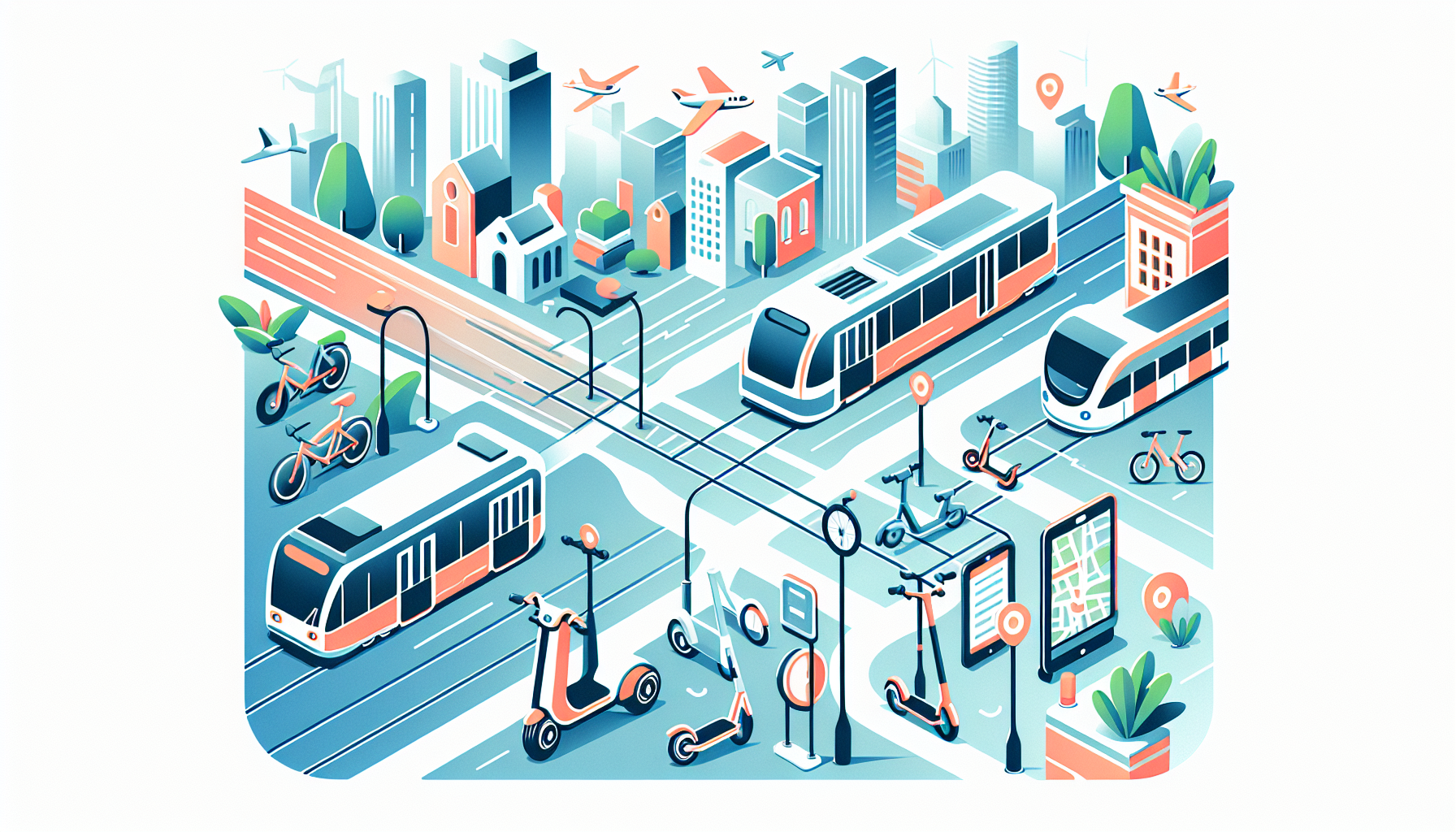
Mobility services now play a central role in enhancing public transit because they solve the practical gaps that fixed-route buses, rail lines, and paratransit systems cannot cover alone. In transportation planning, mobility services refers to the broad set of on-demand, shared, digitally enabled, and customer-focused options that help people reach destinations more easily, more affordably, and with fewer private car trips. That category includes bike share, scooter share, ride pooling, carshare, microtransit, demand-responsive shuttles, integrated trip planning apps, unified payment platforms, first-mile and last-mile connections, employer shuttles, and specialized services for older adults and riders with disabilities. Public transit, by contrast, remains the backbone network: high-capacity buses, bus rapid transit, light rail, subway, commuter rail, and ferries that move large numbers of people efficiently along core corridors.
The relationship between the two is often misunderstood. Mobility services are not a replacement for public transit, and cities that treat them as substitutes usually end up with fragmented networks, lower ridership, and higher emissions. The stronger model is integration. I have seen agencies improve weak stations, low-density suburbs, and off-peak service by pairing reliable trunk transit with flexible connectors. When that pairing works, riders experience one trip rather than separate modes stitched together with uncertainty. A commuter can use a shared bike to reach a train station, pay through the same app, receive real-time delay alerts, and complete the final segment on a neighborhood circulator. A senior rider can book a demand-responsive shuttle that feeds into a frequent bus line instead of relying on an expensive door-to-door trip for the entire journey.
This matters because urban mobility is no longer judged only by route maps and peak-hour capacity. People evaluate systems by access, convenience, safety, time certainty, and cost across the entire trip chain. Congestion, climate targets, housing growth, labor shortages, and aging populations all increase pressure on agencies to provide better door-to-door mobility without funding every low-demand area with fixed-route service. Mobility services help transit agencies extend coverage, improve accessibility, support ridership, and make networks more resilient. As cities build sub-pillar content around urban mobility and transportation, this hub article frames the miscellaneous but essential services that connect specialized tools, digital systems, and rider needs into a coherent public transit experience.
Why mobility services matter to modern public transit
The most important role of mobility services is filling the first-mile and last-mile gap. A rail line can move thousands of passengers per hour, but many potential riders live too far from stations to walk comfortably, especially in suburban or low-density areas. Research and agency data repeatedly show that distance to transit is one of the strongest predictors of ridership. In practice, the difference between a ten-minute walk and a two-minute bike ride can determine whether a resident chooses transit or drives. Docked bike share systems in cities such as Montreal, Washington, and London have consistently increased the catchment area around stations. In neighborhoods with connected cycling infrastructure, they allow agencies to expand effective station access without building large parking facilities that consume land and encourage car dependence.
Mobility services also improve temporal coverage. Fixed routes work best where demand is predictable and strong, but many cities struggle to serve late-night workers, weekend travelers, and low-density employment zones with the same efficiency. Demand-responsive transport, app-booked neighborhood shuttles, and employer-linked circulators can provide targeted service when a forty-foot bus running every thirty minutes would be mostly empty. The goal is not to chase novelty; it is to match service design to demand patterns. Agencies in places such as Arlington, Texas, and parts of Los Angeles County have used on-demand zones to replace or supplement underperforming routes. Results vary by design, but when agencies define clear service areas, transfer points, and wait-time standards, riders gain practical access to the larger transit network.
Another reason mobility services matter is customer experience. Riders compare transit not only with other public options but with the perceived convenience of driving. If wayfinding is confusing, payment is fragmented, and transfer protection is weak, the full network feels unreliable even when the train itself is fast. Integrated mobility services reduce friction. Real-time trip planners, mobile ticketing, fare capping, and service alerts help riders make informed choices quickly. In my work reviewing agency platforms, the biggest gains often came from basic integration rather than expensive technology: one account, one wallet, one map, and one set of rules. Those changes reduce cognitive load, which is especially important for occasional riders, tourists, new residents, and people navigating transit in a second language.
Core categories of mobility services that strengthen transit networks
Different mobility services play different roles, and agencies need to be precise about what problem each one is meant to solve. Micromobility, including bike share and scooter share, is best suited to short trips and station access in areas with safe street design. It is most effective where protected lanes, lower traffic speeds, and secure parking exist. Carshare serves a narrower but still useful purpose by reducing the need for household car ownership, which can make transit-oriented living more practical. Ride pooling and subsidized transportation network company trips can help in edge cases such as overnight shifts or low-demand corridors, but they need careful policy controls because they can also pull riders away from buses and increase vehicle miles traveled. Microtransit sits between bus and taxi: shared, dynamically routed vehicles serving zones or feeder trips. It can work, but only when agencies set clear productivity goals and avoid treating it as a universal solution.
Digital mobility services are equally important. Journey planning apps, mobility wallets, account-based ticketing, and multilingual rider support often determine whether physical services are actually usable. A traveler who can compare bus, train, bike share, and walking options in one interface is more likely to complete a multimodal trip. Account-based systems let riders tap with a card or phone, then calculate the best fare later, including daily or weekly caps. This matters for equity because lower-income riders often cannot prepay large passes even when passes would save them money over time. Open data standards such as GTFS and GTFS Realtime have made trip planning and service visibility dramatically better by allowing agencies and third-party developers to publish schedules, vehicle positions, and alerts in consistent formats.
| Mobility service | Primary transit benefit | Best use case | Main limitation |
|---|---|---|---|
| Bike share | Expands station access radius | Dense areas with safe cycling networks | Weather and infrastructure sensitivity |
| Scooter share | Fast short-distance connections | Short urban first-mile trips | Parking clutter and safety concerns |
| Microtransit | Flexible feeder or coverage service | Low-density zones and off-peak periods | Higher cost per passenger than frequent bus |
| Ride pooling | Fills niche service gaps | Late night, shift work, targeted subsidies | Can compete with transit if poorly managed |
| Carshare | Supports car-light households | Transit-oriented neighborhoods | Limited value for daily commuting access |
| Integrated payment apps | Reduces friction across modes | Regional multimodal systems | Requires agency and vendor coordination |
Specialized mobility services deserve equal attention. Travel training programs help older adults, students, and riders with cognitive or sensory disabilities learn to navigate transit safely. Volunteer driver programs, non-emergency medical transportation coordination, and flexible community shuttles address needs that standard routes cannot fully meet. These are often labeled miscellaneous in agency planning documents, yet they are critical to network completeness. A transit system is only as useful as its ability to serve diverse trip purposes, not just peak-hour commuting. When agencies map these specialized services alongside mainline transit, they create a fuller mobility ecosystem rather than a narrow commute machine.
Integration strategies that turn separate services into one rider experience
The biggest performance gains come from integration, not accumulation. Cities often launch mobility pilots without connecting them to transit fares, station design, or customer information. That produces scattered services with weak adoption. Effective integration starts with network planning. Agencies should identify high-frequency corridors as the backbone, then assign supporting mobility services to specific functions: feeder access, coverage in low-density neighborhoods, late-night continuity, accessibility support, or event management. Every service should have a transfer logic. If a microtransit zone does not reliably meet trains, or if bike share docks are missing at key stations, riders experience the system as disjointed.
Payment integration is one of the clearest indicators of maturity. In regions that still require separate apps, separate registrations, and separate balances for bus, rail, bikes, and on-demand shuttles, multimodal travel remains a hassle. Account-based ticketing and mobility wallets improve this by linking modes under one rider identity. Fare capping is especially effective because it protects frequent riders without requiring them to predict future travel. Some agencies have also used targeted subsidy programs, offering discounted bike share memberships or subsidized rides to stations in areas with poor fixed-route coverage. These programs work best when they are tied to measurable goals such as increased station boardings, reduced parking demand, or improved access to jobs within a defined travel time threshold.
Physical integration matters just as much as digital integration. Good interchanges provide intuitive wayfinding, lighting, weather protection, curb management, secure bike parking, charging for e-bikes or scooters where appropriate, and designated pickup zones for shuttles and accessible vehicles. Poor curb design can undermine the entire concept by creating conflicts between buses, delivery vehicles, and ride-hail pickups. I have seen stations where a carefully designed feeder service failed simply because the pickup location was hard to find and lacked shelter. The rider rarely blames the curb; the rider blames transit. That is why station area design, universal accessibility, and curb policy need to be treated as core mobility services enablers rather than peripheral engineering details.
Equity, accessibility, and public trust
Mobility services enhance public transit only when they improve access for the people who most depend on it. Equity starts with geography. High-income downtown districts often receive the earliest pilots because they are visible and commercially attractive, yet transit dependency is usually higher in outer neighborhoods where access gaps are worse. Agencies should allocate services based on need, not novelty. That means analyzing trip origins, income, disability prevalence, car ownership, language access, and job locations. It also means accepting that some useful services will require subsidy because the market alone will not serve them. Public transit has never been judged solely by short-term profit, and supporting mobility services should be held to the same public-interest standard.
Accessibility requires more than ADA compliance checklists. Apps need screen-reader compatibility, simple booking flows, and non-smartphone options. Vehicles need low-floor boarding or ramp access. Pickup windows must account for riders who need more boarding time. Payment systems should support cash loading at retail locations for riders without bank accounts. Multilingual support is essential in diverse metro areas. Trust also depends on privacy and safety. Mobility platforms collect sensitive location data, and agencies must set clear rules for data retention, vendor access, and public reporting. Safety concerns vary by mode: micromobility needs protected infrastructure and parking enforcement, while on-demand services need transparent driver standards, incident reporting, and customer support.
Affordability is another decisive factor. If a shared scooter costs more than a bus fare for a two-mile trip, many riders will not use it as a station connector. If paratransit alternatives shift costs onto vulnerable users, they undermine public trust. Agencies should compare total door-to-door costs and design subsidies accordingly. The fairest systems lower the total burden of travel time, cash outlay, and uncertainty. When mobility services are planned with equity and accessibility at the center, they do not just extend the network; they broaden who can realistically participate in city life.
Operational challenges, metrics, and what success looks like
Mobility services can fail when agencies adopt them for image rather than outcomes. The most common mistakes are unclear goals, weak procurement standards, and poor evaluation. A microtransit pilot should not be judged by downloads alone. It should be measured by wait times, shared rides per hour, cost per passenger, successful transfers to fixed-route transit, accessibility performance, and customer satisfaction. Similarly, bike share near stations should be assessed through dock availability, rebalancing efficiency, station access mode shift, and safety outcomes. Without these metrics, agencies cannot tell whether a service is complementing transit or cannibalizing it.
Cost discipline matters. Frequent fixed-route transit remains the most efficient way to move large numbers of people, especially along dense corridors. No mobility service changes that basic fact. Flexible services generally have higher operating costs per passenger, and they should be deployed where flexibility solves a specific problem that fixed routes cannot solve well. Labor and maintenance constraints are also real. Shared fleets require rebalancing, battery charging, cleaning, and repair. On-demand services require software oversight, customer support, and contract management. Agencies need strong service-level agreements with vendors, open data requirements, and contingency plans for operator turnover or platform shutdowns.
Success looks practical rather than flashy. More people can reach frequent transit within a reasonable time. Transfers become easier and more predictable. Riders with disabilities face fewer barriers. Households can reduce car ownership without sacrificing access to work, education, healthcare, or shopping. Stations become mobility hubs rather than isolated boarding points. The most effective systems blend reliable mass transit with targeted flexibility, using mobility services to close gaps, not create parallel networks. For cities building stronger urban mobility and transportation resources, that is the core lesson: treat miscellaneous mobility services as strategic connectors, measure them rigorously, and design them around the rider. Audit your network, identify the missing links, and build integration where it matters most.
Frequently Asked Questions
What are mobility services, and how do they support public transit?
Mobility services are the flexible transportation options that help people complete trips before, after, or instead of a traditional bus or rail ride. In practice, this includes services such as bike share, scooter share, ride pooling, carshare, microtransit, and other on-demand, digitally enabled travel options. Their value in public transit is that they fill the gaps fixed-route systems cannot always cover efficiently, especially for first-mile and last-mile connections, off-peak travel, low-density neighborhoods, and trips that do not align neatly with a bus stop or train station.
Rather than replacing public transit, mobility services often strengthen it by making the entire network more usable. A commuter may take a train for the longest segment of a trip but use a shared bike to reach the station. A senior rider may rely on on-demand neighborhood service to connect to a major transit corridor. A worker with an irregular schedule may use ride pooling when bus frequency is limited late at night. In each case, the core transit system remains important, but mobility services improve access, convenience, and reliability around it.
From a planning perspective, mobility services also help transit agencies expand transportation choices without building entirely new fixed routes everywhere demand exists. That makes them valuable tools for improving mobility, reducing dependence on private cars, and creating a more connected, customer-focused transportation ecosystem.
Why are mobility services important for solving the first-mile and last-mile problem?
The first-mile and last-mile problem refers to the challenge people face getting from their starting point to transit, and then from transit to their final destination. Even when buses and rail lines operate effectively, many potential riders are discouraged if stations are too far away, sidewalks are incomplete, parking is limited, or transfers are inconvenient. This is one of the biggest barriers to transit use, and mobility services directly address it.
Shared bikes and scooters can make short connections to transit stations fast and practical. Ride pooling and on-demand shuttles can serve areas where walking to a stop is unrealistic or where fixed-route service would be too costly or infrequent. Carshare can also complement transit by reducing the need for full-time car ownership while still giving people access to a vehicle for occasional trips that transit does not handle well. These services help bridge the distance between transit infrastructure and real daily destinations such as homes, offices, schools, medical centers, and retail districts.
When first-mile and last-mile barriers are reduced, public transit becomes more competitive with private driving. People are more likely to choose transit when the full trip feels seamless rather than fragmented. That means better ridership outcomes, stronger return on transit investments, and broader access to jobs and services for people who may not own a car. In this way, mobility services are not just convenient extras; they are often the missing link that turns a transit network into a truly functional door-to-door system.
How do mobility services improve accessibility, equity, and convenience for riders?
Mobility services can improve accessibility and equity when they are designed to expand transportation options for people who have historically faced barriers in the transportation system. This includes people with disabilities, older adults, low-income households, workers with nontraditional schedules, and residents of neighborhoods with limited fixed-route coverage. Traditional transit is essential, but it cannot serve every location and every trip pattern equally well. Mobility services help close those service gaps.
For example, on-demand neighborhood shuttles and ride-pooling programs can provide better access in areas where bus frequency is low or where long walking distances make transit difficult to use. Bike share and scooter share can offer inexpensive and fast short-distance travel in dense urban areas. Carshare can reduce transportation costs for households that do not need a personal vehicle every day but occasionally need one for errands, appointments, or family responsibilities. When agencies and cities integrate these options with transit payment systems, trip planning tools, and service information, riders experience a simpler and more convenient journey.
Equity depends on how these services are implemented. Public agencies need to consider affordability, digital access, language access, wheelchair accessibility, geographic coverage, and safe street design. A mobility service is only equitable if it is genuinely usable by the people who need it most. When planned well, these services can make transit more inclusive, reduce transportation burdens, and give more people reliable access to opportunity.
Can mobility services reduce private car use and improve sustainability?
Yes, mobility services can play a major role in reducing private car dependence, especially when they are coordinated with strong public transit. One of the main reasons people choose to drive is that a personal vehicle offers flexibility for trips that buses and trains may not serve directly. Mobility services help provide that flexibility without requiring every household to own and use a car for every trip. By offering shared, on-demand, or short-distance travel options, they make it easier for people to combine transit with other modes and still travel efficiently.
Bike share and scooter share can replace short car trips, especially in urban areas where parking is costly and congestion is common. Ride pooling can reduce the number of single-occupancy vehicle trips by allowing multiple passengers to share similar routes. Carshare gives users access to a vehicle only when needed, which can lower overall car ownership and encourage more use of transit, walking, and cycling for routine travel. When these services are integrated thoughtfully, they support a multimodal system in which private driving becomes one option among many rather than the default choice.
The sustainability benefits can be significant. Fewer private car trips can mean lower greenhouse gas emissions, less traffic congestion, reduced parking demand, and better use of public space. However, these benefits are not automatic. If poorly managed, some services can duplicate transit or increase vehicle miles traveled. That is why policy, pricing, curb management, and agency partnerships matter. The greatest environmental gains occur when mobility services are aligned with transit goals and used to complement high-capacity public transportation rather than compete with it.
What should transit agencies and cities consider when integrating mobility services into public transportation?
Successful integration requires more than simply allowing new mobility providers to operate. Transit agencies and cities need a clear strategy that connects mobility services to public goals such as access, affordability, ridership growth, equity, safety, and sustainability. The first step is identifying where existing transit works well and where service gaps remain. Mobility services are most effective when they are deployed intentionally to improve connections, expand coverage, or address time periods and locations where fixed-route service is difficult to provide efficiently.
Agencies should also focus on customer experience. Riders benefit when trip planning, booking, payment, and real-time information are easy to use across multiple modes. Integrated apps, fare coordination, and clear wayfinding can make a multimodal trip feel like one connected journey instead of several disconnected segments. Physical infrastructure matters too. Safe sidewalks, bike lanes, pickup and drop-off zones, secure parking for shared devices, and accessible transit stops all influence whether people can actually use these services comfortably and safely.
Finally, partnerships and accountability are essential. Public agencies should set expectations around data sharing, service quality, accessibility, labor considerations, and geographic coverage. They should evaluate whether services are reaching underserved communities and supporting transit rather than undermining it. When cities and transit providers treat mobility services as part of a larger public transportation strategy, they can build a system that is more flexible, more efficient, and far more responsive to the way people actually travel.