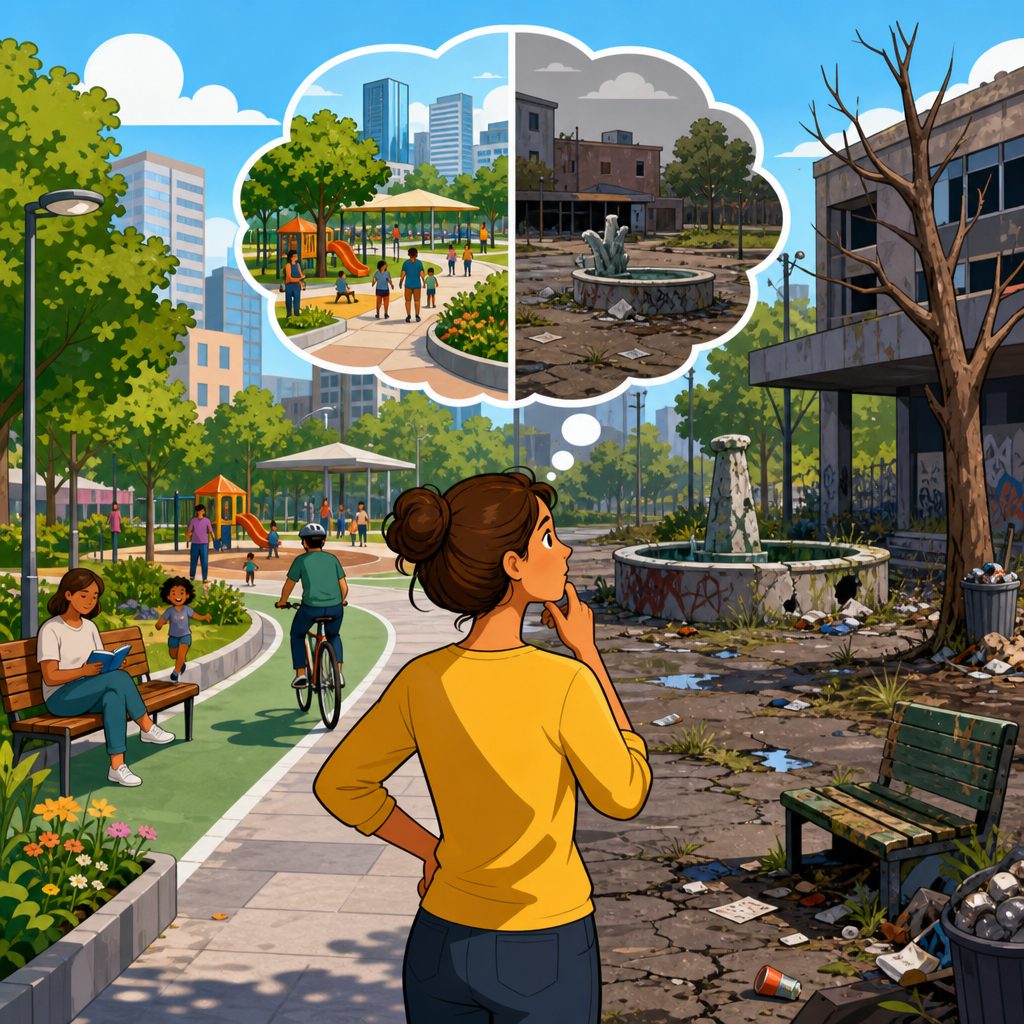
Public space planning often fails at the point where design ambition meets the long life of upkeep. The maintenance problem in public space planning is the gap between what cities build and what they can reliably care for over decades. In practice, that gap shows up as broken benches, dead trees, stained paving, unsafe lighting, clogged drains, vandalized play equipment, and landscapes that become expensive liabilities instead of civic assets. I have seen projects win awards at opening and struggle within two budget cycles because maintenance was treated as an operating detail rather than a core design constraint. For sustainable urban development, this matters because parks, plazas, streetscapes, waterfronts, and greenways only deliver environmental, social, and economic value when they remain usable, safe, and attractive year after year.
Maintenance in this context means the full set of recurring actions required to preserve function and appearance: cleaning, inspection, repair, horticulture, irrigation, drainage management, resurfacing, repainting, asset replacement, and stewardship of public behavior. Public space planning means the policy, design, funding, governance, and management decisions that shape shared outdoor environments. The central issue is not whether maintenance is important; every experienced planner, landscape architect, parks manager, and public works director already knows that. The issue is why maintenance is repeatedly underfunded, underdesigned, and operationally disconnected from capital delivery. Cities often approve visible construction budgets while deferring invisible life-cycle costs, even though standards such as ISO 55000 on asset management and whole-life costing methods have long established that assets should be planned over their entire service life.
The result is a predictable cycle. A city secures capital funding for a signature square, complete street, or stormwater park. Designers specify custom furniture, special paving, or intensive planting palettes to meet placemaking, climate, and accessibility goals. The project opens with strong public support. Then staffing shortages, fragmented agency responsibilities, procurement limits, and unstable operating budgets collide with the daily realities of weather, heavy use, and wear. Within a few years, deferred maintenance erodes public trust. Residents begin to read neglect as a signal that the space is unmanaged or unsafe. Footfall drops, anti-social behavior becomes harder to control, and political support for future public investment weakens. Understanding this chain of cause and effect is essential because maintenance is not a back-office task; it is the long-term delivery mechanism for equity, resilience, accessibility, biodiversity, and public safety.
Why Maintenance Becomes the Hidden Failure Point
The maintenance problem begins with incentives. Capital projects are easier to announce, photograph, and fund than operating commitments. Grants, bond programs, and developer contributions frequently pay for construction but rarely cover twenty years of staffing, replacement cycles, or specialist care. In many municipalities, parks departments maintain planting, public works handles paving, transportation manages signals and road markings, sanitation addresses litter, and utilities intervene when underground access is needed. Each unit has its own budget, service level targets, and procurement rules. When nobody owns the complete user experience, maintenance becomes fragmented. A plaza can have clean paving but dead planters; a green street can manage stormwater well but feel unsafe because lights fail and sightlines are blocked.
Design choices also create maintenance debt. Bespoke elements, nonstandard materials, and complex assemblies can raise identity and aesthetic value, but they usually increase inspection and replacement costs. I have reviewed projects where imported stone could not be matched after minor utility cuts, where custom seating required long lead times for replacement parts, and where water features consumed staff hours far beyond initial assumptions. Even ecologically driven features need maintenance literacy. Bioswales, rain gardens, and urban forests are not self-sustaining in the short term. They need weeding, sediment removal, pruning, inlet cleaning, mulching, and monitoring. If those tasks are omitted, performance declines and the public may wrongly conclude that green infrastructure itself does not work.
Maintenance becomes a hidden failure point because deterioration is gradual until it suddenly becomes politically visible. A small crack becomes trip risk exposure. A blocked drain becomes localized flooding. Deferred pruning reduces visibility and perceived safety. Minor graffiti, if left in place, signals slower response times. These are not cosmetic issues alone. They shape whether older adults can walk comfortably, whether children can use play areas, whether disabled users can navigate routes, and whether businesses benefit from adjacent foot traffic. The real cost of poor maintenance is therefore broader than repair bills; it includes reduced social value, lower health benefits, lost climate performance, and weakened confidence in government capacity.
How Life-Cycle Planning Changes Public Space Outcomes
The most effective way to solve the maintenance problem is to shift from project thinking to life-cycle planning. That means estimating total cost of ownership before design is finalized, not after construction documents are complete. A disciplined process includes asset inventories, expected service lives, maintenance frequencies, replacement schedules, labor assumptions, water and energy use, and risk registers for high-failure components. Quantity surveyors and municipal asset managers do this routinely for buildings and infrastructure, yet public realm projects are still too often judged mainly on capital cost per square meter. That is a mistake. A cheaper installation can become the more expensive option if it doubles annual maintenance hours or requires replacement in half the time.
Life-cycle planning improves decision quality because it reveals tradeoffs early. For example, unit pavers can simplify underground utility access and spot repairs, while large-format decorative paving may deliver a stronger visual effect but create higher replacement complexity. Native planting can reduce irrigation demand after establishment, but only if species are matched to soil, exposure, and management capacity. Powder-coated steel furniture may outperform timber in some climates, yet timber can be easier to repair locally and age more gracefully in heritage settings. There is no universal best material. The right choice depends on exposure, use intensity, vandalism risk, available crews, and procurement lead times.
One practical approach is to require every major public space project to submit a maintenance management plan at concept stage and update it through design development. That plan should identify who maintains each asset, how often, with what skills, at what cost, and under which service standard. It should also include handover training, spare parts lists, warranty terms, and digital asset records linked to GIS or computerized maintenance management systems such as Cityworks, Maximo, or Asset Essentials. When cities adopt this discipline, the conversation changes from “Can we afford to build this?” to “Can we afford to operate this well?” That is the question that prevents elegant designs from becoming neglected spaces.
Designing for Durability, Access, and Repairability
Good public space planning treats maintenance as a design parameter equal to aesthetics, accessibility, and stormwater performance. Durable design is not bland design. It means choosing materials and details that can withstand local conditions, fail safely, and be repaired without heroic effort. In streetscapes with utility cuts, modular surfaces outperform fragile bespoke finishes. In waterfronts, corrosion resistance and fixings matter as much as visual quality. In heavily used parks, edge details, root protection, and vehicle access for maintenance crews determine whether landscapes remain healthy. I have found that some of the best-performing spaces are not the ones with the most expensive palettes, but the ones where every detail anticipated cleaning paths, replacement logistics, drainage behavior, and user wear patterns.
Repairability is especially important. Public spaces are open systems exposed to weather, events, delivery vehicles, protests, skateboarding, and everyday misuse. Damage is normal, not exceptional. Designers should ask simple operational questions: Can a bench slat be replaced without removing the entire frame? Can a broken luminaire be serviced with standard equipment? Is there room for a small utility vehicle to reach planting beds? Can a single paver be lifted without damaging adjacent units? These questions sound basic, yet they separate resilient spaces from brittle ones.
| Planning choice | Short-term appeal | Long-term maintenance effect |
|---|---|---|
| Custom furniture | Strong identity and placemaking | Higher parts cost, longer replacement lead times |
| Modular paving | Less visually dramatic | Easier utility access, simpler spot repair, lower downtime |
| Intensive ornamental planting | Immediate visual richness | Higher pruning, irrigation, and seasonal replanting needs |
| Native and climate-fit planting | Slower initial appearance in some schemes | Lower water demand after establishment, better resilience |
| Integrated drainage details | More coordination during design | Fewer puddles, less surface damage, lower safety risk |
| Standardized lighting fixtures | Less bespoke character | Faster procurement, simpler maintenance, consistent service levels |
Accessibility should be part of maintenance design, not treated as a compliance box checked at opening day. Uneven surfaces, ponding water, faded tactile indicators, overgrown vegetation, and blocked routes undermine inclusive access faster than many cities realize. Standards such as the ADA Standards for Accessible Design in the United States and similar national guidance elsewhere set baseline requirements, but the operational reality is what users feel. A route that meets slope requirements on paper still fails if tree roots heave the pavement or winter maintenance leaves it icy. Sustained accessibility depends on inspection regimes and timely repair.
Governance, Funding, and the Operating Budget Gap
Even excellent design fails without a governance model that supports care. Many maintenance problems are institutional rather than technical. Responsibility may transfer from a capital delivery team to a parks unit with no additional budget. Business improvement districts may maintain downtown plazas at a higher standard than neighborhood parks, creating uneven service quality. Public-private partnerships can help, but they also raise equity questions if affluent districts receive premium upkeep while lower-income areas rely on overstretched municipal crews. From a sustainable urban development perspective, maintenance funding is a justice issue because uneven upkeep creates unequal access to health, shade, safety, and recreation.
Stable operating budgets are the foundation of good stewardship. Cities that perform well usually combine baseline municipal funding with transparent service standards, asset inventories, and scheduled renewal plans. Some also use dedicated revenue tools such as park levies, conservancies, or maintenance endowments linked to large capital projects. The key is predictability. Seasonal or discretionary funding leads to reactive work orders and deferred renewal. Reactive maintenance is almost always more expensive than planned maintenance because it increases emergency callouts, liability exposure, and full-asset replacement.
Procurement rules can worsen the gap. Lowest-bid contracting may reduce upfront costs while producing poor workmanship, inconsistent horticultural care, or limited accountability for outcomes. Better practice uses performance-based specifications, clear inspection metrics, and contract structures that reward quality over the full term. For example, litter removal can be specified by cleanliness standard and response time, not just collection frequency. Landscape contracts can include establishment periods, survival rates for trees, and soil health requirements. When cities define outcomes clearly, contractors and in-house teams can be managed against measurable public value rather than vague expectations.
Maintenance as Climate Adaptation and Social Infrastructure
Well-maintained public spaces are essential climate infrastructure. Shade trees only reduce urban heat if they survive establishment, develop healthy canopies, and receive pruning that maintains clearance and structure. Rain gardens and permeable surfaces only reduce runoff if inlets are clear, media remain functional, and sediment is removed. Coastal promenades and riverfronts only protect access if corrosion, erosion, and drainage are monitored continuously. In other words, adaptation features are operations-heavy assets. Cities that treat them as one-time installations will underperform during heat waves and storm events.
Maintenance is also social infrastructure because visible care influences behavior. Research in environmental psychology and urban management consistently shows that orderly, clean, and well-lit spaces support perceived safety and invite longer stays. That does not mean aggressive over-management or sterile design. It means routine stewardship that communicates presence, responsibility, and welcome. In my experience, a plaza with daily cleaning, prompt repairs, active programming, and healthy planting can accommodate very high use without feeling out of control. The same physical layout, when neglected, quickly attracts conflict over use and generates complaints that are often blamed on design alone.
Technology can support this work, but it is not a substitute for crews and clear accountability. Sensors can monitor irrigation leaks, smart bins can optimize collection routes, and GIS-based inspections can map recurring failures. Drones can help review large parks or waterfront edges after storms. Yet the most important operational improvements are usually simpler: a complete asset register, a prioritized inspection schedule, trained field staff, and a budget aligned with realistic service levels. Public space maintenance remains labor-dependent because care is visible, place-specific, and relational.
What Cities Should Do Next
Cities can improve public space outcomes quickly if they adopt a few non-negotiable practices. First, require whole-life cost analysis for every significant public realm project. Second, set maintenance standards before design approval and tie those standards to identified operating funds. Third, involve maintenance supervisors, gardeners, accessibility specialists, and asset managers in design reviews, not just at handover. Fourth, favor standardized, repairable components unless there is a strong public-value case for custom elements. Fifth, track asset condition with digital records and publish basic performance measures so elected officials and residents can see whether service levels are being met.
Just as important, planners should treat maintenance as part of community trust. Residents notice whether trees are watered, lights are repaired, and litter is removed. They read these signals as evidence of whether public institutions value their neighborhood. The maintenance problem in public space planning is therefore not merely technical or financial. It is a test of whether sustainable urban development can move beyond ribbon cuttings and deliver enduring public benefit. Cities that plan for upkeep from the start build spaces that age with dignity, support climate goals, remain accessible, and continue to earn public affection long after opening day.
The core lesson is simple: a public space is only as successful as its maintenance model. Design excellence, environmental performance, and civic identity depend on daily, seasonal, and long-term care. If you are shaping a park, plaza, street, or waterfront, ask the operational questions now, attach funding to the answers, and make maintenance visible in every planning decision. That is how public space becomes truly sustainable.
Frequently Asked Questions
What is the maintenance problem in public space planning?
The maintenance problem in public space planning is the disconnect between the ambition of a project at opening day and the reality of caring for it year after year. Many parks, plazas, streetscapes, playgrounds, waterfronts, and civic landscapes are designed to impress in the short term, but they are not always matched to the budgets, staffing, equipment, and management systems needed to keep them safe, clean, and functional over decades. That mismatch is where the problem starts. A space may look exceptional in renderings and still become difficult to sustain once daily wear, weather, vandalism, seasonal cycles, and public use begin to accumulate.
In practical terms, the gap shows up in very visible ways. Benches loosen or break and are not repaired quickly. Trees fail because soil volumes, irrigation, or pruning plans were inadequate. Paving stains, cracks, or settles without a realistic replacement schedule. Lighting becomes unreliable, creating safety concerns and reducing use at night. Drains clog, planting beds decline, play equipment is tagged or damaged, and custom-designed elements become expensive to replace because no one planned for parts, access, or lifecycle costs. Over time, the public experiences these failures not as isolated defects but as a signal that the place is neglected.
This is why maintenance is not a secondary issue. It is central to whether a public space succeeds. A well-maintained ordinary place often serves people better than a spectacular but fragile one. The strongest public space plans treat maintenance as part of design from the beginning, not as a problem to solve later. That means asking hard questions early about durability, staffing, replacement cycles, inspection routines, cleaning needs, water use, pruning, security, and who will pay for all of it once the ribbon cutting is over.
Why do so many public spaces deteriorate after they open, even if the original design was praised?
Public spaces often deteriorate because project delivery systems reward opening-day success more than long-term performance. Design competitions, political timelines, funding programs, and public attention all tend to focus on what can be seen at launch: bold forms, distinctive materials, signature features, and fast completion. Much less attention is typically given to what happens in year five, year ten, or year twenty. As a result, cities may inherit landscapes and public amenities that are visually ambitious but operationally demanding, with maintenance expectations that exceed available resources.
Another major reason is that capital funding and maintenance funding are usually treated separately. A city may secure money to build a new plaza or park but not enough recurring money to clean it, inspect it, replant it, repair it, and manage it properly. This creates a structural imbalance. The project gets delivered, but the organization responsible for upkeep may already be understaffed, using outdated equipment, or stretched across many other sites. Even a good maintenance team will struggle if the design requires specialized care, imported materials, complex lighting systems, delicate finishes, or intensive horticulture without the corresponding support.
Deterioration also happens when planners and designers do not fully account for real-world patterns of use. Public spaces are messy, high-contact environments. People move furniture, skateboard on edges, spill food and drink, compact soils, damage bark, clog drains with litter, and wear down surfaces faster than expected. Weather adds another layer of stress through heat, freeze-thaw cycles, heavy rain, flooding, and UV exposure. If a project is not designed for these realities, maintenance problems appear quickly. What looked elegant in concept can become a constant repair burden in operation.
There is also an institutional issue. In many places, the teams that approve, design, build, and maintain public spaces are not well integrated. Maintenance staff may be brought in too late or not at all. Their experience with recurring failures, replacement challenges, and service limitations is valuable, but it is often underused. When operational knowledge is missing from planning, the result is predictable: spaces that are difficult to maintain, expensive to repair, and vulnerable to decline despite strong initial praise.
How can cities design public spaces that are easier and more affordable to maintain?
Cities can design more maintainable public spaces by treating upkeep as a design criterion equal to aesthetics, accessibility, safety, and public value. The most effective approach is to ask maintenance questions at the earliest planning stage, before materials and features are locked in. That means evaluating not only whether something looks good, but whether it can be cleaned easily, repaired quickly, replaced locally, inspected safely, and managed with the crews and budgets that actually exist. Maintenance should be built into concept design, detailed design, procurement, and post-occupancy management, not left for later.
Material choice is one of the most important decisions. Durable, standard, repairable materials usually outperform highly customized or delicate elements in public settings. A bench that uses common parts and robust finishes is easier to keep in service than a sculptural seating system that requires a custom fabricator every time it is damaged. Planting design matters too. Landscapes should be matched to climate, water availability, soil conditions, and the maintenance capacity of the owner. That often means prioritizing resilient species, adequate root space, manageable planting densities, and clear access for pruning, irrigation checks, litter removal, and replacement.
Good design for maintenance also depends on reducing hidden complexity. Drainage systems need to be accessible for cleaning. Lighting should use fixtures that can be serviced without excessive cost or specialized tools. Surfaces should be selected with staining, slip resistance, and patchability in mind. Irrigation should be understandable and monitorable. Trash and recycling should be placed where crews can service them efficiently. If maintenance staff have to work around complicated layouts, obstructed service routes, or fragile details, routine care becomes slower and more expensive.
Equally important is involving maintenance teams directly in the planning process. The people who mow, inspect, repair, clean, prune, and respond to complaints understand where projects fail in practice. Their feedback can improve everything from tree placement and edge detailing to fixture selection and storage needs. Cities that routinely include operations staff in design reviews tend to avoid avoidable mistakes. Over time, they also build a more realistic culture of public space planning, one that values endurance and stewardship instead of novelty alone.
What role do budgets, staffing, and governance play in long-term public space upkeep?
Budgets, staffing, and governance determine whether maintenance plans are real or merely aspirational. A public space may be beautifully designed, but if there is no reliable operating budget behind it, deterioration is only a matter of time. Maintenance is not a one-time cost. It is a long-term commitment that includes cleaning, horticulture, inspections, repairs, utilities, replacement of worn components, seasonal work, security coordination, and response to unexpected damage. When cities underestimate these recurring obligations, the physical condition of the space begins to slip and user confidence declines with it.
Staffing is just as critical as funding. Maintenance quality depends on having enough trained people with the right tools, schedules, and authority to do the work. Many public agencies are expected to care for a growing number of sites with limited crews and aging equipment. In that environment, high-maintenance designs create chronic pressure. Tasks get deferred, response times lengthen, and small defects become larger capital problems. A broken light fixture left unresolved can affect perceptions of safety. A clogged drain can lead to standing water and surface damage. Deferred pruning can turn a manageable task into a costly intervention.
Governance shapes accountability. One of the most common reasons public spaces decline is that responsibility is fragmented. Different departments may control landscape maintenance, lighting, stormwater, waste, event permitting, and security, while no single entity has full ownership of overall condition. When something goes wrong, the response can be slow because the issue falls between agencies. Clear governance helps prevent this. Successful public spaces usually have defined responsibilities, service standards, inspection routines, reporting systems, and performance expectations. Someone knows who is responsible, how problems are identified, and how quickly they should be addressed.
Some cities improve outcomes through dedicated conservancies, business improvement districts, friends groups, or hybrid management models, but these arrangements only work well when roles are clearly structured and equitable. The key point is that maintenance needs stable systems, not just goodwill. Long-term upkeep depends on realistic funding, sufficient staffing, and governance arrangements that make stewardship continuous, visible, and accountable.
What should planners, designers, and city leaders do differently to close the maintenance gap?
They should start by redefining project success. A public space should not be judged only by its opening-day appearance, awards, or public relations value. It should also be judged by how well it performs after years of weather, heavy use, and routine municipal constraints. That means shifting the culture of public space planning away from short-term image and toward lifecycle thinking. Leaders should ask not just, “Can we build this?” but “Can we care for this reliably for the next twenty to thirty years?” That question changes priorities in productive ways.
One practical step is to require lifecycle cost analysis during planning and design. Every major project should include realistic estimates for annual maintenance, periodic replacement, utilities, staffing demands, and likely repair needs. Those estimates should inform design decisions rather than being treated as a separate exercise. If a project includes custom paving, water features, specialty lighting, or intensive horticulture, decision-makers