School Streets and car-free plazas are practical urban design strategies that temporarily or permanently remove motor traffic from streets around schools and civic spaces, giving priority to children, caregivers, pedestrians, cyclists, play, social interaction, and cleaner air. In city planning, a School Street usually means timed vehicle restrictions at school start and finish, enforced with bollards, cameras, or staffed closures. A car-free plaza is a street, parking area, or traffic island converted into public space for sitting, gathering, walking, events, and informal recreation. I have worked on street redesign projects where a single traffic order and a few movable barriers changed the entire feel of a neighborhood within one term. The topic matters because children experience cities at a different scale than adults do: shorter sightlines, slower walking speeds, greater sensitivity to noise and emissions, and less control over travel choices. When streets outside schools function mainly as pick-up queues, children lose safety, independence, and everyday contact with public life. Reclaiming space for children improves road safety, physical activity, air quality, community cohesion, and local economic vitality, while also advancing climate, health, and equity goals.
The case for change is supported by established public health and transport evidence. Road danger remains one of the leading risks to children in cities, and vehicle emissions are concentrated close to roads where many pupils wait each morning. Studies from London and other European cities have linked traffic reduction around schools with lower nitrogen dioxide exposure, calmer arrival patterns, and increased walking and cycling. Car-free plazas likewise convert underused asphalt into productive civic infrastructure. A plaza with shade, seating, drainage, trees, and clear access routes can function as a playground before school, a meeting place after school, and a community venue in evenings and weekends. These interventions are not anti-access when designed well; they are pro-child, pro-neighborhood, and pro-choice. The central question is not whether streets should serve movement, but what kind of movement, for whom, and at what cost.
What School Streets and Car-Free Plazas Actually Do
A School Street changes the operating rules of a street during defined periods, typically thirty to sixty minutes at drop-off and pick-up. Residents, blue badge holders, school transport, emergency vehicles, and essential services may be exempt, while through traffic and routine parent driving are restricted. The direct result is fewer vehicle conflicts at the gate. The indirect results are often just as important: less engine idling, easier crossing, lower stress for teachers managing arrivals, and more confidence among parents who want children to walk or cycle. In practice, successful schemes combine regulation with design. Temporary cones can launch a pilot, but durable outcomes usually require modal filters, widened footways, visible entry signage, planting, cycle parking, and clear stewarding during early phases.
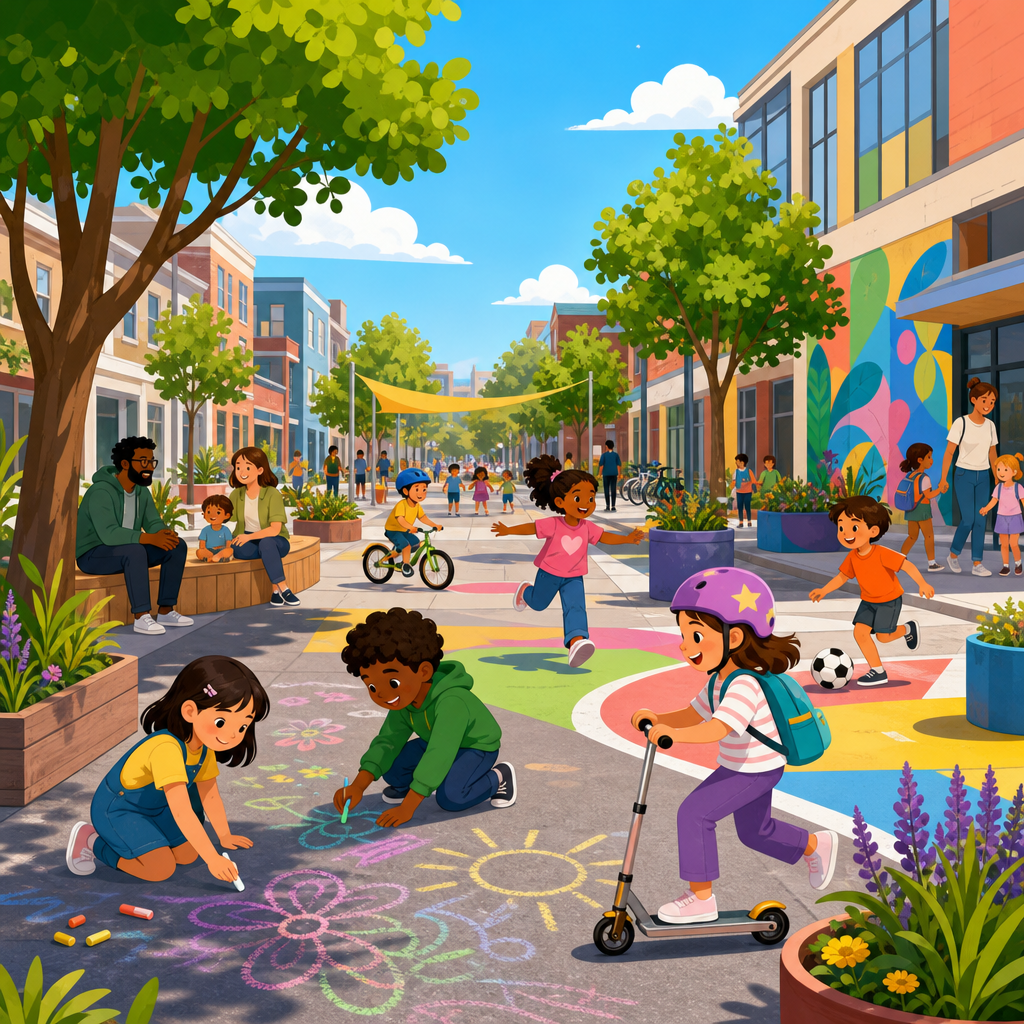
Car-free plazas work differently because they reshape the public realm all day, not just during school hours. They may remove parking, close a slip road, or consolidate multiple traffic lanes into one simpler circulation pattern. The reclaimed area can include benches, play features, drinking fountains, public art, trees, permeable paving, and flexible space for markets or performances. Good plazas are legible and inclusive. They provide step-free movement, tactile paving where needed, lighting, weather protection, and enough open sightlines for caregivers to supervise children without feeling trapped. In Barcelona’s superblocks, Paris schoolyard greening projects, and New York’s plaza program, the strongest results came when cities treated these spaces as social infrastructure rather than decorative leftovers. A successful child-friendly plaza is not a mini park dropped into traffic; it is a safe, connected extension of the everyday street network.
Why Children Benefit First, and Cities Benefit Next
Children gain immediate safety benefits when vehicle volumes and turning movements fall near schools. Collision risk is not only about speed; it is also about complexity. The typical school gate at eight-thirty combines reversing, double parking, impatient U-turns, walking groups, scooters, and late arrivals. Remove most motor traffic and the conflict matrix shrinks dramatically. The health gains are equally concrete. Short daily walking trips help children accumulate moderate physical activity, which supports cardiovascular health, concentration, sleep, and emotional regulation. Cleaner air matters too, especially for children with asthma, whose symptoms can worsen near congested kerbs where exhaust accumulates. Teachers often report calmer starts to the day because pupils arrive less stressed and less rushed.
Cities then benefit through wider system effects. When a school street works, some car trips disappear, some shift to walking and cycling, and some are combined differently. That frees road space and reduces peak-time pressure on adjoining streets when the scheme is properly designed. Public space quality also improves. Parents linger, neighbors talk, and local shops gain passing foot traffic instead of just seeing windscreens. I have seen schools use the newly safe forecourt for bike training, reading corners, gardening tables, and student art displays. Those activities strengthen civic identity at low cost. There are tradeoffs, including concerns about traffic displacement, accessibility, and enforcement burden, but these are design and management problems, not reasons to preserve unsafe conditions. The evidence from repeated implementations is clear: when cities reclaim small amounts of street space around children, benefits extend well beyond the school boundary.
Design Principles That Make Projects Work
The strongest projects begin with a movement audit, not a sketch. Planners need baseline counts for pedestrians, cycles, vehicles, parking occupancy, turning movements, and crossing delays. They also need to understand school operations: staggered starts, bus arrivals, nursery access, deliveries, waste collection, and safeguarding procedures. From there, design should follow five principles. First, make the traffic rule obvious at a distance using gateway treatments, signs, and physical cues. Second, create enough space where people actually wait, not just where drawings look tidy. Third, maintain essential access for emergency services and legitimate exemptions. Fourth, connect the intervention to wider walking and cycling routes so it is not an isolated island. Fifth, measure results and refine the layout after observing real behavior on wet days, exam days, and event days, not just ideal conditions.
Materials and details matter more than many decision-makers expect. Lightweight planters can define space quickly but may drift, break, or create clutter if not anchored and maintained. Fixed bollards communicate permanence but can complicate servicing. Raised tables and continuous footways slow turning traffic and improve crossing comfort where full closures are not feasible. Trees and rain gardens add shade and stormwater management, yet root zones, visibility, and maintenance obligations must be planned from the start. Seating should support different age groups, including older caregivers. Lighting should eliminate dark edges without creating glare. For plazas near schools, toilets and drinking water become operational issues, not optional extras, especially if the space is intended for extended dwell time. Good design is less about signature objects than about removing friction from ordinary use.
| Design element | Purpose | Good practice example |
|---|---|---|
| Timed vehicle restriction | Reduces conflict at arrival and dismissal | Automatic camera enforcement with resident exemptions |
| Modal filter or bollards | Prevents through traffic from bypassing closures | Lockable bollards with emergency key access |
| Widened footway | Creates waiting space and easier passing | Build-outs at school gates and corners |
| Cycle parking | Supports mode shift | Secure Sheffield stands near visible entrances |
| Shade and seating | Improves comfort and inclusivity | Trees with benches placed outside main desire lines |
| Rain garden | Manages runoff and cools the space | Kerbside bioswale integrated with plaza planting |
Policy, Operations, and Community Buy-In
These projects succeed when policy tools, school leadership, and neighborhood communication align. The legal mechanism may be a traffic regulation order, experimental order, pedestrian zone designation, or street management permit, depending on jurisdiction. Experimental orders are often effective because they allow cities to trial changes, gather evidence, and adjust before making them permanent. Enforcement is a decisive factor. A restriction without compliance quickly loses credibility, so cities need either trained stewards during pilot phases or camera enforcement where permitted. Clear exemption lists are essential. Residents need to understand access windows, caregivers of disabled children need reliable arrangements, and school staff need procedures for deliveries and visitors. Without operational clarity, even a well-designed scheme can become a source of avoidable friction.
Community engagement should be structured, not performative. The most useful process starts with listening to specific concerns: displaced traffic on one side street, worries about emergency response, fears from traders about lost customers, or mobility barriers for grandparents collecting children. Then planners test those concerns against evidence and site observation. In many cases, objections soften once people see actual conditions during a pilot. At one school, businesses opposed removing curbside parking, but after six weeks they reported stronger lunchtime trade because parents and children stayed in the area instead of driving away immediately. Schools themselves are powerful partners. Student travel surveys, class mapping exercises, and temporary street events create visible ownership. Children explaining why they want cleaner air and room to walk often persuade adults more effectively than technical reports do.
Common Challenges and How Cities Solve Them
Traffic displacement is the first issue critics raise, and it must be taken seriously. Some trips will reroute, especially at the start. The best response is area-wide planning rather than a single closure in isolation. That may include complementary filters on parallel streets, signal timing changes, parking management, and improvements to key walking routes from nearby neighborhoods. Monitoring should cover adjacent streets as well as the school gate. Another challenge is equity. If families live far from school because of catchment patterns or housing costs, mode shift will be harder. Cities should pair school streets with safe routes to school programs, secure cycle storage, school bus improvements, and fair exemption policies so the burden does not fall on those with the fewest options.
Maintenance and permanence are also common stumbling points. Many pilots begin with paint and planters because they are fast and affordable, but neglected temporary materials can make a scheme look second-rate and weaken support. Cities should budget from the outset for replacement planting, surface repairs, cleaning, and enforcement administration. Weather resilience matters as well. Plazas need drainage, shade, and durable surfaces that stay usable in rain and heat. Finally, there is the political challenge of measuring success. Decision-makers often focus narrowly on vehicle delay, while families care about whether children can cross independently. The right evaluation framework includes traffic counts, speed, air quality indicators, active travel rates, near-miss reports, user satisfaction, and observed public life. What gets measured shapes what gets defended.
How This Hub Connects the Wider Child-Friendly Streets Agenda
As a hub within sustainable urban development, this topic links transport planning, public health, climate adaptation, education policy, and public realm design. School Streets are the gateway intervention because they are understandable, measurable, and emotionally resonant: almost everyone can picture the school gate and judge whether it feels safe. Car-free plazas broaden that logic into an all-day neighborhood strategy. From here, the wider subtopic naturally branches into safe routes to school, low-traffic neighborhoods, tactical urbanism, complete streets, urban greening, stormwater design, accessibility standards, curb management, and participatory planning with children. In practice, the most durable programs combine these strands. A timed closure works better when crossings are upgraded on feeder streets, when cycle networks reach the gate, and when nearby public spaces invite families to stay rather than merely pass through.
This hub approach matters because isolated projects can be dismissed as one-off experiments, while a connected program demonstrates policy coherence. A city that implements school streets, redesigns plazas, plants shade trees, adjusts parking, and supports active travel is not just beautifying a block; it is changing the hierarchy of street use. That shift has measurable outcomes: fewer dangerous conflicts, healthier travel habits, stronger neighborhood ties, and public spaces that acknowledge children as legitimate urban citizens. If you are shaping a sustainable urban development strategy, start with the school gate and the nearest asphalt surplus. Map the conflicts, test a pilot, measure the results, and build outward. Reclaiming space for children is one of the fastest ways to make a city safer, fairer, and more livable for everyone.
Frequently Asked Questions
What is a School Street, and how is it different from a car-free plaza?
A School Street is a traffic management measure that restricts or removes motor vehicles from the street outside or near a school during the busiest arrival and dismissal periods. The goal is to create a safer, calmer, and healthier environment for children, caregivers, and school staff at the exact times when pedestrian activity is highest. In practice, this often means timed closures using removable bollards, cameras, gates, signage, or trained staff who manage access. Residents, emergency services, school transport, and some authorized vehicles may still be allowed depending on the local scheme, but through-traffic and routine drop-offs are typically discouraged or prohibited.
A car-free plaza is broader in purpose and often more permanent in design. It transforms a street segment, parking lot, slip lane, or underused paved space into a public place centered on people rather than vehicles. Instead of functioning primarily as a movement corridor for cars, the area is redesigned for walking, sitting, play, gathering, outdoor learning, community events, greenery, shade, and cycling access. Around schools, a car-free plaza can act as a shared civic space where children and families linger safely before and after the school day, but these spaces can also serve the whole neighborhood throughout the day and week.
The key distinction is that a School Street is usually a timed operational strategy focused on peak school travel periods, while a car-free plaza is a spatial redesign that permanently or semi-permanently reassigns street space to public life. Many successful projects actually combine both ideas: a school frontage may begin as a timed closure and later evolve into a redesigned plaza with seating, planting, traffic calming, stormwater features, and play elements once the community sees the benefits.
Why are School Streets and car-free plazas considered so beneficial for children and families?
The most immediate benefit is safety. Streets around schools are often congested at pick-up and drop-off times, with idling vehicles, rushed turning movements, illegal parking, and poor visibility creating stressful and risky conditions. By reducing motor traffic where children are walking, scooting, or cycling, School Streets lower the likelihood of collisions and make street crossings more predictable. Children are smaller, less visible to drivers, and still developing judgment about speed and distance, so even modest changes to traffic conditions can make a significant difference.
Air quality is another major advantage. Idling and stop-start traffic near school gates can expose children to concentrated vehicle emissions at exactly the times they are arriving and leaving. Because children breathe more rapidly than adults and are still developing physically, they are particularly sensitive to poor air quality. Reducing vehicles in these spaces can cut exposure to exhaust pollution and create a healthier school environment, especially when combined with trees, planting, and wider walking areas that move people farther from traffic.
These interventions also support independence, physical activity, and social development. When streets feel safe and welcoming, more families are willing to walk, cycle, or scoot to school instead of driving. That shift can help reduce traffic even further, creating a positive cycle. Children gain everyday movement, confidence navigating public space, and opportunities for informal play and interaction. Caregivers benefit as well: a calmer school frontage is easier to use, less stressful, and more social. Instead of a hurried vehicle queue, the space can become a place where neighbors talk, children gather, and communities build stronger connections.
There are broader urban benefits too. Reclaiming space from traffic can improve accessibility, reduce noise, support local businesses by increasing foot traffic, and encourage more equitable use of public space. Streets occupy a large share of city land, and projects like these ask a simple but powerful question: should the most valuable space around schools be reserved primarily for moving and storing cars, or should it prioritize children and community life? Increasingly, cities are choosing the latter.
How are School Streets and car-free plazas typically implemented and enforced?
Implementation usually begins with understanding local conditions. City planners, transportation departments, schools, and community groups assess traffic patterns, pedestrian flows, bus access, emergency response requirements, parking needs, and the specific risks faced by children at the site. They then define the operating model: what area will be restricted, during what hours, who can still enter, how deliveries and accessible transport will work, and what physical or digital tools will be used to manage the scheme.
For School Streets, enforcement often relies on a combination of clear signage, retractable or movable bollards, staffed closures, camera enforcement, automatic number plate recognition systems where permitted, and exemptions for essential access. Some programs begin with staff or volunteers physically stewarding the closure while families adjust to the new routine. Others use a legal traffic order and cameras to deter non-compliant drivers. Consistency matters. If drivers believe the closure is optional or weakly enforced, the benefits quickly erode.
Car-free plazas typically involve both policy and design changes. Temporary pilots may use planters, paint, barriers, benches, and movable furniture to quickly test a new layout at low cost. These “tactical urbanism” approaches help cities gather feedback before making expensive capital investments. If the pilot succeeds, the area may be upgraded with permanent paving, trees, lighting, drainage improvements, seating, bike parking, public art, play features, and universal accessibility elements such as level surfaces and clear circulation routes.
Communication is essential throughout the process. Residents, school communities, nearby businesses, public transport agencies, sanitation teams, and emergency services all need timely information and realistic alternatives. The strongest programs are not simply imposed; they are carefully designed, trialed, measured, and refined. Cities often monitor vehicle counts, walking and cycling rates, air quality, near misses, user satisfaction, and school travel behavior to judge success and make adjustments over time.
Do School Streets just move traffic and parking problems onto nearby roads?
This is one of the most common concerns, and it is a reasonable question. In some cases, a closure can initially shift traffic or short-term parking pressure to nearby streets, especially if many families are accustomed to driving directly to the school gate. However, well-designed School Streets are intended not just to displace traffic but to reduce unnecessary car trips overall by changing travel behavior. When direct vehicle access is restricted, some families choose to walk, cycle, scoot, park farther away, or use “park and stride” arrangements rather than circling the entrance.
The outcome depends heavily on design quality and supporting measures. If a School Street is implemented in isolation without safe walking routes, convenient crossing points, cycle parking, or clear alternative drop-off plans, neighboring streets may feel some pressure. But when the intervention is part of a broader strategy that includes traffic calming, wider sidewalks, improved crossings, protected bike routes, signage, and coordinated curb management, the area often adapts successfully. Over time, habits change, and the predicted congestion impacts can be much smaller than opponents expect.
Monitoring is important here. Cities should measure not only conditions on the restricted street but also on surrounding roads before and after implementation. If problems emerge, they can be addressed through permit controls, adjusted operating hours, one-way access changes, loading management, school travel plans, or expanded low-traffic measures in adjacent blocks. The best programs treat traffic displacement as a planning issue to manage, not a reason to abandon child-centered street design altogether.
It is also worth remembering that the status quo already creates harms. Heavy school-gate traffic produces unsafe crossings, poor air quality, stress for families, and a public realm dominated by vehicles at the exact times children most need protection. The question is not whether change has effects, but whether cities are willing to manage those effects in pursuit of safer and healthier outcomes. In many places, the answer has increasingly been yes.
What makes a School Street or car-free plaza successful in the long term?
Long-term success depends on more than closing a road. The most effective projects are rooted in a clear purpose: protecting children, improving daily travel, and creating a higher-quality public space. That purpose needs to be reflected in every part of the project, from street design and enforcement to communications and maintenance. If the intervention feels temporary, confusing, or under-supported, compliance can weaken and public confidence may fade. If it feels intentional, welcoming, and well managed, people quickly begin to see it as a normal and valuable part of neighborhood life.
Strong community involvement is critical. Schools, parents, nearby residents, and local businesses should have opportunities to shape the design and identify practical needs early on. A successful scheme typically addresses questions such as: How will disabled users access the area? Where will deliveries occur? What routes will older siblings use by bike? Is there shade and seating for caregivers? Can the space support informal play as well as circulation? The more thoroughly these real-world details are considered, the more resilient the project becomes.
Good design also matters enormously. A long-term car-free space should not feel like a road that cars happen to be missing from; it should feel like a place that belongs to people. That means high-quality surfaces, greenery, stormwater-sensitive landscaping where possible, lighting, places to sit, clear pedestrian routes, safe cycling access, and flexible areas for events or outdoor learning. Around schools, details such as playful markings, secure bike and scooter parking, and waiting areas for families can make the space far more useful and appealing.
<p