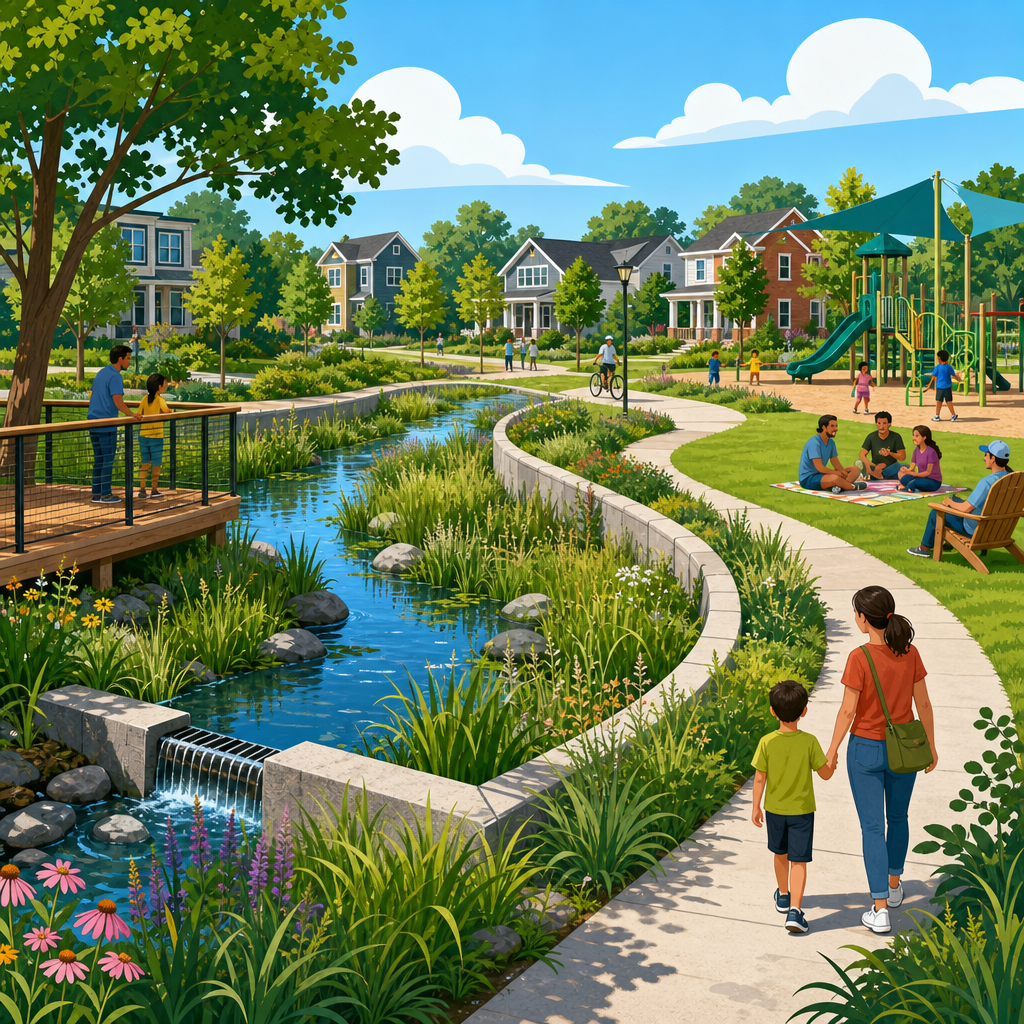
Stormwater parks that double as neighborhood amenities solve two urgent urban problems at once: they reduce flood risk by managing runoff, and they give residents attractive public space for recreation, cooling, and community life. In practical terms, a stormwater park is a landscape designed to temporarily store, slow, filter, and sometimes infiltrate rainwater from streets, roofs, and parking lots, while functioning during dry weather as a park, plaza, trail network, sports field, wetland, or civic green. I have worked on site planning reviews where conventional detention basins were fenced off, barren, and disconnected from daily life, and the contrast with well-designed stormwater parks is stark. When the landscape is shaped intentionally, the same acreage can protect downstream infrastructure, improve water quality, expand habitat, and raise neighborhood value. For cities facing stronger storms, aging drainage systems, hotter summers, and pressure to deliver better public amenities with limited land budgets, this model matters because it turns a hidden utility into visible public infrastructure people use and support.
The concept sits within a broader shift from gray infrastructure alone toward green infrastructure and water-sensitive urban design. Traditional gray systems move runoff away quickly through pipes, culbs, channels, and outfalls. Stormwater parks, by contrast, manage water closer to where it falls using detention, retention, bioswales, rain gardens, constructed wetlands, permeable surfaces, floodable lawns, and restored floodplains. Detention means holding water temporarily and releasing it slowly; retention means keeping a permanent pool or infiltrating water into soil; water quality treatment removes sediment, nutrients, metals, trash, and hydrocarbons before water reaches rivers or bays. The best projects are not decorative add-ons. They are engineered landscapes sized to meet runoff volume targets, peak discharge limits, and maintenance requirements, often guided by municipal stormwater manuals, watershed plans, and federal permit obligations. As a neighborhood amenity, the same site must also feel safe, legible, and inviting, with paths, shade, seating, lighting, edges that frame activity, and programming that makes the space useful in ordinary weather, not just during storms.
Why Cities Are Building Stormwater Parks
Cities build stormwater parks because land has to work harder. In many neighborhoods, especially those developed around car-oriented impervious surfaces, every heavy rain sends water rapidly into undersized drainage networks. That creates street flooding, basement backups, stream erosion, and polluted discharges. Expanding pipe capacity everywhere is usually cost-prohibitive, disruptive, and insufficient on its own. A park-based approach creates distributed storage and treatment while delivering visible civic value. This dual-function logic is particularly persuasive for elected officials and residents because the return is not limited to avoided flooding. A well-used park can support walking, informal play, social gathering, tree canopy expansion, and heat mitigation. Research from the Trust for Public Land and related urban resilience studies consistently shows that access to parks supports physical activity, mental health, and neighborhood cohesion; when the same capital investment also addresses stormwater compliance, projects become easier to justify.
There is also a regulatory driver. Many U.S. cities operate under municipal separate storm sewer system permits that require pollutant reduction and post-construction runoff controls. Combined sewer communities face overflow reductions under consent decrees or long-term control plans. Stormwater parks can help meet those obligations by retaining or detaining runoff and improving water quality through sedimentation, filtration, biological uptake, and infiltration. In practice, I have seen projects succeed when stormwater objectives are quantified early: design storm, water quality volume, drawdown time, freeboard, emergency overflow routing, and maintenance access all need to be resolved before amenities are layered on top. If that engineering is treated as secondary, the park may look good in renderings but fail under real rainfall. When it is integrated from the start, the site becomes more resilient, understandable, and fundable.
How a Stormwater Park Works Day to Day and During Storms
A stormwater park must perform in two modes. In dry weather, it should read as a normal, comfortable public space. Paths stay open, lawns are usable, seating areas are pleasant, and planting feels intentional rather than overgrown. During rain, selected areas fill in a controlled sequence. Inlets capture runoff from surrounding streets and parcels, pretreatment features settle sediment and trash, basins or wetlands store water, and outlet structures meter release downstream. The success of the park depends on grading and hydraulics more than on superficial landscaping. Bowl-shaped lawns, terraced banks, forebays, micropools, underdrains, check dams, and overflow weirs all influence whether the site drains predictably and recovers quickly enough for regular use.
Good projects make this hydrology legible. Residents should be able to understand where water comes from, where it goes, and which spaces are designed to flood. That clarity reduces complaints after storms and builds acceptance of periodic inundation. In one review process I supported, the turning point was adding section diagrams and signage that showed a central lawn intentionally holding six to twelve inches of stormwater for several hours after a major event. Once neighbors understood that temporary ponding was a feature rather than a failure, support improved. Design details matter here: durable turf or flood-tolerant meadow species, reinforced path edges, benches set above storage elevations, and railings only where truly needed help the park remain welcoming while acknowledging water’s movement.
| Design element | Stormwater function | Neighborhood amenity value |
|---|---|---|
| Detention lawn | Stores peak runoff temporarily and releases it slowly | Open play space, event lawn, flexible gathering area |
| Constructed wetland | Filters sediment and nutrients, provides storage | Habitat viewing, education, scenic landscape |
| Bioswale along paths | Conveys and infiltrates runoff from pavement | Green edge, traffic buffer, seasonal planting interest |
| Permeable plaza | Reduces surface runoff and promotes infiltration | Market space, seating area, civic gathering spot |
| Shaded berm | Provides flood protection and directs overflow | Seating, overlook, walking loop, wind break |
Core Design Principles That Make These Parks Successful
The first principle is to design around the watershed, not just the site boundary. A park receives runoff from a drainage area, and its sizing depends on upstream impervious cover, soil conditions, slope, and the local rainfall profile. Modeling tools such as EPA SWMM, HydroCAD, and InfoWorks ICM are commonly used to estimate inflows and storage performance. The second principle is to create a clear hierarchy of storms. Small, frequent events should be captured and treated efficiently; larger events need safe conveyance routes and protected overflow paths. A stormwater park that handles the water quality storm beautifully but fails during a ten-year or hundred-year event is incomplete. The third principle is robust maintenance access. Sediment forebays need cleanout, inlets clog, vegetation requires stewardship, and permeable pavement must be vacuum swept. If maintenance crews cannot reach critical elements, long-term performance drops quickly.
The fourth principle is safety through predictable use, not over-fencing. Many older detention facilities were treated as hazards first and public spaces never. Modern parks still need safe side slopes, stable banks, visibility, lighting at active edges, and clear separation between deep water and play zones, but they should avoid creating dead spaces. The fifth principle is landscape selection tied to hydrologic zones. Upland trees that dislike wet feet will fail in seasonally inundated soils; wetland species placed too high will struggle in drought. Successful planting plans map moisture gradients precisely, from permanently moist depressions to episodically flooded shelves to dry circulation routes. Finally, equity must shape the program. Neighborhoods with the greatest flood burden often have the least access to quality parks. Stormwater parks should not be treated as technical fixes alone; they should close public-space gaps in communities that have historically been overlooked.
Real-World Examples and What They Teach
Several built projects show how this approach works at different scales. Buffalo Bayou Park in Houston is not simply a detention basin, but it demonstrates how flood-resilient landscape design can transform a vulnerable corridor into a major civic amenity. Trails, overlooks, habitat restoration, and public art coexist with infrastructure designed to withstand periodic flooding. The lesson is that flood-prone land can still be a beloved public asset if materials, planting, and maintenance are calibrated to recurring inundation. In New York, the bluebelt approach on Staten Island preserves and enhances streams, wetlands, and ponds to manage stormwater at watershed scale while providing ecological and recreational benefits. It proves that natural drainage systems, when protected and connected to urban drainage planning, can reduce the need for more expensive conventional infrastructure.
On a more neighborhood scale, many schoolyard and park retrofits across Philadelphia, Portland, and Seattle function as local stormwater assets while serving daily users. Philadelphia’s greened schoolyards and recreation areas often combine subsurface storage, rain gardens, shade trees, and porous play surfaces. Residents may see a basketball court, seating, and a cooler microclimate, while beneath or beside those amenities the site is detaining runoff from roofs and hardscape. Portland’s Tanner Springs Park shows how an urban wetland can fit into a dense district as both habitat and public space. The key takeaway from these examples is not that every city should copy one form, but that stormwater performance can be embedded in many park typologies: linear greenways, restored creek corridors, plazas, playfields, and small neighborhood commons. The best precedent for a site is the one that matches its drainage area, culture, and maintenance capacity.
Benefits for Neighborhoods Beyond Flood Control
Flood reduction is the headline benefit, but the broader neighborhood gains are often what sustain political support. First, these parks improve water quality by trapping sediment and allowing pollutants to settle, bind to soils, or be taken up by plants. That matters for urban streams impaired by nutrients, bacteria, metals, and thermal pollution. Second, they reduce heat. Tree canopy, evapotranspiration, and less exposed pavement can lower surface temperatures meaningfully during hot weather. Third, they increase biodiversity by creating habitat mosaics for birds, pollinators, amphibians, and aquatic species, especially when native planting is used and habitat patches are connected.
They also improve the social fabric of a neighborhood. A fenced detention pond contributes little to daily life, while a walkable stormwater park can host exercise, casual encounters, children’s play, outdoor classes, and community events. Property markets often respond to better public space, though that can be a double-edged sword if rising values accelerate displacement. That is why affordability tools, community ownership strategies, and anti-displacement policies matter alongside green investment. In my experience, the strongest projects pair technical performance with visible amenities residents requested themselves: more shade, safer walking routes, places to sit, culturally relevant programming, and play features for different age groups. When people feel the park was built with them rather than for them, stewardship improves and vandalism declines.
Common Challenges, Tradeoffs, and How to Address Them
Stormwater parks are not simple wins without constraints. Land acquisition is the first challenge, especially in built-out neighborhoods where parcels are fragmented and expensive. Retrofitting school grounds, utility corridors, underused parking lots, and flood-prone vacant land can be more feasible than assembling a large new site. The second challenge is maintenance funding. Green infrastructure is not maintenance-free; it shifts work from hidden pipes to visible landscapes. Municipalities need clear operations plans, trained crews, sediment removal schedules, vegetation management protocols, and budgets that extend beyond ribbon cuttings. Third, there are design tradeoffs between usability and hydrologic performance. A basin with steep, hard-edged geometry may store water efficiently but feel hostile. A richly planted wetland may support ecology but limit active recreation. The right balance depends on local needs, and not every site should attempt every function.
Public perception can also be difficult. Residents may worry about mosquitoes, safety, muddy conditions, or unattractive standing water. These concerns should be answered directly. Mosquito problems are usually associated with stagnant water persisting for days; properly designed facilities drain within required timeframes or support predators in permanent wetlands. Safety improves with visibility, active edges, clear sightlines, and programming. Mud can be managed with reinforced turf, boardwalks, durable surfaces, and controlled access during recovery periods. Finally, climate uncertainty complicates sizing. Historical rainfall records may underestimate future extremes, so designers increasingly include adaptive capacity, freeboard, and phased improvements. The most resilient parks are designed as systems that can be modified over time rather than as fixed objects expected to solve every future storm forever.
How Cities and Developers Can Plan Better Projects
Better stormwater parks start with interdisciplinary planning. Civil engineers, landscape architects, ecologists, parks staff, maintenance supervisors, and community representatives need to shape the concept together from the earliest phase. If engineering happens first and public use is added later, the result often feels like infrastructure with ornamental edges. If placemaking leads without hydrologic rigor, the project may fail compliance or flood in unintended ways. Cities should identify candidate sites through watershed mapping, flood complaint data, heat vulnerability, park access gaps, and capital coordination opportunities such as street reconstruction or school modernization. Developers can contribute through district-scale stormwater strategies, public open-space dedications, and partnerships that treat runoff obligations as opportunities to create more valuable places.
Procurement and governance matter as much as design. Performance targets should be explicit, including runoff reduction, water quality treatment, canopy goals, accessibility, and post-storm recovery time. Community engagement must move beyond showing finished renderings; residents should help determine desired amenities, acceptable floodable areas, and maintenance expectations. Monitoring is essential. Install level sensors, inspect vegetation, track infiltration rates, and document how spaces are used. Those data improve future designs and justify investment. Stormwater parks that double as neighborhood amenities work best when cities treat them as core public infrastructure: engineered, funded, maintained, measured, and loved. If your community is planning flood upgrades or park improvements, push for projects that do both well, because the smartest urban land solves infrastructure needs while making everyday life better.
Frequently Asked Questions
What is a stormwater park, and how can it function as both flood infrastructure and a neighborhood amenity?
A stormwater park is a public landscape intentionally designed to capture, slow, store, clean, and sometimes soak in rainwater that would otherwise rush into streets, storm drains, and nearby waterways. What makes these spaces so valuable is that they are built to perform two jobs at once. During storms, they act like working infrastructure, managing runoff from roofs, roads, parking lots, and other hard surfaces. During dry weather, the same space can serve as a park, trail corridor, sports field, playground area, wetland boardwalk, shaded plaza, or community gathering place.
This dual purpose is possible because stormwater parks use landforms and landscape features that are both functional and inviting. A shallow basin might look like an open lawn most of the time but temporarily hold water during a heavy rain. A planted swale can guide runoff while also adding greenery and habitat. Terraced edges, rain gardens, wetlands, and permeable paths can all be designed to improve drainage while making a neighborhood more attractive and usable. In many cities, this approach is especially effective because it turns a necessary public works investment into something residents can see, enjoy, and benefit from every day.
In practical terms, stormwater parks help reduce localized flooding, ease pressure on aging drainage systems, and improve water quality by filtering pollutants before runoff reaches rivers, lakes, or coastal areas. At the same time, they add recreation space, reduce urban heat through trees and vegetation, support biodiversity, and create a stronger sense of place. Instead of hiding stormwater management underground, these parks make it visible, educational, and community-centered.
How do stormwater parks reduce flood risk in urban neighborhoods?
Stormwater parks reduce flood risk by interrupting the fast, concentrated flow of rainwater that typically occurs in built-up areas. In neighborhoods dominated by pavement and rooftops, rain cannot soak into the ground easily, so runoff builds quickly and overwhelms drains, pipes, and channels. A well-designed stormwater park helps solve this problem by giving water space to go. It stores water temporarily, spreads it out, slows it down, and releases it more gradually, which lowers the chance of flooded streets, overwhelmed sewers, and damage to nearby homes or businesses.
These parks often combine several strategies rather than relying on a single feature. Detention basins hold water for a short period and release it slowly after a storm. Retention ponds keep a permanent pool while allowing extra storage during peak rainfall. Bioswales and rain gardens capture smaller, more frequent storms and filter runoff through soil and plant roots. Constructed wetlands add storage while improving water quality. Permeable pavements, amended soils, and infiltration zones help some of the water soak into the ground instead of entering the drainage system all at once.
The most effective stormwater parks are usually part of a larger watershed-based plan. That means designers look at where runoff originates, how it moves across streets and lots, and where flooding tends to happen. By placing parks in strategic low points or along drainage corridors, cities can use open space to absorb some of the pressure that would otherwise hit conventional infrastructure. This does not eliminate flood risk in every storm, especially during extreme weather, but it can significantly reduce nuisance flooding and improve overall resilience. In many cases, it is also more adaptable and cost-effective than trying to solve every drainage problem with larger underground pipes alone.
What features make a stormwater park useful and enjoyable for residents year-round?
The best stormwater parks are designed so that their water-management role does not make them feel off-limits or purely technical. Instead, they are planned as everyday public places with amenities people want to use in all seasons. This often includes walking and biking paths, shaded seating, overlooks, play areas, picnic lawns, fitness stations, native gardens, public art, lighting, and clear wayfinding. Even where water storage is the main engineering purpose, the landscape can still feel welcoming, safe, and active.
Flexibility is a key design principle. For example, an open field may be dry and usable for sports or events most of the time, yet be engineered to safely hold water after major rainfall. Boardwalks and elevated trails can let people experience wetlands without damaging them. Terraces and gentle slopes can provide places to sit when dry and also define how water moves and collects during storms. Native planting palettes add seasonal interest, attract pollinators and birds, and typically require less irrigation once established. Trees contribute shade and cooling, which can be especially important in dense neighborhoods that lack canopy cover.
Good stormwater parks also pay close attention to comfort, safety, and accessibility. Entrances should be easy to find, pathways should be usable for people of different ages and mobility levels, and seating should be placed where people naturally gather. Lighting, sightlines, and maintenance matter just as much as hydrology. Educational signage can help residents understand why areas flood temporarily and why certain plantings or landforms are important. When people know a park is designed to work with water, temporary ponding feels like a sign of success rather than a problem. That public understanding can build long-term support for resilient landscape design.
Are stormwater parks safe, sanitary, and expensive to maintain?
When properly designed and managed, stormwater parks can be safe, sanitary, and practical to maintain, but they do require ongoing stewardship like any other public space. Safety begins with the layout. Designers typically use gentle side slopes, controlled overflow paths, durable surfaces, visible edges, and clear circulation routes so the park remains understandable and usable in both wet and dry conditions. Areas that are expected to flood are usually planned to drain within a reasonable time frame, which helps reduce usability issues and limits conditions that can lead to odor or nuisance concerns.
Sanitation depends largely on the source of the water and how the park is engineered. Stormwater runoff is not the same as untreated sewage, though in some older cities combined sewer systems can complicate this issue. In well-planned projects, pretreatment features such as forebays, sediment traps, vegetated filters, and separated drainage systems help remove trash, sediment, and pollutants before water reaches the main park areas. Plantings and soil systems also help clean runoff biologically and physically. Mosquito concerns are commonly addressed by avoiding stagnant, shallow water that lingers too long, designing for drainage, supporting ecological balance, and maintaining vegetation appropriately.
As for cost, maintenance needs vary depending on the design, but they are usually manageable when considered early in the planning process. Typical tasks include litter removal, sediment cleanup, inspection of inlets and outlets, pruning, mowing where appropriate, replanting, and periodic repairs to paths, signage, and site furnishings. In many cases, a naturalized stormwater park can be less resource-intensive over time than a highly ornamental landscape, especially if it uses native plants suited to local conditions. The most successful projects are those with a clear operations plan, defined responsibilities, and long-term funding. When maintenance is consistent, stormwater parks remain attractive civic assets rather than turning into neglected infrastructure.
Why are cities investing in stormwater parks instead of relying only on traditional drainage systems?
Cities are investing in stormwater parks because conventional drainage systems alone are often no longer enough to handle modern urban challenges. Many communities face a combination of aging pipes, more intense rainfall, increased pavement, shrinking open space, rising heat, and growing demand for equitable access to quality parks. Expanding underground infrastructure can be extremely expensive, disruptive, and limited in what it accomplishes. A larger pipe may move water faster, but it does not create public space, reduce heat, improve habitat, or make a neighborhood more livable.
Stormwater parks offer a more layered return on investment. They help manage runoff and reduce flood impacts, but they also provide health, environmental, and economic benefits. Residents gain places to walk, exercise, gather, and connect with nature. Trees and planted landscapes cool surrounding areas and improve comfort during hot weather. Cleaner runoff supports healthier streams and waterways. Attractive public spaces can increase neighborhood pride, support local business districts, and in some cases catalyze broader reinvestment. For underserved areas that have historically lacked both infrastructure upgrades and park access, stormwater parks can address multiple inequities at once.
Just as important, these parks fit well within broader resilience and climate adaptation strategies. They are visible, flexible, and easier to integrate into streetscapes, schools, housing developments, and redevelopment districts than many people assume. Rather than treating water as a problem to hide underground, cities are increasingly designing with it on the surface in ways that educate the public and strengthen community identity. That shift reflects a larger understanding in urban planning: infrastructure works best when it solves technical problems while also improving daily life.