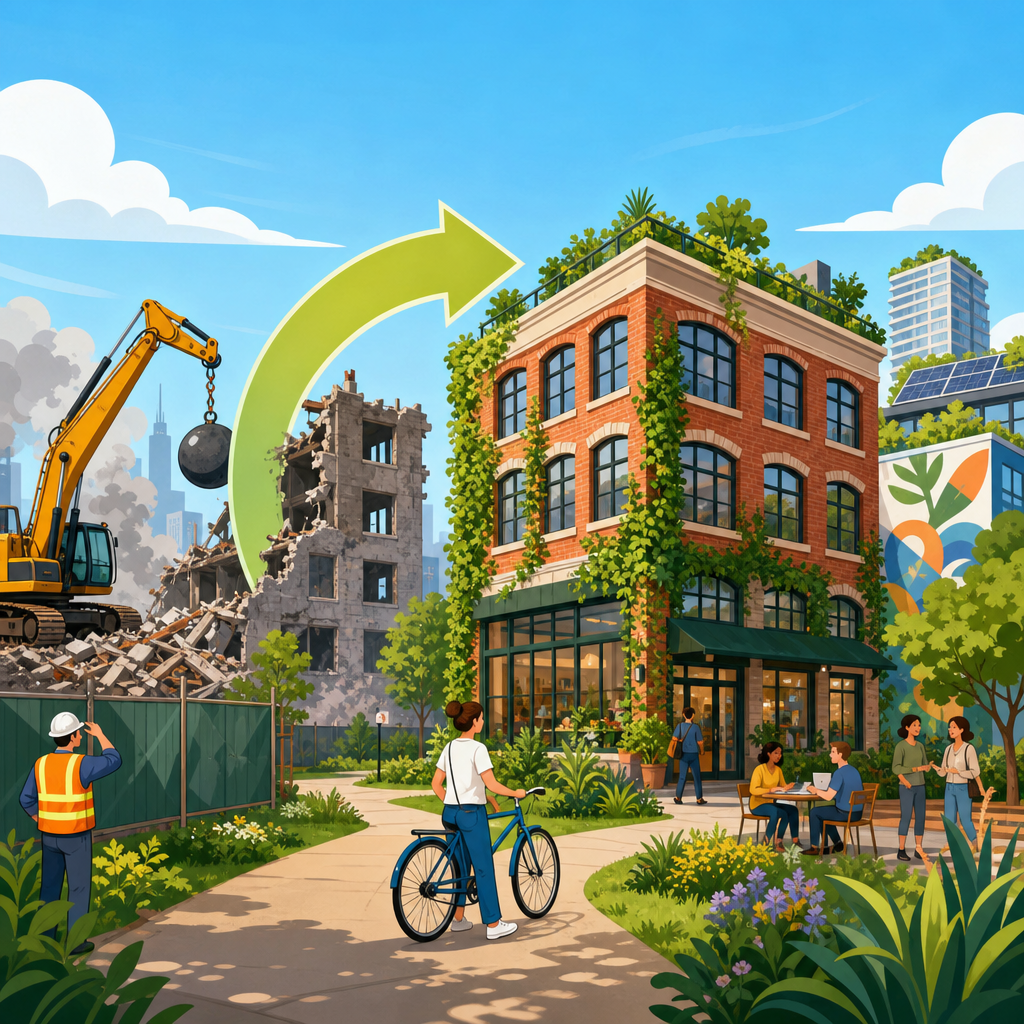
Reuse before demolition is one of the most practical sustainability principles in urban development because the greenest building is often the one that already exists. In city planning, existing buildings are structures already standing and connected to a neighborhood’s materials, infrastructure, and social history. Reuse means extending that life through renovation, retrofitting, adaptive reuse, and careful maintenance rather than tearing a structure down and starting from zero. Demolition, by contrast, ends the service life of usable materials, creates waste, and triggers a new round of emissions from construction.
This matters because the climate impact of buildings is not limited to heating, cooling, and lighting. Every beam, slab, brick, pane, and finish carries embodied carbon, the greenhouse gas emissions released during extraction, manufacturing, transport, installation, maintenance, and disposal. When a sound building is demolished, much of that stored investment is discarded, and a replacement project usually adds a fresh carbon burden before tenants even move in. I have worked on project reviews where teams focused heavily on efficient mechanical systems but overlooked the fact that preserving the structure delivered the largest immediate emissions savings.
Across growing cities, the sustainability case for existing buildings extends beyond carbon. Reuse can reduce landfill pressure, protect historic character, limit neighborhood disruption, preserve affordable space, and shorten construction timelines. It also aligns with resilience planning because older buildings often occupy central, transit-served sites where keeping the urban fabric intact supports walkability and local business continuity. The strongest urban strategies now treat existing buildings as assets first and redevelopment sites second. That shift is changing policy, finance, design practice, and public expectations.
For a hub article under sustainable urban development, the key question is simple: when should cities and owners reuse before demolition, and what makes reuse succeed? The answer is not ideological. Some buildings are unsafe, contaminated, or poorly suited to continued use. But in far more cases than the market assumes, retaining all or part of an existing structure offers the better environmental outcome. Understanding why requires a close look at embodied carbon, operational performance, urban economics, regulations, and the practical methods teams use to evaluate a building’s future.
Why existing buildings matter in climate strategy
Buildings account for a large share of global energy-related emissions, and the sector’s footprint comes from both operations and materials. Operational carbon includes emissions from electricity, heating fuels, cooling systems, and equipment during use. Embodied carbon covers the emissions tied to products and construction processes before and after occupancy. For decades, policy focused mainly on operations, which made sense when inefficient envelopes and fossil-fuel heating dominated. Today, better codes, electrification, and renewable power are reducing operational emissions in many markets, which makes upfront embodied carbon a larger share of a new building’s total climate impact.
That is where reuse becomes decisive. If an existing foundation, frame, floor plates, and enclosure remain serviceable, keeping them avoids a substantial volume of emissions that a new build would trigger immediately. Institutions such as the World Green Building Council, Architecture 2030, and the Carbon Leadership Forum have helped standardize this discussion by distinguishing between operational and embodied impacts and by encouraging whole-life carbon assessment. In practice, I have seen early carbon studies change owner decisions because they reveal that preserving the structure can protect years, sometimes decades, of emissions reductions compared with replacement.
The climate value of reuse is strongest in carbon-intensive structural systems. Concrete and steel, common in mid-rise and high-rise buildings, carry significant manufacturing emissions. Portland cement production alone is a major industrial emissions source. When demolition removes a viable concrete frame, the replacement often requires new cement, reinforcing steel, decking, finishes, and interior fit-out. Even if a portion of the debris is recycled, recycling does not erase the emissions from producing the original materials or the new ones required. Salvage helps, but retention usually helps more.
There is also a timing issue. Upfront emissions happen now, while climate science emphasizes the importance of near-term reductions. A highly efficient new building may eventually outperform an older one operationally, but if it creates a large upfront carbon spike, the payback period can be long. In many cases, a deep energy retrofit of the existing structure reaches a better whole-life outcome within the timeframe cities must act. Reuse is therefore not a sentimental preference. It is a carbon management strategy rooted in accounting, material science, and the urgency of decarbonization.
How adaptive reuse delivers environmental and urban benefits
Adaptive reuse means converting an existing building to a new or intensified use while preserving substantial physical components. Common examples include warehouses becoming apartments, offices becoming schools or labs, mills becoming mixed-use centers, and obsolete retail boxes becoming clinics or logistics hubs. The environmental advantage starts with material retention, but it spreads further. Reuse typically requires less site disturbance, fewer truck movements, and less demolition debris. It may also preserve mature streetscapes, tree cover, utility connections, and transit relationships that already support lower-carbon mobility.
Urban benefits are just as important. Existing buildings often anchor neighborhood identity. Reusing them can maintain continuity for residents and businesses while unlocking new economic activity. A preserved corner commercial block with upgraded systems can keep a district recognizable in a way a cleared site cannot. In downtowns struggling with office vacancies, converting underused buildings to housing or education space can restore foot traffic and support restaurants, pharmacies, and local services. In industrial districts, reusing large-span structures can create affordable maker space that would be difficult to build new at comparable cost.
Reuse can also improve social sustainability when cities connect preservation with housing policy and community services. Schools, libraries, municipal buildings, and older apartment blocks are often located where people already need them. Retrofitting these assets can be faster than land assembly and full redevelopment, which matters when a city is responding to housing shortages or public facility demands. I have seen municipalities preserve structurally sound civic buildings not only for emissions reasons but because keeping them open avoided service disruption and maintained trust with neighborhoods that had already experienced years of construction pressure.
Not every adaptive reuse project is automatically sustainable. Deep interior reconfiguration, facade replacement, hazardous material abatement, or major code-triggered upgrades can add substantial costs and impacts. Yet even with those complications, reuse frequently remains favorable when teams assess the full picture: retained structure, avoided waste, reduced neighborhood disruption, and the value of building on infrastructure that already exists. Success depends on careful due diligence, realistic pro formas, and design decisions that work with a building’s strengths instead of forcing a completely alien program into it.
Evaluating reuse versus demolition in practice
The best reuse decisions come from disciplined assessment, not assumptions. Owners should start with structural condition, code pathway, envelope performance, hazardous materials, floor-to-floor heights, core configuration, and market fit. A building that appears obsolete may still have a robust frame, generous daylight, and a flexible grid that supports new uses. Conversely, a charming older structure may have seismic deficiencies, water intrusion, or contamination that make retention difficult. The point is to compare options on evidence. In serious project planning, I advise teams to run both a whole-life carbon study and a lifecycle cost analysis before selecting demolition.
| Decision factor | Questions to ask | Why it matters |
|---|---|---|
| Structural system | Can the foundation and frame support continued use or added loads? | Retaining primary structure usually preserves the largest share of embodied carbon. |
| Code compliance | Which fire, accessibility, seismic, and energy upgrades are triggered? | Code pathways shape feasibility, schedule, and cost. |
| Operational performance | Can envelope, HVAC, and controls be upgraded efficiently? | Retrofits must lower ongoing energy use, not just save materials. |
| Market and program fit | Do floor plates, heights, and location suit the intended use? | A sustainable building still needs a viable, long-term function. |
| Material hazards | Are asbestos, lead, mold, or contaminated soils present? | Abatement can be manageable, but it must be priced and planned early. |
Carbon accounting tools make these comparisons more rigorous. Teams commonly use whole-building lifecycle assessment methods aligned with standards such as EN 15978 and product data such as environmental product declarations. Tools including One Click LCA, EC3, and Athena can estimate upfront and whole-life impacts across scenarios. A credible comparison should include retention assumptions, retrofit materials, demolition waste, replacement structure, and realistic operational modeling. If the analysis only compares old operations against new operations, it misses the core question. The right comparison is reuse plus retrofit versus demolition plus new construction across the same study period.
Financial analysis also needs nuance. Demolition and new construction can appear simpler to underwrite because lenders and appraisers are familiar with standard products. Reuse projects may carry hidden conditions and uncertain approvals. But they can also deliver advantages: lower material quantities, faster occupancy when shells are retained, tax incentives for historic rehabilitation, and reduced entitlement risk in established neighborhoods. The strongest business cases usually emerge when climate benefits align with market realities, such as office-to-residential conversions in transit-rich cores or industrial reuse in districts where creative and light manufacturing tenants need character space.
Decision-making improves further when cities require alternatives analysis before demolition permits, especially for larger buildings. Several jurisdictions are experimenting with deconstruction ordinances, embodied carbon reporting, and reuse studies as part of planning review. These policies do not prohibit redevelopment. They simply make the environmental cost visible and force a more honest comparison. That is useful because demolition has long been treated as a routine reset button when, from a sustainability perspective, it should be a last resort after retention options have been tested thoroughly.
Design and policy strategies that make reuse work
Successful reuse depends on design intelligence and supportive policy. On the design side, the most effective teams begin with what can stay: structure, facade elements, stair cores, shafts, and durable interior materials. They then target operational improvements with high return, such as air sealing, insulation where appropriate, high-performance windows or interior storm systems, heat pumps, energy recovery ventilation, LED lighting, and advanced controls. Commissioning matters because retrofits often fail through poor integration rather than poor technology. Existing buildings can perform very well when systems are sized correctly and occupants can operate them simply.
Policy can remove barriers that otherwise push owners toward demolition. Adaptive reuse codes are a strong example. Standard new-building codes may apply requirements that are difficult to meet in older structures even when life safety can be achieved through equivalent measures. Tailored code pathways, used in cities such as Los Angeles for office-to-residential conversions, can unlock feasible projects without sacrificing safety. Zoning flexibility also matters. Allowing residential use in former commercial areas, reducing unnecessary parking mandates, and streamlining change-of-use approvals can determine whether a building is reused or abandoned.
Public incentives strengthen the case. Historic tax credits remain among the most proven tools for preserving significant buildings, but cities can go further with low-interest retrofit financing, property assessed clean energy programs, grants for predevelopment studies, and procurement rules that prioritize existing public assets. Embodied carbon limits in public projects can also shift practice by rewarding retention of structures and low-carbon materials. When governments measure carbon explicitly, project teams respond quickly because the rules change what counts as value.
Owners and developers should also think in portfolios, not one building at a time. Large institutions, housing providers, campuses, and municipalities can benchmark assets, identify candidates for deep retrofit, and phase investment according to condition and carbon impact. This creates a repeatable pipeline instead of a one-off experiment. In my experience, organizations become far more confident about reuse after completing one or two successful projects because they build internal knowledge about surveys, selective demolition, tenant communication, and procurement. Reuse then shifts from exception to standard practice, which is exactly where sustainable urban development needs it to be.
Conclusion: building the future by keeping more of the past
The sustainability case for existing buildings is clear. Reuse before demolition cuts embodied carbon, reduces waste, limits disruption, and preserves the urban fabric that makes cities efficient and livable. It also supports practical goals that matter to owners and communities: faster delivery in some cases, conservation of cultural value, continuity for local businesses, and better use of infrastructure already in place. New construction still has a role, especially where buildings are unsafe or cannot meet future needs responsibly. But demolition should no longer be the default response to age or obsolescence.
The most effective approach is straightforward. First, evaluate what can be retained. Second, compare reuse and replacement through whole-life carbon and lifecycle cost analysis. Third, pair retention with serious energy upgrades so the building performs well over time. Finally, use policy tools and financing mechanisms that reward conservation of existing assets rather than the unnecessary loss of them. Cities that follow this sequence make more credible progress on climate goals because they reduce emissions now, not only in distant operating years.
As this hub within sustainable urban development, reuse before demolition should frame every related discussion about housing, heritage, circular construction, retrofit policy, and downtown recovery. Existing buildings are not obstacles to sustainability. They are one of its strongest levers. If you are planning a project, start with a reuse study before approving teardown. That single step often reveals the most sustainable building strategy was already standing on the site.
Frequently Asked Questions
Why is reusing an existing building often considered more sustainable than demolishing it and constructing a new one?
Reusing an existing building is often the more sustainable option because it preserves the embodied carbon already locked into the structure. Embodied carbon refers to the emissions generated through extracting raw materials, manufacturing products like steel, concrete, and glass, transporting them, and assembling them on-site. When a building is demolished, much of that past environmental investment is wasted, and a new project usually triggers another large wave of emissions before the replacement building even opens. In contrast, renovation, retrofitting, and adaptive reuse allow cities and property owners to keep much of the original structural frame, foundations, and materials in service, which can significantly reduce the total environmental footprint of a project.
There is also a broader systems-level sustainability benefit. Existing buildings are already connected to roads, utilities, public transit, and neighborhood activity patterns. Keeping them in use reduces the pressure to consume new materials and avoids unnecessary waste entering the demolition stream. In many cases, reuse also supports more resilient communities by preserving familiar places, maintaining urban continuity, and reducing disruption to nearby residents and businesses. While new construction can be appropriate in some situations, the sustainability case for reuse is strong because it addresses both carbon reduction and resource conservation at the same time.
What does “adaptive reuse” mean, and how is it different from a standard renovation?
Adaptive reuse is the process of taking an existing building and repurposing it for a new or expanded use while retaining much of its original structure and character. For example, a warehouse may become apartments, a former school may be converted into offices, or an older commercial building may be transformed into a mixed-use community space. The goal is not simply to repair or modernize a building, but to extend its useful life in a way that responds to current economic, social, and environmental needs.
A standard renovation usually focuses on improving a building for the same general purpose it already serves. That might include replacing worn systems, updating finishes, improving accessibility, or boosting energy performance. Adaptive reuse goes further by rethinking how the building can function in a changing city. From a sustainability perspective, this is especially valuable because it allows communities to meet new demands without automatically resorting to demolition and replacement. It also creates opportunities to preserve architectural identity and neighborhood history while making the building relevant for modern use. In practice, many projects combine renovation and adaptive reuse, but the defining feature of adaptive reuse is that it gives an existing structure a renewed role rather than treating it as obsolete.
Can older buildings really be made energy-efficient enough to support modern climate goals?
Yes, many older buildings can be substantially improved to support modern climate and energy goals, although the right strategy depends on the building’s age, condition, construction type, and intended use. Energy-efficient upgrades often include better insulation, high-performance windows where appropriate, air sealing, modern HVAC systems, LED lighting, smart controls, water-saving fixtures, and electrification measures such as heat pumps. In some projects, renewable energy systems can also be added. These improvements can dramatically reduce operational energy use while allowing the structure itself to remain in place.
It is important to look at the full lifecycle picture rather than operational efficiency alone. A brand-new “green” building may perform well once occupied, but if it required demolition of a viable structure and extensive new material production, its total carbon impact can remain high for years. Reusing an existing building while improving its performance can often deliver a better balance between immediate carbon savings and long-term efficiency. Even when an older building cannot reach the exact performance level of a top-tier new building, reuse may still be the more climate-responsible option overall. The most effective approach is usually a whole-building assessment that considers carbon, energy, durability, occupant comfort, heritage value, and long-term adaptability together.
What are the biggest challenges to reusing existing buildings instead of demolishing them?
One of the biggest challenges is that existing buildings can come with technical, financial, and regulatory complexities. Older structures may have deferred maintenance, outdated mechanical systems, hazardous materials, or layouts that do not easily fit current uses. Bringing a building up to modern safety, accessibility, and energy standards can require careful design and sometimes significant investment. There can also be uncertainty early in the process, because hidden conditions are more common in retrofit projects than in ground-up construction, and that uncertainty can affect budgets and timelines.
However, these challenges do not mean reuse is impractical. They mean it requires strong planning, interdisciplinary coordination, and a willingness to evaluate value beyond short-term construction simplicity. Policy and market signals also matter. In some places, zoning rules, financing structures, appraisal methods, and development incentives still favor demolition and new construction, even when reuse would provide stronger environmental and community benefits. As cities place greater emphasis on carbon reduction and circular economy principles, those barriers are increasingly being reconsidered. Successful reuse projects usually begin with a thorough condition assessment, a realistic understanding of code requirements, and a design strategy that works with the building’s strengths rather than fighting them. When approached thoughtfully, many of the perceived obstacles can be managed effectively.
How does preserving and reusing existing buildings benefit neighborhoods and communities, not just the environment?
Preserving and reusing existing buildings benefits neighborhoods because buildings are more than physical assets; they are part of local identity, memory, and everyday social life. Existing structures often reflect a community’s history, craftsmanship, scale, and development patterns. When they are reused thoughtfully, they help maintain a sense of place that can be lost when demolition clears entire blocks for generic replacement projects. This continuity matters in urban development because healthy neighborhoods are shaped not only by efficiency and density, but also by familiarity, cultural meaning, and human-scale environments.
Reuse can also support local economic vitality. Rehabilitation projects often create demand for skilled labor, specialty trades, and locally grounded design solutions. Adaptively reused buildings can bring new housing, shops, offices, cultural venues, or community services into areas that already have infrastructure and transit access, which can strengthen neighborhood activity without the same level of disruption caused by demolition and complete rebuilding. In many cases, reuse encourages incremental development rather than abrupt transformation, helping communities evolve in a way that feels more rooted and less extractive. For city planners, property owners, and residents alike, that makes building reuse an environmental strategy and a placemaking strategy at the same time.