Sustainable infill development adds new homes within existing neighborhoods instead of pushing growth outward onto farmland, forests, and car-dependent fringe areas. In practice, it means using vacant lots, underused parcels, obsolete commercial sites, oversized parking areas, and aging single-use properties to create housing where streets, utilities, schools, parks, and transit already exist. I have worked on redevelopment briefs and site feasibility reviews where a single underperforming parcel near a bus corridor produced dozens of homes without extending a mile of new sewer line. That is the core promise of infill: more housing, lower infrastructure waste, and better urban land use.
The term sustainable matters because not every infill project improves a city. Good infill development reduces land consumption, supports walking and transit, preserves natural areas at the edge, and uses public infrastructure more efficiently. It also needs to respond to heat, stormwater, tree canopy, affordability, and neighborhood fit. Housing matters because most growing regions face a basic mismatch between demand and supply. When cities block new homes in established areas, pressure shifts outward. The result is sprawl: longer commutes, higher public service costs, more traffic emissions, and greater loss of open land. Sustainable infill development is one of the few strategies that addresses housing shortage and environmental impact at the same time.
This article serves as a hub for the full infill topic. It explains what sustainable infill development is, why cities pursue it, what forms it takes, which barriers stall projects, and how local governments, developers, and communities can get better results. It also answers practical questions people ask early in research: Is infill cheaper than greenfield growth? Can infill add affordable housing? Does density automatically mean high-rise buildings? What design standards help a project fit an existing neighborhood? The short answers are yes, sometimes, no, and context-specific design standards matter greatly. Understanding those distinctions is essential if a city wants to add housing without repeating the mistakes of sprawl or poor urban renewal.
What Sustainable Infill Development Includes
Sustainable infill development is the process of building housing on land inside an already urbanized area while improving, or at least not degrading, environmental and social performance. Typical sites include vacant lots, brownfields, dead malls, aging strip centers, surface parking lots, former industrial parcels, and large residential lots suitable for subdivision or accessory units. The housing types can range from accessory dwelling units and duplexes to courtyard apartments, mixed-use mid-rise buildings, and adaptive reuse of offices or warehouses. In my experience, the most successful infill sites are not always the most visible. Small parcels near daily destinations, transit stops, and utility capacity often move faster than flashy mega-sites because entitlements, financing, and construction logistics are more manageable.
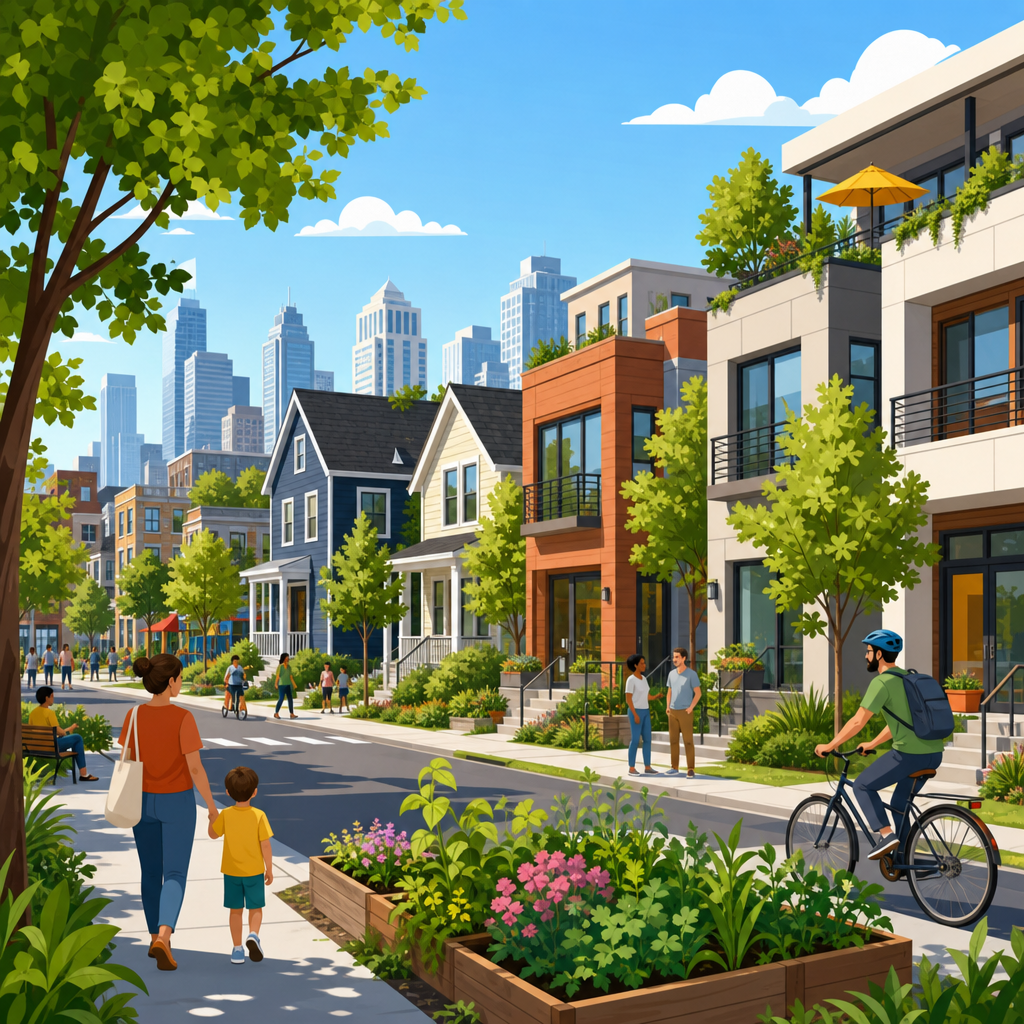
Infill is not synonymous with high density or luxury redevelopment. A neighborhood can add meaningful housing through “missing middle” forms such as townhouses, fourplexes, bungalow courts, and small apartment buildings that fit on residential blocks. These formats were common before zoning codes separated uses and imposed large minimum lot sizes, setbacks, and parking requirements. Sustainable infill also includes upgrades around the project itself: safer sidewalks, street trees, permeable surfaces, bicycle parking, district energy connections where available, and stormwater controls such as bioswales or green roofs. If a project merely inserts units while worsening heat, runoff, congestion, or displacement risk, it is infill, but not especially sustainable infill.
Why Infill Development Helps Cities Avoid Sprawl
Sprawl occurs when urban growth expands outward in low-density, single-use patterns that require long trips and costly infrastructure extensions. Infill counters that pattern by placing homes closer to jobs, shops, schools, and services already supported by public investment. This matters fiscally. Extending roads, water mains, sewer systems, and emergency services to fringe development is expensive to build and maintain. The Strong Towns movement has repeatedly highlighted how low-density expansion can create long-term liabilities that exceed the tax revenue generated. By contrast, compact areas tend to produce more value per acre and use existing networks more efficiently.
The environmental case is equally strong. Transportation is a major source of greenhouse gas emissions in many countries, and land-use patterns strongly shape travel behavior. Housing near transit and daily destinations reduces vehicle miles traveled more reliably than asking people to simply drive cleaner cars. Infill also limits conversion of agricultural land and habitat at the metropolitan edge. The Intergovernmental Panel on Climate Change and many national planning bodies have emphasized that compact, connected urban form can lower per-capita emissions. A resident in a walkable infill neighborhood may still own a car, but they are more likely to combine trips, walk for errands, or take transit for commuting than a resident in an outer subdivision with no nearby services.
Common Infill Housing Types and When They Work Best
Different sites call for different housing forms. Accessory dwelling units work well on established residential lots where homeowners want rental income, family housing, or aging-in-place options. Duplexes, triplexes, and fourplexes are effective where a city needs gentle density without changing block character dramatically. Townhouses often fit transition zones between detached homes and commercial corridors. Mid-rise mixed-use buildings perform best on transit corridors, near downtowns, and on redeveloping commercial land where ground-floor retail or community space can support street life. Adaptive reuse can deliver housing quickly when older buildings have strong structure, adequate floor plate depth, and code-compliant paths for light, egress, and seismic upgrades.
| Infill type | Best context | Main benefit | Key challenge |
|---|---|---|---|
| Accessory dwelling unit | Single-family neighborhoods | Low-impact housing growth | Owner financing and permitting complexity |
| Duplex to fourplex | Residential blocks near services | Missing-middle density | Neighborhood opposition and lot standards |
| Townhouse | Transition areas and corner parcels | Family-sized ownership units | Land assembly and parking design |
| Mid-rise mixed use | Corridors, centers, transit areas | High unit yield and walkability | Construction cost and entitlement risk |
| Adaptive reuse | Older offices, schools, warehouses | Embodied carbon savings | Building code and floor plan constraints |
Choosing the right form depends on more than density targets. Parcel dimensions, fire access, utility capacity, local rents or sale prices, and construction type all influence feasibility. For example, a five-over-one wood-frame apartment building may make sense on a commercial corridor, but a courtyard apartment can deliver similar livability on a smaller site with less visual bulk. I have seen projects fail not because the idea was wrong, but because the building type did not match the block, financing stack, or entitlement environment. Sustainable infill development works best when city rules allow multiple formats rather than pushing every site toward either detached housing or large podium buildings.
Design Principles That Make Infill Sustainable
Good infill starts with site design. Buildings should address the street, place entrances where people actually walk, and reduce blank walls and curb cuts. Parking should be right-sized rather than dictated by outdated minimums that consume land and increase cost. On many urban infill sites, structured parking can add tens of thousands of dollars per stall, directly affecting housing prices. Eliminating or reducing parking minimums, as cities such as Buffalo and Minneapolis have done, can unlock projects that otherwise would not pencil. That does not mean banning parking. It means calibrating supply to context, transit access, and actual demand.
Environmental performance is also central. Sustainable infill should conserve existing buildings where feasible because reuse often preserves embodied carbon already invested in structure and materials. New construction should consider passive solar orientation, high-performance envelopes, electric heating systems, durable low-carbon materials, and water-sensitive landscape design. Urban heat island mitigation is especially important on small sites. Trees, reflective surfaces, shade structures, and reduced paving improve comfort and public health. Stormwater management needs equal attention. Dense sites shed water quickly, so permeable paving, detention systems, rain gardens, and green roofs help prevent flooding and combined sewer overflows. Infill is most defensible when it upgrades resilience rather than simply occupying leftover land.
Policy and Zoning Reforms That Unlock Housing
Many cities say they support infill while maintaining rules that make it difficult or impossible. Common barriers include single-family-only zoning, large minimum lot sizes, excessive setbacks, height caps disconnected from street context, parking minimums, lengthy discretionary review, and impact fees calibrated for greenfield conditions instead of urban reuse. Reform usually begins with legalizing more housing types by right in appropriate areas. Oregon’s statewide middle housing reforms, California’s accessory dwelling unit changes, and numerous city-level zoning rewrites show that modest code changes can produce real unit growth over time.
Streamlined approvals matter as much as use permissions. Time is a major cost in infill development because holding land, redesigning for comments, and waiting through hearings can kill financing. Predictable form-based standards often work better than subjective case-by-case review. If a city wants context-sensitive outcomes, it should codify frontage design, massing transitions, tree requirements, active transportation links, and stormwater performance in clear standards. Infrastructure policy also matters. Utility connection fees, affordable housing incentives, tax increment tools, brownfield remediation grants, and density bonuses can make difficult infill sites viable. When cities align zoning, capital planning, and housing policy, sustainable infill development stops being an aspiration and becomes a repeatable delivery system.
Affordability, Equity, and Community Trust
A common question is whether infill development improves affordability or accelerates displacement. The honest answer is that it can do either, depending on market conditions and policy design. Adding housing supply in high-demand areas helps moderate price pressure over time, especially when it expands the range of unit types. But new development on its own does not protect low-income tenants or preserve community stability. Cities need anti-displacement measures alongside growth: tenant protections, right-to-return policies for redevelopment, community land trusts, inclusionary housing where feasible, nonprofit acquisition funds, and preservation of existing naturally occurring affordable housing.
Community trust is often the difference between a durable infill strategy and constant political backlash. Residents usually respond better when they see concrete local benefits: safer crossings, better parks, streetscape upgrades, neighborhood-serving retail, and housing options for older adults, young families, and local workers. Engagement must begin early, before architectural details are fixed, and it should focus on tradeoffs honestly. I have found that opposition softens when planners explain what happens without infill: rising rents, longer commutes, school enrollment imbalance, and outward land consumption. Sustainable infill development is not a slogan about density. It is a practical choice about where a city will place inevitable growth and who will benefit from it.
How Cities Can Build a Strong Infill Pipeline
The most effective cities treat infill as a system, not a one-off project category. They map opportunity sites, audit zoning barriers, identify public land, pre-plan infrastructure upgrades, and publish design guidance that reduces uncertainty. They also track outcomes by permits, completed units, affordability levels, tree canopy, stormwater performance, and transportation access rather than counting rezonings alone. Public agencies should coordinate planning, housing, transportation, and utilities so that corridor plans are tied to realistic capital investment. A bus rapid transit line, for example, supports more housing only if zoning, sidewalks, and utility capacity are addressed before developers submit applications.
For private developers and community development organizations, the discipline is similar. Start with site selection near services and transit, test multiple building types, verify utility constraints early, and budget for community engagement and environmental remediation. Smaller-scale infill builders are especially important because they deliver accessory units, lot splits, townhouses, and small apartments that larger firms often ignore. If you are evaluating sustainable infill development for a city, neighborhood, or portfolio, begin with a straightforward question: where can new homes be added within existing urban areas while improving long-term environmental performance and community value? Answer that with clear standards and consistent approvals, and housing can grow without sprawl.
Frequently Asked Questions
What is sustainable infill development, and how is it different from sprawl?
Sustainable infill development is the practice of adding new housing and mixed-use space within existing communities rather than expanding outward into undeveloped land. Instead of building on the suburban edge, infill focuses on vacant lots, underused parcels, obsolete shopping centers, oversized parking lots, aging strip commercial sites, and other properties that can accommodate new homes where infrastructure is already in place. That means streets, water and sewer lines, schools, parks, transit routes, and neighborhood services are already serving the area, which can make growth more efficient and less environmentally damaging.
Sprawl works in the opposite direction. It extends development farther from job centers and established neighborhoods, often consuming farmland, forests, habitat, and open space. It also tends to create car-dependent patterns that require more road construction, more utility extensions, longer commutes, and higher long-term public service costs. Infill, when planned well, can reduce land consumption, support walkability, improve access to transit, and create more housing choices in places where people already want to live.
The sustainability benefit is not just about where housing gets built, but how efficiently land and infrastructure are used. A single underperforming parcel in an established area can often accommodate homes near jobs and services without repeating the full environmental and fiscal cost of edge expansion. Done thoughtfully, infill helps communities grow inward, strengthen existing neighborhoods, and meet housing demand without pushing growth farther into undeveloped areas.
Why is infill development considered more sustainable than building new housing on the outskirts of a city?
Infill development is generally more sustainable because it makes better use of land, infrastructure, and public investment that already exist. When new housing is built within an established neighborhood, the community does not need to duplicate as many roads, pipes, utility corridors, and public facilities on the fringe. That reduces both upfront construction impacts and long-term maintenance burdens. It also allows growth to happen in places that are already connected to schools, parks, transit, shops, and jobs, which can lower vehicle miles traveled and make daily life less dependent on driving.
There is also a major land preservation benefit. Outward expansion typically consumes greenfield sites such as farmland, woodlands, wetlands, and other undeveloped land. Those landscapes often provide stormwater absorption, habitat, local food production, and climate resilience. By channeling more housing into underused urban and suburban sites, infill helps protect those environmental assets. In many cases, redeveloping a surface parking lot or obsolete low-rise commercial parcel is a far more responsible use of land than extending a subdivision into previously untouched territory.
From a climate and resource perspective, infill can support smaller housing footprints, shared walls, shorter utility runs, and transportation options beyond private cars. It can also revitalize aging corridors and make better use of existing neighborhoods that have the capacity to absorb modest growth. Sustainable infill is not automatically perfect, however. Projects still need good design, careful stormwater management, tree preservation or replacement, and sensitivity to neighborhood context. But compared with sprawl, infill offers a more efficient and lower-impact way to add housing at a community scale.
What kinds of properties are typically good candidates for sustainable infill housing?
The best infill opportunities are usually properties that are underperforming relative to their location and surrounding infrastructure. Common examples include vacant lots, empty or partially occupied commercial parcels, aging strip centers, obsolete office sites, dead malls, former industrial land suitable for remediation and reuse, oversized parking lots, and single-story buildings in areas that can support more homes. In many communities, corner lots, shallow commercial corridors, aging motels, and institutional properties with excess land also present opportunities for carefully planned infill.
What makes a site promising is not just that it is available, but that it can support housing without creating avoidable strain on the surrounding area. A strong candidate usually has access to public streets, water and sewer service, transit or jobs nearby, and a physical layout that can accommodate building mass, setbacks, access, drainage, and open space. Parcels near neighborhood commercial districts, frequent bus corridors, downtown edges, or community amenities are often especially effective because new residents can rely less on long car trips.
Feasibility also depends on zoning, parcel dimensions, environmental conditions, ownership complexity, and redevelopment cost. Some sites look ideal on a map but become difficult because of contamination, awkward easements, fragmented ownership, flood constraints, or expensive utility upgrades. Others can be transformed with relatively modest intervention, such as converting excess parking into townhomes or adding apartments above ground-floor retail on an underused corridor. In practice, some of the most effective infill projects come from rethinking everyday low-intensity sites that no longer reflect the full value of their location.
Does infill development always mean large apartment buildings and major neighborhood change?
No. One of the biggest misconceptions about infill development is that it always means a large, abrupt increase in scale. In reality, infill can take many forms, and some of the most sustainable solutions are relatively modest. These include accessory dwelling units, duplexes, triplexes, fourplexes, cottage courts, townhomes, small courtyard apartments, mixed-use buildings on neighborhood corridors, and redevelopment of underused commercial sites into housing with compatible design. In many places, “missing middle” housing provides a way to add homes gradually while keeping the overall neighborhood fabric recognizable.
Good infill is about fit as much as density. That means paying attention to building placement, height transitions, privacy, street trees, materials, entrances, parking design, and pedestrian connections. A well-designed infill project can add meaningful housing supply while reinforcing the pattern of the block rather than overwhelming it. It can also repair places that are currently dominated by empty lots, blank walls, surface parking, or aging single-use properties that contribute little to neighborhood life.
Major redevelopment does happen on some sites, particularly dead malls, obsolete shopping centers, and large commercial parcels, but that is only one part of the infill spectrum. Sustainable infill should be thought of as a toolbox, not a single building type. Communities that want to avoid sprawl usually need a range of housing options across different site sizes and contexts. That allows growth to be distributed more thoughtfully instead of concentrated only in a few very large projects or pushed outward to the metropolitan edge.
How can communities support infill development while protecting neighborhood quality and affordability?
Communities can support successful infill by aligning policy, zoning, infrastructure planning, and design expectations around the idea that growth should happen where existing systems can handle it best. That often starts with updating zoning codes that make it difficult to build modest multifamily housing, reuse commercial land, reduce excessive parking, or add homes near transit and neighborhood centers. Clear rules are important because they reduce uncertainty, shorten approval timelines, and make it easier for property owners and builders to pursue housing on appropriate sites.
Protecting neighborhood quality requires more than simply allowing more units. Cities should establish context-sensitive design standards, invest in sidewalks and street trees, improve stormwater systems, manage curb access carefully, and make sure public amenities keep pace with growth. Residents are more likely to support infill when they can see that redevelopment will improve the public realm rather than just maximize building area. Transparent planning, early engagement, and realistic visual examples also help communities distinguish thoughtful infill from poorly designed speculation.
Affordability is another critical piece. Infill land can be expensive, especially in high-demand neighborhoods, so communities often need complementary strategies such as inclusionary housing policies, density bonuses, tax incentives, land banking, public-private partnerships, adaptive reuse support, or direct subsidy for income-restricted units. Preserving naturally occurring affordable housing should also be part of the conversation, especially where redevelopment pressure could displace long-term residents. The most effective approach is usually balanced: make it easier to add more housing overall, target growth to well-served sites, require or incentivize quality design, and pair redevelopment with anti-displacement and affordability tools so that infill benefits a wider range of households.