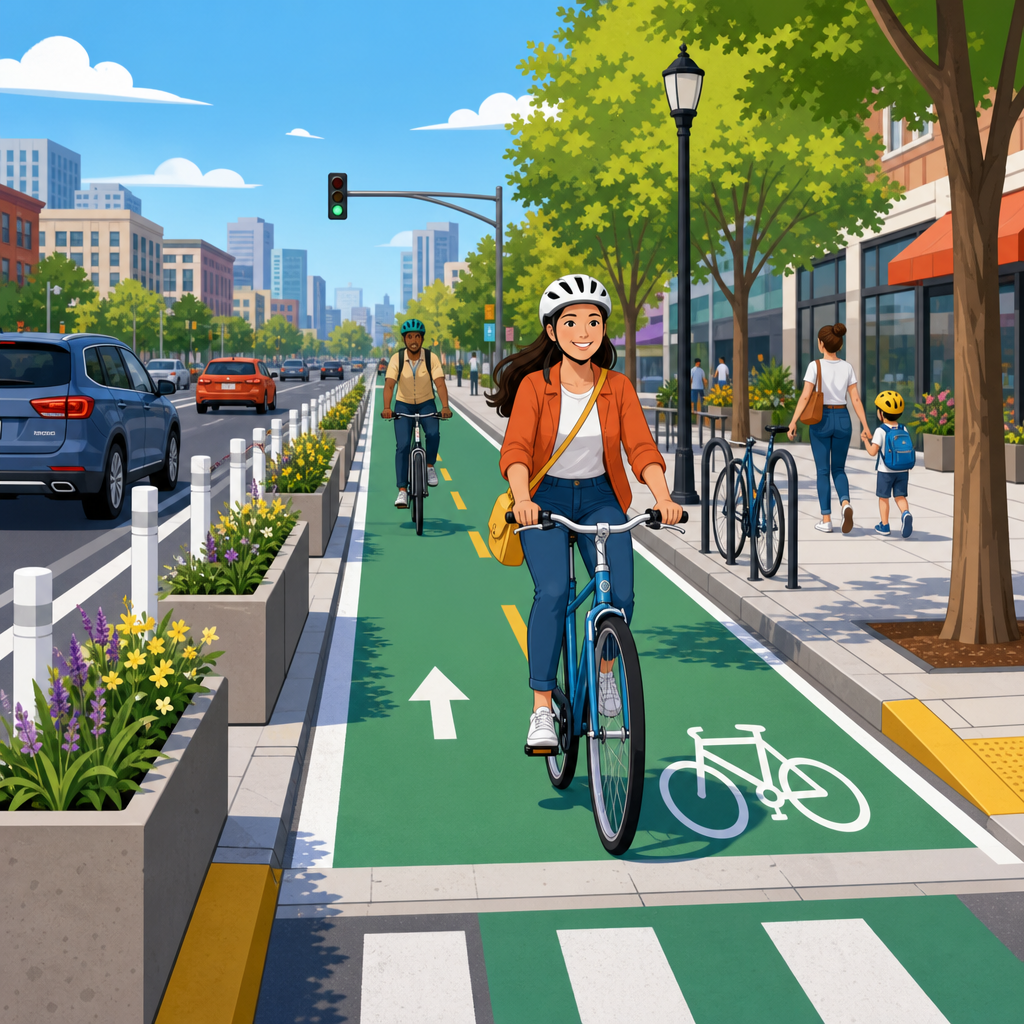
Protected bike lanes are often described as painted stripes with posts, but the design details that determine safety, comfort, and everyday usefulness go far beyond surface markings. A protected bike lane is a dedicated cycling space separated from moving traffic by vertical elements, raised curbs, parked cars, medians, planters, or grade changes, rather than paint alone. In practice, the difference between a bike lane people tolerate and one they choose every day usually comes down to width, intersection geometry, sight lines, drainage, maintenance access, and the quality of physical separation. After working on corridor redesigns and reviewing crash patterns at complex urban intersections, I have seen the same lesson repeated: paint communicates intent, but geometry controls behavior. That matters for cities pursuing sustainable urban development because transportation emissions, traffic injuries, noise, public health, and access to jobs are all shaped by street design. Well-designed protected bike lanes increase the number and range of people willing to cycle, including children, older adults, and new riders who will never feel comfortable beside fast traffic.
When planners talk about a high-comfort bike network, they mean more than isolated facilities. They mean connected routes that feel predictable at every block, every driveway, every bus stop, and every signalized junction. Research from the National Association of City Transportation Officials, the Federal Highway Administration, and studies in cities such as New York, Montreal, Seville, and Copenhagen consistently shows that separated cycling infrastructure is associated with lower injury risk and higher ridership than conventional painted lanes. Yet not all protected bike lanes perform equally. A corridor can look impressive in an aerial photo and still fail because the separation disappears before intersections, the lane is too narrow for passing, turning vehicles cut across the path unexpectedly, or snow and debris accumulate where riders actually travel. The central issue is simple: protection must be continuous, legible, and forgiving. If a person on a bicycle has to negotiate frequent ambiguity, the facility is not truly protected. That is why the details matter more than paint.
Why separation quality determines whether people actually ride
The first design question is not whether to add a stripe but how to create meaningful separation from moving vehicles. Flexible delineator posts can be useful for quick-build projects, testing layouts, and reducing encroachment, but they do not provide the same level of comfort as concrete curbs, planters, parking-protected layouts, or raised cycle tracks. On streets with high vehicle volumes, frequent truck traffic, or operating speeds above roughly 25 miles per hour, stronger separation becomes more important because rider stress rises sharply when adjacent traffic is fast and close. I have watched riders avoid a nominally protected lane where posts were spaced too far apart and delivery vehicles regularly parked in the buffer. By contrast, a lane with a mountable curb and regular access points for emergency use remained clear and felt reliable throughout the day.
Width is equally decisive. A one-way protected bike lane generally works best when it includes sufficient operating space for standard bicycles, cargo bikes, handcycles, and occasional passing, plus shy distance from vertical barriers. If the usable width is too tight, riders drift toward the curb or into the buffer, reducing comfort and increasing conflict. Two-way protected lanes need even more care because opposing bicycle flows create overtaking and turning conflicts at intersections. Design guidance varies by jurisdiction, but the underlying principle is consistent: the effective width, not the nominal curb-to-curb measurement, is what matters. Drain inlets, utility covers, sign posts, and rough joints can narrow the real rideable space by several inches or more, enough to change how a facility functions.
Continuity also determines whether a lane attracts risk-averse riders. A corridor that alternates between protected segments and painted gaps tells users that protection is optional exactly where they need it most. This is especially common approaching intersections, where older designs removed separation to increase visibility. In reality, eliminating protection near conflict points often invites speeding, illegal parking, and sweeping turns. Better designs maintain separation while managing crossings through setback crossings, corner refuge islands, protected signal phases, and tighter turning radii. People judge a route by its weakest block, not its best rendering. If one intimidating intersection breaks the network, the lane will underperform no matter how attractive the midblock section looks.
Intersection design is where safety is won or lost
Most serious conflicts involving protected bike lanes occur at intersections and driveways, not in the middle of a straight block. That is why intersection design matters more than the color of pavement. The key objective is to reduce conflict speed, improve sight lines, and make the expected paths of cyclists and drivers obvious before they cross. A protected intersection uses corner islands, forward bicycle stop bars, and setback crossings to organize these movements. By moving the bicycle crossing away from the motor vehicle lane by several feet, the design creates space for a turning driver to slow down, yield at a right angle, and see an approaching cyclist more clearly. This geometry also shortens crossing distances for pedestrians and reduces the temptation for high-speed slip turns.
Signal timing can reinforce the geometry. Leading bicycle intervals, dedicated bicycle phases, and turn restrictions during peak periods can all lower conflict rates when applied to the right context. On busy downtown streets, separate bicycle signals are often worth the complexity because they remove ambiguity. At lower-volume intersections, a well-designed yield condition may be enough if sight lines are unobstructed and motor vehicle turn speeds are tightly controlled. The wrong approach is to rely on signage alone where geometry still invites dangerous behavior. A “yield to bikes” sign is ineffective if the corner radius allows a driver to turn at 20 miles per hour while scanning primarily for a gap in vehicle traffic.
Driveways deserve the same scrutiny as major intersections because commercial corridors may have a driveway every few hundred feet. Raised crossings, continuous sidewalk and cycle track materials across minor driveways, and clear priority markings signal that drivers are entering a pedestrian and cycling zone rather than crossing a shoulder. In project reviews, I have seen crash and near-miss complaints cluster around gas stations, fast-food exits, and supermarket entries where sight lines were blocked by signs or landscaping. The remedy is not simply brighter paint. It is access management, lower entry speeds, and designs that present the cycle path as a continuous route with legal and visual priority.
Street operations, curb management, and transit integration shape real-world performance
A protected bike lane does not function in isolation from deliveries, buses, emergency access, sanitation, or street sweeping. Many underperforming projects fail because the operational plan was treated as an afterthought. Parking-protected bike lanes, for example, can create excellent comfort if the floating parking lane is designed with frequent loading zones, visible pedestrian crossings, and enough buffer space to reduce dooring and random stopping. Without designated loading, couriers and service vehicles inevitably use the nearest convenient space, which is often the bike lane itself. Curb management is therefore part of safety design. Cities that digitize curb inventories and assign timed loading, pickup, and accessible spaces usually maintain better compliance than those relying on generic no-stopping signs.
Bus stops require equally careful integration. The most successful treatment on constrained urban corridors is often the floating bus stop, where the bike lane runs behind a boarding island. This arrangement minimizes bus-bike weaving and gives transit riders a predictable waiting area. It only works, however, if the boarding island is wide enough, the pedestrian crossing over the bike lane is short and highly visible, and cyclists receive adequate cues to slow down. Tactile paving, crosswalk markings, and slight vertical deflection can help. Where planners instead force cyclists to merge with buses at every stop, less confident riders often abandon the route. Sustainable streets should not make people choose between safe cycling and reliable transit.
| Design element | Common weak approach | Better protected bike lane treatment | Why it matters |
|---|---|---|---|
| Midblock separation | Painted buffer with sparse posts | Curb, parking protection, or raised track | Reduces encroachment and stress from fast traffic |
| Intersection crossing | Protection drops before junction | Setback crossing with refuge island | Slows turns and improves visibility |
| Driveway treatment | Bike lane dips behind wide apron | Raised continuous crossing | Clarifies priority and lowers entry speed |
| Bus stop interface | Bus-bike mixing zone | Floating stop with marked pedestrian crossing | Reduces weaving and confusion |
| Maintenance access | No plan for snow or sweeping | Equipment-fit dimensions and routine schedule | Keeps the lane usable year-round |
Maintenance is another design issue, not a separate municipal chore. If a lane cannot be swept by available equipment, or if snow storage blocks the riding surface after every storm, the facility is effectively seasonal. I have seen cities install excellent curbed lanes and then undermine them because the maintenance fleet could not fit through the access points. Debris accumulation near drainage inlets, ponding at low spots, and leaf buildup beside vertical separators can force riders into conflict zones. Good projects specify maintenance vehicle dimensions early, coordinate catch basin placement, and avoid trap-like edges that collect gravel or broken glass. The standard should be all-weather usability, not ribbon-cutting-day appearance.
Network logic, inclusion, and measurable outcomes separate good projects from symbolic ones
Protected bike lanes work best as part of a coherent network that connects homes to schools, transit stations, shopping streets, parks, and job centers. A short showcase segment outside a civic building may photograph well, but it will not transform travel behavior if it dumps riders into hostile traffic two blocks later. The planning test I use is practical: can a twelve-year-old, an older adult, or a parent on an e-bike with a child seat complete essential daily trips without advanced cycling skills? If the answer is no, the network remains incomplete. This framing changes project priorities. It favors continuous corridors, calm neighborhood connectors, and safe crossings of arterial barriers over decorative treatments in already comfortable areas.
Inclusive design means accounting for the full range of bicycle and micromobility users. Cargo bikes need wider turning space. Adaptive cycles may require more lateral clearance and smoother transitions. E-bikes increase average travel speed, which makes sight distance and passing zones more important. Accessibility also extends to pedestrians, especially people with visual impairments navigating floating bus stops or shared spaces near intersections. The best projects involve disability advocates, freight operators, transit agencies, school communities, and emergency responders early enough to shape geometry, not merely comment on striping plans. That process often uncovers issues a standard traffic model misses, such as where paratransit loading occurs or how school dismissal patterns affect curb turnover.
Measuring outcomes is essential because protected bike lanes are transportation infrastructure, not branding. Useful metrics include bicycle volumes by time of day, rider demographics, injury severity, turning conflict observations, motor vehicle speeds, bus travel time, loading compliance, and retail vacancy or footfall where economic claims are made. New York’s protected lane corridors have shown injury reductions for all street users on several redesigns, while cities like Paris and London have documented large ridership increases after connected protected networks expanded. Local context matters, but the pattern is clear: when cities provide continuous, physically protected routes tied to destinations, more people ride. When they install fragmented paint-first schemes with unresolved intersections, the gains are smaller and the criticism is stronger.
The strongest case for protected bike lanes is not aesthetic and not ideological. It is operational, environmental, and human. Design details such as separation type, effective width, turning geometry, signal timing, bus stop layout, drainage, and maintenance planning determine whether a lane is truly safe and useful or merely symbolic. Cities serious about sustainable urban development should treat these facilities as core transportation assets that deserve the same engineering discipline applied to transit lanes, sidewalks, and roadways. The payoff is broader than cycling: lower crash risk, cleaner air, quieter streets, healthier residents, and more equitable access to daily destinations.
If you are planning, funding, or evaluating a street redesign, focus first on the moments where users feel exposed: intersections, driveways, loading zones, bus stops, and winter operations. Ask whether the route remains protected where conflicts are most likely, whether the design works for a wide range of users, and whether maintenance can keep it functional every day of the year. Paint can highlight a path, but only durable design creates confidence. Build the details right, connect them into a network, and protected bike lanes will do what cities need them to do: move more people safely, sustainably, and comfortably.
Frequently Asked Questions
What makes a protected bike lane truly protected, beyond paint and flexible posts?
A truly protected bike lane is defined by physical separation that changes driver behavior, not just by markings that suggest where people on bikes should ride. Paint can organize space, but by itself it does very little to prevent encroachment, speeding, illegal parking, or close passes. A protected facility uses design elements such as raised curbs, concrete islands, parking buffers, medians, planters, grade separation, or other vertical and horizontal barriers that create a clear, durable boundary between bicycle traffic and moving motor vehicles.
The most effective designs also consider the full riding experience, not just midblock appearance. That means the lane should have adequate operating width, predictable alignment, smooth pavement, and separation that remains consistent through conflict points. It should also reduce common stressors such as door-zone exposure, sudden merges, and right-hook conflicts at intersections and driveways. In other words, protection is not just about what the lane looks like from above on a plan sheet; it is about whether the design consistently lowers risk and increases comfort for people of different ages and experience levels.
When cities rely too heavily on paint and occasional posts, the result can be a lane that appears protected in photos but feels vulnerable in daily use. By contrast, a well-designed protected bike lane creates a self-enforcing street layout. Drivers are less likely to drift into it, stop in it, or treat it as extra roadway. That is the design threshold that matters: real separation, clear priority, and continuity from one block to the next.
Why does bike lane width matter so much for safety and everyday usability?
Width affects nearly every part of the rider experience. A lane that is technically separated but too narrow can still feel uncomfortable, especially when people are passing one another, riding side by side with a child, carrying cargo, or using adaptive cycles, e-bikes, trailers, or mobility devices. Narrow lanes also leave less room to recover from small steering movements, avoid debris, or maintain comfort near fixed barriers such as curbs, posts, or parked cars.
Good width is not just a convenience issue; it is a safety and access issue. Riders need usable operating space, not a nominal dimension measured from barrier to stripe. If the design places riders next to vertical objects, drainage inlets, rough pavement edges, or doors from parked cars, the effective width becomes much smaller than the drawing suggests. That can force people to ride too close to conflicts, reduce passing opportunities, and create bottlenecks that make the lane feel crowded or frustrating during peak periods.
Generous width also improves inclusivity. Streets are more successful when they work not only for confident commuters but also for older adults, teenagers, people carrying groceries, parents with children, and riders who simply want a calmer trip. In practice, people are far more likely to choose a protected bike lane every day when it feels spacious enough to ride naturally without constant precision steering. That is why width is one of the most important design details, and one of the easiest to undervalue if the focus stays on paint instead of actual human use.
How do intersections and driveways affect the performance of protected bike lanes?
Intersections and driveways are where most of the important design work happens. A protected bike lane can feel excellent between intersections yet become stressful or dangerous exactly where turning movements occur. That is why strong protected bike lane design does not end at the corner. It manages visibility, speed, priority, and turning geometry so that people on bikes are seen clearly and conflicts happen at lower speeds and with better angles.
Key details often include setback crossings, corner islands, protected signal phases, raised crossings, daylighting near corners, and tighter turning radii that slow drivers as they approach the bike crossing. These treatments help drivers notice cyclists earlier and make decisions at a more controlled speed. They also reduce the classic right-hook problem, in which a turning vehicle cuts across the path of a through-riding cyclist. At driveways, the same principles apply: good sight lines, clear crossing markings, low entry and exit speeds, and a continuous bike lane path that communicates priority and reduces ambiguity.
If these details are missing, the lane may technically exist but function poorly in real life. Riders end up weaving, yielding unexpectedly, or entering blind conflict zones where drivers are focused on finding gaps in car traffic instead of watching for people on bikes. In contrast, when intersections and driveways are carefully designed, the protected lane feels coherent and trustworthy. That reliability is one of the biggest reasons people use it consistently rather than only when traffic is light.
What role do buffers, barriers, and parking play in making a protected bike lane comfortable?
Buffers and barriers are essential because they shape how separation works in practice. A narrow painted buffer may offer visual order, but a usable buffer paired with a meaningful barrier creates space for error, reduces pressure from adjacent traffic, and helps prevent intrusion. The type of barrier matters too. Concrete curbs, medians, and raised elements generally provide stronger and more durable protection than flexible posts alone, especially on streets with higher traffic volumes, frequent turning activity, or recurring parking violations.
Parking-protected bike lanes can be especially effective when they are designed carefully. In those layouts, parked cars sit between moving traffic and the bike lane, creating a substantial physical shield from passing vehicles. But the details are critical. Designers need enough buffer between parked cars and the bike lane to reduce dooring risk, clear access points for passengers, and good visibility near intersections so parked vehicles do not block sight lines. Loading zones, accessible parking needs, and pickup activity also need dedicated solutions; otherwise, the protected lane can become a default space for stopping and unloading.
Comfort comes from consistency. Riders feel more secure when the separation is obvious, continuous, and forgiving. They feel less secure when barriers disappear unexpectedly, when the bike lane hugs opening car doors, or when delivery activity constantly spills into the path. The best protected bike lanes treat buffers and barriers as operational tools, not cosmetic add-ons. Their purpose is to preserve clear space, maintain visibility, and keep the lane functioning predictably throughout the day.
Why are maintenance, drainage, and surface quality just as important as the initial design?
A protected bike lane only works well if people can rely on it every day, in different seasons and conditions. That makes maintenance and surface quality central to the design, not secondary concerns. If the lane collects debris, puddles, snow, leaves, broken glass, or trash because sweepers and plows cannot access it easily, the practical benefit of protection drops quickly. Riders may be forced to slow abruptly, swerve, or leave the lane altogether, which undermines both safety and confidence.
Drainage is a frequent but overlooked issue. Because protected lanes often sit next to curbs, planters, separators, or parking, poor drainage design can turn them into collection points for standing water and sediment. That creates slippery conditions, pavement damage, and avoidable maintenance burdens. A high-quality design accounts for how water moves, where debris settles, and how crews will clean the space regularly without damaging barriers or disrupting access.
Surface quality matters just as much. Smooth pavement supports control, comfort, and accessibility for a wider range of riders and devices. Rough patches, utility covers, poorly aligned joints, and patched trenches can make a lane feel harsh and unpredictable, especially for children, older riders, and people using smaller wheels or adaptive equipment. In the long term, the best protected bike lanes are not simply installed; they are operated. A city that designs for easy sweeping, snow removal, drainage performance, and pavement upkeep is far more likely to deliver a facility that people trust and use year-round.