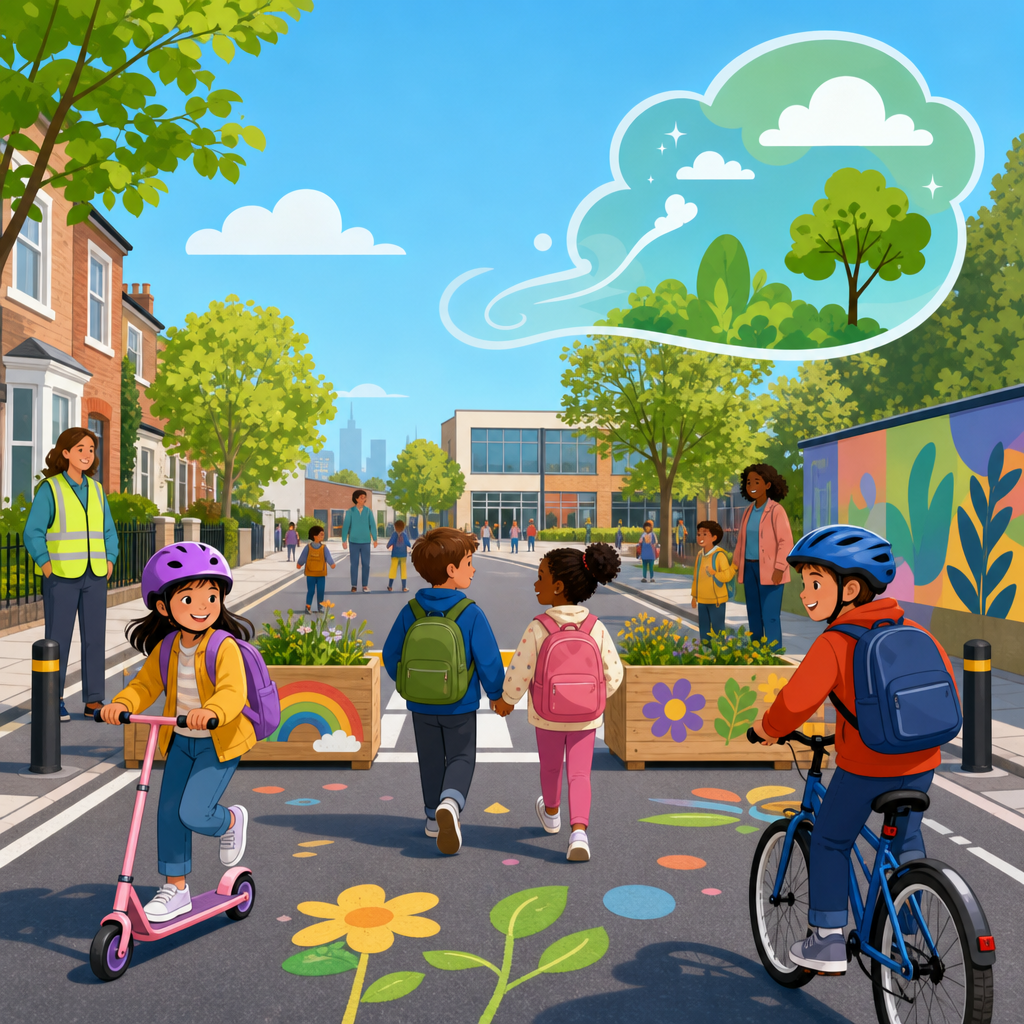
School Streets are timed road closures or traffic restrictions outside schools at arrival and dismissal, designed to reduce vehicle dominance, improve child safety, and cut pollution where children gather most densely. In practice, they may prohibit private cars entirely, allow access only for residents and emergency vehicles, or use camera enforcement and staffed barriers during short operating windows. I have worked on transport content around these schemes, and the core idea is consistent across cities: remove unnecessary traffic at the school gate, and the environment changes immediately. Noise drops, crossing becomes simpler, and the trip to school feels less like a roadside hazard and more like part of a neighborhood.
The concept matters because school entrances concentrate several public health risks at once. Young children have limited peripheral vision, weaker judgment of speed and distance, and greater vulnerability to air pollution than healthy adults. At the same time, the traditional school run often creates a queue of idling cars, unsafe reversing, blocked sidewalks, and hurried drop-offs exactly when hundreds of children are arriving. A School Street addresses those linked problems together. It is not only a traffic management measure; it is a street design and behavior change tool that supports walking, cycling, and calmer public space. For cities pursuing sustainable urban development, that combination makes School Streets one of the most practical place-based interventions available.
Definitions are important because the term is sometimes used loosely. A School Street is not simply a lower speed limit, a painted crossing, or a “be careful” sign outside a campus. It is a managed access scheme with clear operating rules, specific times, and enforcement. Most programs run for thirty to ninety minutes around the start and end of the school day. Depending on local law, the restriction may be established through a traffic order, supported by automatic number plate recognition cameras, movable bollards, or volunteer stewards. Success also depends on surrounding measures: modal filters on side streets, protected crossings on approach roads, secure cycle parking, and communication with parents. The best School Streets are therefore systems, not one-off closures.
How School Streets improve road safety
The most immediate benefit is fewer conflict points between children and moving vehicles. When private traffic is removed from the gate area, the number of crossing decisions falls sharply. Children are no longer weaving between parked cars or stepping into the road from behind SUVs that block sightlines. Drivers who do have legitimate access, such as residents or blue-badge holders where exemptions apply, travel more slowly because the street environment is controlled and less congested. That reduction in traffic complexity is the safety mechanism. It does not rely on perfect behavior from every road user; it reduces exposure to risk in the first place.
Real-world evidence supports this. London boroughs expanded School Streets rapidly in the early 2020s, and local monitoring repeatedly found lower traffic volumes on the restricted streets during operating periods, alongside increased walking and cycling. Edinburgh, Milan, Paris, and Barcelona have used similar approaches around schools as part of wider child-friendly mobility programs. The details differ by street layout and legal framework, but the pattern is familiar: when vehicle access is managed, dangerous maneuvers such as three-point turns, U-turns, and pavement parking become much less common. In site reviews, I consistently see that the “feel” of safety changes before crash data has even had time to accumulate, because conflict is visibly reduced from day one.
There are limits, and they matter. A School Street is not a guarantee that every surrounding road becomes safe. Risk can shift if planners ignore neighboring junctions, if informal drop-off moves a block away, or if crossing facilities on main roads remain poor. That is why strong schemes include perimeter planning. Parents need a safe place to approach on foot from nearby parking or transit stops. Intersections on desire lines need raised tables, signal timing, or zebra crossings. Staff need reliable procedures for late arrivals and special access. In other words, School Streets work best when treated as part of a network of safe routes to school rather than an isolated frontage treatment.
How they reduce air pollution around schools
Air quality is the second major benefit, and it is especially important because children breathe faster than adults and are still developing lungs. Pollutants associated with road traffic include nitrogen dioxide, particulate matter such as PM2.5 and PM10, and black carbon from combustion and brake and tire wear. Concentrations can spike near idling and accelerating vehicles, which is exactly the pattern seen during school drop-off and pick-up. By restricting traffic at those peak moments, School Streets reduce the source intensity directly outside the gate. They also change behavior by making driving less convenient for very short school trips, which can lower traffic demand over time.
The health rationale is strong. Long-term exposure to air pollution is linked to asthma exacerbation, reduced lung function growth, cardiovascular disease, and wider inequities because schools on busy roads are often in lower-income areas. School Streets cannot solve regional background pollution on their own, but they do improve the microenvironment children experience every day. Monitoring from multiple cities has shown drops in traffic counts and, in some cases, measurable reductions in roadside pollutants during operating periods. Results vary with weather, street canyon effects, and nearby through roads, so claims should be precise: School Streets improve local exposure conditions most reliably when paired with broader low-emission transport policies.
| Measure | What changes on a School Street | Why it matters for children |
|---|---|---|
| Traffic volume | Fewer private cars enter during start and finish times | Lower collision risk and fewer crossing conflicts |
| Idling emissions | Queueing and waiting outside gates are reduced | Less direct exposure to nitrogen dioxide and particulates |
| Street noise | Engine noise, horns, and stop-start driving decline | Calmer arrivals improve concentration and comfort |
| Active travel | More pupils walk, scoot, or cycle on the final approach | Daily physical activity supports health and independence |
| Driver behavior | Illegal stopping, reversing, and pavement parking decrease | Safer sightlines for children and caregivers |
Why School Streets support walking, cycling, and healthier routines
One of the most valuable effects is mode shift. Families who might not be ready to cycle on a busy arterial road often are willing to walk the last five to ten minutes if the school gate itself is calm and predictable. That seemingly small change matters. Replacing short car trips with walking or wheeling cuts emissions disproportionately because cold-start urban journeys are inefficient. It also builds routine physical activity into the day without requiring a separate exercise program. Public health agencies have long stressed that active travel helps children meet movement guidelines, supports mental wellbeing, and improves independence and road awareness when routes are designed properly.
The behavior change mechanism is social as well as physical. When a School Street is operating, families see other families walking, talking, scooting, and cycling. The school entrance becomes a civic space rather than a pickup lane. In schools I have studied, teachers often report calmer starts to the day and better relationships at the gate because adults are not competing for curb space. This is one reason many successful programs combine the restriction with “park and stride” sites, cycle training, and communication campaigns that explain the purpose in plain language. Infrastructure sets the conditions, but visible norms help make the change stick.
There is also an equity dimension. Not every household owns a car, and many children already walk to school through environments shaped around drivers. School Streets rebalance that space toward the majority of users who arrive on foot. Done well, they include exemptions and design responses for disabled pupils, carers, and residents, rather than assuming one travel pattern fits all. Accessibility should be built into the operating model from the start: dropped curbs, uncluttered sidewalks, step-free routes, and clear permit systems. A scheme that improves average conditions but creates obstacles for disabled users is incomplete. Inclusive design is not optional; it is part of whether the intervention is genuinely sustainable.
What successful implementation looks like
The strongest School Streets programs start with street-level diagnosis, not branding. Planners need baseline traffic counts, turning movement data, collision history, air quality context, and observations of how children actually arrive. A primary school on a cul-de-sac needs a different design from one on a bus corridor. Authorities then choose an access model: full closure with stewarded barriers, camera-enforced restrictions, or filtered permeability that allows cycles and pedestrians while preventing through traffic. Temporary trials are common because they let cities test operations quickly using signs, cones, and movable planters before investing in permanent materials.
Communication is just as important as engineering. Parents, nearby residents, school staff, bus operators, emergency services, and delivery providers all need clear rules and realistic alternatives. The best schemes explain not only what is changing, but why. Messages that focus on child safety, legal access, and practical travel options work better than abstract slogans. Schools can support this by staggering entrances during rollout, mapping walking routes, and identifying pickup points outside the restricted area. Local authorities should publish monitoring results after implementation so communities can see whether traffic fell, whether displacement occurred, and what adjustments are planned. Transparent data builds legitimacy.
Enforcement determines credibility. If drivers learn that the restriction is rarely monitored, compliance drops quickly. Camera enforcement is often the most consistent method, though it requires legal authority, privacy safeguards, and accurate exemption lists. Where cameras are not available, staff presence can work, but labor costs and reliability become issues. Physical design also shapes compliance: narrow entries, clear signs, and visible closures reduce “accidental” violations. I have seen schemes fail not because the idea was weak, but because signage was confusing, hours were inconsistent, or side-street rat runs were ignored. Implementation quality is the difference between a symbolic closure and a functioning mobility policy.
Common concerns and how cities address them
The most common objection is traffic displacement. Residents worry that one street becomes quieter only because the next street gets busier. This concern is valid and should be measured, not dismissed. Good evaluations compare conditions on the restricted street, nearby boundary roads, and wider catchment areas over time. In many cases, some traffic does reroute initially, but part of the demand also evaporates as families switch modes, combine trips differently, or stop driving short distances. The policy question is therefore whether the net outcome is better for children and neighborhoods. When School Streets are paired with wider walking and cycling improvements, the evidence usually points to a positive overall effect.
Another concern is convenience for parents balancing work, care, and tight schedules. Here, rigid moralizing is unhelpful. Some families have legitimate reasons to drive. Effective schemes acknowledge that reality while changing the default. Exemptions for disabled users, designated parking a short walk away, and predictable enforcement windows make the system workable. Businesses may also worry about deliveries, but most School Streets operate for limited periods, allowing servicing outside those times. Emergency access is always maintained. The practical lesson is that successful schemes do not demand perfection from everyone; they remove unnecessary traffic at the highest-risk times and provide orderly alternatives.
Political durability depends on framing and results. Programs survive when they are presented as child safety and public health measures, backed by before-and-after data, and refined in response to legitimate access needs. They struggle when introduced as isolated experiments with weak consultation and no monitoring plan. For city leaders, School Streets are appealing because they are relatively low cost compared with major road redesigns, yet visible enough to demonstrate action quickly. For schools, they offer a direct way to improve the daily environment without waiting years for corridor-scale reconstruction. That practicality is a major reason the model has spread internationally.
School Streets improve safety and air quality because they tackle the precise place and time where children are most exposed to traffic danger and vehicle pollution. By restricting motor access outside schools during arrival and dismissal, they reduce conflict points, cut idling emissions, support walking and cycling, and create calmer public space. The strongest results come when the closure is part of a wider safe-routes strategy with good enforcement, inclusive access, and honest monitoring of nearby streets. They are not a cure-all, but they are one of the clearest examples of how small operational changes can deliver meaningful public health benefits.
For sustainable urban development, the value of School Streets is broader than the school gate. They show how cities can prioritize vulnerable users, improve local environmental conditions, and encourage lower-carbon travel without waiting for massive capital projects. If you are evaluating mobility policies for a school district, municipality, or community group, start with the fundamentals: map current risks, design a timed access restriction, plan for exemptions, and measure results. A well-run School Street is simple, visible, and effective. It protects children where they need protection most and helps turn everyday travel into a healthier urban routine.
Frequently Asked Questions
What is a School Street, and how does it work in practice?
A School Street is a timed traffic management scheme outside or near a school that limits motor vehicle access during the busiest parts of the day, usually at morning drop-off and afternoon pick-up. The main purpose is to reduce the volume of traffic where children are arriving, crossing, waiting, and socialising. In practical terms, that can mean a short section of road is temporarily closed to private cars, opened only to exempt vehicles such as residents, school transport, blue badge holders in some cases, emergency services, or deliveries by arrangement, or managed with staffed barriers, signs, or camera enforcement. The exact design varies by location, but the principle is the same: remove unnecessary vehicle movements during the periods when risk and exposure are highest.
These schemes are typically active only for limited operating windows rather than all day, which helps balance safety benefits with local access needs. By reducing through-traffic and parent parking close to the school gates, School Streets create a calmer environment that is easier for children, parents, and staff to navigate. They also encourage more walking, wheeling, cycling, and scooting, because families feel less intimidated by traffic. In many places, School Streets form part of a wider road safety and public health strategy, combining signage, public engagement, crossing improvements, and enforcement so that the street outside a school functions first and foremost as a child-focused space rather than a congested vehicle queue.
How do School Streets improve safety for children and families?
School Streets improve safety by directly reducing the number of vehicles in the area at the exact times when large groups of children are most vulnerable. The period before and after school is often when roads outside school gates are at their most chaotic, with vehicles stopping suddenly, reversing, turning across footways, mounting kerbs, or blocking sightlines. When traffic is restricted, those conflict points are significantly reduced. Children can see and be seen more easily, crossings become simpler to use, and parents are less likely to feel pressured by a fast-moving or unpredictable traffic environment.
There is also an important behavioural effect. Streets with fewer cars tend to feel calmer, and calmer streets usually lead to slower speeds, more cautious driving on surrounding roads, and better compliance with road rules. That matters because many collisions near schools are not caused by extreme speeding but by congestion, distraction, poor visibility, and rushed manoeuvres. School Streets address those issues at the source. They can also improve the safety of the wider journey to school by making active travel a more realistic option. If more families choose to walk or cycle, there can be fewer car trips overall, which reinforces the safety benefits. In short, School Streets help convert an often stressful and vehicle-dominated space into one that prioritises children’s movement, visibility, and wellbeing.
How do School Streets help reduce air pollution around schools?
School Streets target pollution at one of the worst possible places for it to build up: right outside school entrances, where large numbers of children gather at the same time every day. Air pollution from traffic is especially concentrated during drop-off and pick-up periods because of idling engines, repeated acceleration and braking, and tightly packed vehicle queues. By restricting access and cutting the number of cars entering the immediate area, School Streets reduce those local emissions during the periods of greatest exposure. That can mean lower levels of pollutants such as nitrogen dioxide and fine particulate matter close to the school gate.
This is especially important because children are more vulnerable to poor air quality than adults. Their lungs are still developing, they breathe more rapidly, and they are often closer to vehicle exhaust level. Even short bursts of exposure in a congested street can be significant when repeated day after day over a school year. School Streets do not solve all urban air quality problems on their own, but they can make a meaningful difference precisely where children spend time waiting, talking, and entering the school grounds. They also support longer-term emissions reductions by encouraging mode shift. If families begin walking or cycling instead of driving short distances, the benefit extends beyond the restricted period and can contribute to lower traffic volumes and cleaner air across the surrounding neighbourhood.
Do School Streets just move traffic and pollution onto nearby roads?
This is one of the most common concerns, and it is reasonable to ask. In some cases, traffic patterns do change when a School Street is introduced, especially in the early stages. However, the evidence and experience from many schemes show that the outcome is not simply a one-for-one displacement of every car onto adjacent roads. Some drivers adapt by changing route, combining trips differently, parking farther away and walking the final section, switching to active travel, or deciding not to make a short car journey at all. This is sometimes referred to as traffic evaporation or traffic reduction through behaviour change, and it is an important part of how these schemes deliver broader benefits.
That said, scheme design matters. A well-planned School Street should be monitored carefully, with local traffic counts, air quality observations where possible, and feedback from residents, schools, and emergency services. If nearby roads experience unintended pressure, authorities can adjust the design through complementary measures such as parking controls, crossing upgrades, one-way changes, or wider low-traffic neighbourhood planning. The key point is that School Streets are not usually implemented in a vacuum. They work best as part of a transport strategy that considers the wider network. When that happens, the benefits around the school gate are clear, and any knock-on effects can be understood and managed rather than assumed to outweigh the core gains in safety and air quality.
Who is usually allowed access during School Street hours, and how are the rules enforced?
Access rules vary by scheme, but most School Streets are designed to limit non-essential private vehicle use while still allowing necessary access. Emergency vehicles are almost always exempt, and residents living within the restricted zone may be permitted to enter, sometimes through a permit system or vehicle registration list. In some areas, blue badge holders, school transport, carers, or essential service vehicles may also receive exemptions, depending on local policy and the street layout. The details are important because the most successful schemes are firm enough to reduce traffic but practical enough to accommodate genuine access needs without undermining the main objective.
Enforcement is handled in several ways. Some School Streets use physical barriers staffed by school volunteers, council officers, or marshals during operating times. Others rely on automatic number plate recognition cameras, which can issue penalties to unauthorised vehicles entering during restricted hours. Clear signage is essential so drivers understand when the restriction applies and who is exempt. In many places, there is also an initial warning period to help families and residents adjust before full enforcement begins. Consistent enforcement is critical because the effectiveness of a School Street depends on compliance. If too many unauthorised vehicles continue to enter, the safety and air quality benefits are diluted. When the rules are clear, exemptions are sensibly managed, and enforcement is reliable, School Streets tend to function far more smoothly and gain stronger long-term support from schools and local communities.