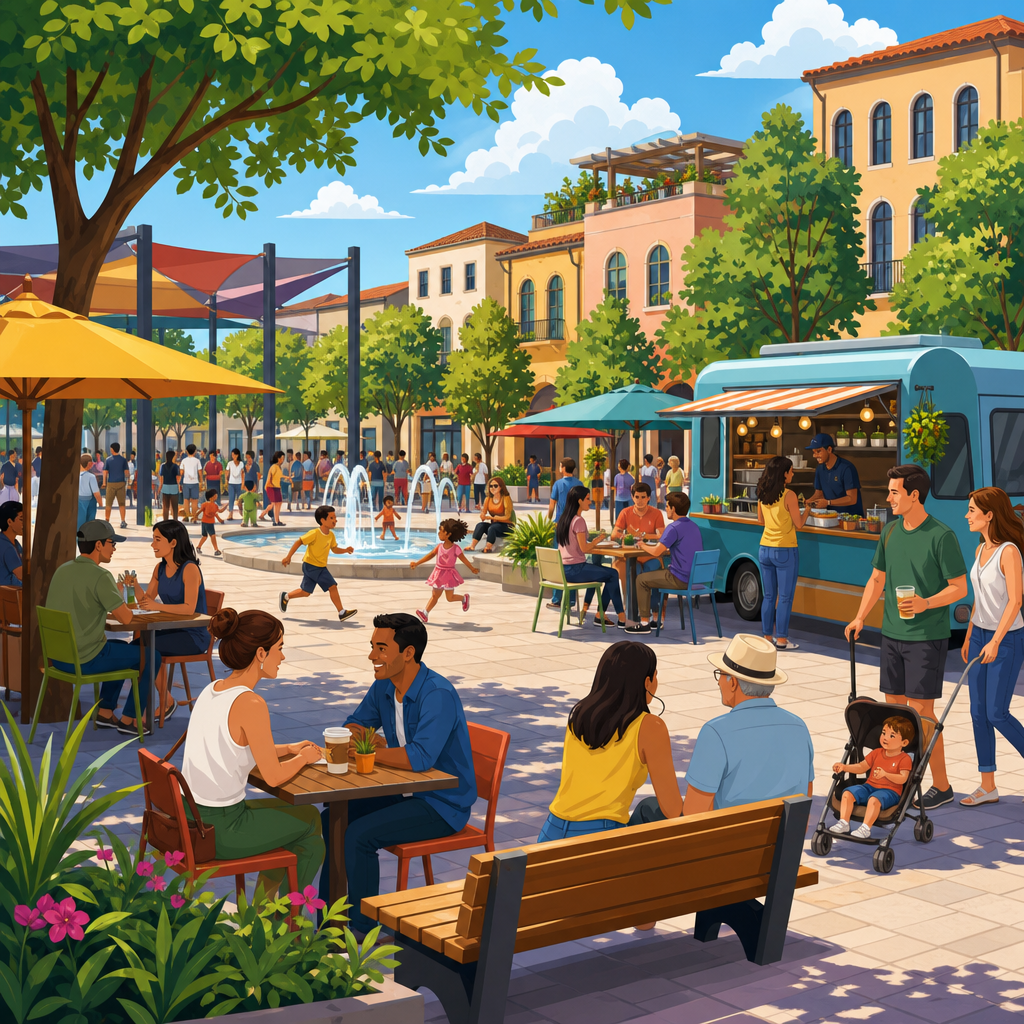
Successful plazas are not accidents; they are carefully tuned public spaces where seating, shade, food, and the rhythms of human activity combine to make people stay, return, and care for a place. In urban design, a plaza is an open civic space framed by buildings or streets, intended for gathering, passing through, resting, trading, watching, and participating in public life. A plaza that works does more than look attractive in a rendering. It supports everyday use at multiple times of day, welcomes different age groups and incomes, remains comfortable across seasons, and balances movement with lingering. That matters because public space influences economic vitality, public health, social cohesion, thermal comfort, and perceptions of safety. After working on downtown streetscape and campus open-space projects, I have seen the same pattern repeatedly: where people can sit comfortably, escape sun or wind, buy something small, and observe others without pressure, activity compounds. Where those basics are missing, expensive paving and signature sculptures rarely compensate. This hub article explains the core ingredients of effective plazas and how they interact, so planners, developers, institutions, and community groups can make better decisions from concept through operation.
Why Seating Determines Whether a Plaza Functions
Seating is the first test of whether a plaza supports human use. People need places to pause, wait, eat, talk, read, and watch. The best plazas offer a mix of fixed and movable seating because different users want different degrees of control. Fixed benches provide permanence, accessibility, and predictable maintenance. Movable chairs let people chase sun in winter, seek shade in summer, form social clusters, or sit alone at a comfortable distance. William H. Whyte documented this in New York decades ago, and the observation still holds in contemporary projects from Bryant Park to smaller neighborhood squares. A common rule used by practitioners is to provide much more seating than seems necessary on paper, because visible abundance reduces competition and makes lingering feel legitimate.
Good seating also depends on dimensions and placement. Seats need backs often enough to support older adults, seat heights generally around 17 to 19 inches, and adjacent clear space for wheelchair users. Ledges can supplement benches, but narrow decorative edges do not perform like real seating. I have seen projects fail because designers counted planter rims as seats even though they were too hot, too low, or interrupted by spikes. Orientation matters as much as quantity. Some seats should face activity such as fountains, play, transit stops, or café edges, while others should face outward for privacy or quieter conversation. Social comfort increases when users can choose exposure levels rather than accept a single arrangement.
Maintenance affects seating effectiveness too. Dirty surfaces, puddling beneath benches, and missing slats can depress use immediately. Durable materials like hardwood, powder-coated metal, and well-detailed precast concrete outperform trendy but fragile custom pieces. The objective is simple: if a person can find a comfortable place to sit within seconds of entering a plaza, the space has passed its first operational test.
Shade, Sun, and Microclimate Shape Dwell Time
Comfort is not abstract. It is thermal, sensory, and seasonal. Shade has a measurable effect on whether people stay in a plaza longer than a few minutes, especially as cities face more frequent heat events. In warm climates, tree canopy is usually the most valuable comfort investment because it cools through both shade and evapotranspiration. Shade structures, arcades, umbrellas, and tensile canopies also help, but they rarely match mature trees for long-term environmental performance. The best plazas provide layered microclimates instead of one uniform condition. People should be able to choose full sun on a cold morning, dappled shade at lunch, and deeper protection in peak afternoon heat.
When evaluating comfort, I look at solar orientation, prevailing wind, reflected heat from glazing, and the amount of hardscape storing heat into the evening. Dark stone, unshaded metal furniture, and large south-facing paved expanses can make a plaza visually elegant but physically punishing. Conversely, deciduous trees allow winter sun while filtering summer heat, which is why species selection matters. Cities often underestimate irrigation, soil volume, and root space, then wonder why new plazas feel barren five years later. A healthy canopy requires structural soil, suspended pavement systems, or large planting zones integrated from the start.
Microclimate planning should include rain and wind, not just sun. In colder regions, wind tunneling between tall buildings can empty a space even on bright days. Screens, planting, kiosk placement, and careful building massing can reduce downdrafts. In rainy climates, overhangs and edges matter because many users want partial shelter while remaining connected to public life. A plaza works best when it offers climate choice, not when it forces everyone into the same exposure.
Food Creates Reasons to Arrive and Reasons to Stay
Food is one of the most reliable activity generators in public space because it serves both necessity and pleasure. A plaza with coffee, snacks, lunch options, or a market stall gains repeat visits from workers, residents, students, and tourists. Even small food offers can transform use patterns by extending dwell time and creating natural surveillance. In projects I have evaluated, the difference between a pass-through forecourt and a social plaza often came down to one kiosk with morning coffee and afternoon sandwiches. Food draws people at predictable times, and predictable use helps other users feel the space is viable.
Not every plaza needs a full restaurant, but successful food integration requires infrastructure. Vendors need power, water access, grease management where relevant, waste and recycling stations, delivery planning, and seating nearby. Without these basics, food service becomes intermittent and fragile. The public realm also benefits when food edges are porous. Transparent storefronts, service windows, market tables, and spill-out seating animate plaza boundaries better than blank walls or deeply recessed lobbies. The edge condition is critical because plazas depend on exchanges between open space and adjacent uses.
Affordability is another design issue, not just an economic one. If every food option is premium priced, the plaza may feel exclusive despite being technically public. A balanced mix might include a café, food trucks on designated pads, seasonal carts, and local vendors during events. Cities such as Portland and Copenhagen have shown how flexible, low-barrier food models can activate public space without requiring large capital investment. The core principle is practical: give people a modest reason to stop, and many will create additional social activity on their own.
Human Activity Patterns Reveal What a Plaza Needs
Plazas succeed when design responds to actual behavior rather than idealized diagrams. Human activity patterns are the recurring ways people move, pause, gather, queue, perform, supervise children, use devices, and occupy edges throughout the day and year. Observing those patterns is basic due diligence. I typically study arrival points, desire lines, dwell zones, lunch peaks, school release times, weekend family use, and evening perceptions of safety before finalizing layout decisions. A plaza near offices behaves differently from one near housing, transit, a university, or a stadium. Programming should follow those rhythms instead of fighting them.
One useful distinction is between necessary, optional, and social activities, a framework associated with Jan Gehl. Necessary activities happen regardless of conditions: commuting, crossing, waiting. Optional activities such as sitting in the sun or eating outside increase when comfort improves. Social activities emerge when enough optional activity accumulates. This sequence explains why amenities that seem minor, like movable chairs or a shaded edge, can produce outsized results. They convert a route into a destination. Once people stay, others come to watch, meet, or trade, and the plaza begins to sustain itself.
Data should guide this process. Pedestrian counts, heat mapping, Wi-Fi analytics where appropriate, intercept surveys, and direct observation all help. However, numbers alone can mislead if they ignore who is absent. A plaza busy with office workers at noon may still fail older adults, children, or women at night if lighting, visibility, and amenities are weak. The right question is not simply whether the space is used, but whether different users can claim it comfortably across time.
Designing the Plaza as a System, Not a Collection of Objects
Seating, shade, food, and activity patterns work best when planned as one system. Too many projects treat them as separate add-ons after paving, drainage, and branding are decided. That sequence usually produces conflicts: benches baked by afternoon sun, café seating far from service, event spaces with no everyday use, or trees planted where crowds need flexibility. An effective plaza begins with operational scenarios. Who arrives at 8 a.m.? Where do they sit at noon? What happens on a hot Saturday, a rainy weekday, a market day, and a quiet winter evening? These use cases should shape geometry, utilities, planting, and management from the start.
The table below summarizes common plaza components and what they are meant to achieve in practice.
| Component | Primary function | Common failure | Better approach |
|---|---|---|---|
| Seating | Support rest, eating, waiting, socializing | Too little variety or poor comfort | Mix backs, ledges, movable chairs, accessible clearances |
| Shade | Reduce heat stress and extend dwell time | Decorative canopy with limited coverage | Layer mature trees, structures, and seasonal sun access |
| Food | Create repeat visits and natural surveillance | No power, waste plan, or affordable options | Provide vendor infrastructure and varied price points |
| Edges | Connect plaza to surrounding buildings and streets | Blank façades or inactive lobbies | Use transparent frontages, kiosks, and spill-out uses |
| Programming | Seed activity during weak periods | Only large events, no daily life | Combine routine uses with seasonal events |
Standards help, but adaptation matters. Guidance from NACTO, Gehl, Project for Public Spaces, and local accessibility codes provides strong baselines. Yet every plaza sits within a distinct social and climatic context. A civic square in Phoenix needs deeper shade and evening activation; one in Stockholm must capture winter light and shelter wind. The system approach means every design choice should strengthen ordinary daily use, not just ceremonial moments.
Operations, Safety, and Long-Term Performance
Many attractive plazas decline because operations were treated as an afterthought. Public space requires stewardship: cleaning, horticulture, furniture repair, vendor coordination, event scheduling, and clear rules that do not discourage legitimate use. Safety depends heavily on visibility, staffing patterns, and routine occupation. Empty plazas often feel unsafe not because of one dramatic problem but because there is no ordinary presence. Food vendors, maintenance crews, nearby tenants, and overlapping user groups create the passive oversight that discourages antisocial behavior. Lighting should support recognition of faces, clear paths, and comfortable evening use without harsh glare.
Flexibility is essential for long-term performance. Cities change, tenants turn over, weather grows more extreme, and user expectations evolve. Durable infrastructure for temporary power, movable furniture storage, and adaptable surfaces allows a plaza to host markets, performances, protests, quiet lunches, and informal play without expensive retrofits. Measurement should continue after opening. Track dwell time, shade coverage as trees mature, vendor sales, maintenance costs, and user feedback by season. If a windy corner stays empty, redesign it. If one movable chair zone is always full, expand it. The best plazas are managed as living systems, refined through observation rather than defended as finished compositions.
For sustainable urban development, this matters at city scale. Effective plazas support walking, reduce reliance on private indoor consumption spaces, strengthen local commerce, and offer shared comfort during hotter summers. They also express civic values by giving residents free, dignified places to be. The lesson is straightforward: start with human needs, test decisions against actual behavior, and operate the space with the same seriousness applied to streets or buildings. If you are planning a plaza or improving an existing one, audit seating, shade, food access, and daily activity patterns first; those fundamentals determine whether public life takes root.
Frequently Asked Questions
What makes a plaza actually work in everyday urban life?
A successful plaza works because it supports real human behavior, not just visual composition. In practice, that means it offers a comfortable mix of places to sit, stand, pass through, meet, eat, and watch other people. The best plazas serve multiple purposes at once: they function as shortcuts, lunch spots, waiting areas, social stages, and places for informal rest. Rather than depending on a single event or a dramatic design gesture, they perform well during ordinary hours on ordinary days. That is the real test of whether a public space is successful.
Several elements usually show up in plazas that perform well over time. First, there is a clear relationship between movement and staying. People can cross the space easily, but there are also edges, ledges, steps, movable chairs, benches, and shaded corners that invite them to pause. Second, comfort is taken seriously. Sun, wind, noise, access to food, visibility, and cleanliness all influence whether people remain in a space for two minutes or forty-five. Third, the plaza is legible. People understand where to go, where to gather, and how the space can be used without needing signs to explain it.
Importantly, working plazas are tuned to time. A space that feels lively at noon may feel empty at 6 p.m. unless it has evening lighting, nearby destinations, or food and beverage activity that extends use beyond office hours. Good urban design anticipates these daily rhythms and supports a range of users, including workers, residents, children, older adults, tourists, and people simply passing through. In other words, a plaza succeeds when it offers comfort, choice, and social possibility across different times of day and different patterns of use.
Why is seating one of the most important ingredients in a successful plaza?
Seating is critical because sitting is one of the clearest indicators that people feel comfortable enough to stay. If a plaza only allows movement, it behaves like a corridor. If it offers abundant, well-placed seating, it becomes a place. People need somewhere to rest, eat, meet a friend, check a phone, read, supervise children, or simply observe city life. The presence of seating transforms a public space from a decorative foreground into usable urban infrastructure.
Not all seating performs equally well. Fixed benches can be valuable, but the most effective plazas often provide a range of options: benches with backs, low walls, steps, ledges, seat-height planters, café seating, and movable chairs. Variety matters because people use space differently. Some prefer to sit alone, others in groups. Some want to face the sun, others the shade. Some want to watch foot traffic, while others prefer a quieter edge. Movable seating is especially powerful because it gives users control. That flexibility lets people adapt the plaza to weather, social needs, and personal comfort, which typically increases the length and frequency of visits.
Placement matters just as much as quantity. The best seats are often located at edges, near activity, beside planting, under trees, close to food, and along paths where people can enjoy both prospect and refuge. In contrast, seating placed in exposed, isolated, or uncomfortable locations often remains empty no matter how elegant it looks. When planners and designers study a plaza, they often learn that a few feet of shade, a better view, or proximity to pedestrian flow can dramatically change whether a seat is used. In that sense, seating is not just furniture. It is a strategic tool that shapes social behavior, dwell time, and the overall success of the plaza.
How do shade and microclimate affect whether people stay in a plaza?
Shade and microclimate are central to plaza performance because comfort is never abstract. People respond immediately to heat, glare, wind, humidity, cold, and exposure. A beautiful plaza with no protection from summer sun or winter wind may photograph well but fail in actual use. By contrast, a plaza that provides seasonal comfort invites people to linger, gather, and return. In many climates, access to shade is one of the strongest predictors of whether seating will be occupied during warmer parts of the day.
Effective shade can come from many sources: mature trees, canopy structures, arcades, umbrellas, adjacent building shadows, pergolas, and tensile systems. The best public spaces usually combine several of these rather than relying on one approach. Trees are especially valuable because they do more than block sun. They cool surfaces, improve visual comfort, soften the scale of open areas, and make a place feel calmer and more humane. Built shade structures can extend use where tree growth is limited or where immediate coverage is needed. What matters most is that shaded areas align with how people actually use the space, especially during lunch hours, school dismissal periods, and warm-weather afternoons.
Microclimate design also includes attention to wind patterns, surface materials, solar exposure, and the temperature of surrounding buildings and pavements. Dark paving that absorbs heat, vast unbroken hardscape, or wind tunnels created by tall buildings can quickly undermine a plaza’s usability. Designers often improve comfort by introducing planting, permeable surfaces, water features where appropriate, wind buffers, and spatial variety that lets users choose sun or shade depending on season and preference. A plaza that works well understands that comfort is dynamic. People do not all want the same conditions, but they do want options. Providing those options is one of the most practical ways to increase activity and make the space resilient throughout the year.
What role does food play in activating a plaza?
Food is one of the most reliable catalysts for public life because it gives people a reason to come, a reason to stay, and often a reason to return regularly. In successful plazas, food creates predictable activity patterns that help anchor the space across the day. Morning coffee, midday lunch, afternoon snacks, and early evening dining can each draw different groups of users. Even a modest food kiosk or café can dramatically increase foot traffic, dwell time, and social interaction because eating in public naturally supports sitting, meeting, people-watching, and informal community life.
The impact of food goes beyond commerce. It creates visible signs of hospitality and signals that the plaza is meant to be used, not merely admired from a distance. When people see others buying coffee, carrying lunch, sharing a table, or pausing after work, the space feels safer, more welcoming, and more alive. This social proof matters. Human beings are attracted to places where other people appear comfortable. Food vendors, outdoor dining edges, and market stalls often provide the small, repeated activities that turn an empty open space into a dependable urban destination.
That said, food works best when integrated thoughtfully. Access, service lines, waste management, storage, delivery logistics, seating availability, shade, and maintenance all affect whether food activation improves the plaza or creates congestion and mess. Designers and city managers also need to think about affordability and inclusivity. A plaza should not feel privatized by expensive offerings alone. A healthy mix might include permanent cafés, seasonal vendors, informal snack stands, or nearby businesses that spill activity into the square. When food is planned as part of the broader ecosystem of comfort, circulation, and public access, it becomes a powerful engine of everyday vitality.
How do human activity patterns help planners design better plazas?
Human activity patterns reveal how a plaza is actually used, which is far more valuable than relying on assumptions. Good public-space design pays close attention to where people enter, where they pause, how long they stay, what times are busy, who uses the space, and what behaviors repeat from day to day. These patterns help planners understand whether the plaza functions as a commuter shortcut, a lunchtime refuge, an event venue, a social meeting point, or some combination of all four. Once those patterns are visible, design decisions become more precise and effective.
For example, if observation shows that most people stop along edges rather than in the center, that suggests edge seating, planting, lighting, and amenities should be strengthened there. If a plaza fills up at noon but empties immediately afterward, planners may need to add shade, programming, or evening-serving uses such as cafés or adjacent retail. If people bring their own chairs to sunny spots, it may indicate a lack of flexible seating. If families cluster in one area while office workers dominate another, the space may benefit from clearer zoning, better circulation, or more diverse seating types. Behavioral mapping, pedestrian counts, dwell-time studies, and simple repeated observation are all practical tools for understanding these dynamics.
The larger point is that successful plazas are tuned, adjusted, and managed over time. They are not finished the day construction ends. Activity patterns shift with seasons, nearby land uses, transit changes, and demographics. A plaza near offices may need one strategy on weekdays and another on weekends. A space in a hot climate may perform differently in spring than in late summer. By studying how people actually occupy the plaza, cities can make targeted improvements that increase comfort and use without overdesigning the space. That is often what separates plazas that look good on paper from plazas that truly support public life year after year.