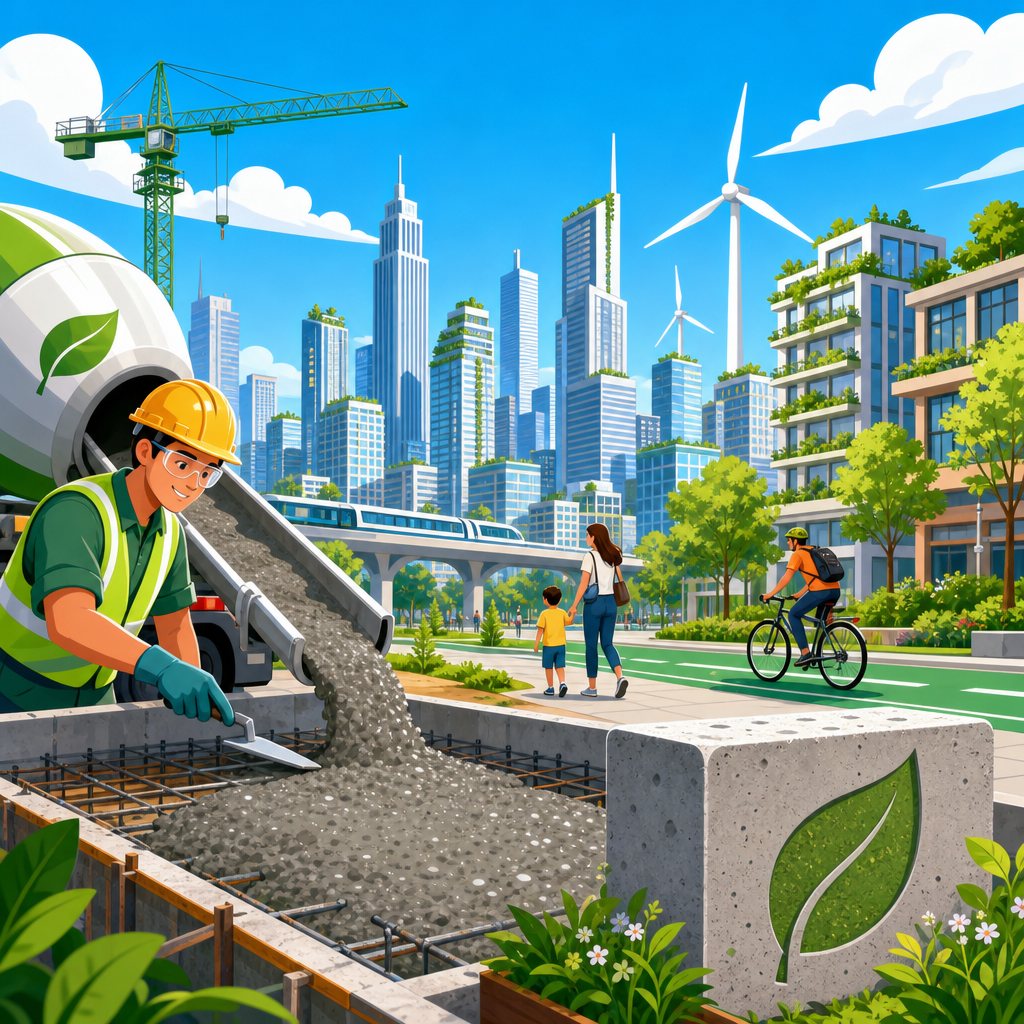
Low-carbon concrete is becoming a defining material in urban development because cities need buildings, streets, utilities, and public spaces that cut emissions without sacrificing durability, safety, or affordability. Concrete already underpins nearly every urban system, from high-rise cores and bridge decks to transit stations, stormwater channels, sidewalks, and foundations. The problem is that conventional concrete depends heavily on Portland cement, and cement production is responsible for a large share of industrial carbon dioxide emissions worldwide. When planners, developers, engineers, and public agencies talk about decarbonizing the built environment, they are often talking about reducing the carbon intensity of concrete first.
In practical terms, low-carbon concrete refers to concrete mixes, production methods, and construction practices that lower greenhouse gas emissions compared with a conventional baseline while still meeting project performance requirements. Those reductions can come from replacing part of the cement with supplementary cementitious materials such as fly ash, slag, calcined clay, or natural pozzolans; using limestone cement; optimizing mix design; injecting captured carbon dioxide during production; specifying recycled aggregates where appropriate; or extending service life so repairs and replacement happen less often. On projects I have worked around, the biggest gains rarely came from one breakthrough ingredient alone. They came from disciplined specification, early supplier engagement, and matching the mix to the actual structural need.
This topic matters because urban development is where material decisions scale fastest. A single district redevelopment can involve thousands of cubic meters of concrete across housing, schools, parking structures, utility corridors, and streetscape work. If those pours are procured with carbon as a decision criterion, cities can cut embodied emissions immediately, often before operational energy upgrades are completed. Low-carbon concrete also matters financially and politically. Many city climate plans now include embodied carbon targets, major owners are asking for environmental product declarations, and green building programs reward lower-impact materials. For developers, the question is no longer whether low-carbon concrete is relevant. The question is how to specify it, verify it, and use it intelligently across urban projects.
Why concrete dominates urban carbon and where reductions come from
Concrete is used at massive volume because it is versatile, locally available, fire resistant, moldable, and comparatively cost effective. Yet most of concrete’s embodied carbon sits in cement, specifically in clinker production. Heating limestone and other raw materials in a kiln requires high temperatures, usually supplied by fossil fuels, and the calcination process itself releases carbon dioxide. This means that even efficient plants have process emissions that cannot be eliminated simply by switching fuels. In city-scale construction portfolios, reducing cement content per cubic meter is therefore one of the most direct ways to cut embodied carbon.
That does not mean every lower-cement mix is automatically better. Urban infrastructure has demanding performance needs: early strength for schedule, sulfate resistance in soils, freeze-thaw durability on exposed pavements, low permeability in basements, and long-span structural performance in towers. The best low-carbon strategies align carbon reduction with engineering function. For example, mass foundations and mat slabs often allow slower strength gain, making them suitable for higher replacement levels with slag or fly ash. Precast elements may need faster stripping times, which can limit substitution rates unless the producer has optimized curing. Sidewalks and nonstructural flatwork may tolerate different aggregate strategies than post-tensioned slabs in high-rise construction.
In urban redevelopment programs, I have seen teams achieve meaningful reductions simply by stopping the default use of one standard mix across every application. A retaining wall, curb, podium slab, and shear wall core should not all be specified the same way if carbon reduction is a goal. Performance-based procurement consistently outperforms prescriptive habits because it lets suppliers tailor mixes to local materials and plant capabilities while still meeting code, schedule, and durability requirements.
How low-carbon concrete is made and specified on real projects
The most established approach is cement substitution. Supplementary cementitious materials have been used for decades, and they remain central to current practice. Ground granulated blast-furnace slag can lower heat of hydration and improve later-age durability. Fly ash has long improved workability and reduced permeability, although availability has declined in some markets as coal plants retire. Calcined clay and limestone blends are gaining attention because they rely on more abundant feedstocks. ASTM C595 blended cements and ASTM C1157 performance cements give specifiers more flexibility than old habits built around one cement type.
Another route is mix optimization through particle packing, admixture selection, and tighter quality control. Producers can often reduce paste content while preserving pumpability and finishability, which lowers both carbon and cost. Carbon mineralization technologies inject captured carbon dioxide into fresh concrete during batching, where it mineralizes and can improve compressive strength. This may allow a modest cement reduction, though outcomes depend on the plant, aggregate gradation, and target performance. Recycled concrete aggregate can reduce virgin material demand, but it must be used with attention to absorption, strength variation, and durability exposure class.
Specification is where many urban projects either succeed or stall. A traditional recipe specification that mandates a cement type, fixed water-cement ratio, and narrow ingredient list can unintentionally block lower-carbon options. A better approach is to define required performance and maximum global warming potential thresholds by strength class or element type, then require supplier documentation. Environmental product declarations are the standard tool for comparing embodied carbon among products. They are not a perfect proxy for every sustainability impact, but they are the market baseline for transparent reporting and procurement. Many public agencies now ask for product-specific declarations rather than generic industry averages because they want decisions tied to actual plant performance.
| Urban application | Low-carbon strategy | Primary benefit | Key watchpoint |
|---|---|---|---|
| Mat foundations | Higher slag or fly ash replacement | Lower cement content and reduced heat | Slower early strength can affect schedule |
| High-rise structural frame | Performance-based strength classes with optimized paste content | Carbon reduction without redesigning the structure | Pumping and finishability must be tested early |
| Precast facade or utility components | Blended cements plus controlled curing | Factory consistency and repeatable lower impacts | Fast turnaround requirements may limit substitution levels |
| Sidewalks and pavements | Local SCMs, recycled aggregate where suitable | Scalable reductions across large municipal programs | Freeze-thaw and deicing salt exposure need verification |
| Nonstructural site concrete | Carbon-mineralized mixes | Incremental savings with minimal workflow change | Claims should be backed by plant-specific data |
Performance, durability, and the standards that matter
The central question decision-makers ask is simple: does low-carbon concrete last? The answer is yes, when it is designed and cured for the exposure conditions it will actually face. Durability is not a marketing claim; it is a technical outcome influenced by permeability, air entrainment, curing, cover depth, crack control, chloride exposure, sulfate conditions, and temperature history. Some low-carbon mixes outperform conventional concrete in durability because supplementary cementitious materials can refine pore structure and reduce ion penetration. Others can underperform if they are rushed into service, cured poorly, or used in the wrong environment.
Relevant standards provide the framework. In the United States, ASTM and ACI documents guide material qualification, mixture proportioning, and structural design. ACI 318 governs structural concrete design requirements, while ACI 301 and related specifications shape construction quality. For embodied carbon assessment, environmental product declarations are commonly developed under product category rules and life-cycle assessment methods aligned with ISO standards. On public projects, agencies increasingly reference embodied carbon limits by strength class or concrete category rather than making vague sustainability requests. That shift is important because it turns aspiration into enforceable procurement language.
Verification should happen in stages. First, teams compare declared global warming potential values across candidate mixes. Next, they run trial batches to confirm slump retention, finishability, set time, and compressive strength development under project conditions. Finally, they monitor field curing and placement practices because even an excellent low-carbon mix can fail if water is added on site or curing is neglected during hot weather. In dense urban construction, logistics matter as much as chemistry. Travel time, pumping distance, placement sequence, and labor readiness all affect whether a lower-carbon mix performs as intended.
How cities, developers, and designers can implement low-carbon concrete at scale
Successful adoption starts early, often before schematic design is complete. Owners should set embodied carbon goals at the portfolio or district level, then require the structural engineer, architect, contractor, and concrete supplier to treat those goals as design inputs rather than late add-ons. On major urban developments, one of the most effective tactics is creating a concrete schedule that lists every expected strength class, exposure condition, and target carbon limit. That schedule becomes the basis for market engagement, bid alignment, and submittal review. Without it, teams end up negotiating mix changes element by element under time pressure.
Structural efficiency also matters. The cleanest cubic meter of concrete is the one not poured. Rational grid spacing, optimized slab thickness, post-tensioning where appropriate, foundation redesign after geotechnical refinement, and better coordination of openings can all reduce concrete volume before suppliers are even selected. I have seen teams focus intensely on reducing kilograms of carbon per cubic meter while ignoring oversized transfer slabs or redundant retaining structures that drive total emissions far higher. Material substitution and design optimization should always be paired.
Procurement needs clear incentives and realistic flexibility. If a city issues a tender requiring low-carbon concrete but refuses equivalent materials, extended testing periods, or phased approval of new mixes, suppliers may price in risk or decline to bid. Better models include prequalified mix libraries, pilot projects, and alternates that reward lower declared impacts. Leading public agencies and institutional owners are also training inspectors and project managers so they understand that slower early strength does not automatically mean poor quality. That operational literacy is crucial. Decarbonization fails when field staff revert to old assumptions the first time a mix behaves differently from a conventional benchmark.
Urban development also benefits from geographic realism. Material availability differs by region. A specification that works in one metro area with abundant slag and a sophisticated ready-mix market may be impractical in another where plants rely on different feedstocks. The most credible low-carbon concrete plans are local, data-driven, and iterative. They use regional supplier information, transportation distances, and plant capabilities instead of copying a sustainability checklist from another city.
The future of urban development with lower-carbon concrete
Over the next decade, low-carbon concrete will move from voluntary leadership to mainstream expectation in urban development. Several trends are driving that shift. First, embodied carbon disclosure is expanding through procurement rules, green building systems, and investor scrutiny. Second, cement and concrete producers are broadening their product lines, offering blended cements, optimized mixes, and carbon accounting tools that make lower-impact options easier to compare. Third, cities are recognizing that embodied emissions occur upfront, at the moment of construction, which makes them critical for near-term climate targets.
The next frontier is deeper decarbonization across the full concrete value chain. That includes kiln fuel switching, lower-clinker cements, wider use of calcined clay systems, carbon capture at cement plants, better aggregate circularity, and digital quality control that reduces overdesign. Designers will also rely more on whole-life carbon thinking, balancing embodied impacts with service life, adaptability, maintenance, and end-of-life recovery. For example, a slightly higher-impact mix may be justified in a marine or deicing environment if it materially extends service life and avoids major rehabilitation. Good policy should recognize that nuance rather than rewarding the lowest declared number in isolation.
Urban development will gain the most when low-carbon concrete is treated as infrastructure strategy, not a niche material choice. Housing, transit, schools, flood protection, and public realm projects all depend on concrete, so the procurement systems behind them must mature. That means better data, stronger specifications, more contractor familiarity, and continuous feedback from built projects. The cities that lead will be the ones that combine technical discipline with market development. They will measure results, publish benchmarks, and help suppliers scale what works.
Low-carbon concrete is not a futuristic concept waiting for perfect technology. It is a practical pathway available now for reducing the embodied emissions of urban development. The strongest results come from using less concrete where possible, lowering cement intensity where practical, and validating performance with standards-based testing and transparent product data. For city agencies, developers, designers, and contractors, the benefit is clear: immediate carbon reduction in the very material that shapes most urban growth. Start by setting project-specific embodied carbon limits, requesting product-specific declarations, and engaging suppliers early enough to develop mixes that fit both climate goals and construction reality.
Frequently Asked Questions
What is low-carbon concrete, and why is it becoming so important in urban development?
Low-carbon concrete is concrete that is designed to reduce greenhouse gas emissions across its lifecycle, especially by lowering the amount of Portland cement used or by changing how the material is produced, mixed, transported, and cured. This matters because conventional cement manufacturing is one of the most carbon-intensive industrial processes in the world. Since concrete is used in almost every part of a city, including towers, roads, bridges, utilities, sidewalks, retaining walls, transit systems, and foundations, even small reductions in the carbon footprint of each cubic yard can create a major cumulative impact at the urban scale.
Its importance in urban development comes from the fact that cities are growing, aging, and under pressure to decarbonize at the same time. Urban planners, developers, public agencies, and engineers need materials that can support dense populations, heavy use, long service life, and strict safety standards while also helping meet climate targets. Low-carbon concrete answers that need by preserving the core advantages that make concrete so widely used, such as strength, resilience, fire resistance, thermal mass, and versatility, while reducing embodied carbon. In practical terms, it allows cities to keep building the infrastructure they depend on without locking in as many emissions from the start.
How does low-carbon concrete reduce emissions compared with traditional concrete?
The biggest source of emissions in traditional concrete is the cement binder, particularly Portland cement. Carbon is released both from the energy needed to heat kilns and from the chemical process that turns limestone into clinker. Low-carbon concrete reduces these emissions in several ways. One common strategy is replacing a portion of Portland cement with supplementary cementitious materials such as fly ash, slag, calcined clay, natural pozzolans, or finely ground limestone. Another is using optimized mix designs that achieve the required strength and durability with less cement overall. Producers may also lower emissions through renewable energy, better kiln efficiency, carbon capture technologies, recycled aggregates, and local sourcing that cuts transportation impacts.
There are also newer approaches that go beyond partial substitution. Some technologies inject captured carbon dioxide into fresh concrete, where it mineralizes and becomes permanently embedded. Others use alternative binders or cement chemistries that produce less carbon during manufacturing. In urban development, these improvements matter because concrete is poured at massive scale. A reduction in emissions per slab, column, pavement section, or utility structure becomes a significant emissions cut when multiplied across apartment complexes, transit expansions, schools, hospitals, streetscapes, and flood-control systems. The key point is that low-carbon concrete does not usually depend on one single innovation. It is often the result of smarter materials selection, tighter performance specifications, and better coordination across the supply chain.
Is low-carbon concrete as strong, durable, and safe as conventional concrete for city infrastructure?
Yes, when it is properly specified, tested, and matched to the application, low-carbon concrete can perform as well as conventional concrete and in some cases even better. The most important issue is not whether a concrete mix is labeled “green,” but whether it meets the structural, durability, curing, placement, and code requirements for the project. Many low-carbon mixes are already being used successfully in high-rise buildings, bridge elements, pavements, precast systems, foundations, marine structures, and public works. Engineers evaluate them based on compressive strength, workability, permeability, shrinkage, freeze-thaw resistance, sulfate resistance, chloride penetration, and other performance factors relevant to urban conditions.
In fact, some lower-carbon mixtures offer excellent long-term durability because supplementary cementitious materials can refine pore structure and reduce permeability, which helps protect reinforced concrete from moisture and corrosive agents. That said, performance can vary depending on climate, construction schedule, local material availability, and curing practices. Some mixes may gain strength more slowly, which can affect formwork removal or project sequencing if teams do not plan ahead. That is why performance-based specifications are becoming more important in urban construction. Instead of requiring a rigid cement content, they define how the concrete must perform. This gives producers and engineers more flexibility to lower emissions while maintaining the safety, resilience, and service life cities require.
What are the main challenges to adopting low-carbon concrete at scale in cities?
The biggest challenges are not usually technical feasibility alone, but consistency, procurement, regulation, and market alignment. Urban development operates on tight timelines, established codes, and risk-sensitive decision-making. Many project teams are still used to traditional prescriptive concrete specifications that limit the use of lower-carbon alternatives, even when those alternatives could meet performance targets. Material availability also varies by region. Some supplementary cementitious materials are abundant in one market and scarce in another, and supply chains are changing as coal plants retire and industrial byproducts become less predictable. That means cities and developers cannot rely on a one-size-fits-all formula.
Cost perception is another barrier. While low-carbon concrete can be cost-competitive, especially when viewed over the full life of an asset, some mixes may carry higher upfront prices or require more testing and coordination. Contractors and owners may also worry about schedule impacts, curing times, or approval delays. On top of that, many public and private buyers still focus more on initial price than embodied carbon. Scaling adoption requires updated standards, better environmental product declarations, clearer carbon benchmarks, and procurement policies that reward measured carbon reductions rather than defaulting to familiar mixes. Education is equally important. Once architects, engineers, code officials, and project owners understand that lower-carbon options can be safe, practical, and durable, adoption becomes far easier across the urban built environment.
How will low-carbon concrete shape the future of sustainable urban development?
Low-carbon concrete is likely to become a foundational material strategy for building cleaner, more resilient cities. Urban development is not just about constructing new towers; it also includes retrofits, transit-oriented growth, affordable housing, utility upgrades, climate adaptation projects, public realm improvements, and replacement of aging infrastructure. Because concrete touches nearly all of these systems, lowering its embodied carbon can influence the emissions profile of entire neighborhoods and municipal capital programs. As cities adopt stronger climate policies, low-carbon concrete will help bridge the gap between necessary development and emissions reduction goals.
Its long-term impact will be especially significant when combined with smarter urban planning and circular construction practices. Cities will increasingly pair low-carbon concrete with design optimization, material efficiency, adaptive reuse, recycled content, modular construction, and life-cycle carbon accounting. This means future projects may use less material overall, choose mixes tailored to actual performance needs, and prioritize durability so that structures last longer and require fewer repairs. Over time, low-carbon concrete will likely move from being a niche sustainability upgrade to a standard expectation in urban procurement and design. The future of urban development depends on materials that can support density, safety, affordability, and climate resilience at once, and low-carbon concrete is emerging as one of the clearest ways to do exactly that.