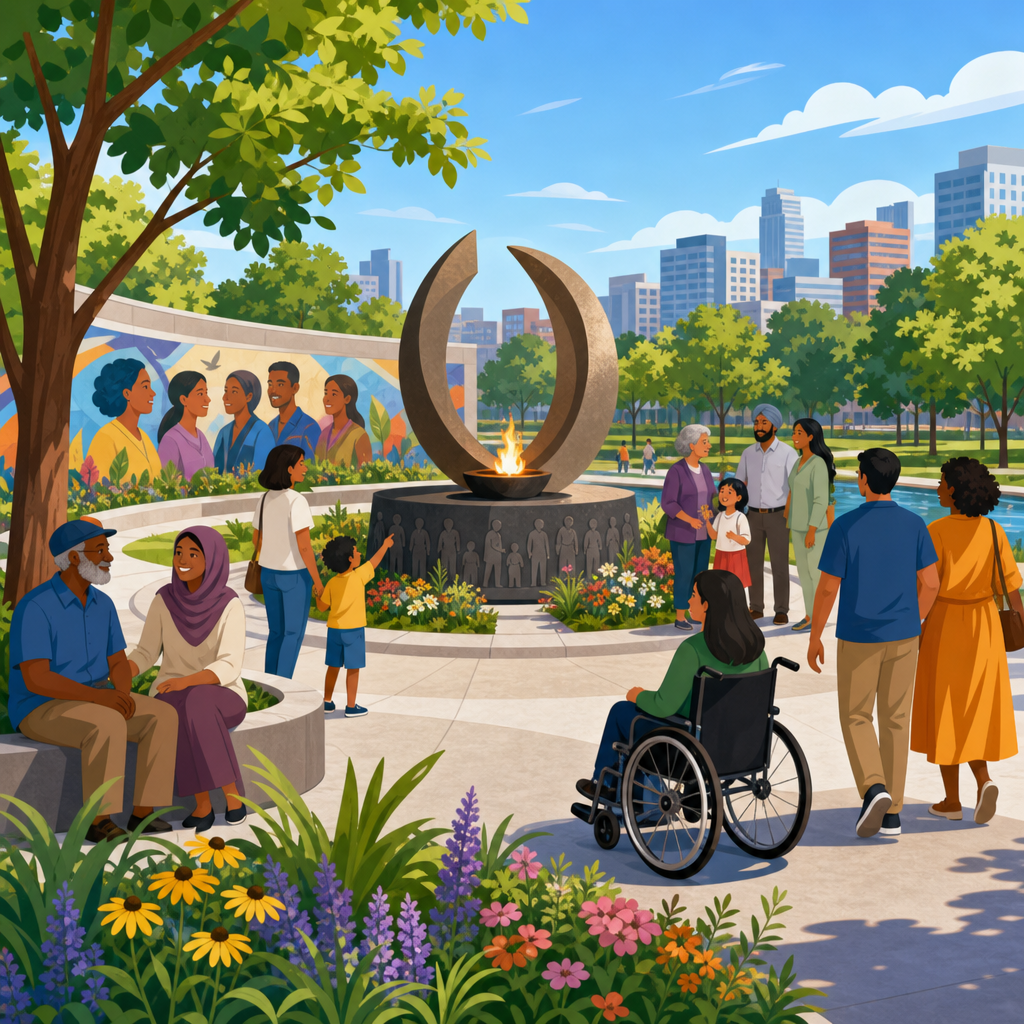
Inclusive memorials and civic spaces shape how communities remember loss, celebrate identity, and share public life across lines of culture, faith, language, age, and ability. In urban development, an inclusive memorial is not simply a monument placed in a plaza; it is a carefully designed public environment that invites broad participation, acknowledges contested histories, and remains usable in everyday civic life. Civic spaces include parks, squares, promenades, community courtyards, libraries, town greens, and streets designed for gathering. When these places are planned well, they support mourning, education, ceremony, protest, recreation, and informal social contact without forcing one group’s narrative over another. That balance matters in diverse communities, where public land often carries the weight of colonial histories, migration, displacement, racial violence, environmental injustice, and changing demographics.
I have worked on public-facing planning projects where one bronze plaque was expected to resolve decades of exclusion. It never does. Residents quickly recognize whether a project was designed for genuine shared ownership or for symbolic compliance. Inclusive memorials and civic spaces matter because they affect social trust, public safety, democratic participation, and long-term stewardship. They also influence whether people feel seen in the built environment. A child who finds signage in familiar languages, step-free access, shade, seating, and stories reflecting her community learns that the city belongs to her too. For municipalities, universities, cultural institutions, and developers, this is not a cosmetic issue. It is core infrastructure for social cohesion within sustainable urban development.
Good practice begins with a clear definition of inclusion. Inclusion means more than physical accessibility, although accessible routes, tactile surfaces, hearing support, and equitable seating are fundamental. It also means representational fairness, procedural justice during planning, cultural competency in design, and programming that keeps spaces alive after ribbon cuttings. A memorial can be architecturally elegant and still exclude if the commissioning process ignored Indigenous nations, descendants, disability advocates, youth, or nearby residents. Likewise, a civic plaza can be beautifully paved and still fail if there is no shade, no toilets, no room for ritual practices, and no policy allowing spontaneous gatherings. The strongest projects treat memory, landscape, and governance as linked systems rather than separate tasks.
This hub article explains how inclusive memorials and civic spaces in diverse communities can be planned, designed, governed, and maintained so they serve many publics over time. It covers principles, engagement methods, design standards, programming strategies, and common mistakes. It also connects the topic to climate resilience, public health, and equitable investment, because durable inclusion depends on more than symbolic design. Public places succeed when they are legible, welcoming, and adaptable enough to reflect living communities rather than frozen ideals.
Why Inclusive Memorials and Civic Spaces Require More Than Symbolic Representation
Many cities start with representation because it is visible: commission a statue, install an artwork, rename a plaza, or add interpretive panels. Those actions can be important, especially where official histories erased trauma or contribution. However, representation alone rarely creates an inclusive civic space. If a memorial honoring immigrant workers sits beside six lanes of traffic without safe crossings, it communicates remembrance without access. If a square recognizes civil rights history but is heavily surveilled, lacks seating, and bans assembly through permit rules, it weakens the civic freedoms the memorial claims to celebrate. Inclusion must therefore be measured in use patterns as much as in symbolism.
In practice, I assess these projects through three lenses: who shaped the narrative, who can physically and socially use the place, and who will care for it after opening. The narrative lens asks whether multiple histories can coexist honestly. The use lens tests circulation, comfort, safety, acoustics, visibility, and amenities. The stewardship lens examines maintenance budgets, governance agreements, event policies, and evaluation plans. This framework is useful because public memory changes. New evidence emerges, communities organize, and values shift. Spaces designed with one fixed meaning often age poorly, while spaces built for layered interpretation remain relevant.
Examples from established projects show this clearly. Berlin’s Memorial to the Murdered Jews of Europe demonstrates how abstraction, scale, and visitor interpretation can create a powerful emotional experience, but it also relies on context, nearby institutions, and ongoing education to deepen understanding. The National Memorial for Peace and Justice in Montgomery uses material form, site choreography, and documented county-level histories to connect individual grief to systemic racial violence. Closer to everyday civic life, renovated plazas in Toronto, Melbourne, and Barcelona increasingly blend remembrance with seating, trees, accessible paths, and community programming so memorial meaning is integrated into daily use rather than separated from it.
Community Engagement That Produces Legitimate Public Memory
The most credible inclusive memorial and civic space projects use engagement methods that are structured, transparent, and compensated where appropriate. Standard public meetings are rarely enough. They often favor people with flexible schedules, confidence in formal settings, and familiarity with planning language. Diverse communities need layered participation: small group workshops, pop-up events in markets and schools, multilingual surveys, oral history collection, design charrettes, youth sessions, faith-based dialogues, and meetings with descendants or directly affected communities. Compensation for lived expertise is especially important when residents are asked to share traumatic memories or significant time.
One lesson from practice is that engagement should shape the brief before designers are selected, not just react to sketches later. If the brief already assumes a heroic statue, a fixed wall, or a polished civic plaza, communities can only decorate a predetermined concept. Better briefs define goals, constraints, and values while leaving room for multiple forms. For example, a city confronting a history of anti-Asian violence may discover through engagement that residents want quiet reflection, mutual aid programming, native planting, and anti-hate education more than a single focal object. That insight changes procurement, budgeting, and long-term operations.
Documentation also matters. Meeting summaries, decision logs, translated materials, and published responses to community input build trust because people can see how recommendations were used. Without that feedback loop, participation feels extractive. I have seen advisory groups disengage when agencies asked for stories but never clarified what choices were still open. Inclusive process means naming what is negotiable, what is constrained by code or budget, and who holds final authority. It also means planning for disagreement. In plural communities, consensus is not always possible, but fair process and clear reasoning can still produce legitimate outcomes.
Design Principles for Accessibility, Belonging, and Everyday Use
Inclusive design begins with universal access but does not end there. Routes should meet or exceed Americans with Disabilities Act requirements or local equivalents, with stable surfaces, manageable slopes, handrails where needed, and seating at regular intervals. Sensory accessibility deserves equal attention: clear wayfinding, high-contrast text, tactile maps, induction loops in performance areas, and spaces that offer both social activity and lower-stimulation refuge. Restrooms, drinking water, shade, and weather protection are not extras. They determine who can stay, not just who can arrive.
Belonging is created through spatial cues that signal hospitality. Entrances should be obvious and barrier free, not hidden behind stairs or security checkpoints. Seating should support individuals, elders, caregivers, and groups of different sizes. Lighting should make people feel safe without turning memorial spaces into harshly lit voids. Planting should consider cultural associations, biodiversity, maintenance, and heat mitigation. Materials should be durable, repairable, and locally appropriate. In hot cities, unshaded dark paving can make a plaza unusable for much of the day; in wet climates, poor drainage can quietly exclude older adults and wheelchair users.
Programming capacity should be designed into the site from the start. That means power access, durable event surfaces, flexible furniture, storage, and acoustical planning for speeches or ceremonies. A memorial integrated into a civic square may host vigils, school visits, interfaith events, festivals, and protests. If the site cannot accommodate those uses safely, managers will restrict them later. Good design therefore anticipates operational reality. The goal is not to dilute memorial meaning but to support respectful coexistence between reflection and public life.
| Design factor | Inclusive requirement | Why it matters |
|---|---|---|
| Access routes | Step-free entries, generous widths, resting points | Allows elders, wheelchair users, parents with strollers, and delivery access |
| Interpretation | Plain language, multiple languages, tactile and audio formats | Extends understanding beyond one dominant audience |
| Comfort | Shade, seating variety, toilets, water | Supports longer stays and broader participation |
| Safety | Clear sightlines, balanced lighting, staffed oversight when needed | Improves perceived and actual security without over-policing |
| Programming | Power, flexible space, acoustics, permits that allow civic use | Makes ceremonies, education, and community events feasible |
| Maintenance | Durable materials, cleaning plans, repair funding | Prevents neglect that signals disrespect or exclusion |
Narrative Inclusion, Interpretation, and the Politics of Memory
Every memorial makes choices about whose story is centered, how harm is named, and whether history is framed as closed or ongoing. Inclusive memorials are explicit about those choices. They do not hide controversy behind vague language such as “difficult past” when records show slavery, displacement, internment, lynching, or forced removal. Precision builds credibility. So does citation. Names, dates, archival sources, oral histories, and partnerships with historians, tribal representatives, or community scholars improve public trust and reduce the risk of simplification.
Interpretation should meet different levels of curiosity. A visitor may want a concise summary on site, while a teacher or journalist may need deeper material through a website, QR code, archive, or nearby exhibition. This layered approach is now standard best practice because public spaces cannot carry every detail physically. Digital interpretation also allows updates as scholarship evolves. That flexibility is important when communities seek to add voices over time or correct prior omissions. Static plaques often age poorly because they imply finality. Layered interpretation supports living memory.
Language access is another essential component. In multilingual neighborhoods, interpretation in only one language can undermine the idea of shared space. Translation should be done professionally and reviewed for cultural accuracy, not generated casually. Equally important is tone. Writing must be clear enough for general audiences without reducing complex histories to slogans. The best memorial texts answer obvious visitor questions directly: What happened here? Who was affected? Why does it matter now? What actions or responsibilities follow from this history?
Governance, Stewardship, and Long-Term Trust
Many civic spaces deteriorate not because the design failed, but because governance was unresolved. Inclusive memorials and civic spaces need operational models that define who schedules events, approves installations, handles security, funds repairs, updates interpretation, and responds to vandalism or political conflict. Public-private partnerships can help with maintenance, but they must protect public access and expressive rights. If a corporate sponsor controls use rules too tightly, the space may become polished but civically weak.
Stewardship should be shared where possible. Advisory boards with representatives from local government, cultural institutions, descendant communities, disability advocates, and nearby residents can review programming and maintenance priorities. Youth participation is especially valuable because memorial spaces are often intended to educate future generations yet are rarely co-governed by them. Maintenance plans should be transparent and fully costed. Water features, specialty stone, custom lighting, and digital screens all create recurring obligations. If budgets cannot sustain them, simpler durable choices are better.
Evaluation closes the loop. Cities should track attendance, dwell time, event diversity, accessibility complaints, maintenance response times, and user feedback across demographic groups. They should also review whether the space is serving intended purposes: education, healing, cultural exchange, civic assembly, or neighborhood identity. Data alone cannot measure dignity, but it can reveal patterns of exclusion. If women avoid the site at night, if wheelchair users report blocked routes, or if one community dominates the event calendar, managers need to adjust operations. Inclusion is a continuing practice, not a one-time design achievement.
Connecting Inclusive Civic Memory to Sustainable Urban Development
Inclusive memorials and civic spaces are central to sustainable urban development because they combine social resilience, environmental performance, and equitable public investment. Tree canopy, permeable surfaces, native planting, and heat mitigation improve everyday comfort while reducing climate risk. Reuse of existing materials, low-carbon procurement, and repairable components lower lifecycle impacts. Locating memorial and civic investments in underserved neighborhoods can correct historic underinvestment, provided funding is paired with anti-displacement strategies such as community land trusts, affordable housing protections, and support for local businesses.
These places also strengthen public health. Research on urban green space and social cohesion consistently shows links between well-designed public environments, lower stress, higher physical activity, and stronger neighborhood ties. Memorial spaces add another dimension by giving communities visible places to process grief after violence, disasters, pandemics, or environmental loss. After the COVID-19 pandemic, many cities created temporary remembrance installations in parks and plazas. The most effective efforts recognized that grieving is not private alone; it is civic, spatial, and ongoing.
For planners, designers, and civic leaders, the practical path is clear: start with honest history, involve affected communities early, design for access and comfort, build flexible interpretation, and fund stewardship for decades rather than months. Inclusive memorials and civic spaces in diverse communities work when memory and daily life support each other. They help residents see themselves in the public realm, encounter neighbors with greater empathy, and use shared space with confidence. If your city is shaping a new memorial, plaza, park, or civic square, treat inclusion as core infrastructure from the first brief onward, then measure success by who truly feels welcome to return.
Frequently Asked Questions
What makes a memorial or civic space truly inclusive in a diverse community?
An inclusive memorial or civic space is designed to welcome, represent, and serve people with different cultural backgrounds, faith traditions, languages, ages, incomes, and abilities. That means inclusion is not limited to symbolic representation, such as adding multiple names, flags, or plaques. It also involves how the space functions in daily life. A truly inclusive place is physically accessible, easy to navigate, comfortable for different generations, and flexible enough to support quiet reflection, civic gatherings, cultural events, and informal community use. In practice, this may include step-free routes, seating for elders, shaded areas, multilingual signage, sensory-friendly design, and programming that reflects more than one community narrative.
Inclusive design also requires thoughtful engagement with history. In many communities, memory is complex and sometimes contested. A memorial cannot assume that everyone experienced the same event in the same way. Instead, it should acknowledge multiple perspectives with clarity and respect. This often involves careful interpretation, community consultation, and design features that encourage learning rather than imposing a single story. When a civic space allows people to see themselves in the landscape while also encountering the experiences of others, it becomes more than a monument. It becomes a shared public environment where remembrance, identity, and everyday civic life can coexist.
Why are inclusive memorials important in urban development and public planning?
Inclusive memorials matter in urban development because public spaces shape social relationships as much as they shape streetscapes. A plaza, park, promenade, library forecourt, or community courtyard can either invite people in or quietly signal that some groups do not belong. When memorials and civic spaces are planned inclusively, they help build trust in public institutions, strengthen local identity, and create a sense of shared ownership over the city. They can support reconciliation, acknowledge historical harm, and provide a visible commitment to dignity and recognition for communities that have often been overlooked in planning processes.
From a practical planning perspective, inclusive spaces also tend to be more resilient and more widely used. A memorial that doubles as a well-designed public environment can remain relevant beyond ceremonial dates because it supports everyday activity. Families may use it as a meeting place, students may gather there, elders may rest there, and community groups may hold events there. This regular use improves safety, visibility, and long-term stewardship. In addition, inclusive planning helps cities avoid creating symbolic spaces that are admired in concept but underused in reality. The strongest civic spaces are those that connect memory with public life, allowing remembrance to remain active, visible, and meaningful within the changing rhythms of the neighborhood.
How can communities address contested histories when designing memorials and shared civic spaces?
Addressing contested histories begins with accepting that disagreement is not a design failure; it is often part of the historical truth. In diverse communities, different groups may remember the same place, event, or public figure in very different ways. Some may associate a site with pride, while others connect it to exclusion, violence, or erasure. An inclusive memorial process does not try to flatten those differences into a simplistic message. Instead, it creates room for complexity through research, public dialogue, transparent decision-making, and interpretive elements that explain context rather than avoid it.
Successful approaches often include community workshops, oral history collection, collaboration with historians and cultural leaders, and design strategies that present layered narratives. This might involve multiple texts, artistic contributions from different communities, digital interpretation, or spaces specifically intended for reflection and dialogue. The goal is not to please everyone with a neutral statement, but to build a public environment that is honest, respectful, and educational. When communities see that difficult histories are being handled with care and openness, memorials can support healing and civic understanding. Even when consensus is incomplete, the process itself can model democratic participation and reinforce the idea that public space belongs to all residents, not only to the loudest or most powerful voices.
What design features help memorials and civic spaces remain accessible and usable for everyone?
Accessibility in memorials and civic spaces should be approached as a core design principle, not an afterthought. Physical access is essential, including smooth and step-free pathways, ramps with appropriate gradients, clear circulation routes, accessible seating, rest areas, nearby transit connections, and surfaces that work well for wheelchairs, strollers, and mobility aids. Good lighting, shade, weather protection, drinking water, and restrooms can also determine whether a space is truly usable by a wide range of people. For older adults, caregivers, and families with children, these practical details have a major effect on whether a civic space feels welcoming or exclusionary.
Inclusive usability also extends beyond mobility. Clear wayfinding, legible text, multilingual information, tactile elements, assistive listening support for events, and attention to sensory experience can make a space more comfortable for people with visual, hearing, cognitive, or sensory processing differences. Designers should also think about how people use space socially and culturally. Some users may seek quiet contemplation, while others may value gathering areas for ceremonies, performances, or communal meals. A well-designed memorial accommodates both individual and collective experience. Spaces that are flexible, intuitive, and dignified in everyday use are far more likely to remain active, cared for, and meaningful across generations.
How can cities ensure inclusive memorials continue to serve communities over time?
Long-term inclusion depends on stewardship as much as initial design. Cities and institutions should think beyond construction and plan for maintenance, programming, interpretation updates, and ongoing community involvement. A memorial that opens with strong public support can lose relevance if signage becomes outdated, landscaping declines, or the space no longer reflects changes in the surrounding population. To prevent that, municipalities often need governance models that include local residents, cultural organizations, accessibility advocates, educators, and historians. This kind of shared stewardship helps ensure the space evolves responsibly without losing its original purpose.
Programming is another major factor in long-term success. Inclusive civic spaces remain vital when they host a range of activities, such as commemorations, school visits, cultural festivals, public discussions, art installations, and neighborhood events. These uses keep the memorial connected to everyday civic life rather than isolating it as a site visited only on anniversaries. Periodic review is equally important. Communities change, language changes, and public understanding of history can deepen over time. Cities that revisit interpretive content, accessibility standards, and community needs are better able to keep memorials relevant, respectful, and well-used. In the strongest examples, inclusion is treated as an ongoing public commitment, not a one-time design achievement.