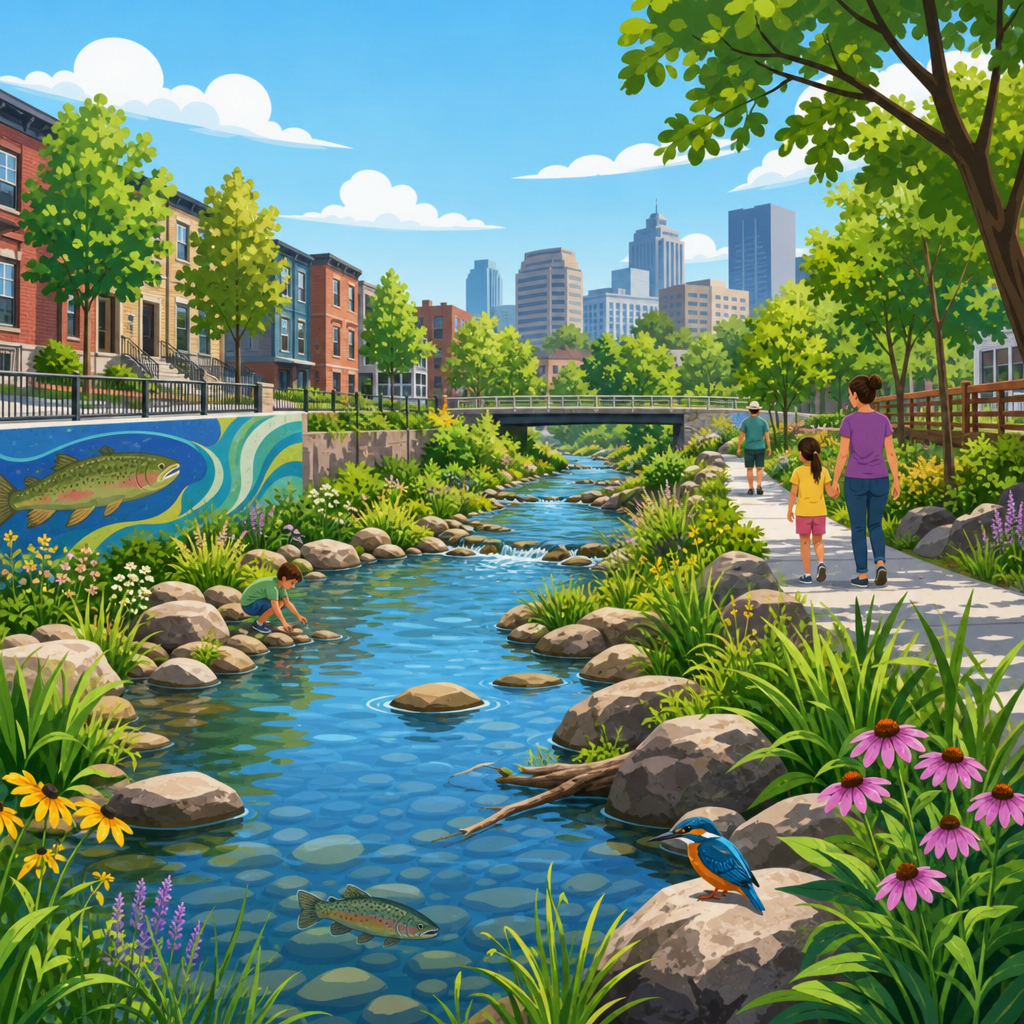
River daylighting and stream restoration in urban neighborhoods reconnect buried waterways with the surface, rebuild ecological function, and solve practical city problems that pipes alone cannot handle. In urban planning, river daylighting means uncovering a stream that was previously confined to a culvert, storm drain, or underground channel. Stream restoration is broader: it includes reshaping banks, reestablishing floodplains, reducing erosion, improving habitat, and managing runoff so water moves more like a natural system. These projects matter because many neighborhoods were built by forcing creeks into pipes during the twentieth century, often to make room for roads, parking lots, and dense development. The result was predictable: faster runoff, higher flood peaks, degraded water quality, and communities cut off from local nature.
I have worked on planning and content around green infrastructure programs, and the pattern is consistent across cities. When a watershed is urbanized, impervious cover such as asphalt and roofs prevents infiltration, causing streams to rise quickly after rain. Culverted channels clog, surcharge, and fail in storms that exceed their design capacity. Older systems were often built for smaller rainfall events than cities now face. Restoring a stream at the surface can reduce pressure on drainage networks, create public open space, and improve neighborhood identity at the same time. It is not a cosmetic landscape upgrade. It is a long-term infrastructure strategy with hydrologic, social, and economic implications.
A useful way to understand the topic is to see river daylighting and stream restoration as a linked set of interventions within sustainable urban development. A city may daylight a short reach of buried creek, then restore upstream tributaries, acquire flood-prone parcels, add bioswales and permeable pavement, and update zoning to protect the corridor. That integrated approach improves resilience more than a single capital project. It also supports multiple municipal goals at once: flood mitigation, Clean Water Act compliance, urban heat reduction, biodiversity, safer public space, and better public health. For neighborhoods that have long experienced infrastructure neglect, a well-designed project can also address environmental justice by reducing repetitive flood damage and adding accessible green space where it is most needed.
Why urban streams were buried and why cities are reversing course
Many urban streams disappeared underground for reasons that seemed rational at the time. Nineteenth- and early twentieth-century engineers often treated streams as sanitation hazards or development constraints. Combined sewer systems, road expansions, rail corridors, and industrial land uses all encouraged channelization and culverting. Straight, enclosed channels appeared efficient because they moved water away quickly and opened land for building. In practice, burying streams transferred risk downstream, concentrated pollution, and erased the natural storage and filtration functions of floodplains and riparian soils.
Cities are now reversing that model because evidence from hydrology, ecology, and asset management shows its limits. A buried stream is difficult to inspect, expensive to replace, and vulnerable to blockage by sediment and debris. When storms intensify, as many regions are experiencing, undersized culverts become flood bottlenecks. By comparison, an open, restored channel can be designed with step-pool sequences, riffles, benches, woody debris, and floodplain terraces that spread and slow high flows. Water quality also improves when runoff passes through vegetated systems that capture sediment and nutrients before they reach the stream.
High-profile examples have helped shift policy. Seoul’s Cheonggyecheon restoration removed elevated infrastructure and revived a stream corridor that now serves flood management, cooling, and public space functions. In Yonkers, New York, the Saw Mill River daylighting project brought a buried river back into the downtown fabric, pairing hydraulic improvements with economic revitalization. In California, projects along reaches of Strawberry Creek and other urban waterways demonstrate how even constrained sites can recover habitat and civic value when surface water is treated as an asset rather than a nuisance.
How river daylighting and stream restoration work in practice
A successful project starts with watershed-scale analysis, not just site beautification. Engineers model peak flows using design storms, continuous simulation, and land cover data. Geotechnical teams assess soils, groundwater, and bank stability. Ecologists document existing habitat, target species, invasive pressure, and riparian condition. Planners examine right-of-way constraints, parcel ownership, utility conflicts, and neighborhood access needs. Community engagement begins early because buried streams often run beneath streets, parking lots, or private land, and restoration changes how people move through the area.
Design then focuses on restoring process, not merely appearance. A stable urban stream needs an appropriate channel dimension, pattern, and profile for expected flows and sediment loads. If a channel is too wide, shallow low flows can overheat and fail to support habitat. If it is too narrow, banks erode and infrastructure is threatened. Designers often use regional curves, reference reaches, and hydraulic modeling software such as HEC-RAS to test alternatives. They may reconnect a stream to a floodplain bench, install grade control structures, add root wads or engineered log jams, and plant native riparian species suited to local hydrology. The most durable projects also treat runoff at the source through green streets, detention, and infiltration measures upstream.
| Project element | Primary purpose | Neighborhood benefit |
|---|---|---|
| Daylighted channel | Replace culvert capacity with open conveyance and floodplain storage | Lower flood risk and visible water amenity |
| Riparian planting | Stabilize banks, shade water, filter runoff | Cooler public space and better habitat |
| Stormwater pretreatment | Capture sediment, trash, and pollutants before discharge | Cleaner water and lower maintenance burden |
| Floodplain bench | Spread high flows and reduce erosive velocity | Improved resilience during intense storms |
| Paths and overlooks | Provide safe public access without damaging habitat | Recreation, visibility, and stewardship |
Construction sequencing matters as much as design. Utilities may need relocation before excavation begins. Temporary bypass pumping, erosion controls, and contaminated soil handling plans are common in legacy industrial areas. In dense neighborhoods, crews often phase work block by block to maintain emergency access and business operations. After construction, monitoring is essential. Teams typically track vegetation survival, bed stability, temperature, dissolved oxygen, macroinvertebrates, and maintenance issues for several years. If invasive species recolonize or a structure causes unexpected scour, adaptive management corrects the problem before it becomes chronic.
Benefits for flooding, water quality, habitat, and public health
The clearest benefit in many urban neighborhoods is flood risk reduction. Open channels with restored floodplain capacity attenuate peak flows better than buried pipes alone, especially when paired with upstream green infrastructure. They also make failure visible. A blocked culvert can remain unnoticed until streets flood; an open channel can be inspected after every major storm. This visibility improves routine maintenance and emergency response. In capital planning terms, daylighting can defer or reduce the cost of replacing aging storm drains if hydraulic performance is improved at the watershed level.
Water quality gains are equally important. Urban runoff carries suspended solids, phosphorus, nitrogen, hydrocarbons, metals, chloride, and bacteria. A restored stream corridor cannot eliminate all of these pollutants, but it can significantly reduce loads when combined with pretreatment and source control. Shaded channels also help with thermal pollution, which is critical for aquatic life. Where cities are under municipal separate storm sewer system permits or total maximum daily load requirements, stream restoration can support compliance by reducing erosion and improving pollutant removal performance across the drainage network.
Habitat outcomes vary by context, but even modest projects can produce measurable ecological improvements. Native vegetation supports pollinators and birds, while varied flow depths and substrate sizes create refugia for fish and benthic organisms. Reconnecting fragmented reaches allows species movement that a pipe cannot support. Social and health benefits are often underestimated. Green corridors encourage walking, provide restorative views, reduce localized heat, and create places for environmental education. In neighborhoods with limited park access, a restored stream can function as both infrastructure and everyday public realm, which is one reason these projects often deliver value beyond what standard cost-benefit analysis initially captures.
Equity, land use, and neighborhood design considerations
River daylighting in urban neighborhoods succeeds only when social design is treated with the same rigor as hydraulic design. Streams often run through places shaped by redlining, industrial zoning, freeway construction, and disinvestment. If a restoration project raises nearby property values without protections for existing residents, it can produce green gentrification. Cities should plan anti-displacement measures alongside the project, including affordable housing requirements, tenant protections, community land trusts, small business support, and equitable park programming. Public benefit must be defined by current residents, not just by regional branding goals.
Access and safety require careful balancing. A restored channel should be visible and welcoming, but unrestricted access to every bank can damage habitat and create maintenance problems. Good neighborhood design uses trails, overlooks, lighting, wayfinding, and seating in durable areas while protecting sensitive zones with planting and grade changes rather than heavy-handed fencing whenever possible. Universal design principles matter here. Paths need appropriate slopes, surfaces, and entrances so older adults, wheelchair users, and families with strollers can use the corridor comfortably.
Land use policy can either support or undermine restoration. Updated setbacks, stream buffer ordinances, tree protection standards, and stormwater retention requirements help preserve project performance over time. Transit-oriented development near restored corridors can work well when runoff controls, public access easements, and flood-safe building design are integrated from the start. I have seen projects struggle when the stream is treated as a narrow landscape strip after entitlements are already set. The more effective model is to use the corridor as structuring infrastructure that shapes block layout, open space, and drainage patterns from the earliest planning stage.
Costs, funding, governance, and long-term maintenance
Costs vary widely because site conditions vary widely. A short daylighting project in a simple park setting may be relatively modest, while a downtown utility-heavy corridor with land acquisition, contaminated soils, and traffic reconstruction can be expensive. Still, comparing only upfront construction cost misses the point. Cities need lifecycle accounting that considers culvert replacement, flood damage, emergency repairs, regulatory compliance, insurance impacts, heat mitigation, health benefits, and increased public realm value. When those factors are included, restoration often compares favorably with gray infrastructure alternatives.
Funding usually comes from layered sources. Municipal stormwater utilities, hazard mitigation grants, state revolving funds, federal programs, local bonds, and private development contributions can all play a role. In the United States, projects may align with FEMA mitigation priorities, EPA water quality goals, and Army Corps ecosystem restoration objectives, depending on scope. Nonprofit watershed groups and conservancies often help with grants, volunteer planting, and stewardship. Governance matters because streams cross departmental lines. Public works, parks, planning, transportation, housing, and environmental services must coordinate on design standards, maintenance responsibility, and performance metrics.
Maintenance determines whether a project remains an asset. Restored streams need trash removal, invasive species control, replanting, inspection after major storms, sediment management in pretreatment areas, and periodic repair of paths or bank protection. These are not signs of failure; they are standard operating requirements, just as pipe systems require jetting and replacement. The best programs budget for maintenance from day one, assign clear ownership, and publish monitoring results. That transparency builds public trust and helps decision-makers refine future projects using actual performance data rather than assumptions.
River daylighting and stream restoration in urban neighborhoods are practical tools for building safer, healthier, and more resilient cities. They reduce flooding, improve water quality, restore habitat, and create civic space in places where buried waterways once functioned as hidden liabilities. The strongest projects do more than uncover a stream. They pair watershed analysis, careful engineering, native planting, equitable neighborhood planning, and long-term maintenance so the restored corridor performs as infrastructure and public realm together.
The central lesson is straightforward: cities work better when they make room for water instead of forcing every storm into aging pipes. Daylighting is not appropriate on every block, and restoration requires tradeoffs involving land, cost, utilities, and community priorities. Yet where conditions allow, it consistently offers broader benefits than conventional drainage upgrades alone. For a sustainable urban development strategy, this topic belongs at the hub because it connects climate adaptation, parks, transportation, housing, and environmental repair in one visible system.
If your city is evaluating flood mitigation, corridor redevelopment, or green infrastructure investment, start by mapping buried streams and asking what each reach could become. A feasibility study, community process, and watershed-based design review can identify realistic opportunities quickly. Done well, restoring urban streams turns forgotten infrastructure into lasting neighborhood value.
Frequently Asked Questions
What is the difference between river daylighting and stream restoration in urban neighborhoods?
River daylighting and stream restoration are closely related, but they are not exactly the same thing. River daylighting refers specifically to bringing a buried or piped stream back to the surface. In many cities, small rivers and creeks were historically pushed into culverts, storm drains, or underground channels to make room for roads, buildings, and development. Daylighting reverses that process by reopening the waterway so it can flow in a more visible, accessible, and natural condition.
Stream restoration is the broader practice. It can include daylighting, but it also covers many other actions designed to improve the health and performance of an urban stream system. Restoration work may involve reshaping the channel, stabilizing banks, reconnecting the stream to its floodplain, planting native vegetation, improving fish and wildlife habitat, reducing sediment and erosion, and slowing polluted runoff before it reaches the water. In other words, daylighting is often one tool within a larger stream restoration strategy.
In urban neighborhoods, the distinction matters because a project does not have to fully uncover a buried stream to deliver benefits. Some sites may restore sections of open channel, add green infrastructure upstream, or rebuild riparian habitat without complete daylighting. Other projects focus on opening an entire watercourse and redesigning the surrounding public space. The best approach depends on available land, flood risks, neighborhood priorities, infrastructure constraints, and long-term maintenance goals.
Why are cities investing in river daylighting and stream restoration instead of relying only on pipes and storm drains?
Traditional pipe-and-drain systems are designed to move water away quickly, but they often do little to improve water quality, habitat, neighborhood livability, or resilience to larger storms. In many urban areas, aging stormwater infrastructure is overwhelmed by modern runoff volumes created by pavement, rooftops, and compacted soils. When too much water enters pipes too fast, cities can face flooding, sewer overflows, erosion, and expensive maintenance problems.
River daylighting and stream restoration address those problems in a more complete way. By restoring a stream corridor, cities can spread, slow, and temporarily store stormwater rather than forcing all of it underground at once. Reconnected floodplains and vegetated streambanks help absorb energy during storms, reducing downstream erosion and flood peaks. Native plantings can filter pollutants, lower water temperatures, and improve ecological function in ways pipes alone cannot achieve.
There are also social and economic reasons for investing in these projects. Open streams and restored green corridors can create parks, trails, shade, public gathering areas, and healthier neighborhood landscapes. They can increase access to nature, support environmental education, and improve the appearance of underused or infrastructure-dominated spaces. Over time, cities may also reduce costs tied to flood damage, channel repairs, and repeated underground system upgrades. For many communities, stream restoration is not a replacement for every pipe, but it is a smarter and more flexible complement to conventional infrastructure.
What benefits do urban neighborhoods gain from stream restoration and daylighted rivers?
Urban neighborhoods can gain a wide range of benefits, and the strongest projects usually deliver several at once. One of the most immediate advantages is better stormwater management. Restored streams are better able to handle runoff by slowing flows, reducing erosion, and reconnecting water to floodplain areas where it can spread out more safely. That can lower localized flooding, reduce pressure on drainage systems, and improve performance during intense rain events.
Ecological improvements are another major benefit. When streams are buried or hardened, habitat is greatly reduced and water quality often declines. Restoration can bring back native vegetation, improve oxygen levels, create cooler shaded conditions, and support insects, birds, amphibians, and fish. Even in highly developed settings, a healthier stream corridor can become an important ecological link that reconnects fragmented habitats across the city.
Neighborhood quality of life often improves as well. Daylighted streams can transform neglected or purely functional infrastructure spaces into amenities people actually use and value. Residents may gain walking paths, seating areas, safer green space, and visual relief from dense development. Access to natural features has been linked to mental well-being, outdoor activity, and stronger community identity. In some places, restored waterways also help residents reconnect with the environmental and cultural history of a neighborhood that had long been hidden underground.
Finally, these projects can support long-term resilience and equity goals when they are planned carefully. A restored stream corridor can reduce heat, expand tree canopy, improve public space in underserved areas, and create opportunities for community stewardship. The biggest neighborhood gains happen when engineering, ecology, and public use are considered together rather than treated as separate goals.
What challenges make river daylighting and stream restoration difficult in built-up urban areas?
Urban stream projects are often complex because they must work within places that were not designed to keep waterways visible or functioning naturally. One of the biggest challenges is limited space. Streams that were buried decades ago may now run beneath roads, parking lots, utilities, buildings, or other critical infrastructure. Reopening or reshaping those corridors can require land acquisition, redesign of transportation routes, relocation of underground services, and careful coordination among multiple public agencies and property owners.
Hydrology is another challenge. Urban runoff tends to be fast, flashy, and polluted because so much of the surrounding land is impervious. If a stream is simply uncovered without addressing upstream stormwater inputs, the restored channel may still suffer from erosion, poor water quality, and unstable flows. That is why successful daylighting usually needs a watershed-scale strategy that includes detention, infiltration, green infrastructure, and careful grading rather than a surface makeover alone.
Contamination, permitting, and cost can also complicate projects. Urban soils and sediments may contain pollutants from past industrial use, roadway runoff, or aging infrastructure. Regulatory approvals may involve floodplain rules, water quality permits, habitat review, transportation agencies, and local planning requirements. Construction can be expensive, especially where utilities, retaining walls, or contaminated materials are involved. In addition, long-term maintenance must be planned from the beginning so restored plantings, public spaces, and channel features continue to function as intended.
Community concerns are equally important. Residents may worry about safety, mosquitoes, flooding, construction disruption, or changes to neighborhood character. In some areas, people also raise valid concerns about gentrification and displacement if environmental improvements increase property values without protections for existing residents. The most durable urban stream restoration efforts are transparent, technically sound, and deeply engaged with the community from the earliest planning stages.
How do cities design successful river daylighting and stream restoration projects that last?
Successful projects start with clear goals and a realistic understanding of the watershed, not just the visible project site. Cities need to assess how much water enters the system, how fast it arrives, what pollutants it carries, where erosion is occurring, and how existing infrastructure affects stream behavior. That technical groundwork helps determine whether the project should prioritize flood reduction, habitat recovery, public open space, water quality improvement, educational use, or a combination of these objectives.
Strong design usually combines natural channel principles with urban practicality. That may include creating a stable stream shape, reconnecting the waterway to a floodplain where possible, using native vegetation for bank stability and habitat, and incorporating stormwater features such as bioswales, wetlands, step pools, or detention areas upstream. Designers also need to think carefully about pedestrian access, public safety, visibility, maintenance routes, and how the stream corridor connects to streets, parks, schools, and surrounding homes.
Community engagement is essential to long-term success. Residents, businesses, and local organizations can help shape priorities, identify neighborhood needs, and build support for construction and stewardship. Projects tend to perform better over time when the public understands why the stream is being restored, what it is expected to do during storms, and how the landscape should look as vegetation matures. Involving community members early can also surface concerns about access, programming, flooding, and affordability before they become barriers later.
Finally, lasting success depends on maintenance, monitoring, and adaptation. Restored streams are living systems, not one-time construction products. Cities should track channel stability, vegetation survival, habitat conditions, and storm performance after installation. If problems emerge, managers may need to replant, adjust grades, add erosion controls, or improve upstream runoff management. The most effective river daylighting and stream restoration projects are designed not just to look good when completed, but to remain resilient, functional, and valuable to the neighborhood for decades.