
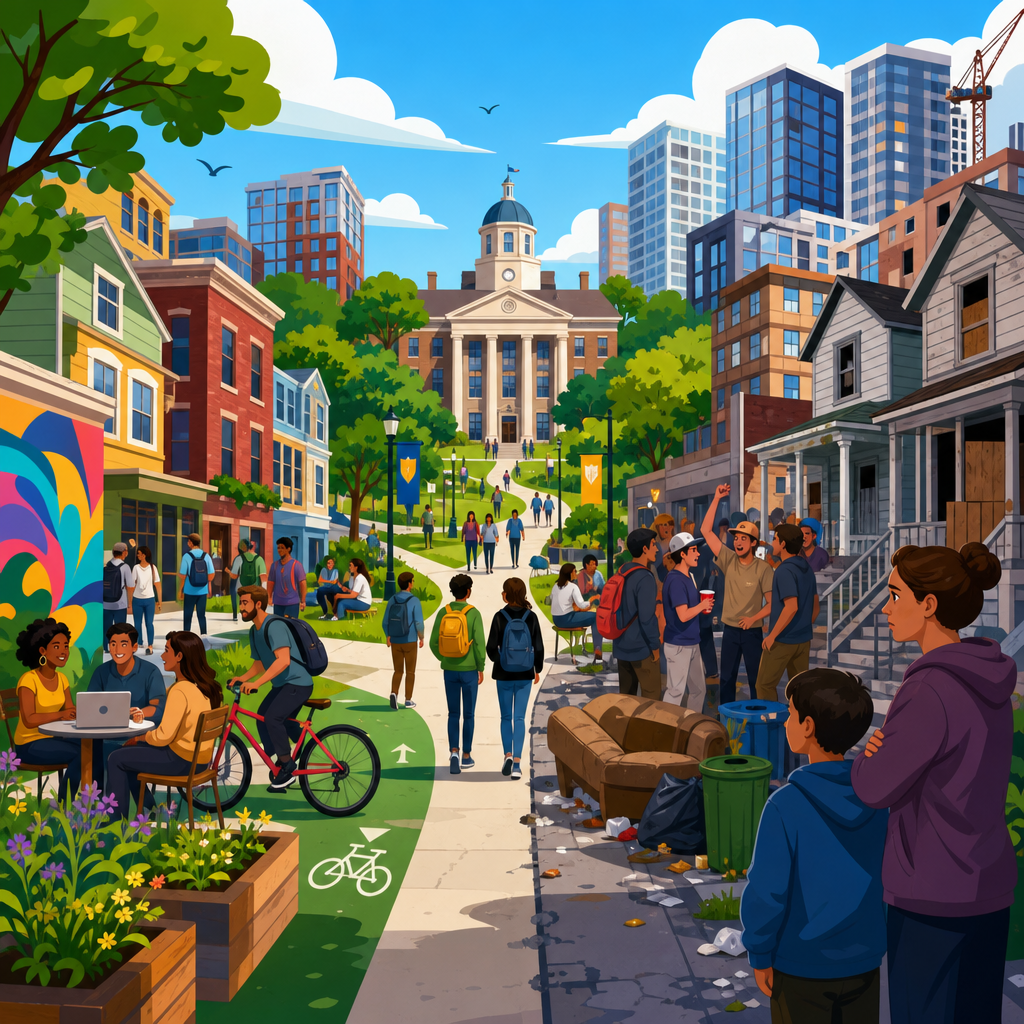
Universities are often described as anchors: large, place-bound institutions that cannot easily relocate and therefore influence the neighborhoods around them for decades. In practice, that influence can improve housing quality, transit, jobs, safety, and public spaces, or it can accelerate rent increases, displacement, and a local economy tilted toward students and higher-income newcomers. Neighborhood change in university districts is not a side effect. It is a predictable outcome of land use decisions, enrollment growth, real estate strategy, municipal policy, and the daily behavior of thousands of students, staff, faculty, and visitors.
When people discuss affordable housing near campuses, they are usually talking about several overlapping issues. One is demand pressure: universities attract residents who need beds close to classrooms, labs, hospitals, and transit. Another is supply constraint: many campus-adjacent neighborhoods have limited land, restrictive zoning, older housing stock, and slow approval processes. A third is purchasing power: institutions, medical centers, and research employers can bring salaries and investment that outpace long-term residents. I have worked on campus-area housing strategy and community engagement processes, and the pattern is consistent. If a university grows faster than housing production and tenant protections, nearby households feel the strain first.
This matters because universities are among the most stable economic engines in many cities. They train workers, support research, purchase goods, employ residents, and often operate major hospitals and cultural venues. Yet their stability can mask uneven local outcomes. A new life sciences building may create jobs while also replacing low-cost apartments. A campus expansion plan may upgrade sidewalks and parks while increasing speculation on nearby blocks. Understanding how universities shape neighborhood change helps residents, planners, and institutional leaders make better decisions about affordable housing, equitable development, and long-term community health.
Neighborhood change around universities is best understood through a few key terms. Gentrification refers to reinvestment and demographic change that raise property values and rents, often displacing lower-income residents. Displacement can be direct, such as eviction or demolition, or indirect, such as rising costs that make staying impossible over time. Studentification describes the concentration of students in a neighborhood, which can alter housing types, retail mix, noise levels, and seasonal occupancy. Anchor institution strategy refers to how universities use hiring, procurement, real estate, and partnerships to influence local development. These are not abstract concepts. They show up in lease renewals, home appraisals, zoning hearings, and school enrollment trends.
Why Universities Change Housing Markets So Quickly
Universities reshape housing markets because they generate concentrated demand with unusual regularity. Every academic year brings a predictable wave of new students, visiting scholars, residents, postdocs, and staff. Unlike many industries, higher education demand is synchronized around semesters and admissions cycles, which means landlords can plan pricing around move-in dates and near-guaranteed occupancy. In neighborhoods within walking, biking, or transit distance of campus, this can create a rental premium even when units are older or smaller than comparable housing elsewhere.
Enrollment growth is the clearest driver. If a university adds 5,000 students without adding enough dorm beds or apartments, those students compete for existing housing. The spillover reaches beyond students. Faculty recruitment increases demand for ownership housing, while campus-related employers attract workers at multiple income levels. Medical campuses intensify this effect because hospitals operate year-round and need shift workers close by. Research parks and innovation districts add office demand, retail turnover, and investor attention, all of which put pressure on nearby land values.
Land use rules often magnify the problem. Many campus-adjacent areas are zoned for single-family homes or low-rise buildings despite being in high-demand, transit-rich locations. Parking minimums, height limits, and lengthy approvals suppress the number of units that can be built. The result is a textbook supply-demand imbalance. In city after city, the absence of new housing does not preserve affordability; it preserves scarcity. Owners of existing buildings then capture the value created by university growth, and renters absorb the cost through higher monthly payments.
Universities also change expectations about future value. Once investors believe an institution will expand, acquire land, or attract private development, speculation begins. Small landlords may reposition modest apartments as student rentals. Developers may buy houses, assemble parcels, and wait. Homeowners may hold out for higher prices. That expectation alone can reshape a neighborhood before any new building opens.
The Main Channels of Impact: Better Outcomes and Harmful Ones
University influence is rarely all positive or all negative. The same institution can finance community clinics, support first-generation students, restore historic buildings, and still contribute to displacement in surrounding blocks. The practical question is not whether universities affect neighborhoods. They do. The question is through which channels and under what safeguards.
| Channel | Potential Benefit | Potential Harm |
|---|---|---|
| Enrollment growth | Supports local businesses and transit ridership | Increases rents when housing supply lags |
| Campus expansion | Upgrades streets, utilities, and public spaces | Removes homes or raises nearby land values |
| Student housing | Can absorb demand if built at scale | Can target luxury price points and reset market expectations |
| Research and medical investment | Creates jobs and attracts services | Brings higher-income demand that outbids existing residents |
| University procurement and hiring | Builds local wealth when contracts and jobs stay nearby | Benefits bypass residents without intentional inclusion measures |
The positive channels are substantial. Universities can stabilize weak real estate markets by investing during downturns when private capital retreats. They can preserve historic structures that might otherwise be abandoned. They often improve lighting, streetscapes, stormwater systems, and public safety coordination. In some cities, universities have funded land banks, employer-assisted housing, legal aid for tenants, and mixed-income developments on university-owned land. These interventions matter most when they are permanent, funded, and tied to measurable outcomes rather than one-time grants.
The harmful channels are equally real. Student demand can convert family-sized homes into bedroom-by-bedroom rentals. New retail may serve campus consumers while basic neighborhood services disappear. Property tax pressure can rise as valuations climb, even if incomes do not. The mismatch is especially severe in historically disinvested neighborhoods adjacent to campuses, where a sudden wave of interest can erase low-cost housing faster than public agencies can replace it.
What Studentification Looks Like on the Ground
Studentification is one of the most visible ways universities reshape neighborhoods. It occurs when a large share of nearby housing is occupied by students, often in rotating annual leases. This changes not just who lives in an area but how housing is configured and managed. Landlords may replace living rooms with extra bedrooms, furnish units for short lease cycles, and market properties by the bed rather than by the unit. That can increase total rent extracted from a building and make it harder for families or older residents to compete.
On the street, studentification changes commercial demand. Copy shops become coffee bars, discount groceries become fast-casual chains, and hardware stores become nightlife venues. Some changes are positive. More foot traffic can support pharmacies, bakeries, and bus service. Empty storefronts may fill. But the retail mix often becomes narrower and less useful for long-term residents. Seasonal occupancy can also create instability, with neighborhoods feeling overburdened during the school year and partially vacant in summer.
Purpose-built student housing is sometimes presented as the solution. It can help, especially when it delivers many beds close to campus and reduces pressure on older housing. Yet not all student housing is equal. Luxury projects with private amenities, premium finishes, and high per-bed pricing can establish a new benchmark that ripples outward. In my experience, the key question is whether the project truly absorbs existing demand or simply segments the top of the market while older apartments continue to climb in price.
University conduct matters here. Institutions that require sophomores or upperclassmen to live on campus, master lease units, or guarantee a large pipeline of dorm beds can reduce spillover. Universities that increase enrollment while underbuilding housing effectively export their growth costs into surrounding neighborhoods.
Expansion, Land Control, and the Politics of Development
Few actors hold land as strategically as universities. They acquire parcels for future academic buildings, clinics, parking, student housing, athletics, and research facilities. Because they plan in decades, not quarterly earnings cycles, they can shape the direction of development over entire districts. This power can be constructive when tied to community-serving goals. It becomes controversial when expansion displaces residents or removes land from the ordinary housing market.
Large campus projects often trigger a familiar sequence. The university announces a master plan. Real estate markets react before construction starts. Property owners expect appreciation. Developers seek rezonings. Tenants face buyouts or nonrenewals. Infrastructure improves, and the area becomes more attractive to higher-income households. None of this is inevitable, but it is common enough that municipalities now require impact studies, community benefits negotiations, and affordable housing commitments for major institutional projects.
Land ownership also affects accountability. Universities may be tax-exempt on core educational property, which can create tension in cities that rely on property taxes to fund schools and services. Some institutions make voluntary payments or contribute through service partnerships, but these arrangements vary widely. Residents often ask a fair question: if the university benefits from city infrastructure and neighborhood vitality, what is it contributing to keep the area livable for people who are not affiliated with the campus?
The strongest expansion plans answer that question clearly. They identify how many units of housing will be added, at what affordability levels, with what anti-displacement protections, and on what timeline. They address construction impacts, tenant relocation, minority-owned contracting, local hiring, and open space access. Good plans treat nearby residents as stakeholders, not obstacles.
How Universities Can Support Affordability Instead of Undermining It
Universities have more housing tools than many people realize. They can build and operate residence halls, ground-lease land for mixed-income housing, contribute to community land trusts, and offer employer-assisted housing for staff. They can support inclusionary zoning, reduce parking requirements on their own projects, and coordinate transit so more housing can be built slightly farther from campus without isolating residents. They can also use data better, publishing enrollment forecasts and housing demand estimates so cities are not planning in the dark.
One effective approach is to tie enrollment growth to housing production. If a university expects to add students, it should commit to a specific number of beds delivered by a set date. Another is to reserve land for permanently affordable homes through deed restrictions or nonprofit ownership structures. Community land trusts are especially useful because they separate land value from housing value, helping preserve affordability over time even in appreciating markets.
Institutions can also protect existing residents more directly. Rental assistance funds, eviction defense partnerships, right-to-return policies after redevelopment, and acquisition funds for nonprofit housing providers can prevent displacement during periods of rapid change. Procurement and hiring matter too. A neighborhood benefits more from university growth when custodial staff, food service workers, lab technicians, and contractors can afford to live nearby rather than commuting long distances from cheaper suburbs.
There are tradeoffs. Building on-campus housing can be expensive. Labor, financing, and construction timelines are real constraints. Universities cannot solve a regional housing shortage alone. But they can stop making it worse. That is a meaningful standard, and in many places it would already represent progress.
What Cities and Communities Should Demand
City governments and neighborhood organizations should treat university growth the way they treat any major economic development force: with clear rules, transparent data, and enforceable commitments. Vague promises about partnership are not enough. The most effective framework starts with measurement. How many students are housed on campus? How many new employees are expected? What is the vacancy rate nearby? How many naturally affordable units are at risk? Without this baseline, policy debates become anecdotal and polarized.
From there, cities can require housing impact assessments for major institutional expansions, align zoning with realistic housing demand, and use tools such as inclusionary requirements, linkage fees, tenant protections, and preservation funds. Community benefits agreements can work when they are specific, monitored, and signed before entitlements are granted. Strong agreements name unit counts, affordability terms, local hiring targets, and reporting requirements.
Communities should also look beyond the campus edge. University effects often spread along transit corridors and into adjacent working-class neighborhoods. That means preservation strategies must cover small apartment buildings, accessory dwelling units, and older homes vulnerable to speculative conversion. Trusted local organizations are critical because residents often need legal help, organizing capacity, and technical support to negotiate effectively with large institutions.
The central principle is straightforward: universities should be evaluated not only by educational and research output, but by how responsibly they share the costs and benefits of neighborhood change. Residents, elected officials, and university leaders all have leverage. Using it well is how affordable housing survives success rather than becoming its casualty.
Universities can be extraordinary neighbors when they match growth with housing, infrastructure, and accountability. They can also destabilize communities when expansion is treated as an internal matter with external consequences. The difference lies in policy choices, land strategy, and whether local residents are included early enough to shape outcomes instead of reacting after decisions are made.
The main lesson is simple. University-driven neighborhood change is not mysterious, and it is not unavoidable. Rising demand, constrained supply, speculative investment, studentification, and land control are identifiable mechanisms. That means they can be managed. Institutions can add beds, preserve affordable homes, fund anti-displacement tools, and coordinate with cities on realistic zoning and transit. Municipal leaders can require impact analysis and enforceable commitments. Residents can organize around clear housing goals rather than broad opposition alone.
For anyone working in affordable housing, campus planning, or neighborhood advocacy, this issue deserves sustained attention because the stakes are long term. A university building may last fifty years; the housing decisions attached to it can shape who gets to live nearby for just as long. If your community is facing campus expansion or rising student pressure, start by gathering data, asking direct housing questions, and pushing for commitments that last beyond a single development cycle.
Frequently Asked Questions
How do universities change neighborhoods over time?
Universities shape neighborhoods because they are unusually large, stable institutions with long planning horizons, major land holdings, and a constant flow of students, staff, faculty, visitors, and investment. Unlike many private employers, a university usually cannot pick up and move, so its decisions about buildings, expansion, hiring, transportation, and real estate have lasting local effects. Over time, those decisions can improve the area around campus by attracting grocery stores, clinics, cultural venues, transit upgrades, better sidewalks, parks, and new housing. University districts often benefit from more foot traffic, more public activity, and stronger demand for services than other nearby areas.
At the same time, the same forces can intensify neighborhood change in ways that are hard on long-term residents. As universities grow, demand for nearby housing increases, especially in walkable areas close to campus. That can raise rents, push up property values, encourage redevelopment, and make it harder for lower-income households and small businesses to stay. Local commercial corridors may shift toward student-oriented retail, short-term rentals, cafes, bars, and higher-margin businesses that serve newcomers rather than established residents. In other words, universities do not just occupy neighborhoods; they help reorganize local housing markets, land use patterns, and the everyday economy. That is why neighborhood change around universities is not accidental. It is a predictable outcome of concentrated institutional presence and the choices that follow from it.
Why are universities often called “anchor institutions,” and what does that mean for local communities?
The term “anchor institution” refers to organizations that are deeply rooted in place and have enough economic and physical scale to influence the communities around them for decades. Universities fit that definition because they own land, operate major facilities, employ thousands of people, attract outside money, and help shape how nearby areas are built and used. Their influence extends far beyond education. A university can affect housing demand, public safety strategies, transportation planning, neighborhood branding, local labor markets, and even which businesses survive on surrounding commercial streets.
For local communities, that can be positive when a university acts like a true civic partner rather than a self-contained campus. Universities can support job pipelines for residents, purchase from local businesses, open amenities to the public, invest in streetscapes and parks, and coordinate with cities on affordable housing or transit. But the anchor label also carries responsibility. Because universities are powerful and place-bound, they can unintentionally produce uneven benefits if they prioritize campus growth without accounting for spillover effects. When expansion happens without protections for tenants, homeowners with limited incomes, or neighborhood-serving businesses, the institution may help create a more expensive and less inclusive district. Being an anchor is not automatically good; it means the institution has outsized influence, and that influence can either stabilize a community or reshape it in ways that leave some residents behind.
Do universities cause gentrification and displacement?
Universities are not the only cause of gentrification, but they can be a major driver of it, especially in neighborhoods where land is relatively undervalued before campus expansion or nearby private investment begins. A growing university increases demand for housing, retail, and office space. It may also improve an area’s image, draw developers, and create confidence that the neighborhood will remain attractive to higher-income renters and investors. New dorms, research buildings, mixed-use projects, and campus-adjacent amenities can all signal that a district is becoming more desirable and more profitable. That often translates into higher rents, rising assessments, speculative property purchases, and pressure on older, lower-cost housing.
Displacement can happen in multiple ways. There is direct displacement, where residents are forced out because a building is demolished, sold, or converted. There is also indirect displacement, where households leave because rent increases, taxes rise, maintenance declines, or the neighborhood’s services and culture shift away from their needs. Small businesses can face similar pressure when commercial rents increase or when customer demand is reoriented toward students and affluent newcomers. To be precise, universities may not always initiate these changes alone, but they frequently accelerate them by adding demand, legitimacy, and institutional momentum to already changing urban markets. The key question is not simply whether a university is present, but whether its growth is paired with policies that preserve affordability, protect tenants, and keep longtime residents and businesses part of the neighborhood’s future.
What are the benefits universities can bring to surrounding neighborhoods?
When managed well, universities can create substantial neighborhood benefits. They often bring jobs across a wide range of skill levels, from custodial and food service positions to research, administration, healthcare, and construction work. They can support local economies by purchasing goods and services, sponsoring business development programs, and creating demand for restaurants, bookstores, childcare, and other neighborhood services. Universities also tend to attract public and private investment in infrastructure, including transit routes, bike lanes, lighting, streetscape improvements, broadband, and public spaces. In many cities, university districts become hubs for cultural programming, lectures, sports, health services, libraries, and community events that residents can access directly or indirectly.
There can also be less visible but meaningful long-term gains. Universities can help stabilize areas that have suffered from disinvestment by making a sustained commitment to place. They may support school partnerships, workforce training, health outreach, legal clinics, and neighborhood planning initiatives. In some cases, their presence helps preserve or rehabilitate historic buildings, increase walkability, and improve safety through more active streets and better-maintained public spaces. The challenge is that these benefits are not distributed automatically. If the gains are captured mainly by developers, higher-income households, or campus affiliates, the surrounding community may see improvement without inclusion. The most beneficial university-neighborhood relationships are the ones where investment is deliberately linked to affordability, local hiring, public accountability, and shared access to the improvements being made.
How can cities and universities reduce harm while still encouraging investment and growth?
The most effective approach is to treat neighborhood change as something that can be governed, not something that simply happens. Cities and universities can reduce harm by planning for housing affordability before expansion pressures peak. That includes building more student housing to ease pressure on nearby residential stock, preserving existing affordable units, supporting community land trusts, funding rental assistance, and requiring or incentivizing affordable housing in new developments. Strong tenant protections, property tax relief for vulnerable homeowners, anti-displacement funds, and support for small landlords who keep rents stable can also make a major difference. The goal is not to stop investment, but to prevent the benefits of growth from depending on the removal of current residents.
Equally important is how decisions are made. Universities should engage neighborhoods early, share data about growth plans, and commit to measurable community benefits rather than one-time gestures. Cities can negotiate development agreements that include local hiring, minority- and women-owned business procurement, public space improvements, and funding for affordable housing or commercial stabilization. Small business support, commercial rent protections where possible, and zoning that preserves neighborhood-serving retail can help maintain a more balanced local economy. In short, the question is not whether universities will shape neighborhood change; they will. The real issue is whether that change is planned in a way that broadens opportunity, protects existing communities, and recognizes that a thriving university district should work for longtime residents as well as students and newcomers.


