
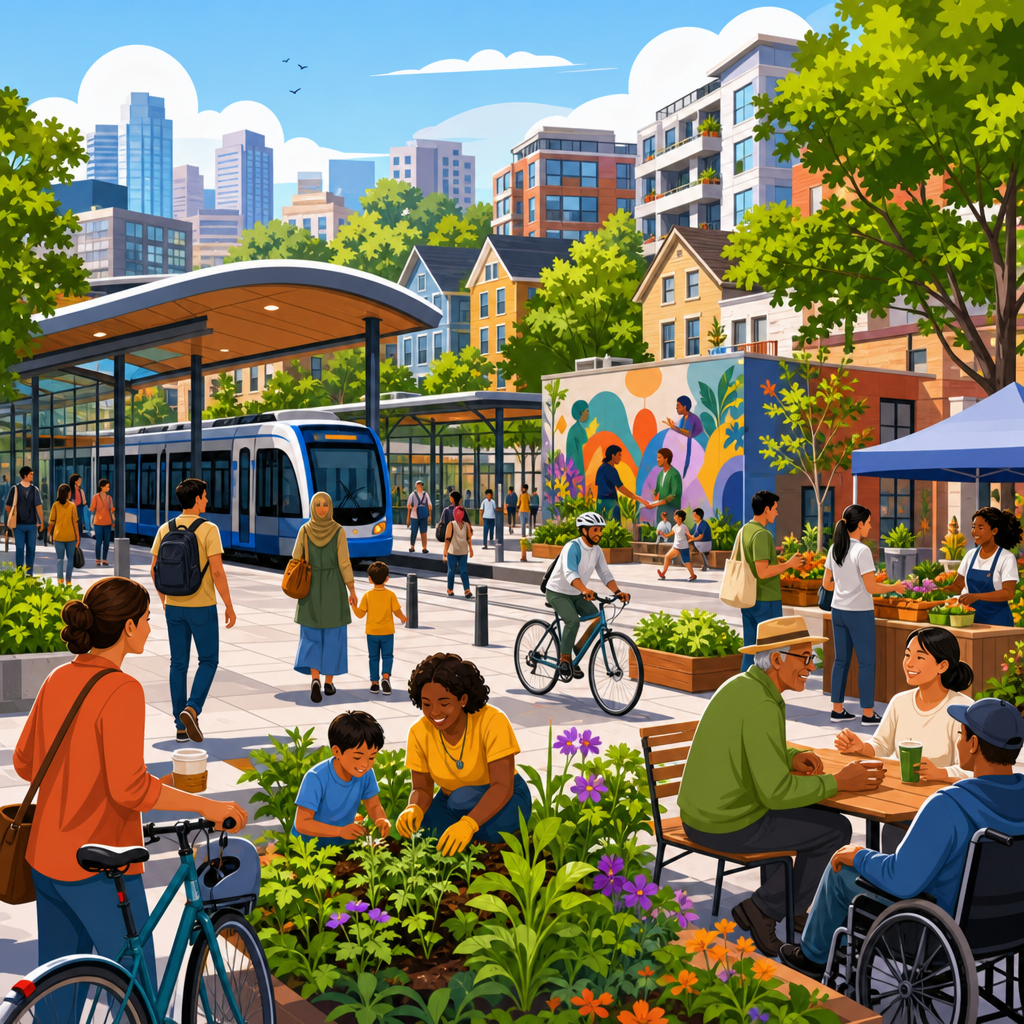
Community development around transit stations is often reduced to cranes, apartment blocks, and ribbon cuttings, but the real work begins long before construction and continues long after new buildings open. In affordable housing practice, transit-oriented development means coordinating homes, jobs, services, public space, and mobility so households can live well with lower transportation costs and better access to opportunity. A station area is the walkable district around a rail stop, bus rapid transit platform, or major bus hub, usually measured within a quarter mile to half mile, where public investment can shape land use, street design, and community outcomes. I have worked on station area plans where the hardest questions were not about height or parking ratios; they were about who gets to stay, who benefits first, and how to turn infrastructure into lasting neighborhood stability. This matters because transportation is typically a household’s second largest expense after housing, and because low-income renters are often pushed farthest from reliable service just as regions add jobs near transit.
When people ask what community development around transit stations should accomplish, the answer is straightforward: it should improve access without triggering exclusion. New buildings can help, especially when they add below-market homes, ground-floor services, and safer sidewalks, but buildings alone do not create equitable neighborhoods. Community development includes anti-displacement policy, small business retention, tenant protections, public health, school access, workforce pathways, and stewardship of public land. It also includes governance: who makes decisions, how benefits are measured, and whether residents can influence phasing, design, and operations. As a hub topic within affordable housing, this article maps the full station-area agenda, from land assembly and financing to public realm improvements and social infrastructure. The goal is practical clarity. If a city, transit agency, nonprofit developer, or neighborhood coalition wants station growth to serve existing residents as well as newcomers, the strategy must go beyond entitlement and construction toward a coordinated, measurable community development program.
What community development around transit stations includes
Community development around transit stations is the deliberate improvement of housing affordability, economic opportunity, neighborhood services, and public space in areas with high transit access. The central idea is that mobility investment should produce shared value, not only higher land prices. In practice, that means aligning zoning, subsidy, infrastructure, and community partnerships within the station catchment area. A useful starting framework is the “3 Ds” first popularized in transit planning—density, diversity, and design—expanded today to include destination accessibility, distance to transit, and demand management. Yet for affordable housing professionals, another set of priorities matters just as much: preservation, inclusion, and access. Preservation keeps existing affordable homes and small businesses from being displaced by speculation. Inclusion ensures new development serves a range of incomes through income-restricted housing, universal design, and family-sized units. Access means residents can reach jobs, schools, groceries, health care, and parks without excessive time or cost.
Real station districts show why this broader definition matters. Arlington County’s Rosslyn-Ballston corridor is frequently cited for channeling growth near stations while protecting surrounding neighborhoods, but its strongest lesson is not simply density near transit; it is the pairing of transportation investment with consistent planning, streetscape upgrades, and affordable housing tools over decades. Denver’s Union Station redevelopment turned a rail asset into a mixed-use district, yet the region also learned hard lessons about rising values and the need for earlier preservation. In Los Angeles, the Metro joint development program has increasingly tied publicly controlled land to affordability requirements, recognizing that transit agencies are not just mobility providers but land stewards. Around smaller bus hubs, the same principle applies. A redesigned transfer center with safer crossings, childcare nearby, and preserved naturally occurring affordable housing may deliver more equitable benefit than a luxury tower beside a platform.
Housing stability must come before and during growth
The most important question around a new or upgraded station is usually not “What can be built?” but “What can be protected?” Research across multiple regions has shown that expectations of transit investment can raise land values before service starts, a process sometimes called the transit anticipation effect. If cities wait until construction begins to address affordability, they are late. Early action starts with an inventory: deed-restricted units, unsubsidized low-cost rentals, mobile home parks, public housing, expiring use properties, and small multifamily buildings vulnerable to acquisition. In my experience, this parcel-level baseline changes the entire conversation because it identifies where preservation dollars and tenant outreach should go first. Tools include acquisition funds for nonprofit buyers, right-of-first-refusal policies, rental assistance targeted to station areas, code enforcement that prevents neglect-based displacement, and tax relief for low-income homeowners facing assessment spikes.
New affordable housing remains essential, but station-area production needs disciplined standards. Inclusionary zoning can reserve a share of homes in market-rate projects, though outcomes depend on calibration, land values, and whether off-site compliance is allowed. Public land disposition can require deeper affordability, family-sized units, and long affordability terms, often ninety-nine years through ground leases or recorded covenants. Low-Income Housing Tax Credits, tax-exempt bonds, HOME funds, Community Development Block Grant funds, local housing trust funds, and transit-adjacent density bonuses are often layered to close financing gaps. Because transit access reduces car dependence, projects can sometimes lower parking ratios, freeing capital for more units or resident services. But lower parking only works where the walking environment is safe, transit frequency is reliable, and households are not burdened by spillover parking conflicts. Housing strategy around stations succeeds when preservation pipelines, new construction financing, and tenant protections are treated as one program rather than separate silos.
Economic development should support existing residents and businesses
Station investment often promises economic growth, but growth is not automatically inclusive. Construction jobs are temporary, while rent increases for storefronts and apartments can be immediate. Effective community development protects existing neighborhood commerce while creating pathways into new employment. That starts with understanding the local business base: immigrant-owned shops, child care providers, home-based enterprises, cultural venues, and service businesses that depend on foot traffic and manageable leases. Commercial stabilization tools include small business technical assistance, facade grants, below-market retail in mixed-use projects, master leases by nonprofits, and legal support for lease negotiation. Some cities have used legacy business registries or cultural district designations to recognize and support longstanding establishments. These measures matter because station-area identity is often built by local businesses long before redevelopment markets arrive.
Workforce benefits should be specific, not symbolic. Community benefits agreements, project labor agreements, and targeted hiring provisions can connect nearby residents to construction and permanent jobs, but they need enforcement, training partners, and reporting. Anchor institutions near stations—hospitals, colleges, municipal offices, logistics centers—can strengthen outcomes through local procurement and apprenticeship pipelines. The strongest examples tie mobility access to employment access. In Cleveland’s HealthLine corridor, bus rapid transit improved links to the Cleveland Clinic and University Circle while catalyzing development; the lesson for affordable housing practitioners is that access to major employers must be paired with anti-displacement planning or low-income households may lose the ability to benefit from those connections. Economic development around stations should therefore be judged by resident income gains, business survival rates, and reduced commute burdens, not only by assessed value or new square footage.
Public space, services, and safety determine whether a station area works
A transit station can be technically efficient yet socially ineffective if the surrounding public realm feels unsafe, inaccessible, or barren. Community development requires complete streets, shaded sidewalks, short crossings, lighting, wayfinding, traffic calming, and accessible curb ramps that meet Americans with Disabilities Act standards. It also requires daily needs within reach: groceries, clinics, libraries, schools, parks, public restrooms, and places to sit. These are not cosmetic extras. They determine who can use transit comfortably, including older adults, children, shift workers, and people with disabilities. I have seen stations with strong ridership potential underperform because reaching the platform meant crossing six lanes of traffic or walking past blank walls and unlit lots. A station area should be designed for the full trip chain, from front door to destination, not only the rail platform itself.
| Community goal | Station-area intervention | Why it matters for affordable housing |
|---|---|---|
| Prevent displacement | Acquire vulnerable rental buildings before speculation accelerates | Preserves lower-cost homes close to transit and avoids costly relocation |
| Improve access | Upgrade sidewalks, crossings, bus stops, and bike connections | Reduces transportation costs and expands access to jobs and services |
| Support local commerce | Provide small business grants and affordable commercial space | Protects neighborhood-serving businesses used by lower-income households |
| Build trust | Use participatory planning with published metrics and timelines | Gives residents influence over changes affecting tenure and quality of life |
| Strengthen long-term affordability | Place public land in long-term ground leases with income restrictions | Keeps publicly created value tied to community benefit for decades |
Safety also needs careful definition. Residents often mean personal safety, traffic safety, and confidence that harassment, over-policing, or dangerous driving will not shape the trip. Crime prevention through environmental design can help when used responsibly: active frontages, clear sight lines, transparent ground floors, and steady foot traffic generally work better than fortress-style barriers. Social service coordination matters too. Stations often concentrate visible poverty because they are places of shelter, movement, and public contact. The answer is not hostile design. It is outreach, mental health support, sanitation, and respectful operations that balance rider needs with human dignity. Public agencies should track not just incident reports but sidewalk quality, crash history, elevator uptime, bus reliability, and user perceptions by age, gender, disability, and income. If residents avoid the station after dark or cannot navigate it with a stroller or wheelchair, the development strategy is incomplete.
Governance, financing, and measurement decide long-term results
Many station-area plans sound equitable on paper and disappoint in implementation because governance is weak. Responsibilities are split among transit agencies, planning departments, housing finance entities, public works, school districts, redevelopment authorities, and private developers. Without a formal delivery structure, commitments drift. The strongest approach is a station-area implementation plan with named owners, deadlines, capital sources, and public dashboards. Transit agencies can contribute land policy, access planning, ridership data, and joint development authority. Cities can align zoning, infrastructure budgets, and anti-displacement programs. Community development corporations and land trusts can hold property and maintain accountability over time. Philanthropy can help fund early organizing, preservation acquisition, and technical assistance, but recurring public revenue remains the backbone. Tax increment financing, value capture districts, impact fees, parking revenue, bond proceeds, and dedicated housing trust funds can all play roles if structured transparently and without diverting resources from core services.
Measurement should focus on outcomes residents can feel. Useful metrics include preserved affordable units, new income-restricted units by affordability level, eviction filings, rent trends, commercial vacancy, small business turnover, sidewalk completion, crash reduction, transit travel times to major job centers, and access to parks, child care, and health care. Equity metrics should be disaggregated by race, income, disability, age, and tenure. Climate metrics also belong here, because station-area development can reduce vehicle miles traveled when it truly shifts travel behavior. Still, not every station can or should become a high-rise district. Market strength, infrastructure capacity, local culture, and displacement risk vary widely. A suburban bus hub may need modest infill, safer crossings, and preservation of garden apartments. A central rail stop may support major mixed-income redevelopment on public land. The point is disciplined fit. Community development around transit stations works when public investment captures accessibility benefits for residents, not just landowners. Cities and transit agencies should start with a station-area inventory, protect existing affordability early, tie new development to clear community outcomes, and publish progress every year. That is how transit becomes a platform for lasting affordable housing gains.
Frequently Asked Questions
1. What does community development around transit stations mean beyond constructing new buildings?
Community development around transit stations is much broader than adding apartments, retail space, or new infrastructure near a rail stop or bus rapid transit line. At its core, it is about shaping a complete, walkable district where people can reliably access housing, jobs, schools, healthcare, groceries, childcare, parks, and public services without needing to depend heavily on a car. In practice, that means planning for the daily life of residents, workers, and small businesses, not just the physical form of a project. New buildings may be part of the picture, but so are safer sidewalks, street trees, accessible crossings, community-serving businesses, public gathering spaces, and connections to bus routes, bike networks, and essential services.
In affordable housing and equitable transit-oriented development, the goal is to reduce transportation costs while expanding access to opportunity. That requires coordination across housing policy, land use, mobility, economic development, and community engagement. A successful station area does not emerge from a single ribbon-cutting; it evolves through long-term investment and stewardship. The most resilient transit districts are places where longtime residents can remain, new households can move in, local businesses can grow, and public space supports social life. In other words, community development around transit stations is about creating neighborhoods that function well for people over time, not just delivering visible construction.
2. Why is affordable housing such a central part of development around transit stations?
Affordable housing is essential because transit access is most valuable when the people who benefit most from lower transportation costs and better regional access can actually live near stations. Households with low and moderate incomes often spend a disproportionate share of their budgets on both housing and transportation. When affordable homes are located near reliable transit, families may be able to reduce car ownership, shorten commutes, improve access to jobs and education, and free up income for food, healthcare, and savings. Without a strong affordable housing strategy, rising land values near stations can push out the very residents who would most benefit from living there.
Station area development that overlooks affordability often produces a familiar pattern: public investment improves access and neighborhood appeal, property values rise, rents increase, and longtime residents and small businesses face displacement pressures. That outcome weakens the social and economic goals of transit-oriented development. By contrast, preserving existing affordable homes, building new income-restricted housing, supporting nonprofit and mission-driven ownership, and using tools such as land banking, inclusionary housing, density bonuses, tax credits, and public land policies can help maintain a mixed-income community. Affordable housing near transit is not simply a housing issue; it is a mobility, equity, public health, and economic opportunity issue all at once.
3. How can a station area support existing residents and small businesses instead of displacing them?
Supporting existing residents and local businesses requires early action, not just mitigation after market pressure intensifies. Communities and public agencies can begin by identifying who lives and works in the station area, what kinds of housing and commercial spaces exist, and which groups are most vulnerable to rising costs. From there, a comprehensive anti-displacement strategy may include preserving naturally occurring affordable housing, funding tenant protections, offering home repair and tax relief programs for longtime homeowners, and acquiring key sites before land prices escalate. Community land trusts, limited-equity models, nonprofit developers, and long-term affordability covenants can all help keep housing stable over time.
For small businesses, the challenge is often commercial rent increases, lease insecurity, construction disruption, and changing customer patterns. Effective responses can include small business stabilization funds, technical assistance, flexible commercial space design, affordable commercial leases, façade improvements, and support for legacy businesses that provide cultural and social value. Public agencies and developers can also phase construction to reduce disruption and create procurement pathways so local entrepreneurs and contractors benefit from investment. Most importantly, residents and merchants should have a real role in planning decisions. When local knowledge shapes the vision, station area growth is more likely to strengthen the neighborhood’s existing social fabric rather than erase it.
4. What makes a transit station area truly walkable, connected, and community-serving?
A truly successful station area is one where the trip to and from transit feels safe, direct, comfortable, and useful for a wide range of people, including children, older adults, people with disabilities, shift workers, and families carrying groceries or pushing strollers. That requires more than proximity on a map. Good station areas have complete sidewalks, safe intersections, curb ramps, lighting, weather protection where possible, wayfinding, bike parking, calm traffic conditions, and street design that prioritizes people over fast vehicle movement. The quality of the first and last part of a trip often determines whether people will actually use transit regularly.
Just as important, the station area should include the destinations and services people need in daily life. A transit stop surrounded only by new buildings but lacking affordable food options, healthcare, childcare, green space, and welcoming public space will not function as a complete neighborhood. Community-serving development also considers hours of activity, cultural identity, public safety strategies that do not rely solely on enforcement, and the inclusion of civic and social infrastructure. Libraries, clinics, workforce services, plazas, and flexible spaces for events and markets can make a station district feel like part of the community rather than an isolated real estate project. The best station areas knit transportation into neighborhood life instead of treating the station as a stand-alone asset.
5. How should cities and developers measure success in transit-oriented community development?
Success should be measured by long-term community outcomes, not only by the number of units built, total investment, or the visual transformation of a station area. Those metrics matter, but they are incomplete. A more meaningful approach asks whether people of different income levels can afford to live near transit, whether residents have better access to jobs and essential services, whether transportation costs have declined, whether walking and transit use have become easier and safer, and whether longtime community members have been able to remain and benefit from change. Metrics should also examine who is being served and who may be excluded.
Strong evaluation looks at housing preservation and production, displacement trends, tenant stability, small business retention, public space quality, accessibility improvements, and connectivity to schools, healthcare, and employment centers. It should include both quantitative data and community-defined indicators, such as whether residents feel safer walking to transit, whether local culture is visible and respected, and whether public engagement led to real influence over decisions. In other words, the measure of success is not simply whether a station area looks new, but whether it works better, more fairly, and more sustainably for the people who depend on it. Transit-oriented community development succeeds when public investment translates into lasting social, economic, and mobility benefits for the whole neighborhood.


