
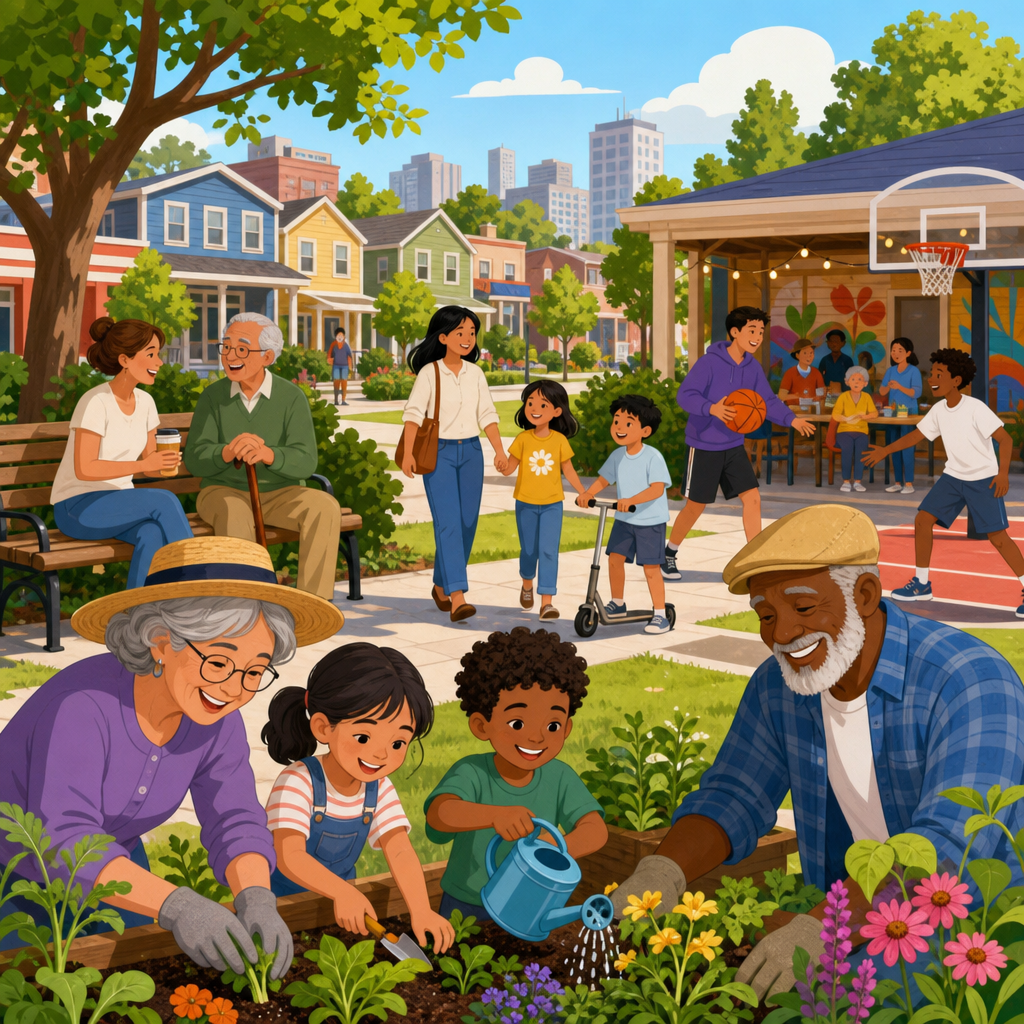
Building intergenerational neighborhoods through community development means designing places where children, working-age adults, and older residents can live, socialize, and access services in the same community without isolation. In affordable housing, the concept goes beyond putting different age groups near one another. It involves land use, housing design, transportation, public space, social programming, health access, and governance choices that help people of different generations support one another in daily life. I have worked on housing and community planning initiatives where age segregation happened by default, usually because financing, zoning, and service delivery were organized in silos. Reversing that pattern requires intentional strategy.
An intergenerational neighborhood is not simply a mixed-age census tract. It is a place where the built environment and the social environment both encourage meaningful contact across age groups. That can look like accessory dwelling units that let grandparents live close to family, affordable apartments near schools and clinics, parks with seating and shade for elders alongside play features for children, and community centers that host after-school tutoring in the same building as senior wellness programs. Community development is the practical framework that aligns these pieces. It combines housing production, economic development, infrastructure investment, resident engagement, and local partnerships to improve neighborhood conditions over time.
This matters because the United States is aging while housing costs remain historically difficult for families, fixed-income seniors, and younger workers. The Harvard Joint Center for Housing Studies has repeatedly documented rising cost burdens among renters and owners, especially older adults and lower-income households. At the same time, social isolation has become a measurable public health issue. The U.S. Surgeon General’s advisory on loneliness highlighted links between isolation and poorer physical and mental health outcomes. Intergenerational neighborhoods address both pressures at once. They help communities use limited land and public dollars more efficiently while supporting caregiving, social connection, and local economic resilience.
For affordable housing practitioners, this hub topic matters because many of the strongest outcomes come from coordination rather than from a single project type. A well-located affordable development can reduce transportation costs, support aging in place, improve school stability for children, and strengthen neighborhood retail demand. The central question is straightforward: how do you build neighborhoods that work for people at every life stage without making the place unaffordable or institutionally complex to manage? The answer begins with shared design principles, then moves into policy, finance, partnerships, and measurable outcomes.
Why intergenerational neighborhoods strengthen affordable housing outcomes
Intergenerational neighborhoods improve affordability because households do not experience housing costs in isolation. They also experience transportation costs, childcare costs, healthcare access barriers, and the cost of unpaid caregiving. When housing is near schools, grocery stores, parks, transit, and health services, families spend less time and money moving between disconnected destinations. Older adults can remain in familiar surroundings longer, delaying or avoiding more expensive institutional care. Young families gain informal support networks. Local employers benefit when workers can live closer to jobs and dependents.
In practice, I have seen this work best when communities stop treating seniors, families, and young adults as separate planning categories. A development with universal design features, flexible unit mixes, and strong transit access serves all three groups. Sidewalk quality, safe crossings, benches, lighting, and public restrooms are often discussed as senior-friendly improvements, but they also help parents with strollers, children walking to school, and workers commuting without a car. Likewise, reliable broadband supports telehealth for older residents, homework for students, and remote work for adults. The same investment can solve several age-related challenges at once.
Neighborhood stability is another benefit. Areas dominated by one age cohort often become vulnerable to demographic turnover, service mismatches, and weaker civic continuity. Mixed-age communities distribute that risk. Schools, clinics, faith institutions, libraries, and neighborhood associations have broader constituencies and steadier demand. When residents encounter one another across generations in routine settings, trust tends to deepen. That trust matters during crises such as heat waves, public health emergencies, or economic downturns, when informal checking on neighbors can be as important as formal service systems.
Core design principles for mixed-age communities
The physical design of an intergenerational neighborhood should support independence, safety, and social interaction without feeling institutional. Universal design is foundational. Step-free entries, wider doorways, lever handles, good lighting, acoustically considerate materials, and bathrooms that can accommodate mobility aids benefit residents across age groups. Visitability standards matter too. Even when every unit is not fully accessible, homes should allow guests with mobility limitations to enter, use a restroom, and move through shared spaces. This expands family connection and reduces exclusion.
Site planning is equally important. The most effective affordable housing communities I have evaluated place daily destinations within a comfortable walking distance and connect them through complete streets. That means sidewalks on both sides, curb ramps aligned with crossings, traffic calming, street trees, and clearly marked intersections. Public space should offer layered uses rather than age-segregated zones. A small plaza can include movable seating, shade, play elements, and clear sightlines so caregivers and older adults feel comfortable staying longer. Libraries, schools, and community centers should be treated as anchor infrastructure, not afterthoughts.
Housing diversity is another core principle. A neighborhood that only offers large detached homes, or only offers studio apartments, cannot support people across life stages. A healthy mix includes family-sized apartments, smaller units for singles and seniors, accessory dwelling units, duplexes, courtyard buildings, and supportive housing where needed. Tenure diversity matters as well. Renters, homeowners, cooperative members, and residents in community land trust homes all add resilience. The goal is not maximum variety for its own sake. The goal is to create pathways so people can stay in the same neighborhood as their needs and incomes change.
Policy and financing tools that make these neighborhoods possible
Most communities already know the design features they want. The harder challenge is assembling policy and financing tools that allow mixed-age affordable housing to pencil out. Inclusionary zoning, density bonuses, reduced parking requirements near transit, and by-right approvals for missing-middle housing can all lower barriers. Local governments should review zoning codes for rules that unintentionally separate generations, such as limits on accessory dwelling units, restrictions on multigenerational households, or excessive minimum lot sizes that push up land costs.
Capital stacks often combine Low-Income Housing Tax Credits, HOME funds, Community Development Block Grants, tax-exempt bonds, local housing trust funds, and philanthropic support. For projects with service components, developers may also braid healthcare partnerships, Medicaid-funded supportive services in some states, or grants for community facilities. The key is matching the funding source to the intended outcome. If a project aims to support aging in place, budget for service coordination and accessibility upgrades from the start rather than treating them as optional amenities that can be cut during value engineering.
Long-term affordability protections are essential. Communities can spend years cultivating a mixed-age neighborhood only to lose it to rising rents and speculative acquisition. Deed restrictions, community land trusts, limited-equity cooperatives, and mission-driven ownership structures preserve affordability over time. Public agencies should also monitor property tax impacts on longtime owners, especially older adults on fixed incomes. Relief tools such as circuit breakers, deferrals, or targeted exemptions can prevent displacement while allowing neighborhoods to improve.
| Tool | How it helps intergenerational neighborhoods | Common limitation |
|---|---|---|
| Accessory dwelling unit reform | Creates flexible homes for older relatives, caregivers, or adult children | Homeowners may still face financing and permitting complexity |
| Low-Income Housing Tax Credit | Finances affordable rental housing at scale | Service-rich designs can be hard to fund without additional sources |
| Community land trust | Preserves affordability and reduces speculative pressure | Needs sustained stewardship capacity and public support |
| Reduced parking minimums | Lowers development cost and frees land for housing or open space | Requires viable transit, walking, or shared mobility options |
Services, programming, and partnerships that turn housing into community
Buildings alone do not produce intergenerational connection. Programs, staffing, and local partnerships do. The most successful communities use shared spaces intentionally, with calendars that mix age groups while also respecting different needs. A community room might host preschool story time in the morning, digital literacy coaching in the afternoon, and a tenant meeting in the evening. Schools can partner with senior residents for reading mentorship. Health systems can offer blood pressure screenings or vaccine clinics on site. Food access partners can operate mobile markets or community gardens where children and elders work side by side.
Service coordination is especially valuable in affordable housing. Residents often need help navigating benefits, transportation, caregiver resources, or preventive healthcare. A skilled service coordinator can connect older adults to home modification programs, help families enroll in childcare subsidies, or refer youth to job training. These roles improve housing stability because they address the non-rent pressures that often lead to displacement or crisis. I have seen modest investments in coordination prevent repeated emergency interventions later, which is both more humane and more cost-effective.
Partnerships should be formal enough to survive staff turnover. Memoranda of understanding, shared outcome measures, referral protocols, and regular cross-sector meetings create durability. Strong partners typically include housing providers, public health agencies, parks departments, school districts, transit agencies, libraries, and community-based organizations. Faith institutions and local businesses are often overlooked, but they can be anchor partners because they already hold trust and physical space. The principle is simple: every neighborhood asset should be evaluated for how it can support multiple generations, not just its traditional user group.
Measuring success and avoiding common mistakes
Communities should measure intergenerational neighborhood performance with both housing metrics and social outcome metrics. Standard housing indicators include rent burden, eviction rates, unit accessibility, length of tenure, and preservation of affordable units. Neighborhood indicators should include walkability, transit access, park quality, crime trends, and proximity to essential services. To understand whether generations are actually connecting, resident surveys, participation data, volunteer rates, and social isolation screening can be useful. Health systems and public agencies may also track preventable emergency visits, falls, or missed school days where data-sharing rules allow.
One common mistake is assuming proximity equals connection. Putting senior housing next to family housing does not guarantee relationships. Shared entrances, visible common areas, cross-programmed activities, and trusted staff matter. Another mistake is overprogramming without resident input. People want opportunities for interaction, not constant managed events. Communities should ask residents what supports dignity and convenience. In some places that means a shaded courtyard and flexible seating. In others it means evening bus service, laundry access, or safer crossings near a clinic.
Another recurring failure is excluding residents from governance. Intergenerational community development works best when planning, implementation, and oversight include renters, homeowners, elders, youth, and caregivers. Resident councils, participatory budgeting, and advisory boards with real decision-making power improve project fit and long-term legitimacy. The best hub strategy for affordable housing is to treat this topic as a connected system: land use, capital, design, services, and resident leadership must reinforce one another. That is how neighborhoods become places where people can remain rooted through different stages of life.
Building intergenerational neighborhoods through community development is one of the most practical ways to strengthen affordable housing outcomes while improving everyday quality of life. The approach works because it addresses how people actually live. Families need homes near schools, groceries, and childcare. Older adults need safe mobility, nearby healthcare, and options to age in place. Workers need reliable transportation and stable rents. When a neighborhood is planned for all of those needs together, public investment performs better and residents gain more than shelter. They gain connection, continuity, and access to support that reduces isolation and instability.
The strongest intergenerational neighborhoods share several traits. They offer diverse housing types, long-term affordability protections, accessible design, and walkable public spaces. They align zoning and financing so mixed-age housing can be built and preserved. They also invest in service coordination and partnerships with schools, health providers, libraries, and community organizations. Just as important, they measure results and adjust based on resident experience. That balance of physical design and social infrastructure is what turns a housing development into a functioning neighborhood.
For affordable housing leaders, this hub topic should guide future planning, not sit apart from it. Review your zoning code, map service gaps, evaluate accessibility, and ask residents where generational barriers still exist. Then build a pipeline of projects and partnerships that keep people rooted across life stages. Start with one block, one redevelopment site, or one corridor, but start deliberately. Communities that make room for every generation become more affordable, more resilient, and more humane.
Frequently Asked Questions
What does it really mean to build an intergenerational neighborhood through community development?
Building an intergenerational neighborhood means creating a community where people at different life stages can live well in the same place, not just live close to one another. In practice, that includes children, teens, working-age adults, caregivers, and older residents having access to housing, services, public spaces, and daily routines that make connection possible and practical. In affordable housing and community development, this goes far beyond age diversity on paper. It involves planning decisions about land use, street design, building layout, shared spaces, transportation options, healthcare access, and resident programming so people can meet everyday needs without being isolated by age, income, mobility, or caregiving responsibilities.
An intergenerational approach also recognizes that different generations have assets as well as needs. Older adults may offer stability, experience, mentorship, and informal childcare support. Families with children bring activity, social energy, and demand for schools and parks. Working-age adults often sustain local businesses, volunteer networks, and caregiving systems. When a neighborhood is designed to support these overlapping roles, residents are more likely to help one another, remain in the community longer, and build stronger social ties. The goal is not to force interaction, but to remove barriers that keep generations separated and to create settings where support, belonging, and mutual benefit can develop naturally over time.
Why are intergenerational neighborhoods especially important in affordable housing communities?
Intergenerational design matters in affordable housing because low- and moderate-income residents often face multiple barriers at once: rising housing costs, limited transportation choices, fewer nearby services, health inequities, and social isolation. When affordable housing is planned without considering age-related needs, communities can become fragmented. Families may struggle to find safe play areas or nearby childcare. Older adults may be cut off from transit, healthcare, or walkable destinations. Working caregivers may be stretched thin trying to support both children and aging relatives. Intergenerational community development responds to these realities by treating housing as part of a broader ecosystem of support rather than as a standalone building or unit count.
This approach can also improve long-term housing stability. Residents are more likely to remain housed when they can access services that match changing life circumstances, whether that means mobility-friendly design for aging in place, after-school programming for children, or nearby clinics and grocery options for households managing tight budgets. Affordable housing communities that welcome all generations can reduce loneliness, strengthen informal support networks, and lower the daily burden of transportation and caregiving. From a development perspective, these communities can be more resilient because they serve a wider range of households over time and are better positioned to adapt as resident needs evolve. In short, intergenerational planning helps affordable housing perform not only as shelter, but as a foundation for health, connection, and opportunity.
What design and planning features help different generations thrive together in the same neighborhood?
The most effective intergenerational neighborhoods combine physical design with practical accessibility. On the land use side, that usually means mixed-use and mixed-income planning where homes are near parks, schools, clinics, community centers, retail, and transit. A neighborhood that allows residents to reach essential destinations without long car trips is especially important for children, older adults, and people with disabilities. Housing itself should include a mix of unit sizes and flexible layouts so singles, multigenerational families, and older residents can all find appropriate options. Universal design features such as step-free entrances, wider doorways, good lighting, elevators, accessible bathrooms, and clear wayfinding help residents remain in place as needs change.
Public realm design is just as important. Sidewalks should be safe, shaded, and connected. Crosswalks need enough time for slower walkers. Parks should include seating, restrooms, play areas, and spaces that feel comfortable for both active and quiet use. Community rooms, courtyards, front porches, gardens, and shared kitchens can encourage interaction across ages when they are visible, welcoming, and easy to access. Transportation planning should include reliable transit, safe bike routes, stroller-friendly and mobility-device-friendly paths, and convenient drop-off zones for caregivers and service providers. The best intergenerational neighborhoods also integrate services directly into the community, such as health programs, senior resource navigation, childcare partnerships, digital access, and resident-led events. These layered features make it easier for people of different generations to participate in community life on equal footing.
How can community programming and local governance strengthen intergenerational relationships?
Physical design creates opportunity, but programming and governance turn that opportunity into lasting community life. Intergenerational neighborhoods work best when there are structured ways for residents of different ages to engage one another around shared interests and needs. That can include mentorship programs, community gardening, intergenerational arts events, technology tutoring, storytelling projects, walking groups, homework support, meal programs, and volunteer opportunities that pair youth and older adults. The key is to design programming that respects each group’s time, abilities, and preferences rather than assuming everyone wants the same type of interaction. Good programs are consistent, well-supported, and rooted in resident input.
Governance matters because residents are more likely to trust and sustain a community when they have a voice in how it operates. Inclusive governance can include resident councils, multilingual outreach, youth advisory roles, accessible meeting formats, and decision-making processes that consider workers, parents, elders, and people with disabilities. Property managers, nonprofit partners, healthcare providers, schools, and local governments all have roles to play, but successful intergenerational communities do not rely solely on top-down management. They build local leadership. When residents help shape priorities around safety, maintenance, programming, mobility, and services, the neighborhood becomes more responsive and more equitable. Strong governance also helps address conflict, balance competing needs, and make sure benefits are shared across age groups rather than concentrated in one population.
What are the biggest challenges to creating intergenerational neighborhoods, and how can communities overcome them?
One of the biggest challenges is that many housing and planning systems are still organized in silos. Developers may focus on unit production, transportation agencies on mobility, health systems on clinical care, and service providers on separate age-based programs. That fragmentation can lead to neighborhoods where housing exists but daily life remains difficult for families, older adults, or caregivers. Zoning restrictions, limited funding streams, and short development timelines can also make it harder to include mixed uses, adaptable design, and community-serving amenities. In some cases, there is also a misconception that intergenerational living happens automatically if different age groups are housed nearby, when in reality meaningful inclusion requires intentional planning and ongoing coordination.
Communities can overcome these barriers by using a cross-sector approach from the start. That means bringing together housing developers, residents, public agencies, health organizations, schools, transit planners, and local nonprofits early in the planning process. Data on demographics, disability access, caregiving patterns, transit use, and resident priorities should inform both design and operations. Financing strategies can combine housing funds with grants or partnerships for health, public space, food access, and community programming. Equally important, success should be measured by more than occupancy rates or construction outputs. Communities should ask whether residents of all ages feel safe, connected, represented, and able to meet daily needs close to home. When intergenerational neighborhoods are treated as long-term community infrastructure rather than a short-term housing product, they are far more likely to succeed.


