
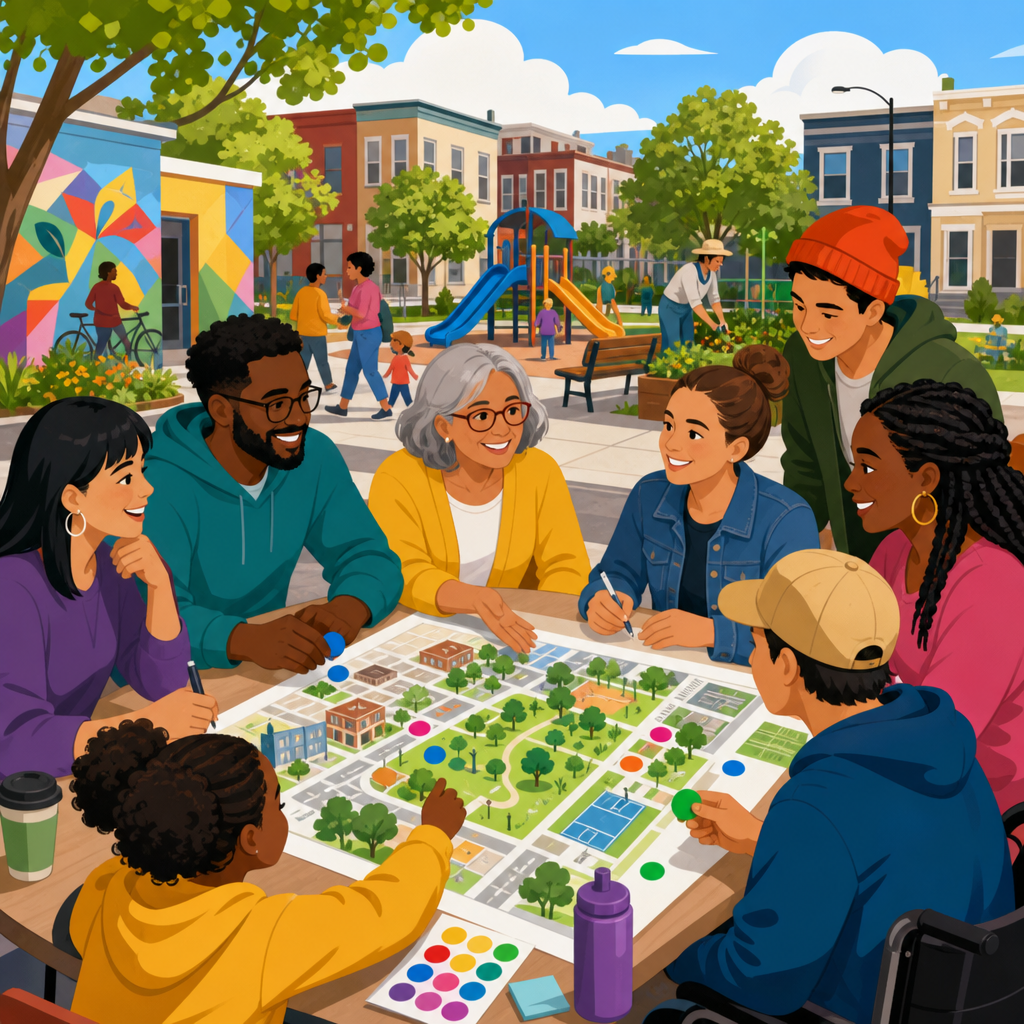
Participatory budgeting for neighborhood improvements gives residents direct power over public spending, turning abstract civic engagement into visible changes such as safer crossings, playground repairs, street trees, bus shelters, and library technology. In practical terms, participatory budgeting, often shortened to PB, is a structured process in which community members propose ideas, public agencies review feasibility and cost, and residents vote on which projects receive funding. Neighborhood improvements are the small and mid-sized capital or program investments that shape daily life block by block. This matters because many cities struggle with low trust, uneven investment, and spending decisions that feel distant from the people affected most. I have worked with local planning teams and community groups on public engagement for capital projects, and PB consistently produces two benefits at once: it funds tangible improvements and teaches residents how city government actually works. In U.S. cities, PB has also become relevant to affordable housing because the same neighborhoods facing housing pressure often need better sidewalks, lighting, parks, accessibility upgrades, and public space improvements that support stability and quality of life.
The core promise of participatory budgeting is simple: people closest to neighborhood problems help decide how public money should be used. Yet the design details determine whether that promise is real or symbolic. Who can vote: only registered voters, or also youth, immigrants, and formerly incarcerated residents? What funds are eligible: capital budgets only, or operating funds too? How are ideas developed, costed, translated, and communicated? Those choices shape participation, project quality, and trust. U.S. cities have now generated enough experience to identify lessons that travel across contexts. Chicago’s ward-based experiments showed how PB can work at a hyperlocal scale. New York City demonstrated that large cities can run multi-district processes with substantial outreach. Vallejo, California showed how PB can grow after a municipal bankruptcy as a trust-building measure. Boston’s youth-focused approach proved that younger residents can generate serious, implementable projects. The broad lesson is not that one model fits everywhere, but that successful participatory budgeting for neighborhood improvements depends on clear rules, inclusive outreach, transparent project review, and public accountability after the vote.
How participatory budgeting works in U.S. neighborhoods
Most participatory budgeting programs follow five stages. First, a city or district sets aside a defined amount of money and publishes clear eligibility rules. Second, residents submit ideas through assemblies, pop-up events, schools, libraries, online forms, or neighborhood organizations. Third, volunteer budget delegates or staff clusters turn raw ideas into workable proposals, often with help from transportation, parks, public works, housing, and finance departments. Fourth, agencies conduct feasibility review, estimating costs, timelines, legal constraints, maintenance needs, and whether a project is capital-eligible. Finally, residents vote, and winning projects move into the regular implementation pipeline.
That sequence sounds straightforward, but the mechanics matter. Capital projects usually fit best because cities can tie them to one-time appropriations and asset creation, such as curb ramps, pedestrian lighting, benches, traffic calming, tree planting, schoolyard improvements, and accessibility retrofits. Operating projects, like ongoing staffing or recurring services, are harder because they create future budget obligations. In my experience, programs fail when eligibility rules are vague or when agencies review proposals too late. Residents need early clarity on what the money can buy and what city departments can realistically deliver within one to three years.
Neighborhood improvements are particularly suitable for PB because residents can identify highly specific needs that broad capital plans often miss. A transportation department may prioritize arterial resurfacing based on pavement condition indices, while residents may prioritize a dangerous midblock crossing near a senior building. Both are valid, but PB creates a channel for lived experience to inform investment. That is why many winning PB projects are modest in cost and high in visibility. They solve everyday friction points that shape whether people feel safe, welcome, and connected in their neighborhood.
What U.S. city examples teach about design choices
Chicago is widely recognized as an early U.S. participatory budgeting leader because aldermanic wards used discretionary menu funds for local capital projects. The ward model demonstrated that PB can produce concrete neighborhood outcomes when the pot of money is real and geographically relevant. Residents were often voting on street resurfacing, murals, bike lanes, playground equipment, and school improvements they could see within walking distance. The tradeoff was fragmentation: ward-level control encouraged responsiveness, but it also meant process quality varied by political leadership, staff capacity, and outreach effort.
New York City scaled PB across multiple council districts and invested heavily in multilingual outreach, school partnerships, community-based organizations, and neighborhood assemblies. That scale showed the value of standardization. When staff use common rules, timelines, and ballot formats, residents can understand the process more easily and city departments can coordinate review more efficiently. New York also highlighted a common challenge: proposal pipelines become crowded with worthy ideas that exceed available funds. Managing expectations is not a side task; it is central to credibility.
Vallejo, California launched PB after a period of severe fiscal distress, using a share of a local tax measure to let residents decide on community priorities. The important lesson from Vallejo is that participatory budgeting can function as a trust repair tool when public confidence has been damaged. But trust is rebuilt only if governments report back visibly on implementation. When residents vote for school crossing safety upgrades or youth facilities, they expect to see project status, procurement milestones, and reasons for delay. Silence undermines the entire process.
Boston’s youth-focused model showed that age-inclusive design expands the value of PB beyond project selection. Young people can assess bus stop conditions, recreation needs, public art, digital access, and mental health supports with seriousness and creativity. Cities that include teenagers are not lowering standards; they are widening civic intelligence. The same principle applies to noncitizens and residents in public or subsidized housing. If neighborhood improvements affect them, excluding them weakens the process and distorts local priorities.
| City | Notable PB Feature | Key Lesson for Neighborhood Improvements |
|---|---|---|
| Chicago | Ward-based discretionary capital funds | Local geography makes projects visible and personally relevant |
| New York City | Multi-district process with multilingual outreach | Standard rules and broad inclusion improve participation quality |
| Vallejo | Post-fiscal-crisis trust-building use of resident voting | Implementation transparency is essential after the vote |
| Boston | Youth-centered participatory budgeting | Expanding voter eligibility strengthens ideas and legitimacy |
Common project types and why they win
Across U.S. cities, winning neighborhood improvement projects cluster around safety, accessibility, public space, and community amenities. Traffic calming wins because residents experience speeding, poor visibility, and unsafe crossings every day. Typical PB transportation projects include speed humps, curb extensions, pedestrian refuge islands, repainting crosswalks, flashing beacons, bike racks, and bus stop seating. These are often less expensive than major roadway redesigns and can fit within district-level allocations.
Accessibility improvements also perform well because they convert civil rights obligations into visible neighborhood upgrades. Curb ramps near transit stops, sidewalk repairs, accessible playground surfaces, and wayfinding improvements around libraries or senior centers are easy to understand and broadly beneficial. Parks and public space projects are similarly popular. Residents support shade structures, benches, drinking fountains, community gardens, dog park features, and court resurfacing because the benefits are immediate and shared.
Digital and civic infrastructure increasingly appears on PB ballots too. Public Wi-Fi in community spaces, library makerspace equipment, school technology, and security lighting around public facilities reflect how neighborhood quality now includes both physical and digital access. The strongest proposals usually combine a clear problem statement, a defined user group, a plausible site, and a manageable maintenance burden. A project that promises “beautify the neighborhood” is too vague. A project that installs benches, lighting, and native landscaping along a specific commercial corridor is fundable because departments can scope it precisely.
Inclusion, equity, and affordable housing connections
Participatory budgeting is often discussed as a democracy reform, but for affordable housing communities it is also an equity tool. Lower-income neighborhoods have historically received less political attention and often have fewer informal channels to influence capital planning. PB can counter that pattern if the process is intentionally designed. That means offering materials in multiple languages, holding meetings at accessible locations and times, providing childcare and food, allowing online and in-person participation, and partnering with trusted groups such as tenant associations, schools, mutual aid networks, settlement houses, and community development corporations.
The connection to affordable housing is practical. Stable housing depends on the surrounding environment, not just the rent level inside a unit. Families need safe walking routes to school, lighting near transit, flood mitigation on frequently inundated blocks, park improvements near apartment complexes, and accessibility upgrades for seniors aging in place. In neighborhoods with subsidized housing, PB can surface small capital needs that broader housing programs overlook. For example, residents may prioritize shade at a bus stop serving a senior complex, traffic calming near an affordable housing site, or better lighting around a public housing playground.
Equity also requires attention to who participates and who wins. If only highly organized homeowners vote, PB can reproduce existing inequalities. Strong programs track participation by geography, language, age, tenure, and race or ethnicity where legally appropriate, then adjust outreach accordingly. Equity does not mean guaranteeing outcomes by demographic category. It means removing barriers, distributing information fairly, and ensuring project review does not quietly eliminate ideas from lower-income areas because residents lack technical vocabulary.
Implementation challenges and how cities can avoid failure
The biggest risk in participatory budgeting is not bad voting. It is poor delivery after good voting. City agencies may underestimate procurement timelines, utility conflicts, site control issues, environmental review, or maintenance obligations. When projects stall for years, residents understandably conclude that participation was performative. The remedy is disciplined project management from the start. Feasibility review should include realistic cost estimating, identification of responsible departments, basic schedule assumptions, and confirmation that a project can be operated after construction.
Another frequent problem is using too little money. A token PB allocation can generate enthusiasm at first, but if residents spend months developing proposals only to see one tiny project funded, the process loses legitimacy. Programs need enough funding to produce multiple visible wins. There is no universal threshold, but the amount should match the geography and the cost environment. In high-cost cities, even simple streetscape work can consume budgets quickly, so cities may need to narrow eligible project types or pool funding across departments.
Digital tools help, but they do not replace field outreach. Platforms for idea collection, mapping, and voting can widen access, yet the best results still come from canvassing, tabling at transit hubs, meetings in schools and libraries, and collaboration with resident leaders. Staff should also publish public dashboards showing proposal status, vote totals, implementation stages, and completed project photos. Transparent reporting is the most effective answer to skepticism because it links resident decisions to visible outcomes.
Best practices for launching or improving a local program
Cities considering participatory budgeting for neighborhood improvements should start with a clear scope, a realistic budget, and a written rulebook that residents can understand without insider knowledge. Define who can participate, what types of projects qualify, how ideas are reviewed, how ties are handled, and when implementation updates will be posted. Train department staff before launch so feasibility review is consistent. Use plain language in all materials and translate them professionally. Build outreach around community institutions people already trust.
It is also wise to treat the first cycle as a learning year. Evaluate turnout, project diversity, geographic distribution, implementation speed, and participant satisfaction. Then revise the process. In my experience, the strongest PB programs are iterative rather than rigid. They simplify ballots, shorten review bottlenecks, improve cost estimating, and add support where participation was weak. Over time, the program becomes not just a voting exercise but a durable civic infrastructure for neighborhood problem solving.
Participatory budgeting for neighborhood improvements works best when cities respect residents as practical experts on place. U.S. experience shows that the model succeeds not because it is trendy, but because it solves a real governance problem: public spending is better when informed by lived experience and backed by transparent delivery. Chicago, New York City, Vallejo, Boston, and other communities demonstrate that residents can make thoughtful choices about sidewalks, parks, safety, accessibility, and public amenities when the process is well designed. The main lessons are consistent. Set aside meaningful funds. Make participation inclusive. Review proposals honestly and early. Publish implementation progress. Learn from each cycle and improve the next one.
For affordable housing stakeholders, this approach has special value because neighborhood quality shapes housing stability, health, mobility, and trust in local government. A safer crossing near an apartment complex, better lighting around transit, or a renovated playground next to affordable homes may seem small compared with housing production, yet these improvements materially affect daily life. Participatory budgeting gives residents a structured way to identify those needs and direct public dollars toward them. If your city, housing organization, or neighborhood coalition is exploring stronger community voice, start by examining where a modest PB program could fund visible improvements and build long-term civic capacity at the same time.
Frequently Asked Questions
What is participatory budgeting, and how does it improve neighborhood projects?
Participatory budgeting, often called PB, is a public decision-making process that allows residents to help decide how a portion of government funding is spent. Instead of city agencies or elected officials making all spending choices on their own, community members identify local needs, suggest project ideas, review priorities, and vote on which proposals should receive funding. In the context of neighborhood improvements, this can lead to highly visible, practical investments such as safer pedestrian crossings, repaired playgrounds, better street lighting, bus shelters, street trees, traffic calming features, library technology upgrades, and improvements to parks or public spaces.
What makes PB especially valuable is that it connects civic engagement to tangible outcomes. Residents are not just attending meetings or filling out surveys; they are shaping real capital projects that affect daily life. U.S. cities that have used participatory budgeting have shown that local people often surface small but important infrastructure needs that traditional budgeting processes may overlook. A dangerous intersection near a school, broken benches in a park, missing curb ramps, or a lack of shade on a busy block may not always rise to the top of a citywide capital plan, but they matter deeply to the people who use those spaces every day.
PB also improves neighborhood projects by increasing transparency and trust. Because proposals are discussed publicly, reviewed for feasibility, and voted on openly, residents can better understand what projects cost, what agencies can legally fund, and how public money moves from idea to implementation. That transparency helps demystify local government and can strengthen long-term civic participation. In many communities, PB has become a practical tool for making public spending more responsive, equitable, and visible at the block-by-block level.
How does the participatory budgeting process typically work in U.S. cities?
While the exact structure varies from city to city, most participatory budgeting programs follow a similar series of steps. First, a city, district, school system, housing authority, or other public body sets aside a defined amount of money for PB. That funding pool is usually limited to specific kinds of expenditures, often capital improvements or one-time public investments rather than ongoing operating costs. Officials then launch a public outreach phase to inform residents about the process, eligibility rules, and timeline.
Next comes idea collection. Residents submit proposals based on what they see in their neighborhoods and public spaces. These ideas may come from community assemblies, online forms, school-based workshops, pop-up events, tenant meetings, libraries, or neighborhood organizations. Common suggestions include sidewalk repairs, traffic safety improvements, playground equipment, street trees, bike racks, public seating, accessibility upgrades, public art, and technology improvements in civic facilities.
After idea collection, city staff and volunteer budget delegates usually work together to turn broad suggestions into workable proposals. Public agencies review each idea for legality, jurisdiction, technical feasibility, maintenance implications, and estimated cost. This stage is critical because it determines whether a resident idea can realistically be delivered within the available budget and under existing rules. In well-run PB processes, this review is transparent and includes clear explanations when proposals are rejected or modified.
The final stage is public voting. Eligible residents choose among the vetted project proposals, and the projects with the most support are funded until the PB budget is fully allocated. The winning projects then move into design, procurement, and construction or installation through the appropriate city departments. One of the key lessons from U.S. cities is that implementation matters just as much as voting. Residents judge PB not only by whether they were invited to participate, but by whether promised neighborhood improvements are actually completed on time and communicated clearly throughout the process.
What kinds of neighborhood improvements are best suited for participatory budgeting?
Participatory budgeting works best for projects that are visible, localized, and easy for residents to understand. Neighborhood improvements are especially well suited because they directly affect quality of life and are often grounded in firsthand resident experience. Good PB projects tend to be specific and concrete: installing speed humps on dangerous streets, adding crosswalks near schools, repairing basketball courts, improving park lighting, planting street trees, upgrading community center equipment, adding bus shelters, or replacing outdated computers in a library branch.
These types of projects are effective in PB because residents can clearly see the problem, imagine the benefit, and evaluate the tradeoffs. A parent knows whether a playground is unsafe. A senior knows where a missing bench would make walking easier. A transit rider knows which stop lacks shelter. This local knowledge is one of PB’s greatest strengths, especially in neighborhoods that have historically had limited influence over conventional planning and budgeting processes.
That said, not every community priority fits neatly into PB. Programs that require ongoing staffing, annual operating expenses, or major citywide system changes can be harder to fund through a PB process that is designed for one-time capital spending. For example, hiring more permanent staff for a recreation center or expanding a bus route may fall outside PB rules even if residents strongly support those goals. Successful U.S. cities address this challenge by being clear early on about what qualifies, helping residents shape ideas into eligible projects, and using PB feedback to inform broader policy decisions even when certain proposals cannot be funded directly through the PB pool.
What lessons have U.S. cities learned about making participatory budgeting equitable and inclusive?
One of the biggest lessons from U.S. cities is that participatory budgeting does not automatically become equitable simply because it is open to the public. Inclusion has to be designed into the process. Communities that see stronger results usually invest heavily in outreach, translation, accessible meeting formats, youth engagement, and partnerships with trusted local organizations. Without those efforts, participation can skew toward residents who already have time, confidence, and familiarity with public meetings, which can reproduce the same inequities PB is meant to address.
Many successful PB programs lower barriers by allowing participation from people who are often left out of traditional civic processes, including teenagers, non-citizens, public housing residents, or people without prior voting history, depending on local rules. They also bring the process to where people already are instead of expecting everyone to come to city hall. That can mean hosting idea collection events in schools, libraries, parks, transit hubs, faith institutions, senior centers, and community festivals, as well as offering digital participation options alongside in-person engagement.
Another important lesson is that equity depends on implementation quality, not just participation numbers. If residents in underinvested neighborhoods vote for projects but then face long delays, cost overruns, or poor communication, trust can erode quickly. Cities that build credibility tend to publish clear timelines, share feasibility criteria openly, provide regular progress updates, and explain setbacks honestly. They also use data to assess who is participating, which neighborhoods are benefiting, and whether the funded projects align with areas of greatest need. In practice, equitable PB is not just about giving everyone a ballot; it is about ensuring that communities with the greatest infrastructure gaps can meaningfully shape, win, and see the delivery of neighborhood improvements.
What are the main challenges of participatory budgeting, and how can cities make it more effective?
Participatory budgeting offers real advantages, but it also comes with practical challenges. One common issue is scale. PB funds are often relatively small compared with the full range of neighborhood needs, so residents may expect transformative change when the available budget only supports a limited number of projects. Another challenge is feasibility review. Ideas that seem simple in concept can become complicated once agencies examine land ownership, utility conflicts, permitting rules, procurement requirements, accessibility standards, long-term maintenance obligations, and actual construction costs.
Cities also struggle when implementation is slow. Residents may enthusiastically participate in workshops and voting, only to wait months or even years for the winning projects to appear. That delay can make PB feel symbolic rather than impactful, especially if communication is weak. In addition, some agencies are not fully prepared for the administrative work PB requires, including outreach, technical review, project scoping, interdepartmental coordination, and public reporting. Without internal capacity and leadership support, even well-designed PB programs can underperform.
To make participatory budgeting more effective, cities should start with clear rules, realistic project categories, and a funding amount large enough to produce visible results. They should explain eligibility standards early, provide hands-on support to residents developing ideas, and make feasibility review transparent. Strong outreach is essential, but so is strong delivery: residents need to see that the winning projects move forward. Many U.S. cities have learned that PB works best when it is treated as a serious part of public budgeting rather than a one-time engagement exercise. When local governments pair resident voice with administrative follow-through, participatory budgeting can become a durable tool for improving neighborhood infrastructure, strengthening public trust, and making civic participation feel concrete and worthwhile.


