Designing safer intersections for pedestrians and cyclists is one of the most effective ways cities can reduce severe crashes, support active transportation, and make streets usable for people of all ages and abilities. An intersection is the place where travel paths cross, decisions happen quickly, and conflicts concentrate. For pedestrians, the main risks include turning vehicles, long crossing distances, poor visibility, and excessive wait times that encourage unsafe crossings. For cyclists, danger often comes from right hooks, left-turn conflicts, inadequate signal timing, and designs that force riders to merge with faster traffic at the most complex point on a corridor. In practice, I have found that the quality of an intersection often determines whether an otherwise good walking or cycling route feels comfortable enough to use daily. When planners talk about safer intersections, they mean geometry, signals, markings, speed management, lighting, accessibility, and operations working together to lower conflict and reduce injury severity. This matters because intersections account for a disproportionate share of urban crashes, and the safest solutions also advance sustainability goals by making short trips possible without a car. Better intersection design improves public health, expands mobility for children, older adults, and disabled users, and helps main streets function as places rather than just traffic channels.
Why intersections are high-risk points in urban streets
Intersections are hazardous because multiple users occupy the same space while moving in different directions and at different speeds. A driver may be scanning for gaps in vehicle traffic while failing to notice a person stepping off the curb or a cyclist approaching in a bike lane. This is a classic human factors problem: attention is limited, and conventional intersection layouts ask road users to process too much information at once. Research from the Federal Highway Administration and National Association of City Transportation Officials consistently shows that reducing vehicle speed and simplifying movements are the strongest predictors of safety gains. A person struck at 20 mph has a far greater chance of survival than a person struck at 40 mph, so design speed matters more than posted speed alone. The safest intersections do not rely on perfect behavior. They create self-enforcing conditions where turning radii are tighter, sight lines are clear, and crossings are short enough that exposure time drops.
Land use also shapes risk. Near schools, transit stops, neighborhood retail, parks, and housing with low car ownership, intersections carry more pedestrians and cyclists and should be designed accordingly. Yet many cities still apply highway-style geometry in urban contexts, with wide lanes and sweeping corners that invite fast turns. That mismatch is dangerous. A sustainable urban development approach starts with the expected users, not just vehicle throughput. If an intersection sits on a route to a train station, a school district, or a commercial corridor, the design should assume regular foot traffic, riders with cargo bikes, children on scooters, wheelchair users, and people crossing slowly. Safety improves when those users are treated as the design baseline instead of an afterthought.
Core design principles that consistently reduce crashes
Safer intersections share a set of principles that hold across contexts. First, reduce speed at the conflict point. Tight curb radii, raised crossings, compact corner geometry, and vertical deflection slow turning vehicles without requiring constant enforcement. Second, reduce crossing distance. Curb extensions, median refuges, and protected islands shorten the time a pedestrian spends in the traveled way. Third, improve visibility. Daylighting, which removes parking or obstructions near corners, allows drivers and cyclists to see each other earlier. Fourth, separate movements in time or space. Protected signal phases, setback crossings, and corner islands prevent direct conflicts between turning vehicles and through cyclists. Fifth, keep operations legible. The design should make the correct path obvious for every user, especially in bad weather, at night, or under heavy traffic conditions.
Accessibility must be embedded from the beginning. Intersections that are safer for pedestrians and cyclists are also more navigable for blind or low-vision users, wheelchair users, and people pushing strollers. That means ADA-compliant curb ramps aligned with the crossing direction, detectable warning surfaces, accessible pedestrian signals, and smooth, continuous surfaces through conflict areas. Good design avoids channelized slip lanes that create free-flow turns and force people to monitor traffic from multiple directions. Where slip lanes remain, they should be tightened, raised, and controlled so that drivers must yield at slow speed. In project reviews, this is often the point where safety ambitions either hold or weaken. If cities compromise geometry to preserve turning speed, they usually preserve the collision pattern as well.
Proven intersection treatments and when to use them
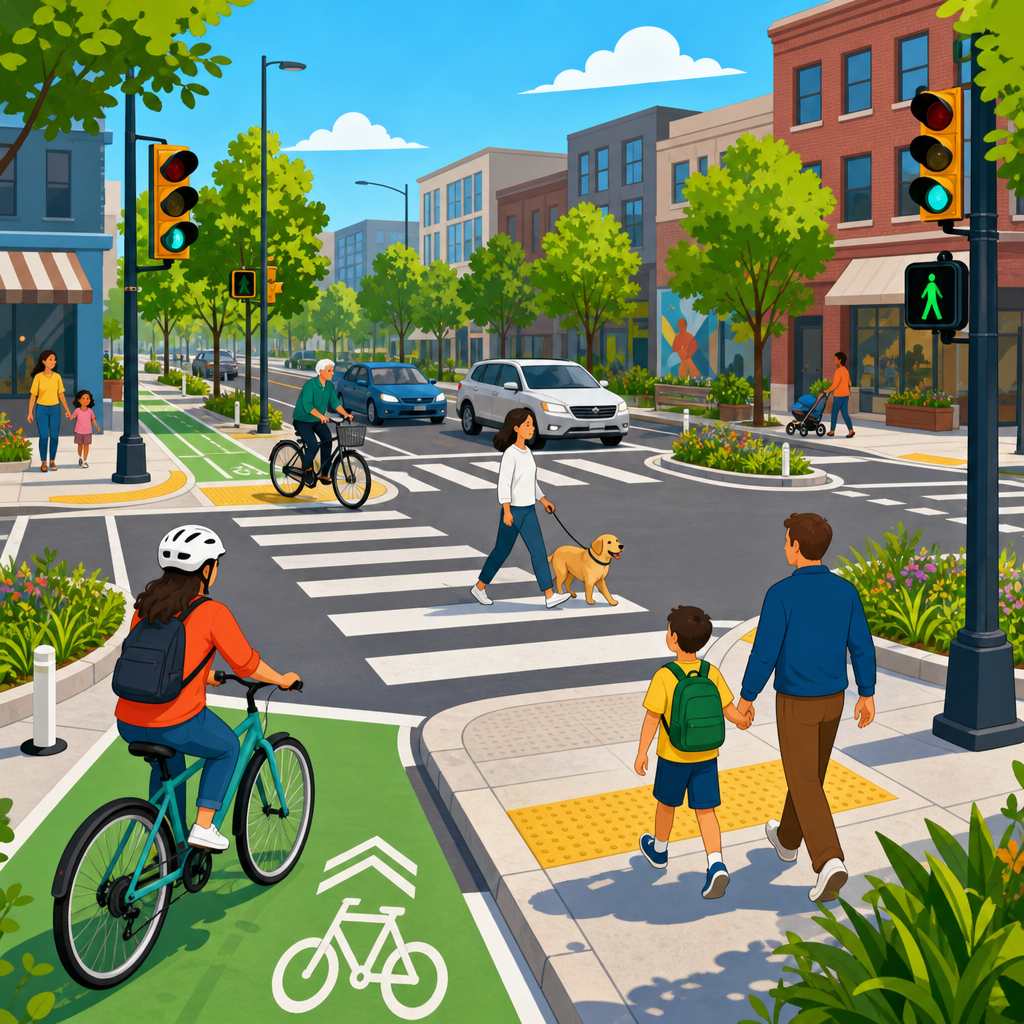
No single treatment solves every problem, but several measures are repeatedly effective when matched to context. Raised crosswalks and raised intersections work well on local streets, town centers, and school zones because they physically reinforce low-speed operation. Curb extensions are useful where parking lanes exist and pedestrian volumes are high, especially near bus stops and retail corners. Median refuge islands are valuable on multilane streets, allowing pedestrians to cross in two stages and reducing cognitive load. Leading pedestrian intervals give walkers a head start before turning traffic moves, making them more visible in the crosswalk. For cycling corridors, protected intersections adapted from Dutch practice offer one of the strongest design models. They use corner refuge islands, setback crossings, and defined turning paths to reduce right-hook and left-turn conflicts while preserving continuity of protected bike lanes.
Signal strategy matters as much as physical form. Separate bicycle signal heads, protected left-turn phasing, no-turn-on-red rules in dense pedestrian areas, and transit signal priority can all improve safety when coordinated carefully. The best choice depends on speed, volume, turning patterns, heavy vehicle presence, and nearby destinations. A freight route may need mountable aprons or more carefully designed corner islands; a university district may prioritize large pedestrian queues and bike turn boxes. The strongest projects combine treatments rather than relying on paint alone. Paint can clarify priority, but geometry changes behavior. When budgets are limited, cities can start with quick-build materials such as modular curbs, posts, and temporary islands, then evaluate and harden successful designs into concrete.
| Treatment | Best use case | Main safety benefit | Key limitation |
|---|---|---|---|
| Leading pedestrian interval | Signalized urban crossings with turning traffic | Improves pedestrian visibility before vehicles turn | Less effective if turning speeds remain high |
| Curb extension | Main streets with parking lanes and short blocks | Shortens crossing distance and tightens turns | Must account for drainage and bus operations |
| Median refuge island | Multilane streets with long crossings | Allows two-stage crossing and lowers exposure | Needs adequate width for wheelchairs and bikes |
| Protected intersection | Bike corridors crossing higher-volume streets | Reduces turning conflicts and clarifies priority | Requires careful signal and curb design |
Designing specifically for cyclists, not just adding bike paint
Cyclist safety at intersections depends on continuity. A protected bike lane that disappears 100 feet before the stop line often leaves riders in the exact conflict zone the protection was meant to avoid. Effective bicycle intersection design carries separation to the intersection, manages turning movements, and provides clear priority. Setback crossings are especially important because they create space between the motor vehicle stop line and the bicycle crossing, improving sight angles and allowing turning drivers to yield without blocking through riders. Corner islands slow turns and shorten crossing distances while helping define the cyclist path. Dedicated bicycle signals can separate bike movements from turning traffic or provide an early release phase that places riders ahead of vehicles before conflicts occur.
Different rider types should shape the design decision. An experienced commuter may navigate mixed traffic that a child, older rider, or casual user will avoid entirely. If the city wants broader mode share, intersections must be comfortable for the “interested but concerned” majority. That usually means protected facilities, low turning speeds, and intuitive wayfinding. At complex intersections, two-stage turn queue boxes can help cyclists make left turns without merging across lanes. At roundabouts, separated cycle tracks with yield control and low entry speeds can outperform conventional multilane designs, but only when geometry is disciplined. I have seen intersections fail because engineers preserved too many lanes through the node, leaving no room for protection where it mattered most. Reallocation is often the real safety intervention.
Designing specifically for pedestrians, including children, older adults, and disabled users
Pedestrian-first intersection design starts by recognizing that walking speed varies widely. Standard timing based on faster walking assumptions can leave older adults stranded in the roadway. Countdown timers, accessible pedestrian signals, median refuges, and adequate clearance intervals are basic requirements, not premium features. Crosswalk placement also matters. Marked crossings should align with natural desire lines and connect directly to sidewalks, transit stops, schools, and building entrances. If people have to detour significantly to reach a legal crossing, many will cross where it is most convenient. The right response is usually to create a safer crossing where demand exists, not simply add enforcement. Raised crossings near schools and senior centers are especially effective because they combine visibility with speed control.
For disabled users, details determine whether a crossing is truly usable. Curb ramps should point into the crosswalk rather than toward the center of the intersection. Detectable warnings must be placed consistently. Pushbuttons should be reachable from a wheelchair landing and should clearly indicate which crossing they activate. Surface quality is critical for cane users, wheelchair users, and people with mobility impairments. Ponding water, broken pavement, and utility covers in the walking path create real barriers. Lighting deserves more attention than it usually gets in project budgets. Good vertical illumination helps drivers detect people at night and improves personal security for those walking after dark. Safe intersections are not only about preventing collisions; they are also about making crossing feel predictable and dignified for every user.
Implementation, measurement, and policy choices that make safety stick
Strong intersection design is usually the product of policy as much as engineering. Cities that make progress typically adopt a clear street design manual, a complete streets policy, target speed guidance, and a crash analysis process that prioritizes severe and fatal injury reduction. They use exposure data, not just raw crash counts, and they study near misses, yielding compliance, and turning speed. Before-and-after evaluation should measure crossing distance, pedestrian delay, vehicle speed, sight obstruction, and user behavior. Video analytics tools such as Miovision, Numina, and Transoft can help teams quantify conflicts and turning paths, while open data from police reports and hospital trauma systems can reveal patterns missed by one source alone. A project should not be judged successful merely because vehicle delay stayed flat.
Public engagement is essential, but it must be structured well. Residents can identify where drivers cut corners, where schoolchildren cross outside the marked crosswalk, or where bike riders avoid a particular intersection at rush hour. Maintenance crews can flag drainage issues and snow storage conflicts. Bus operators can explain where curb geometry interferes with boarding. Freight operators can identify loading needs that affect curbside design. The best projects bring these perspectives into a disciplined process instead of treating safety as a popularity contest. Quick-build pilots are valuable because they let cities test geometry, signal timing, and curb access before final construction. If results show lower speeds, shorter crossings, and better yielding, agencies can move to permanent materials with confidence.
Designing safer intersections for pedestrians and cyclists is not a niche mobility upgrade; it is a foundational strategy for sustainable urban development. Intersections determine whether walking and cycling networks are truly connected, whether children can travel independently, and whether main streets support commerce without exposing people to preventable harm. The most reliable approach is straightforward: lower turning speeds, shorten crossings, improve visibility, separate conflicts where needed, and design for the full range of human abilities. Cities that apply these principles consistently see benefits beyond safety, including healthier travel patterns, better access to transit, stronger retail streets, and more equitable mobility for households that do not rely on a car.
The key takeaway is that safer intersections are built through intentional choices, not minor cosmetic changes. Geometry, signal timing, accessibility, maintenance, and evaluation all matter, and the strongest results come when they work together. If you are planning a corridor, updating a street design standard, or prioritizing capital projects, start at the intersections where people already want to walk and ride. Audit turning speeds, crossing distance, visibility, and signal operations, then redesign those conflict points first. Safer intersections create safer cities, and safer cities are easier to move through, healthier to live in, and more resilient over time.
Frequently Asked Questions
Why are intersections such a critical focus area for pedestrian and cyclist safety?
Intersections are where the highest number of travel decisions, movements, and potential conflicts happen in a very small space. People walking may be crossing in front of turning vehicles, cyclists may be traveling straight through while drivers are looking for gaps in traffic, and motorists may be accelerating, braking, merging, or changing direction all at once. Because so many movements overlap, intersections are often the places where serious crashes are concentrated.
For pedestrians, the biggest problems usually include long crossing distances, poor sight lines, wide turning radii that allow fast vehicle turns, and signal timing that does not give enough time to cross safely. Excessive wait times can also push people to cross outside the signal cycle, especially when traffic appears light. For cyclists, common risks include right-hook and left-hook conflicts, drivers failing to yield while turning, unclear lane positioning, and designs that force riders into mixed traffic at exactly the point where traffic is most complex.
When intersections are designed well, they reduce speed, improve visibility, organize movements clearly, and give people walking and biking a safer, more predictable path through the crossing. That is why intersection design is one of the most effective tools cities have for reducing severe injuries, supporting active transportation, and making streets more comfortable for children, older adults, and people with disabilities.
What design features make intersections safer for pedestrians?
Several design features consistently improve pedestrian safety, and the most effective projects usually combine multiple treatments rather than relying on just one. Shorter crossing distances are one of the most important improvements. Curb extensions, pedestrian refuge islands, and tighter corner geometry reduce the amount of time a person spends exposed in the roadway and make pedestrians more visible to approaching drivers.
Signal design also matters. Leading pedestrian intervals, which give pedestrians a head start before vehicles get a green light, help make walkers more visible and reduce turning conflicts. Accessible pedestrian signals, countdown timers, and signal timing based on realistic walking speeds make crossings easier and more inclusive for people with mobility limitations, visual impairments, or children. In locations with heavy turning traffic, exclusive pedestrian phases can further reduce conflict by separating people walking from vehicle turning movements.
Visibility improvements are another major factor. Daylighting near corners, better lighting, high-visibility crosswalk markings, and parking restrictions near crossings all help drivers see pedestrians earlier. Raised crosswalks and speed management features can reinforce yielding behavior by requiring drivers to slow down as they approach the crossing. The best pedestrian-oriented intersections are designed to communicate a simple message: people crossing are expected, visible, and must be protected.
How can intersections be designed to better protect cyclists?
Safer bicycle intersections are built around clarity, separation, and reduced conflict speeds. One of the most effective approaches is to provide protected bike lanes that continue through the intersection with clear geometry and markings. This helps define where cyclists should travel and makes their path more predictable to drivers. Protected intersections go further by using corner islands, set-back crossings, and tighter turning angles to slow vehicles and improve sight lines between drivers and cyclists.
Signal treatments are also important for bicycle safety. Dedicated bicycle signals, separate signal phases, and turn restrictions can reduce common crash types such as right hooks and left-turn conflicts. In some cases, mixing zones may still be used, but these tend to work best only where traffic volumes and speeds are low. On busier streets, expecting cyclists to merge with turning vehicles at intersections often creates confusion and raises the risk of severe crashes.
Good bicycle intersection design also accounts for rider diversity. Not every cyclist is comfortable taking a lane in mixed traffic or navigating complex merges. Designs should work for a broad range of users, including children, older adults, and less confident riders. That means using intuitive layouts, minimizing sudden transitions, maintaining bikeway continuity, and ensuring surfaces are smooth and free of hazards. When cyclists have a clear, protected path through the intersection, both safety and comfort improve significantly.
How does slowing vehicle turning speed improve safety at intersections?
Turning speed is one of the most overlooked but most important factors in intersection safety. When drivers turn quickly, they have less time to detect pedestrians and cyclists, and if a crash occurs, the consequences are much more severe. Fast turns often happen where corners are wide and forgiving, which encourages drivers to maintain speed instead of slowing and yielding. This is especially dangerous at intersections used by schoolchildren, seniors, and people crossing with strollers, wheelchairs, or bicycles.
Design can directly influence behavior. Tighter curb radii, smaller effective turning areas, corner islands, raised elements, and protected intersection geometry all force drivers to turn more slowly and at a better angle for seeing who is crossing. Slower turns increase the chance that a driver will notice a pedestrian stepping into the crosswalk or a cyclist proceeding straight through the intersection. They also give pedestrians and cyclists more time to react if a driver makes an error.
Lower turning speeds support a safer intersection for everyone, including motorists. A slower, more controlled environment reduces confusion, improves yielding compliance, and lowers the likelihood of high-severity collisions. In practical terms, designing for slow turns is not about making intersections inefficient. It is about matching vehicle behavior to the complexity of the space and prioritizing human safety where paths cross most frequently.
What should cities consider when planning intersection upgrades for all ages and abilities?
Cities should begin by recognizing that a safe intersection is not just one that functions for confident adults in cars. It should work for children walking to school, older adults who move more slowly, people using wheelchairs or other mobility devices, cyclists with different skill levels, transit riders making connections, and drivers navigating a clear, readable layout. Designing for all ages and abilities means reducing complexity, lowering speeds, and creating crossings and bikeways that are easy to understand and use.
Data should guide investment decisions, but cities should look beyond crash totals alone. Near misses, observed yielding behavior, vehicle speeds, crossing compliance, school routes, transit access, and community input all reveal where people feel unsafe or face barriers. Equity is also essential. Intersections in historically underserved neighborhoods often have greater safety needs, less protective infrastructure, and more residents who rely on walking, biking, and transit. Prioritizing these locations can produce meaningful public health and mobility benefits.
Finally, cities should think in terms of systems, not isolated fixes. A single improved intersection helps, but a connected network of safer crossings, protected bikeways, accessible sidewalks, and lower-speed streets has a much greater impact. Maintenance, signal operations, winter conditions, drainage, signage, and enforcement strategies also affect whether a design performs well over time. The strongest intersection programs combine engineering, community engagement, and ongoing evaluation so that safety improvements are both effective and durable.