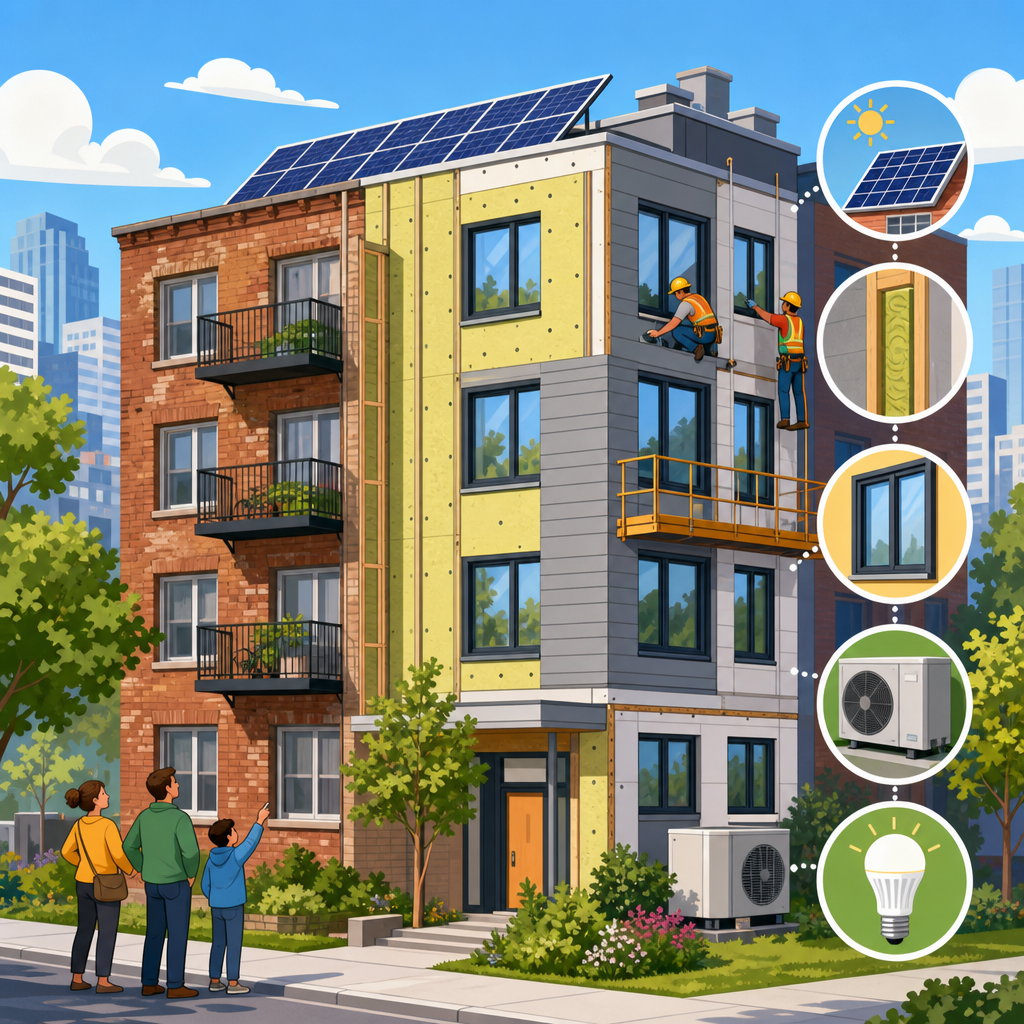
Deep energy retrofits of existing apartment buildings are comprehensive upgrades that cut energy use dramatically while improving comfort, durability, and health for residents. In practice, the term usually means reducing whole-building energy demand by 40 to 70 percent or more through coordinated improvements to the enclosure, mechanical systems, ventilation, controls, and sometimes on-site renewables. I have worked on retrofit planning for multifamily properties where utility costs, tenant complaints, and deferred maintenance were all symptoms of the same problem: buildings were leaking heat, moving moisture unpredictably, and relying on outdated equipment. A deep retrofit addresses those issues as one system rather than as isolated repairs.
Existing apartment buildings matter because they represent a large share of urban housing and a significant source of greenhouse gas emissions. In many cities, the majority of homes that will exist in 2050 are already standing today. That means climate goals, affordability goals, and public health goals depend heavily on upgrading what has already been built. Apartments also pose distinct challenges compared with single-family homes. They have shared walls, central plants or distributed equipment, split incentives between owners and tenants, complex occupancy patterns, and strict requirements for fire safety, access, and resident continuity during construction.
Key terms are worth defining at the start. The building envelope includes walls, roofs, windows, air barriers, and insulation layers that separate indoors from outdoors. Air sealing reduces uncontrolled leakage; insulation slows heat flow; thermal bridges are pathways, often through concrete or steel, that bypass insulation. Electrification means replacing fossil-fuel equipment such as gas boilers or domestic hot water heaters with electric systems, often heat pumps. Balanced ventilation provides measured outdoor air and exhaust, commonly with energy recovery ventilation. Commissioning is the process of verifying that systems are installed and operating as intended. Measurement and verification compare actual post-retrofit performance with pre-retrofit baselines.
For apartment owners and housing agencies, the value proposition goes beyond lower bills. Deep energy retrofits can stabilize operating expenses, reduce maintenance emergencies, improve resilience during extreme heat or cold, support compliance with building performance standards, and extend asset life. For residents, the benefits are tangible: fewer drafts, steadier temperatures, quieter interiors, better indoor air quality, and reduced exposure to combustion pollutants. Done poorly, however, retrofits can create moisture risk, ventilation imbalances, resident disruption, and financial strain. The core lesson from successful projects is simple: sequence matters, details matter, and whole-building thinking consistently outperforms piecemeal upgrades.
How Deep Energy Retrofits Work in Multifamily Buildings
A deep energy retrofit starts with understanding current performance. That usually means utility bill analysis, site investigation, blower door or guarded testing where feasible, infrared thermography, combustion safety review, and assessment of resident comfort complaints. In occupied apartment buildings, I look first for repeat patterns: top-floor overheating, perimeter winter drafts, basement humidity, and chronic domestic hot water losses. Those clues often reveal the biggest loads before modeling begins. Tools such as EnergyPlus, eQUEST, WUFI, and utility benchmarking platforms help quantify savings, but field evidence should guide assumptions.
The reason deep retrofits deliver more than isolated upgrades is interaction. Adding insulation without air sealing can leave stack effect and wind washing largely intact. Replacing a boiler without reducing envelope losses can oversize the new plant and lock in unnecessary capital cost. Installing tighter windows without providing designed ventilation can worsen indoor air quality. The best projects bundle measures so each one supports the next. Envelope upgrades lower peak loads, which enables smaller heat pumps or boilers. Better controls reduce simultaneous heating and cooling. Ventilation with heat recovery trims energy penalties while improving fresh-air delivery.
Project teams usually choose between phased and comprehensive implementation. A comprehensive retrofit captures synergies faster and often delivers better economics over the asset life, but it requires more capital and tighter coordination. A phased approach can align with roof replacement cycles, façade repairs, or unit turnover schedules. The risk is that early measures may constrain later ones, especially if equipment is replaced before envelope loads are reduced. For that reason, even phased programs need a long-term roadmap showing target energy use intensity, electrification strategy, ventilation approach, and trigger points for future capital work.
Envelope Upgrades: The Foundation of Energy Reduction
In most existing apartment buildings, the envelope is where comfort and efficiency begin. Poorly insulated roofs, uninsulated masonry walls, aging windows, and uncontrolled leakage drive heating and cooling demand while causing condensation and occupant complaints. Effective envelope retrofits focus on continuity: a continuous control layer for air, thermal resistance, water, and vapor appropriate to climate. Exterior insulation systems are often preferred for masonry or concrete buildings because they reduce thermal bridging and keep existing structure warmer, lowering condensation risk. Interior insulation can work where façades must be preserved, but it requires careful hygrothermal analysis and detailing around floors, partitions, and window returns.
Window strategy deserves particular care. Full replacement can improve air tightness, solar control, and condensation resistance, yet costs are high and installation quality is decisive. In some projects, especially in moderate climates or where historic character matters, high-performance inserts or targeted air sealing around existing frames can provide strong value. Roof upgrades are usually straightforward and often highly cost effective, particularly when reroofing is already planned. Basement and slab edge measures also matter because lower-level leakage can intensify stack effect through the whole building.
Thermal bridges are frequently underestimated in apartment retrofits. Concrete balconies, shelf angles, exposed slab edges, and steel lintels can undermine nominal insulation values. I have seen buildings with respectable cavity insulation still show cold stripe patterns at every floor line because slab edges were left untreated. Addressing these details may involve exterior insulation continuity, thermal break products in major façade replacements, or strategic interior treatments where exterior work is impossible. The exact solution depends on structure, façade condition, and budget, but ignoring bridges typically leaves comfort problems unresolved.
Mechanical Systems, Ventilation, and Electrification
Once envelope loads are reduced, mechanical design becomes more effective. Existing apartment buildings may use central steam, hydronic heating, packaged terminal units, ductless systems, or electric resistance heat. Deep retrofits do not require one universal solution, but they do require right-sized equipment and controls tailored to occupancy and building form. Air-source and water-source heat pumps are increasingly common because they can provide efficient heating and cooling with no on-site combustion. In colder climates, variable refrigerant flow systems, cold-climate mini-splits, and central heat pump plants have improved substantially, though defrost behavior, low-temperature capacity, and refrigerant management still require careful design.
Domestic hot water is often one of the largest energy uses in apartment buildings. Heat pump water heaters, central heat pump water heating, drain-water heat recovery, pipe insulation, recirculation control, and fixture flow reductions can produce major savings. Recirculation loops are a frequent hidden loss. If they run continuously through poorly insulated shafts and corridors, they become unintended heating systems in winter and cooling penalties in summer. Fixing those losses can yield fast returns and improve resident comfort.
Ventilation is essential in tighter buildings. ASHRAE 62.1 and 62.2 provide recognized frameworks, while local code determines application by building type and system. In multifamily retrofits, balanced ventilation with energy recovery often offers the best combination of indoor air quality and energy performance. Corridor pressurization alone is rarely enough to guarantee apartment-level fresh air distribution, especially in leaky or compartmentalized buildings. Kitchen and bathroom exhaust must be measured, maintained, and coordinated with supply air so that apartments do not experience chronic negative pressure, backdrafting risk, or excessive infiltration from neighboring units and shafts.
| Retrofit Component | Primary Benefit | Typical Risk if Poorly Executed | Good Practice |
|---|---|---|---|
| Exterior wall insulation | Lower heating and cooling loads | Moisture trapping at interfaces | Model dew point behavior and maintain continuous air barrier |
| Window replacement | Better comfort and airtightness | Water leakage at rough openings | Use tested flashing details and field quality checks |
| Heat pump conversion | Electrification and efficiency | Undersized capacity in peak weather | Reduce envelope loads first and verify design temperatures |
| Balanced ventilation | Improved indoor air quality | Noise and airflow imbalance | Commission airflow at each terminal and maintain filters |
| Controls upgrade | Lower waste and better monitoring | Resident confusion or overrides | Use simple sequences and train staff |
Economics, Resident Impacts, and Delivery Strategy
The economics of deep energy retrofits depend on more than simple payback. Owners should evaluate avoided capital replacement, reduced vacancy risk, lower maintenance, compliance exposure, insurance considerations, and potential rent or valuation effects where regulations allow. Incentives can materially improve feasibility. Common sources include utility efficiency programs, tax credits, green banks, weatherization funds, and local decarbonization grants. In affordable housing, layering these sources with preservation financing is often what makes comprehensive work possible. Life-cycle cost analysis is more useful than isolated equipment efficiency comparisons because the project is fundamentally about long-term building performance.
Resident experience can determine whether a technically sound project succeeds. Occupied retrofits require clear communication, scheduling discipline, and protections for vulnerable households. Work inside units affects privacy, routine, noise levels, and trust. I have found that multilingual notices, resident liaisons, temporary cooling plans, and visible punch-list follow-up do more for project outcomes than any brochure about sustainability. Health considerations are equally practical. Sealing combustion pathways, controlling dust, managing lead or asbestos hazards, and maintaining safe egress are nonnegotiable parts of delivery.
Procurement and quality control deserve executive attention. The best design can fail through substitution, sequencing errors, or weak commissioning. Owners should specify performance targets, mockups, submittal requirements, and testing protocols before construction starts. Airtightness testing, infrared scans, ventilation balancing reports, and functional performance testing for controls are not extras; they are how the team confirms that the savings case is real. Portfolio owners can go further by standardizing details, preferred equipment, and lessons learned across properties, which lowers transaction cost on future projects and improves repeatability.
Common Pitfalls and What Successful Projects Get Right
Several mistakes recur across apartment retrofit programs. One is treating tenant complaints as isolated maintenance issues rather than symptoms of enclosure and airflow defects. Another is replacing equipment at failure with like-for-like systems before evaluating whether envelope work could shrink loads. A third is underestimating operations capacity after installation. Advanced systems only perform well when staff can maintain filters, sensors, valves, controls, and monitoring dashboards. Successful projects avoid these traps by starting with diagnostics, setting measurable targets, and involving facilities staff from design through turnover.
Case studies show the pattern. New York multifamily towers have cut heating energy substantially through steam balancing, insulation, air sealing, and controls even before full electrification. European EnerPHit retrofits have demonstrated that exterior insulation, high-performance windows, and heat recovery ventilation can transform resident comfort while sharply reducing demand. In North American affordable housing, projects that combine envelope upgrades with domestic hot water improvements often outperform those focused on equipment replacement alone. The specifics vary by climate and building type, but the principle is stable: the building enclosure, ventilation strategy, and controls are the backbone of durable savings.
Deep energy retrofits of existing apartment buildings are one of the most practical ways to lower emissions, reduce operating costs, and improve urban housing at the same time. The strongest projects begin with a whole-building assessment, prioritize envelope continuity, right-size efficient mechanical systems, and protect resident well-being throughout construction. They acknowledge tradeoffs honestly, especially around cost, phasing, and moisture risk, then manage those tradeoffs with testing and commissioning. If you own, manage, finance, or design multifamily housing, the next step is straightforward: benchmark the building, investigate its weak points, and build a retrofit roadmap that turns maintenance cycles into long-term performance gains.
Frequently Asked Questions
What is a deep energy retrofit in an existing apartment building, and how is it different from a standard renovation?
A deep energy retrofit is a whole-building upgrade strategy designed to significantly reduce energy use while improving resident comfort, indoor air quality, durability, and long-term operating performance. In multifamily buildings, it typically means reducing total energy demand by roughly 40 to 70 percent or more through a coordinated package of improvements rather than isolated fixes. That package often includes air sealing, added insulation, window upgrades, heating and cooling system replacement, ventilation improvements, domestic hot water upgrades, lighting and control enhancements, and in some cases solar or other on-site renewable energy systems.
What makes it different from a standard renovation is the level of integration. A conventional renovation may replace aging equipment or refresh finishes as components fail, but it often does not address how the building enclosure, mechanical systems, and occupancy patterns interact. A deep energy retrofit looks at the building as a system. For example, tightening the enclosure without addressing ventilation can create indoor air quality problems, while installing high-efficiency equipment without reducing heating and cooling loads may leave savings on the table. The goal is not just to swap old products for newer ones, but to optimize performance across the entire property.
In apartment buildings, this whole-building approach is especially important because of split incentives, shared systems, varying tenant behavior, and the need to balance capital planning with resident disruption. A successful project begins with data, including utility analysis, existing conditions assessment, and often blower door, combustion safety, and ventilation testing. From there, owners can prioritize measures that produce measurable savings and support broader goals such as decarbonization, resilience, code compliance, and tenant retention.
Which upgrades usually deliver the biggest impact in a multifamily deep energy retrofit?
The highest-impact measures usually depend on the building’s age, construction type, climate, fuel mix, and existing equipment, but several categories consistently matter most. The building enclosure is often a major opportunity. Air leakage through roofs, walls, penetrations, shafts, and poorly performing windows can drive high heating and cooling loads, drafts, moisture problems, and uneven temperatures between units. Air sealing and insulation improvements are foundational because they reduce wasted energy and allow mechanical systems to operate more effectively. In many buildings, enclosure work also helps with noise reduction and comfort, which residents notice immediately.
Heating, cooling, and domestic hot water systems are another major area of savings. Older boilers, packaged terminal systems, electric resistance heat, and aging distribution infrastructure can consume far more energy than modern high-efficiency alternatives. Depending on the property, owners may consider condensing boilers, variable refrigerant flow systems, cold-climate heat pumps, centralized heat pump water heaters, improved pumping strategies, or controls that better match output to actual demand. Domestic hot water in apartment buildings can be a surprisingly large energy load, so recirculation optimization, pipe insulation, low-flow fixtures, and efficient water heating equipment often produce strong returns.
Ventilation should also be treated as a core upgrade, not an afterthought. Many existing apartment buildings suffer from under-ventilation, over-ventilation, or poorly balanced systems. A deep retrofit often includes properly designed mechanical ventilation with filtration and controls, which supports healthier indoor air and more predictable energy performance. Lighting, common area controls, submetering, and building automation can add meaningful savings as well, especially when paired with improved operations and maintenance. The biggest gains usually come from bundling measures so that one upgrade supports the next, rather than treating each category independently.
How do deep energy retrofits affect residents during and after construction?
Resident impact is one of the most important planning issues in an occupied apartment building retrofit. During construction, the level of disruption depends on the scope of work, whether the upgrades occur inside units, and how much work is focused on common areas or exterior assemblies. Window replacement, in-unit air sealing, ventilation upgrades, plumbing fixture changes, and terminal equipment replacement can require unit access, scheduling coordination, and clear communication with tenants. In affordable and workforce housing, this process has to be handled with particular care because access challenges, language differences, medical needs, and work schedules can all affect participation and project flow.
The best retrofit teams minimize disruption through phased work plans, advance notice, resident education, and consistent site management. Owners and contractors should explain what work is happening, why it matters, how long it will take, and what residents can expect in terms of noise, temporary outages, or access requirements. Simple communication tools such as multilingual notices, text reminders, resident hotlines, and onsite coordination staff can make a major difference. In some cases, temporary relocation may be needed for more invasive work, but many successful multifamily retrofits are completed in occupied buildings through careful sequencing and realistic expectations.
After construction, residents typically experience noticeable benefits. These often include more stable indoor temperatures, fewer drafts, lower noise levels, better humidity control, improved ventilation, and lower utility costs where tenants pay directly for energy. Health and comfort improvements can be significant, especially in buildings that previously had moisture issues, poor air sealing, or inadequate fresh air. That said, post-retrofit success also depends on resident understanding. New thermostats, ventilation controls, induction equipment, or heat pump systems may require orientation so residents know how to use them properly. The buildings that perform best are usually the ones where tenant communication continues after construction, not just before it.
Are deep energy retrofits financially worthwhile for apartment building owners?
In many cases, yes, but the financial case should be evaluated holistically rather than only through simple payback. Deep energy retrofits often involve larger upfront costs than incremental improvements, yet they can create value across multiple categories at once. Direct benefits may include lower utility expenses, reduced maintenance, avoided emergency replacements, fewer comfort complaints, lower vacancy risk, stronger compliance with energy policies, and improved asset competitiveness. For owners planning major capital work anyway, bundling energy measures into roof replacement, facade work, window replacement, or system modernization can make the economics much more attractive than tackling those improvements separately.
Another important factor is how costs and savings are distributed. In apartment buildings, utility structures vary widely. Sometimes the owner pays for central heating, cooling, ventilation, or common area electricity, while residents pay for in-unit electric loads or domestic hot water. That means retrofit planning should account for owner-paid and tenant-paid savings, rent restrictions, financing terms, reserve schedules, and possible non-energy benefits. In affordable housing, health, resilience, and preservation outcomes can be just as important as utility reduction. In market-rate properties, comfort and modernization may support rent stability, tenant retention, and long-term property value.
Owners should also look at available incentives, tax credits, utility rebates, low-interest financing, and local or state decarbonization programs. These can materially change project feasibility, especially for electrification, ventilation, and enclosure work. A professional energy model, capital needs assessment, and lifecycle cost analysis are usually worth the effort because they help identify the right scope, the best sequencing, and the most defensible business case. The strongest projects are rarely based on one measure with a dramatic payback; they are built around a strategic plan that aligns energy performance with capital planning, compliance, resident outcomes, and long-term ownership goals.
What are the biggest mistakes to avoid when planning a deep energy retrofit for an apartment building?
One of the most common mistakes is approaching the project as a collection of unrelated upgrades instead of a coordinated building-system strategy. Replacing equipment without addressing enclosure deficiencies can lead to oversized or poorly performing systems. Tightening the building without adding proper ventilation can create indoor air quality and moisture problems. Installing advanced controls without training operations staff can leave systems running inefficiently. Deep retrofits succeed when design teams understand how insulation, air sealing, ventilation, heating and cooling, hot water, and resident use patterns work together.
Another major mistake is underinvesting in investigation and verification. Existing apartment buildings often have hidden conditions, undocumented system modifications, deferred maintenance, and wide variation between units. Skipping diagnostic testing, field verification, utility benchmarking, and resident feedback can result in a design that looks strong on paper but misses the building’s actual drivers of energy waste and discomfort. It is also a mistake to overlook operations and maintenance. Even excellent retrofit measures can underperform if filters are not changed, controls are overridden, balancing is never completed, or staff are not trained on new systems.
Finally, many projects fall short because they do not fully account for resident experience, phasing, and long-term performance tracking. Communication failures can slow unit access and create unnecessary frustration. Poor sequencing can force rework or increase costs. And if there is no plan for post-occupancy commissioning, metering, or performance review, owners may never capture the savings they expected. The most effective retrofit projects set clear goals early, use experienced multifamily design and construction teams, coordinate resident engagement from the start, and include commissioning and follow-up after installation. That is what turns a major capital project into a durable, high-performing building improvement.