Daylighting strategies for deep-plan urban buildings determine whether dense city projects feel healthy, efficient, and usable or remain dependent on electric lighting for most of the day. A deep-plan building is one where occupied spaces sit far from exterior walls, often beyond the distance that conventional side windows can illuminate effectively. In practice, I see this condition in office floors carved from tight urban lots, adaptive reuse warehouses, podium-and-tower residential projects, schools on constrained sites, and mixed-use developments where retail, parking, structure, and service cores push habitable rooms inward. Daylighting means bringing and distributing natural light so interior spaces achieve useful illuminance, visual comfort, and reasonable energy performance without excessive glare or heat gain.
This topic matters because daylight affects far more than appearance. It shapes occupant well-being, circadian stimulus, wayfinding, leasing value, and compliance with green building goals. It also influences cooling loads, lighting controls, facade costs, and floorplate efficiency. In deep-plan urban buildings, the challenge is rarely just getting more glass onto the facade. Adjacent towers, narrow streets, historic context restrictions, zoning envelopes, and acoustic demands all limit what side-lighting alone can accomplish. Good design therefore relies on a coordinated set of daylighting strategies: massing decisions, section planning, atriums, borrowed light, roof apertures, high-performance glazing, interior reflectance, shading, and controls. The best results come when these moves are integrated early, tested quantitatively, and balanced against thermal, structural, and operational constraints.
Why Deep-Plan Buildings Are Difficult to Daylight
Most standard perimeter windows deliver effective daylight only a limited distance into a room. A practical rule used in early planning is that useful daylight penetration often reaches about 1.5 to 2.5 times the window head height, depending on glazing transmittance, exterior obstructions, ceiling height, and interior reflectance. In urban settings, that range often shrinks because neighboring buildings cut off sky view, the lower floors receive little direct sun, and code-driven floor-to-floor heights constrain tall glazing. Once the floorplate extends well beyond that perimeter zone, the center becomes reliant on electric light unless the section is altered.
Urban geometry compounds the problem. A canyon street can reduce visible sky angle so severely that north-facing facades may still be dim, while east and west facades face high glare risk during low-angle sun. Mechanical systems, elevators, stairs, and egress requirements also compete for the most useful central volume. In retrofit projects, existing structural grids and floor slabs limit new openings. I have found that teams who treat daylighting as a facade issue alone usually hit a wall late in design. Teams that study the building section, circulation, occupancy schedules, and reflective surfaces from the start usually unlock better options.
Start With Massing, Section, and Program Placement
The most effective daylighting strategy for deep-plan urban buildings begins before facade detailing. Massing and section decisions determine whether daylight can enter the building at all. If program and economics allow, break large floorplates into narrower bars, linked volumes, stepped terraces, or courtyards. Even a modest void can create new perimeter and significantly improve daylight autonomy in spaces that would otherwise be permanently dim. Courtyards are especially effective when width-to-height ratios preserve sky exposure; a very narrow shaft may ventilate but contribute little useful daylight below.
Program placement matters just as much. Put spaces with the highest daylight and view needs at the perimeter and near top-lit zones: workstations, classrooms, living rooms, collaboration areas, patient rooms, and regularly occupied amenity spaces. Move support spaces inward: storage, archives, toilets, IT rooms, copy areas, and some back-of-house functions. This sounds obvious, but in real projects lease planning, stacking diagrams, and core locations often drift in ways that bury primary uses in the dark center. Establish daylight priorities early so the architecture, MEP layout, and tenant planning reinforce each other instead of competing.
Sectional variety is often undervalued. Double-height spaces, split levels, interstitial openings, and partial mezzanines can transmit daylight deeper than a flat slab approach. A clerestory above an adjacent lower roof can outperform expensive facade changes on a shaded street wall. Likewise, reducing partition heights near perimeter zones can improve light sharing without sacrificing acoustic performance if glazing and absorptive finishes are specified carefully. Daylight performs in three dimensions, so successful deep-plan design always treats section as an active daylighting tool.
Atriums, Light Wells, and Courtyards
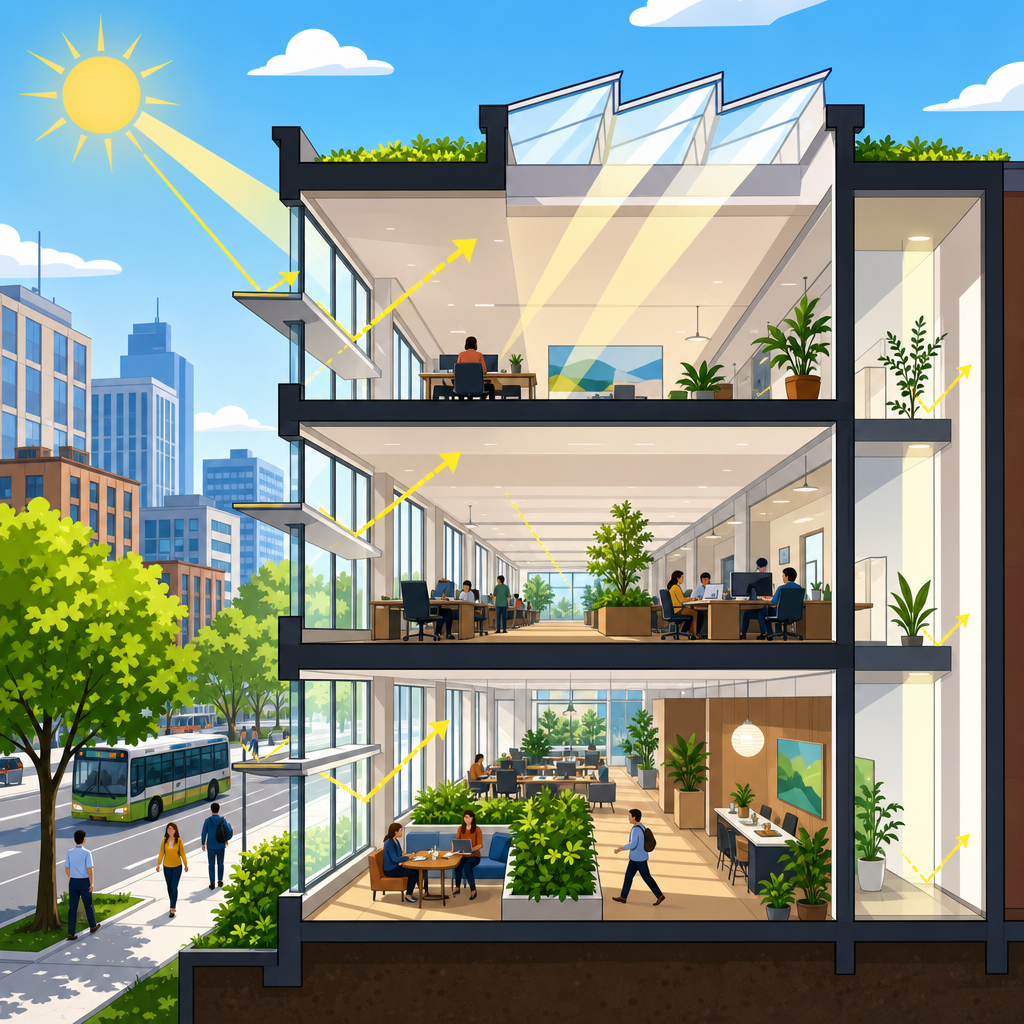
When side-lighting is insufficient, introducing voids into the plan is often the decisive move. Atriums, light wells, and courtyards create additional facade area and expose interior zones to a brighter portion of the sky. Their effectiveness depends on proportion, surface reflectance, orientation, and what occupies the edges. A generous atrium with high-reflectance walls, pale soffits, and visual connections to occupied floors can distribute light and improve orientation at the same time. A tall, narrow shaft lined with dark materials may satisfy a conceptual diagram but deliver disappointing illuminance levels.
For offices and mixed-use buildings, atriums frequently support circulation and social functions as well as daylighting. Bridges, open stairs, and shared amenities placed around them make the void earn its floor area. In residential work, courtyards can bring daylight and air to inner-facing units, though privacy and noise require careful detailing. Schools often benefit from top-lit commons that share borrowed light to adjacent classrooms through interior glazing. In healthcare, light wells can support waiting spaces and staff zones, though infection control, cleaning access, and glare at clinical tasks must be addressed.
There are tradeoffs. Voids reduce net usable area, complicate smoke control, affect structure, and can increase envelope surface area. They must therefore be sized with discipline and justified through performance. Useful metrics include spatial daylight autonomy, annual sunlight exposure, useful daylight illuminance, and view quality assessments. I recommend running early parametric studies to compare several void configurations rather than committing to one diagram too soon. Small changes in width, wall color, or roof aperture geometry can produce large shifts in daylight performance.
Top-Lighting: Skylights, Saws, Clerestories, and Roof Monitors
Top-lighting is the most direct way to reach the center of a deep-plan building, particularly on upper floors or low-rise podiums. Well-designed skylights, northlights, sawtooth roofs, clerestories, and roof monitors can deliver diffuse illumination over broad areas with less dependence on facade orientation. In warehouses converted to offices or studios, existing roof structure often provides opportunities for repetitive monitors that create an even luminous ceiling. In schools, linear clerestories can illuminate corridors and commons that would otherwise need continuous electric lighting.
The details determine success. Horizontal skylights can introduce excessive solar gain and glare if they are oversized or use poor glazing. Diffusing lenses, baffles, integral shades, and selective coatings help, but orientation remains critical. North-facing clerestories generally provide the most stable daylight in the northern hemisphere, while south-facing apertures need shading calibrated to sun angles. Roof monitors should be coordinated with waterproofing, maintenance access, snow or debris accumulation, and fire protection. In dense cities, roof rights, penthouse screening, and mechanical equipment often compete for the same zone, so top-lighting must be planned alongside rooftop program from the beginning.
| Strategy | Best Use | Main Advantage | Primary Risk |
|---|---|---|---|
| Atrium | Large office, mixed-use, civic buildings | Creates new perimeter and social space | Loss of net floor area and smoke-control complexity |
| Courtyard | Residential, schools, hospitality | Improves daylight and ventilation to inward rooms | Privacy, noise, and lower-floor shading |
| Clerestory | Upper floors, podium roofs, tall single-volume spaces | Stable diffuse light deep into plan | Waterproofing and glare if orientation is poor |
| Borrowed light | Offices, schools, adaptive reuse | Low-cost redistribution of existing daylight | Acoustic and privacy limitations |
Facade Design, Glazing, and Exterior Shading
Even in deep-plan buildings, the facade remains the first daylight filter. High visible transmittance glazing can increase daylight availability, but selecting glass by transmittance alone is a mistake. The right specification balances visible light transmittance, solar heat gain coefficient, U-value, color rendering, and bird-safe requirements. In many climates, a moderate-to-high visible transmittance paired with external shading and a thermally robust assembly performs better than dark glass used to suppress heat gain. Dark tinted facades often leave interiors dim and increase reliance on electric light, canceling part of the intended energy benefit.
Window geometry also matters. Higher window heads improve daylight penetration because they deliver light to the ceiling plane, which then reflects it deeper into the room. Light shelves can help under certain conditions by shading the lower view glass and redirecting light upward, but they are not universal solutions. In many contemporary urban buildings with low floor-to-floor heights and irregular sun angles from neighboring towers, exterior shelves gather dirt and underperform. Vertical fins, overhangs, perforated screens, and dynamic shading are often more reliable when tuned to orientation and context.
For west and east exposures, control of low-angle sun is essential. Automated blinds linked to solar sensors can protect occupants from glare, but if the blinds stay down all day, daylight performance collapses. The better approach is layered control: facade shading to reduce the solar peak, interior shades for occupant adjustment, and lighting controls that dim fixtures when daylight is available. The facade should be designed as part of a complete daylighting system, not as an isolated aesthetic surface.
Interior Distribution: Reflectance, Layout, and Borrowed Light
Once daylight enters a deep-plan urban building, the next task is distributing it effectively. Interior surface reflectance has a measurable impact. Ceilings with reflectance around 0.80 or higher, light-toned walls, and carefully chosen floor finishes increase interreflections and improve uniformity. Dark feature ceilings and heavily tinted partitions may look dramatic in renderings but often reduce useful daylight dramatically. In fit-outs, I routinely see tenants spend heavily on glass fronts and then undermine performance with charcoal ceilings, dense storage at the perimeter, or full-height opaque fronts on meeting rooms.
Borrowed light is one of the most practical strategies in constrained plans. Interior glazing, transoms, sidelites, partial-height partitions, and glazed doors can pass daylight from perimeter or atrium zones into adjacent rooms. This works especially well for enclosed offices, conference rooms, corridors, and support areas that do not require complete opacity. When privacy is needed, fritted glass, switchable films, patterned glazing, or layered blinds can preserve some transmission while limiting views. Acoustic detailing is essential; laminated glass, sealed frames, and absorptive finishes can maintain speech privacy better than many teams assume.
Furniture and fit-out planning should support daylight rather than block it. Keep tall storage away from windows, align circulation with brighter zones where possible, and place frequently occupied desks where views and balanced luminance are available. In schools and labs, orient teaching walls and work surfaces to reduce reflected glare. In residential units, open kitchens and living spaces near the facade usually daylight better than compartmentalized layouts. Interior planning decisions are often cheaper to adjust than facade or structural changes, so they offer significant value when budgets tighten.
Simulation, Metrics, and Post-Occupancy Proof
Deep-plan daylighting should be tested with climate-based simulation, not judged by intuition alone. Useful tools include Radiance-based workflows, ClimateStudio, Honeybee, Diva, IES VE, and manufacturer photometric data where relevant. Key metrics have different purposes. Spatial daylight autonomy estimates the percentage of floor area receiving a target illuminance for a defined portion of occupied hours. Annual sunlight exposure flags areas likely to receive too much direct sun, which correlates with glare and overheating risk. Useful daylight illuminance helps teams understand whether illuminance levels are often too low, useful, or excessive.
Simulation should be iterative and tied to decisions. Early studies can compare massing, courtyard width, facade orientation, and core placement. Mid-stage studies can refine glazing ratios, shading geometry, and interior reflectance. Late-stage analysis can tune blind control logic and electric lighting dimming zones. I advise teams to calibrate assumptions carefully: occupancy schedules, neighboring obstructions, sky conditions, furniture layouts, and material reflectances all change outcomes. A beautiful daylight model with unrealistic white surfaces and no surrounding buildings is not evidence.
Post-occupancy evaluation closes the loop. Light loggers, occupant surveys, blind-use monitoring, and energy data reveal whether the design is performing as intended. Some of the most instructive lessons come after handover. I have seen projects with excellent modeled autonomy fail because tenants added opaque branding films to glass fronts, and modest projects succeed because controls were commissioned properly and users understood how to operate shades. Measured feedback improves the next project and makes daylighting a repeatable practice instead of a one-off design aspiration.
Cost, Codes, and Integrated Delivery
Daylighting strategies for deep-plan urban buildings succeed when they are coordinated with cost planning, code compliance, and delivery realities. Building codes affect allowable openings, fire separations, smoke exhaust, and energy performance. Green building frameworks and local performance standards may reward daylight access, glare control, or reduced lighting power, but they do not eliminate the need for thermal comfort and maintainability. A skylight that leaks, a courtyard that creates privacy complaints, or a dynamic facade no one can service is not sustainable in practice.
From a cost perspective, the cheapest option upfront is not always the least expensive over the building life. Better daylight can reduce lighting energy, improve space quality, and support leasing or occupancy outcomes, but those benefits only materialize when controls are commissioned and spaces are planned around the available light. Early collaboration between architect, facade consultant, structural engineer, MEP designer, lighting designer, code consultant, and contractor is decisive. Integrated delivery reduces the common failure mode where one discipline adds a daylight feature and another quietly value-engineers away the elements that made it work.
The core lesson is simple: deep-plan urban buildings are not doomed to gloomy interiors, but they demand deliberate, evidence-based design. Start with massing and section, create additional perimeter where possible, use top-lighting strategically, specify facades for both daylight and heat control, and distribute light through reflective interiors and borrowed-light tactics. Then verify performance with simulation and post-occupancy measurement. If you are planning a sustainable urban project, treat daylight as an organizing principle from the first sketch, and the entire building will work better.
Frequently Asked Questions
What makes daylighting so difficult in deep-plan urban buildings?
Deep-plan urban buildings are challenging because a large share of occupied floor area sits too far from the facade to receive useful daylight from conventional windows alone. In shallow buildings, side lighting can often carry natural light deep enough to support work, circulation, and comfort for much of the day. In a deep-plan layout, however, daylight intensity drops off quickly as the distance from the perimeter increases, especially when floor plates are wide, ceiling heights are modest, and neighboring buildings limit access to direct sun and open sky. That means the center of the building can remain dim even when the exterior appears bright.
Urban conditions make the problem even more complex. Tight lot lines, zoning envelopes, adjacent towers, party walls, and historic reuse constraints can reduce facade exposure and block valuable daylight from multiple directions. In adaptive reuse warehouses or podium-and-tower projects, designers may also inherit structural grids, low floor-to-floor heights, and cores placed in ways that interrupt daylight penetration. As a result, success depends less on a single feature and more on a coordinated daylighting strategy that combines massing, section design, interior planning, glazing performance, reflectance, and lighting controls. The goal is not simply to bring in more light, but to deliver the right quality and distribution of daylight without causing glare, overheating, or excessive contrast.
What are the most effective daylighting strategies for bringing natural light deeper into the floor plate?
The most effective strategies usually start with reshaping how light moves through the building rather than relying only on larger perimeter windows. Designers often use atriums, light wells, courtyards, clerestories, sawtooth roof forms, monitors, skylights, and borrowed-light conditions to create additional daylight entry points beyond the exterior wall. In multi-story urban projects, even a modest internal court or vertical void can significantly improve daylight access by giving interior spaces a view to the sky and introducing light to circulation zones and shared amenities. Where roof access is available, top lighting can be especially powerful because it delivers more uniform illumination than vertical glazing and can reach spaces that side windows never could.
At the room and detail level, daylight can be pushed farther with high ceilings, light shelves, reflective finishes, glazed partitions, and carefully proportioned openings. Light shelves can bounce daylight upward onto the ceiling, helping distribute it deeper into the space while reducing brightness near the window. Interior glass can allow daylight to pass from perimeter zones into adjacent meeting rooms, corridors, or residential common areas, as long as privacy and acoustics are handled properly. Space planning is equally important: placing enclosed service areas, storage, restrooms, and cores in the darkest zones while reserving the best daylight access for occupied rooms is often one of the highest-value decisions in the project. In practice, the strongest results come from layering these moves so the building section, facade, and interior layout all work together.
How do architects balance daylight with glare, heat gain, and occupant comfort?
Good daylighting is not about maximizing sun exposure at all costs. In fact, uncontrolled daylight can create severe glare, overheating, washed-out computer screens, and visual fatigue, especially in offices, classrooms, and residential living areas with extended occupancy. The key is to prioritize diffuse, usable daylight and manage direct sun with orientation-sensitive design. South-facing facades may benefit from horizontal shading, while east- and west-facing facades often require more aggressive vertical fins, external screens, or selective glazing because low-angle sun is harder to control. North light is typically more even and desirable where available, though urban obstructions can still reduce its value.
Material and system choices matter just as much as geometry. High-performance glazing can limit solar heat gain while preserving visible light transmission, but specifications should be tuned carefully because glass that is too dark can undermine daylight quality. Interior surfaces with balanced reflectance help spread light without creating harsh contrast, and automated shades can respond to changing conditions throughout the day. Electric lighting controls should also be integrated from the start so daylight harvesting dims fixtures when natural light is sufficient, maintaining visual consistency while saving energy. The most successful projects treat occupant comfort as the benchmark: if a space is technically bright but causes squinting, overheating, or constant shade-down conditions, the daylighting strategy is not really performing well.
Can existing deep-plan buildings, such as warehouses or office conversions, be improved without major structural changes?
Yes, many existing deep-plan buildings can be improved substantially even when the structure, facade, and core locations are largely fixed. Adaptive reuse projects often begin with a daylight audit to identify where light is entering now, where it is being blocked, and which occupancies truly need the highest quality daylight. Sometimes relatively modest interventions make a meaningful difference, such as removing opaque interior partitions near windows, replacing dark finishes with lighter reflective surfaces, adding transoms or interior glazing, and relocating enclosed rooms away from the perimeter. In older warehouses, exposing higher ceilings and using the upper wall area more effectively can also improve daylight spread.
When budget and code conditions allow, larger interventions can transform usability. Selective floor plate carve-outs, new courtyards, roof monitors, skylights, or vertical shafts can bring daylight to the center of formerly dark plans. Even partial openings over stairs, lounges, or collaborative zones can create a daylight anchor that improves orientation and occupant experience. It is also important to combine physical upgrades with control strategies, including dimmable lighting, occupancy sensors, and zoned switching, so electric lighting responds intelligently to the improved daylight conditions. Not every building can achieve uniformly daylit interiors, but many can become far healthier and less energy-dependent with targeted, high-impact changes rather than complete reconstruction.
How should daylighting performance be evaluated during design for deep-plan urban projects?
Daylighting in deep-plan buildings should be evaluated early and repeatedly, because decisions about massing, core placement, floor depth, facade design, and section geometry have major consequences that are difficult to fix later. Useful assessment usually begins with climate-based daylight modeling rather than simple rule-of-thumb window sizing. Metrics such as spatial daylight autonomy, annual sunlight exposure, daylight factor, and useful daylight illuminance can help teams understand not just how much light enters the building, but where it reaches, how often it is available, and whether certain areas are overexposed. These studies are especially important in dense urban contexts where neighboring buildings can dramatically alter sky access and sunlight patterns.
Performance evaluation should also include a qualitative lens. Designers should review likely glare conditions, contrast ratios, views, shade behavior, and how occupants will actually use the space throughout the day. A floor plan that performs well in average illuminance terms may still feel uncomfortable if workstations face bright windows, if meeting rooms rely on borrowed light with little privacy, or if circulation zones become cave-like away from atriums. For that reason, daylight analysis works best when paired with interior layout studies, facade mockups, and electric lighting coordination. In a strong process, simulation informs design choices at every scale, helping the team create spaces that are not only energy efficient on paper, but genuinely healthy, practical, and appealing for the people who use them.