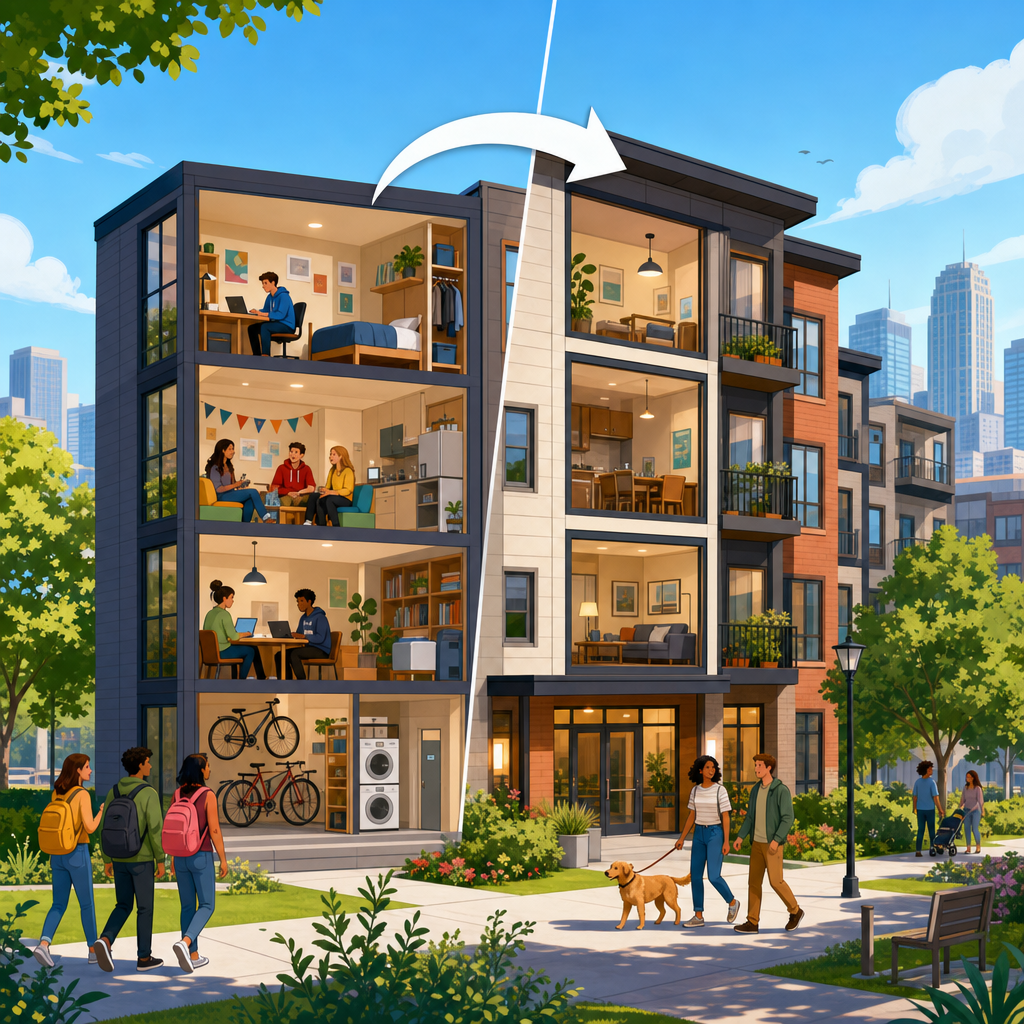
Designing student housing that can be converted to general multifamily later is a practical strategy for developers, universities, cities, and long-term owners facing shifting enrollment, volatile capital markets, and changing neighborhood demand. In simple terms, convertible student housing is a residential building planned from day one so it can operate efficiently as purpose-built student housing now and transition, with limited renovation, into conventional apartments later. That definition matters because traditional student housing often relies on leasing by the bed, oversized bedroom counts, furniture-heavy layouts, and amenity packages tied to campus life, while conventional multifamily depends on household-based leasing, balanced unit mix, durable finishes, and broader neighborhood appeal. I have worked on projects where an asset looked strong during underwriting as student housing but became far more valuable because the team had protected a clear exit into general rental apartments. That flexibility changes financing discussions, entitlement risk, design decisions, and asset management strategy. It also supports sustainable urban development by extending building life, reducing future demolition and waste, and allowing neighborhoods near campuses to adapt as populations evolve. A building that can absorb market change is usually a building that uses land, materials, infrastructure, and capital more responsibly. The core challenge is straightforward: student housing and multifamily share many physical components, but the differences in unit planning, life-safety assumptions, utilities, operations, and resident expectations can become expensive barriers if ignored early. The opportunity is equally clear: when teams design for both use cases at concept stage, they create resilient housing that can serve students today, working households tomorrow, and mixed urban communities over decades.
Start with market positioning and an exit thesis
The best convertible projects begin with a simple question: if this were not student housing in ten years, who would rent it and why? That answer drives nearly every design decision that follows. In practice, I start by mapping two demand pools at once. The first is the campus-driven renter base: undergraduate students, graduate students, international students, and faculty spillover. The second is the long-run multifamily base: young professionals, service workers, couples, downsizing households, and workforce renters priced out of newer luxury inventory. A site one block from campus may still convert well if it also has grocery access, transit, employment nodes, and a street network that feels livable after graduation demand softens.
Owners should define an exit thesis as clearly as they define an initial lease-up strategy. That means identifying target post-conversion rents, likely unit mix, amenity repositioning costs, and whether the future product is market-rate, workforce, or mixed-income housing. The thesis should be tested against local zoning, parking policy, inclusionary requirements, and fair housing obligations. A university-adjacent district with strong transit and healthcare employment may support studios and one-bedrooms later, while a neighborhood with schools and family demand may need larger two-bedroom units and better stroller storage. Without this future-state demand analysis, teams often overbuild four-bedroom student suites that are hard to lease conventionally and costly to reconfigure.
Plan unit layouts that work in both operating models
Unit planning is where convertibility succeeds or fails. The safest approach is to avoid highly specialized student layouts that depend on individual bedroom leases to make economic sense. Instead, use apartment geometries that can function as conventional households with minimal intervention. In many projects, that means favoring studios, one-bedrooms, and two-bedrooms, with a controlled number of three-bedroom units rather than a heavy concentration of four-bedroom configurations. Bedrooms should have dimensions and window placement that meet code, feel proportionate for nonstudent renters, and allow real furniture layouts beyond an extra-long twin bed and a desk.
Kitchens are another pivot point. Student housing sometimes minimizes kitchen size because residents rely on dining plans or shared eating habits. That is a mistake if future conversion is a goal. Full kitchens with adequate counter space, standard appliance clearances, pantry storage, and durable cabinet layouts increase immediate appeal and reduce future renovation scope. Bathrooms should also be planned carefully. The common student model of one bathroom per bedroom can inflate plumbing costs and produce inefficient unit plans for conventional renters. A better balance is shared baths in two-bedroom units and selective en-suite layouts only where they remain marketable later.
Furniture packages should never substitute for functional architecture. I have seen projects lease quickly with matching beds, chairs, and mounted televisions, yet struggle after graduation cycles changed because the underlying rooms were awkward and the living areas undersized. If the room works unfurnished, the building is far more future-proof.
Design building systems for operational flexibility
Mechanical, electrical, plumbing, and data systems should support both dense student occupancy and lower-turnover conventional multifamily operations. Central questions include utility metering, ventilation rates, hot water sizing, laundry strategy, acoustic separation, and internet infrastructure. Student properties often carry heavier simultaneous peak loads because many residents keep similar schedules. Designing systems to recognized standards, including current International Building Code requirements, local energy codes, ASHRAE guidance for ventilation, and accessibility obligations under the Fair Housing Act and ADA where applicable, gives owners a reliable baseline that remains defensible through conversion.
Separate or submetered utilities can be valuable, but the chosen approach should align with the future lease model. In student housing, internet is commonly bundled, and utilities may be capped or embedded in rent. Conventional multifamily may favor resident-paid electric and transparent billing. If meter banks, risers, and panel locations are planned early, the property can change billing structures later without invasive work. Acoustic performance deserves special attention. Student residents may tolerate more noise than conventional households, but post-conversion renters will not. Strong floor-ceiling assemblies, resilient channels, slab detailing, and compartmentalized corridors pay off twice: they improve current resident satisfaction and protect future rent levels.
| Design decision | Student housing priority | Future multifamily benefit |
|---|---|---|
| Balanced unit mix | Broader leasing pool beyond large friend groups | Higher compatibility with household-based rentals |
| Full kitchens | Improves resident experience and parent perception | Reduces renovation needs at conversion |
| Durable acoustic assemblies | Fewer complaints in high-density occupancy | Supports stronger long-term tenant retention |
| Utility metering flexibility | Supports bundled or capped billing models | Allows shift to resident-paid structures later |
| Right-sized amenities | Competitive today without overcommitting space | Easier repositioning into resident lounges or work areas |
Use durable materials and adaptable common areas
Finishes should be selected for abuse resistance, maintenance efficiency, and broad appeal rather than for a narrow student aesthetic that will date quickly. Luxury vinyl tile, quartz or solid-surface counters, robust door hardware, washable paint systems, and commercial-grade flooring in corridors usually outperform cheaper alternatives over the life of the asset. In student housing, heavy annual turn and furniture movement can destroy weak finishes. In multifamily, residents expect cleaner, quieter, and more refined spaces. Materials that withstand student wear while still reading as durable residential quality create a smoother transition.
Common areas need similar discipline. Large gaming rooms, tanning spaces, or oversized package-themed lounges may help during an arms race for student leasing, but they often become stranded square footage later. Flexible rooms are better investments. A study lounge can convert into coworking space. A reservable group room can become a resident meeting room, small fitness studio, or children’s play area depending on future demographic demand. Outdoor areas should support multiple use patterns, not just student socializing. Durable seating, shade, grilling, lighting, and clear sightlines make spaces useful for graduates, couples, families, and older renters as well.
Storage is an often overlooked differentiator. Conventional renters usually need more practical storage than students. Including bike rooms, secure lockers, linen storage, and usable closets makes a building more competitive immediately and much easier to reposition without cutting new space out of rentable area later.
Align codes, accessibility, and parking with future residents
Conversion problems often emerge not from architecture but from regulation. Teams should review local zoning and building code conditions as if the project were both student housing and standard multifamily at entitlement stage. Occupancy classifications, parking minimums, loading, bicycle requirements, trash handling, and open-space standards may differ. If the site only works financially because student parking is reduced, confirm whether future multifamily use can rely on the same transit-oriented relief or whether a variance would be needed. A hidden parking mismatch can erase years of value.
Accessibility should exceed the bare minimum where feasible. Wider clearances, adaptable bathrooms, reachable controls, step-free entries, and elevator capacity are not merely compliance issues; they expand the future renter pool and reduce retrofit cost. Families with strollers, aging renters, residents with temporary injuries, and service workers with irregular schedules all benefit from housing that is easier to navigate. In my experience, accessible planning also improves daily operations because maintenance teams, movers, and cleaners work more efficiently in buildings with rational circulation and durable thresholds.
Safety and security systems should be designed to feel residential rather than institutional. Controlled access, camera coverage in critical areas, layered entry points, and clear sightlines matter in both product types. The difference is tone. Student properties can rely too heavily on surveillance and checkpoint-style management. A building meant to convert later should feel secure but not overmanaged, because conventional renters value privacy and ease of use.
Match operations, branding, and financial modeling to adaptability
A convertible building is not only a design exercise; it is an operating model. Lease structures, staffing, furniture ownership, reserve planning, and lender reporting should all anticipate the possibility of transition. For example, if units are delivered furnished, owners should decide whether furniture is a depreciating operations asset that can be removed in phases or whether built-in elements lock the property into a student identity. Likewise, revenue should not depend too heavily on student-specific fees such as installment plans, guarantor programs, or premium roommate matching that disappear in conventional leasing.
Branding matters more than many teams expect. A building called something explicitly collegiate may perform well near campus now but require expensive repositioning later. Neutral naming, timeless signage, and neighborhood-centered marketing create more optionality. On the financial side, underwriters should model at least one realistic conversion scenario with rent assumptions, vacancy during renovation, capex for furniture removal, amenity refresh, and any unit reconfiguration. Sensitivity analysis should test enrollment dips, new competing supply, and changes in university housing policy. The point is not to predict perfectly. It is to avoid a business plan that only works in one narrow demand environment.
Sustainability also improves when adaptability is built into pro formas. Reusing an existing shell, preserving embodied carbon in structure, and avoiding major demolition can significantly reduce lifecycle impact compared with abandoning a rigid student product and building new apartments elsewhere. Adaptive resilience is not a marketing slogan; it is a measurable urban development advantage when matched with good design and disciplined ownership.
Designing student housing that can later become general multifamily is ultimately about protecting usefulness. The most successful projects do not try to guess every future trend. They make disciplined choices that remain valuable under different resident profiles, leasing structures, and market cycles. Start with a dual-market thesis. Build unit plans that function as real apartments, not just bed counts. Size kitchens, bathrooms, storage, and living areas for daily life beyond the campus years. Specify systems, acoustics, utility strategies, and finishes that support heavy current use while preserving long-term residential quality. Keep common areas flexible, entitlements broad, and accessibility strong. Then connect the physical design to operations, branding, and underwriting so the exit path is not theoretical.
This approach benefits more than owners. Cities gain housing stock that can adjust without costly redevelopment. Universities gain nearby residences that remain viable even if enrollment shifts. Residents gain better homes because adaptability usually produces more functional layouts, stronger materials, and more thoughtful amenities. From a sustainability perspective, the payoff is especially important: buildings that can evolve stay occupied longer, waste fewer materials, and make more responsible use of scarce urban land. In a market where both education demand and apartment demand can change quickly, optionality is not a luxury feature. It is a core development principle.
If you are planning a campus-adjacent project, evaluate every major decision through one question: will this still work as a conventional apartment building with minimal disruption? If the answer is yes, you are designing for durability, resilience, and long-term value. That is the standard worth following.
Frequently Asked Questions
What does it mean to design student housing so it can convert to general multifamily later?
Designing student housing for future conversion means planning a building from the start to serve two different rental models over its life cycle. In its initial phase, the property functions as purpose-built student housing, often with bedroom-oriented leasing, roommate-friendly layouts, durable finishes, and amenities that appeal to students. Later, if enrollment softens, market conditions change, or neighborhood demand shifts, the same building can transition into conventional multifamily apartments without requiring a full structural overhaul. The core idea is flexibility: developers and owners are not betting everything on one tenant type forever.
In practical terms, that flexibility shows up in the unit plans, building systems, circulation, and amenity strategy. A convertible property may use layouts that work for students today but can still feel natural for couples, individuals, roommates, or small families later. Kitchens, living rooms, bathrooms, storage, acoustics, and utility metering are typically designed with both audiences in mind. Rather than creating highly specialized student units that are difficult to repurpose, the project is organized so a future owner can rebrand, make limited interior updates, and operate it as standard apartments with less downtime and lower capital expense.
This approach is attractive because it reduces long-term risk. Universities can experience enrollment volatility. Investor appetite for student housing can change. Neighborhoods near campuses may become stronger conventional rental markets over time. By planning ahead, stakeholders create an asset with broader relevance and more exit options. Instead of asking whether a building is “student” or “multifamily,” the better question is whether it can perform well in both modes. That is the essence of convertible student housing.
Why are developers and long-term owners increasingly interested in convertible student housing?
The biggest reason is uncertainty. Student housing can be a strong asset class, but it depends on factors that owners do not fully control, including enrollment trends, international student flows, university housing policies, and changing preferences among students and parents. At the same time, capital markets can become more cautious about specialized property types. A building that can shift into general multifamily gives owners a form of built-in resilience. It creates a wider range of refinancing, disposition, and operational strategies if the original business plan needs to evolve.
There is also a location-driven reason. Many student housing sites sit in neighborhoods that are not solely dependent on the university. Over time, these areas may attract faculty, hospital workers, young professionals, service workers, downsizing households, or people seeking transit-oriented living. If the building was designed only for by-the-bed leasing and highly student-specific use patterns, it may struggle to compete for those renters. But if it was designed with future apartment functionality in mind, it can reposition much more smoothly and capture demand from a broader market.
Owners also value the ability to control future capital costs. A building that needs major plumbing rework, complete unit reconfiguration, or code-intensive changes at conversion can become prohibitively expensive to reposition. By contrast, a thoughtful upfront design can reduce those future expenses to more manageable items such as finish upgrades, furniture removal, amenity repurposing, branding changes, and leasing model adjustments. That can significantly improve lifecycle economics.
For cities and universities, the appeal is broader than investor flexibility. Convertible housing can help stabilize districts near campus by preventing large, obsolete student projects from becoming underperforming assets. It supports long-term neighborhood adaptability, which is especially valuable in places where housing shortages coexist with uncertain student demand. In short, convertible student housing is gaining attention because it aligns with a more pragmatic, long-view approach to development.
What design features make student housing easier to convert into conventional apartments?
The most important feature is the unit layout. If a floor plan feels overly engineered for student occupancy, conversion becomes much harder. The best convertible designs usually include bedrooms of reasonable size, a true common living area, functional kitchens, adequate storage, and bathroom configurations that work for non-student residents. Units should be able to support household-based leasing, not just individual bedroom leasing. That often means avoiding awkward circulation, undersized living rooms, or arrangements where every bedroom is essentially a mini-suite but the shared space is weak or nonexistent.
Kitchen design is especially important. Student properties sometimes minimize kitchens because residents eat on campus or rely on delivery, but general multifamily renters typically expect a more complete kitchen experience. A convertible building benefits from kitchens with sufficient counter space, cabinet storage, durable appliances, and a layout that feels integrated into everyday apartment living. Similarly, bathrooms should be planned carefully. While multiple bathrooms are attractive in student housing, they should still be configured so the unit remains practical and cost-effective as a conventional apartment.
Mechanical, electrical, and plumbing systems matter as much as aesthetics. Individual utility metering, accessible plumbing locations, and HVAC configurations that align with apartment operations can make conversion far easier. Sound control is another major consideration. Students may tolerate more noise than conventional renters, but long-term apartment residents often place a higher premium on acoustic privacy. Strong wall assemblies, floor-ceiling separation, and thoughtful corridor design can improve marketability in both phases.
Amenity planning should also avoid being too narrow. Study rooms, large gaming lounges, and student-specific social spaces can be useful initially, but spaces that can later function as coworking areas, fitness rooms, community lounges, package rooms, or flexible resident services areas are more valuable over time. Even furniture strategy matters. Built-in student-oriented furnishings may be efficient in the first phase, but they can create unnecessary removal costs later if they are too customized. The most successful projects balance immediate student appeal with long-term residential normalcy.
What are the biggest mistakes to avoid when planning a convertible student housing project?
A common mistake is treating conversion as a vague future possibility rather than a real design requirement. If the project team says a building is “convertible” but does not test floor plans, systems, leasing assumptions, and renovation scenarios early, the concept may not hold up in practice. True convertibility needs to be evaluated during programming and design development, not added as a marketing phrase after major decisions are already set. Without that discipline, owners may discover years later that the building can only convert at a cost far higher than expected.
Another major error is over-specializing the unit mix. Properties dominated by unusual bedroom counts, tiny common areas, or heavily furniture-dependent layouts may perform well for students but struggle in the broader apartment market. For example, units that maximize bed count at the expense of livability can create a poor fit for conventional renters. The same is true for buildings with insufficient storage, weak natural gathering spaces, or kitchens that feel like afterthoughts. If the apartment does not function well as a home beyond the student context, future repositioning becomes much more difficult.
Developers can also make the mistake of ignoring operations. Conversion is not only a design issue; it affects management, branding, maintenance, and revenue strategy. By-the-bed leasing, furnished units, bundled utilities, and student-focused staffing models differ meaningfully from conventional multifamily operations. A well-conceived project anticipates how those systems can change over time. If the building design makes that operational shift cumbersome, the owner may face friction even if the physical space is technically convertible.
Finally, some teams underestimate local regulatory and market realities. Zoning, parking standards, accessibility requirements, family-housing expectations, and competitive multifamily benchmarks all influence whether conversion will be successful. A building that works on paper may still underperform if it is out of step with what the local apartment market values. The smartest approach is to study both the student housing market and the conventional rental market from the beginning, then design to the overlap rather than to one extreme.
How should developers evaluate whether convertible student housing is the right strategy for a specific site or market?
It starts with a dual-market analysis. Developers should examine not only current student demand but also the long-term outlook for conventional renters in the same trade area. That means studying university enrollment trends, housing supply near campus, preleasing patterns, and student price sensitivity, while also looking at job growth, demographics, household formation, competing apartment product, and neighborhood momentum beyond the campus population. If the site has plausible long-term appeal to non-student renters, the case for conversion-ready design becomes much stronger.
Financial modeling is the next step. Owners should compare the cost of designing for flexibility against the potential value of future optionality. Some design choices may increase upfront cost modestly, but they can preserve asset value and reduce future renovation expense. The key question is not whether convertibility is free; it rarely is. The question is whether targeted investments today create a more durable, financeable, and adaptable property over time. In many cases, the answer is yes, especially when capital markets are cautious about single-purpose assets.
Teams should also run realistic conversion scenarios. What renovations would be needed in five years, ten years, or fifteen years? Could the building shift from furnished by-the-bed leasing to unfurnished household leasing with limited downtime? Would amenity spaces still make sense? Would unit layouts compete effectively with nearby apartments? By testing these questions early, developers can identify where a project is truly flexible and where it may still carry hidden constraints.
Ultimately, the right strategy depends on the site, the sponsor’s hold period, the strength of the university, and the surrounding neighborhood