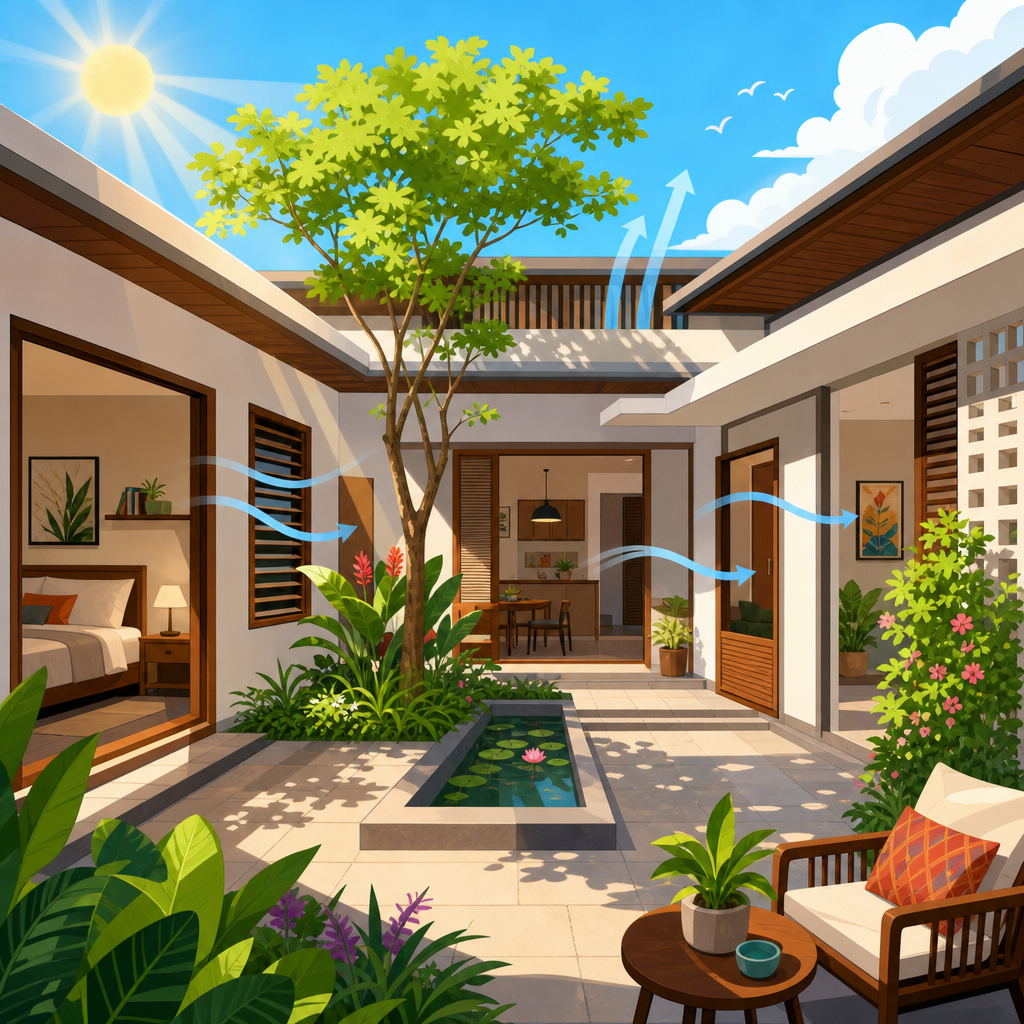
Courtyard housing design solves three problems that shape everyday comfort in dense neighborhoods: bringing daylight deep into rooms, moving fresh air through buildings, and protecting privacy without shutting residents off from outdoor space. In practice, a courtyard house is any dwelling or multi-unit residential building organized around an open-to-sky internal court. That void may sit at the center, along one side, or in a sequence of smaller courts, but its job is consistent: it becomes the environmental heart of the plan. I have worked on infill housing and retrofits where a well-sized courtyard reduced reliance on artificial lighting, improved cross-ventilation, and created quiet, sheltered outdoor living in sites that otherwise felt constrained.
The concept is ancient, but its relevance is increasing as cities get hotter, plots get tighter, and residents demand healthier homes. From riads in Morocco to siheyuan in China, patio houses in Spain, and contemporary apartment blocks in Singapore, designers have used courtyards to mediate climate and social life. The approach matters because it addresses passive performance before mechanical systems are added. A good courtyard can lower cooling loads, improve indoor air quality, and support biophilic design by introducing plants, shade, and sky views. It also creates a clear hierarchy between public frontage, semi-private circulation, and private domestic space, which is difficult to achieve in compact urban housing.
For sustainable urban development, courtyard housing design offers a practical middle ground between detached houses and sealed apartment slabs. It can increase density while preserving access to daylight and outdoor amenities. It can also support mixed household types, from single-family homes to co-housing clusters and perimeter-block apartments. The key terms are straightforward. Daylight refers to usable natural light, not just sun penetration. Ventilation means planned air movement, ideally driven by cross-breezes, stack effect, or both. Privacy includes visual, acoustic, and territorial privacy: who can see in, how sound travels, and how residents feel ownership over space. When these three goals are coordinated early, the courtyard stops being a decorative gesture and becomes a high-performing organizing device.
How courtyard form improves light, airflow, and thermal comfort
The environmental logic of courtyard housing begins with geometry. The width, height, and orientation of the court determine how much sky is visible, how long sunlight reaches the ground plane, and whether wind can pass through adjacent rooms. Designers often think in section first. If surrounding walls are too tall for the courtyard width, lower floors become gloomy and stagnant. If the court is too wide, the enclosure loses its microclimatic benefits and may feel exposed. On several urban projects, I have found that early massing studies using section cuts and sun-path diagrams reveal more than plan drawings alone. A courtyard is not simply empty space; it is a calibrated light well, air reservoir, and social room.
Daylight performance depends on orientation and surface reflectance as much as size. In hot climates, east and west exposure can introduce glare and heat gain, so designers often rely on shading devices, arcades, screens, or vegetation to soften low-angle sun. In temperate climates, opening the court to winter sun can significantly improve interior light levels. Light-colored walls increase reflected daylight into surrounding rooms, while deeply recessed windows need careful detailing to avoid dim interiors. Simulation tools such as Radiance, ClimateStudio, and Ladybug for Rhino help test daylight autonomy and useful daylight illuminance before construction. These metrics matter because a bright courtyard on paper may still fail to deliver balanced, usable light in bedrooms, kitchens, or circulation zones.
Ventilation works best when the courtyard is linked to room openings on at least two sides and connected to prevailing breezes. Cross-ventilation occurs when air enters from one side and exits another, carrying heat and pollutants out. Stack ventilation occurs when warm air rises and escapes through higher openings, drawing cooler air in below. Courtyards can support both. In warm humid regions, wider courts aligned with wind direction can improve air exchange rates. In hot arid regions, shaded courts with planting and water features can temper incoming air, though evaporative strategies must be used carefully where water is scarce. The courtyard microclimate can be several degrees cooler than exposed streets when shade, vegetation, and night flushing are integrated properly.
Proportion, orientation, and layout rules that make courtyard housing work
The most common design mistake is treating courtyard proportion as a stylistic preference. It is a performance decision. A narrow shaft may satisfy planning rules for open space yet fail to provide quality light or air. A broad empty court may produce visibility conflicts and overheating. As a starting point, designers often test height-to-width ratios in relation to latitude, desired daylight, and solar access. There is no single universal ratio, but the principle is fixed: the taller the enclosing walls, the wider the court generally needs to be to maintain sky exposure. Local regulations sometimes use daylight planes or minimum setbacks, but these are minimum safeguards, not design targets. Housing that feels generous usually exceeds minimums in at least one dimension.
Orientation shapes how residents use the court through the day. South-facing courtyards in the northern hemisphere capture winter sun, while north-facing rooms can receive softer, consistent daylight. Where summer overheating is a concern, deciduous trees, pergolas, operable shading, and balcony overhangs can preserve comfort without sacrificing light. Layout also matters. A single central courtyard suits introverted plans and strong privacy control. Side courtyards can pull air and light into narrow urban plots. Multiple smaller courts can separate functions, such as placing a service court near kitchens and utilities while reserving a planted family court for living spaces. In multi-unit housing, semi-private shared courtyards often work best when clearly overlooked by entrances but buffered from living room windows by thresholds or planting.
Successful layouts establish gradients. Public edges face the street, semi-private circulation lines the courtyard, and the most private rooms step back, lift up, or use screened openings. This sequencing reduces the classic problem of direct sightlines from one dwelling into another. In a recent block study, shifting upper-level windows by even half a bay and adding perforated masonry screens preserved airflow while eliminating direct eye-level views. That kind of adjustment seems minor, but it determines whether residents keep blinds open or closed. If occupants feel exposed, the environmental strategy collapses because they block windows and cut off ventilation. Good courtyard housing design therefore depends as much on behavioral realism as on formal composition.
Privacy strategies in dense urban sites
Privacy is often misunderstood as isolation. In housing, the goal is selective openness: residents should enjoy daylight, air, and outdoor connection without constant visual intrusion. Courtyard housing is especially effective because it turns openings inward toward controlled space rather than outward toward traffic or neighboring buildings. Still, inward-facing windows can create their own issues if opposite façades are too close. The best solutions layer distance, level changes, screens, planting, and program placement. Bedrooms generally need more protection than kitchens, stair halls, or circulation galleries. Bathrooms and service spaces can act as buffers on exposed edges, while living areas open to the more protected sides of the court.
Material choices are central to privacy without sacrificing environmental performance. Perforated brick, terracotta jaali, timber battens, expanded metal mesh, and operable louvers allow air passage while filtering views and sun. These are not decorative afterthoughts. They are environmental control devices. In hot climates, fixed external screens often outperform internal blinds because they stop solar radiation before it enters the glazing cavity. Acoustic privacy also deserves attention. Hard courtyard surfaces can reflect voices and domestic noise, making shared courts uncomfortable. Planting beds, textured walls, absorbent soffits, and careful placement of play areas can reduce reverberation. Privacy is therefore visual and acoustic, and both affect whether a courtyard feels restorative or stressful.
| Design issue | Common risk | Effective courtyard response | Example application |
|---|---|---|---|
| Overlooking | Direct views between facing rooms | Offset windows, add screens, increase planting depth | Upper-floor bedrooms screened with perforated brick |
| Poor daylight | Lower levels remain dim | Widen court, brighten wall finishes, reduce overhang depth | Light-toned stucco court in a four-story infill block |
| Weak ventilation | Air stagnates in single-aspect rooms | Create opposite openings and high-level exhaust paths | Operable clerestories paired with courtyard doors |
| Summer overheating | Exposed paving stores heat | Add trees, shade structures, permeable surfaces | Shared court with deciduous canopy and cool paving |
Dense sites also require careful boundary design. If neighboring buildings rise close to the lot line, side-facing windows may need high sills, clerestories, or angled reveals. Where codes allow, parapets and roof terraces can extend usable outdoor space without compromising lower-level privacy. Entry transitions matter too. A gate, vestibule, or covered passage can transform a court from exposed void to secure communal room. I have seen modest projects gain enormous livability simply by designing this threshold well. Residents used the court more often, left windows open longer, and reported feeling safer because access and visibility were legible. Privacy is strongest when it is spatially embedded, not dependent on residents constantly adjusting blinds and curtains.
Landscape, materials, and water management as performance tools
Landscape design determines whether a courtyard merely looks pleasant or actually improves environmental performance. Trees provide shade, reduce mean radiant temperature, and create seasonal variation. Shrubs and climbing plants soften edges and can filter dust from nearby streets. Permeable paving reduces runoff and allows some evaporative cooling after rain. In warm climates, a planted court can noticeably lower surface temperatures compared with dark, hard paving. Species selection matters. Deciduous trees support solar access in winter and shade in summer; evergreen hedges provide year-round screening but can block air movement if packed too densely. Root space, irrigation strategy, and maintenance capacity should be resolved early rather than left to value engineering.
Material specification should support durability and comfort. Light-toned masonry, lime plaster, and textured mineral finishes can bounce daylight while remaining robust in exterior conditions. Timber adds warmth but needs detailing for weathering and fire compliance, especially in multi-family projects. Thermal mass can be helpful where nights cool down, allowing walls and floors to absorb daytime heat and release it later. In climates with warm nights, however, exposed mass without night ventilation can worsen discomfort. Water management is equally important. Courtyards collect rain, so drainage slopes, slot drains, and overflow routes must be integrated cleanly. Bioswales, rain gardens, and cistern-fed irrigation can turn the court into part of a broader stormwater strategy rather than a maintenance liability.
These decisions influence resident behavior more than many teams expect. A shaded bench under a tree will be used; a reflective paved void usually will not. A drain that clogs after one storm can turn residents against an otherwise strong design. On built projects, post-occupancy reviews consistently show that small practical details decide long-term success: hose bibs for planting care, durable seating edges, night lighting that avoids glare into bedrooms, and storage for communal furniture or bicycles. Courtyard housing performs best when architecture, landscape, and building services are coordinated as one system. That systems thinking is what makes the model resilient in real urban conditions.
Applying courtyard housing design to contemporary urban development
Today’s strongest courtyard housing projects adapt the model to modern constraints instead of copying historical forms literally. In narrow infill sites, small courts, light wells, and open-air circulation can recover daylight that would otherwise be lost in deep plans. In perimeter-block developments, a shared inner court can provide communal green space while protecting residents from traffic noise and pollution. In affordable housing, courtyards can reduce common corridor lengths, improve passive surveillance, and create dignified shared space without expensive amenities. The model also works at multiple scales: row-house clusters, senior housing, student residences, co-housing communities, and mixed-use blocks can all use courtyard logic to organize space around climate and privacy.
Digital tools and policy frameworks now make courtyard design easier to justify. Early-stage computational studies can compare solar access, wind flow, daylight factors, and overheating risk across massing options. Standards such as LEED, BREEAM, WELL, and local passive design guidelines reward many of the outcomes courtyards support, including daylight access, natural ventilation, thermal comfort, and connection to nature. Yet tradeoffs remain. Courtyards can reduce net developable floor area if pushed too large, and poor detailing can create maintenance burdens. Fire access, smoke control, and accessibility also need careful integration. The answer is not to abandon the typology, but to design it with technical rigor from the first concept sketch through occupancy.
For planners, developers, and architects, the main lesson is simple: courtyard housing design is not nostalgia. It is a repeatable urban strategy for healthier, lower-energy homes with better privacy. Start with climate and section, not façade styling. Size the court for sky access and airflow. Layer privacy through layout, screening, and planting. Use materials and landscape as performance tools. Then test the design with simulation and resident use scenarios before fixing the plan. When those steps are followed, courtyards produce housing that feels brighter, cooler, quieter, and more humane even on demanding urban sites. If you are shaping a sustainable urban development pipeline, make courtyard housing a core typology and evaluate every site for where it can work.
Frequently Asked Questions
What is courtyard housing, and why is it so effective for light, ventilation, and privacy?
Courtyard housing is a residential design approach that organizes rooms around an open-to-sky outdoor space, whether that space is a single central court, a side court, or a series of smaller courts. Its effectiveness comes from the fact that the courtyard acts as a controlled environmental core for the home or building. Instead of relying only on exterior street-facing walls for daylight and airflow, the design creates an internal edge where windows, doors, and living spaces can open toward protected open air. This helps bring natural light deeper into the floor plan, supports cross-ventilation, and gives residents access to outdoor space without exposing everyday life directly to the street or neighboring properties.
In dense neighborhoods, that combination is especially valuable. Conventional layouts often force a tradeoff: large openings improve daylight and air but reduce privacy, while more enclosed facades protect privacy but make interiors darker and stuffier. Courtyard housing reduces that tension by redirecting openness inward. Bedrooms, living rooms, kitchens, corridors, and shared circulation can all benefit from daylight and breezes from the court while remaining screened from direct outside views. When designed well, the courtyard becomes more than a void in the middle of a plan. It works as a microclimate moderator, a visual focus, a social space, and a buffer between public and private life. That is why courtyard housing remains one of the most durable and adaptable residential strategies across climates, cultures, and urban conditions.
How does a courtyard improve natural daylight in a house or multi-unit building?
A courtyard improves daylight by increasing the number of building surfaces that can receive and distribute natural light. In a standard deep-plan building, many rooms sit far from exterior walls, which means daylight falls off quickly as you move inward. By carving out an open court, designers create a second or even third source of daylight within the plan. Rooms can borrow light from both the outside perimeter and the inner courtyard edge, which dramatically improves brightness, reduces dependence on artificial lighting during the day, and makes interior spaces feel more open and livable.
The geometry of the courtyard matters a great deal. Width, height, orientation, wall reflectance, and opening size all influence how light behaves. A courtyard that is too narrow relative to surrounding building height may admit only limited sky exposure, especially at lower levels. A well-proportioned court, by contrast, allows sunlight to penetrate and also reflects diffuse daylight onto surrounding walls and into adjacent rooms. Light-colored surfaces, carefully placed glazing, clerestories, and shaded transitions can help distribute light more evenly and reduce glare. In hot climates, the goal is often filtered or indirect daylight rather than harsh direct sun, while in cooler or cloudier regions designers may aim to maximize solar access. In both cases, the courtyard allows daylight strategy to be intentional rather than incidental, which is one reason it is so powerful in residential design.
How does courtyard housing support better natural ventilation?
Courtyard housing supports natural ventilation by creating pressure differences and airflow paths that are difficult to achieve in more sealed or single-aspect layouts. When rooms open to both an exterior face and a courtyard, air can move across the building through operable windows, doors, louvers, or high and low vents. This cross-ventilation helps remove heat, humidity, odors, and indoor pollutants while bringing in fresh air. Even in cases where full cross-ventilation is not possible, a courtyard can still improve air movement by acting as a thermal chimney or pressure-moderating void, especially when combined with stack ventilation principles.
As the air in the courtyard warms, it can rise and pull cooler air through lower openings, encouraging passive airflow through adjacent rooms. Planting, water features, shaded paving, and controlled solar exposure can also influence the courtyard microclimate, making incoming air more comfortable. The exact result depends on local wind patterns, temperature swings, building height, and how openings are detailed. For example, aligning windows with prevailing breezes can increase airflow, while using screened openings and adjustable shading devices can maintain comfort and security at the same time. In multi-unit housing, courtyards can also improve ventilation to corridors, shared circulation zones, and apartments that would otherwise be limited to one side for openings. The key is that the courtyard gives ventilation a destination and a route, rather than leaving fresh air to depend on chance infiltration.
Can courtyard housing really provide privacy in dense urban areas?
Yes, and that is one of its biggest advantages. Courtyard housing provides privacy by shifting the home’s primary outlook away from the public edge and toward a more controlled internal outdoor space. Instead of exposing large windows, patios, and daily activities directly to the street or neighboring buildings, the design places many of those openings around the courtyard. This inward orientation allows residents to enjoy daylight, ventilation, and outdoor access while limiting unwanted views from passersby or adjacent properties. It creates a sense of refuge without requiring the building to become completely closed off.
Privacy in courtyard design is not automatic, however. It depends on careful planning of sightlines, window heights, balcony placement, circulation routes, and landscape screening. In single-family homes, this might mean arranging living areas to open generously to the court while keeping perimeter walls more solid. In multi-unit projects, it may involve offset windows, recessed entrances, planted buffers, perforated screens, and layered thresholds between shared and private areas. The best courtyard housing balances visual connection and separation. Residents can look into greenery, sky, and semi-private outdoor rooms rather than directly into someone else’s windows. That balance is especially important in compact sites where lot lines are tight and neighboring buildings are close. A well-designed courtyard offers privacy not by denying openness, but by shaping where openness occurs and how it is experienced.
What are the most important design considerations for a successful courtyard house?
The most important design considerations include courtyard proportion, orientation, climate response, circulation, privacy control, and the relationship between indoor and outdoor uses. Proportion is foundational because it determines how much sky is visible, how daylight reaches lower floors, and whether the space feels airy or confined. Orientation affects solar gain, shading needs, and seasonal comfort. In hot climates, designers often prioritize shade, evapotranspiration, and protected breezes, while in cooler climates they may seek greater winter sun exposure. Circulation also matters because the courtyard should not function only as a visual amenity; it should help organize movement, improve wayfinding, and support everyday use.
Equally important is the layering between public, shared, and private zones. A courtyard can be the social heart of a home, a quiet garden retreat, a children’s play area, a shared space for residents, or a combination of these, but its role should be clear in the plan. Material selection, drainage, planting, acoustics, and maintenance must also be considered early. Hard surfaces can amplify heat and sound, while thoughtful landscape design can cool the air, soften views, and improve comfort. Openings should be placed to capture light and airflow without creating overlook problems. Finally, the courtyard should be designed as an environmental system, not just an aesthetic feature. When integrated with shading devices, operable windows, thermal mass, vegetation, and passive cooling strategies, it becomes a high-performing space that improves comfort, reduces energy demand, and makes dense living feel healthier and more humane.