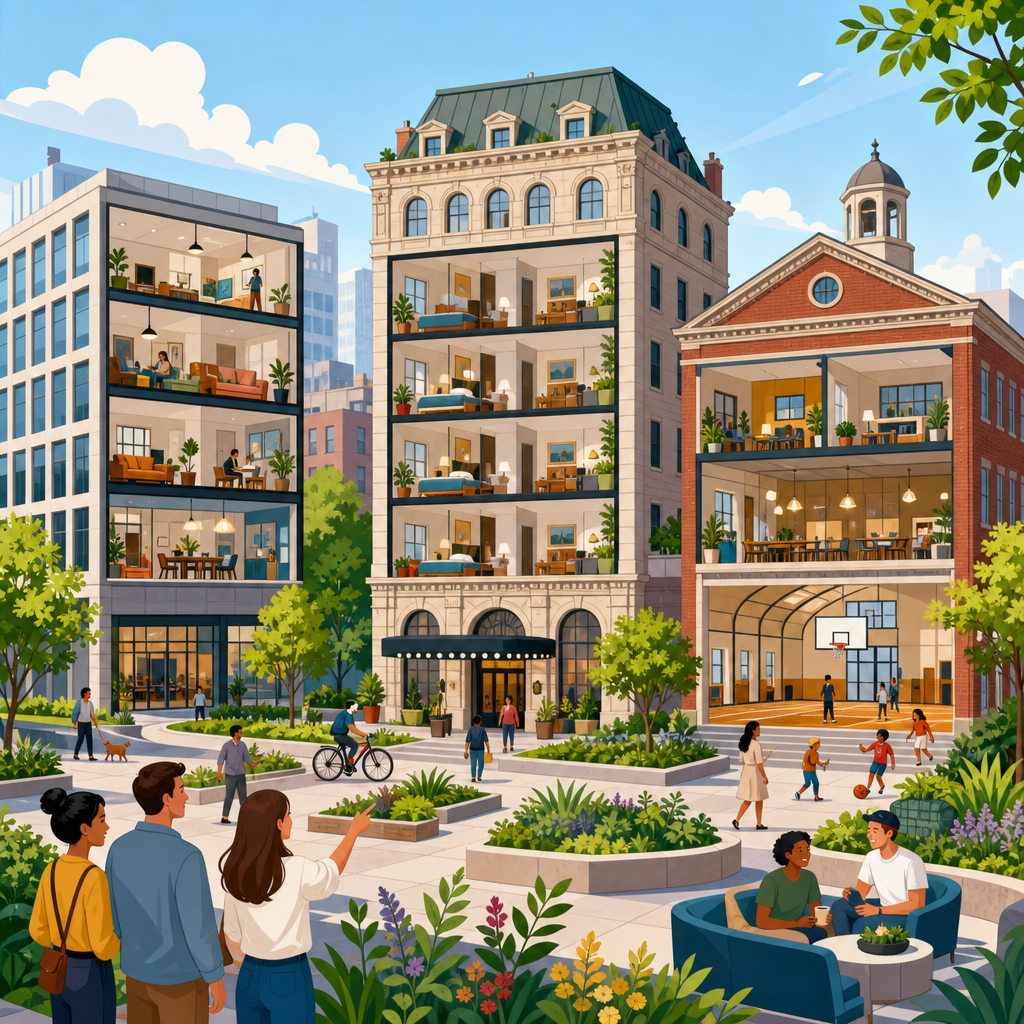
Adaptive reuse for housing turns underused buildings into homes, preserving embodied carbon while adding supply in places where new construction is slow, expensive, or politically constrained. In practice, it means converting offices, hotels, schools, mills, warehouses, and civic buildings into apartments, condominiums, co-living suites, or supportive housing. I have worked on feasibility reviews for these projects, and the same lesson appears every time: reuse is not a sentimental alternative to development. It is a technical housing strategy shaped by floor plate depth, structural grids, window spacing, code pathways, financing, and neighborhood demand. When those variables align, conversions can deliver homes faster than ground-up construction, retain historic character, and support walkable districts.
The topic matters because cities are managing several pressures at once. Downtown office vacancies remain elevated in many North American and European markets, while housing shortages push rents upward and force longer commutes. Demolition and new construction also carry significant carbon impacts from concrete, steel, and transport. Reusing an existing shell can avoid a substantial share of those emissions, especially when foundations and structure remain in service. Yet not every building converts well. Deep office towers may struggle to provide daylight to bedrooms. Older schools can offer beautiful corridors and tall windows but require major work on accessibility, acoustics, and mechanical systems. Hotels often convert efficiently because their room modules already resemble studios, though unit mix and family housing can be harder to achieve. Good adaptive reuse for housing starts with rigorous design judgment, not wishful thinking.
This article examines design lessons from office, hotel, and school conversions, because those three building types reveal the core opportunities and constraints of reuse. Offices teach hard truths about daylight, cores, and plumbing distribution. Hotels show how existing room layouts can lower risk while imposing limits on unit size and amenity planning. Schools demonstrate the value of durable construction, generous ceiling heights, and community identity, but also the complexity of retrofitting institutions for modern residential codes. Across all three, the goal is the same: produce safe, comfortable homes that feel intentional rather than improvised. The best projects do more than insert kitchens into old rooms. They solve privacy, storage, acoustics, accessibility, energy performance, and shared space in ways that make residents want to stay.
Office-to-housing conversions: when the floor plate decides the project
Office-to-residential conversion gets the most attention because office vacancy is visible and politically urgent. The design test is usually simple to state and difficult to solve: can enough habitable rooms sit close enough to windows to meet code and market expectations? Residential units need daylight, natural ventilation in some jurisdictions, privacy, and a comfortable depth from glass line to corridor. Many successful office conversions come from prewar or midcentury buildings with narrow floor plates, operable windows, and repetitive structural bays. Lower Manhattan offers clear examples, where older financial district towers became apartments because their plates were comparatively slim and their facades allowed regular window placement. By contrast, large post-1980 office buildings often have deep plates designed for open-plan workstations around a central core. That geometry can leave a dark center zone too large for corridors, storage, or amenities alone.
When I review office buildings for housing potential, I look first at plate depth, core location, slab-to-slab height, and facade rhythm. Plate depths around 40 to 60 feet from window wall to corridor generally work better than plates exceeding 80 feet, though local codes and unit plans vary. Central cores can simplify egress but complicate plumbing runs if bathrooms and kitchens cannot stack efficiently. Residential layouts reward repetition: vertically aligned wet walls, predictable shafts, and unit mixes that fit the structural grid. Curtain wall offices are another challenge. Full replacement may be necessary to meet thermal performance, acoustics, and operability goals, and facade replacement can erase the cost advantage of reuse. Projects succeed when teams decide early whether they are preserving a shell, recladding a frame, or selectively carving light wells and terraces into the massing.
Several tactics repeatedly improve office conversions. Carving courtyards into deep buildings brings light to interior-facing units and creates amenity space, though it reduces net rentable area. Using the building perimeter for studios and one-bedrooms while placing duplex lofts or maisonette-style units near corners can make irregular geometry productive. Converting obsolete mechanical floors into lounges, laundry rooms, co-working areas, or fitness spaces helps absorb nonresidential zones. Designers also need to confront acoustics early. Office slabs and facades were rarely detailed for residential privacy, so impact isolation, resilient channels, upgraded glazing, and careful shaft lining are essential. The resident experience depends on these invisible choices as much as on historic brick or skyline views. A beautiful conversion that transmits elevator noise, plumbing vibration, and street rumble will underperform quickly in leasing and long-term satisfaction.
Hotel-to-housing conversions: the fastest path is not always the best product
Hotels are often the most straightforward buildings to convert into housing because the bones already support private rooms, attached bathrooms, vertical plumbing stacks, and life-safety systems suited to overnight occupancy. During feasibility studies, hotels usually score well on unit yield and speed to market. Limited-service hotels, extended-stay properties, and older downtown hotels can become micro-units, studios, senior housing, student housing, or supportive housing with relatively modest structural intervention. The reason is modularity. Room widths, corridor arrangements, and shaft locations already align with residential patterns. In cities facing urgent shelter and affordable housing needs, that efficiency matters. Projects in California, New York, and Washington have used hotel conversions to move people into stable units faster than new construction timelines would allow.
Yet the same features that make hotels attractive can constrain housing quality. Standard hotel rooms are small, and combining two rooms to create family-sized apartments reduces yield and complicates structure and services. Existing windows may be narrower than residents want, and room layouts designed for short stays often lack adequate storage, cooking space, and laundry provisions. Mechanical systems are another fork in the road. Packaged terminal air conditioners can be retained for budget reasons, but they are noisy, less efficient, and often inconsistent with long-term residential expectations. Corridors in hotels may also feel monotonous and institutional. Good residential design softens that with better lighting, entry niches, communal rooms, and clear wayfinding. The goal is to avoid producing permanent housing that still operates psychologically like transient lodging.
The strongest hotel conversions start by deciding who will live there and for how long. If the target residents are single adults needing furnished studios, existing room modules may work almost as-is. If the project aims to serve couples, families, or aging residents, designers must rethink unit mix, accessibility, and amenity support. Community kitchens, storage rooms, stroller parking, package areas, and shared laundry become more important than banquet rooms or business centers. Ground floors deserve special attention. Former lobbies can transform into social spaces, clinics, leasing offices, or neighborhood-serving retail, making the building feel anchored in the street rather than detached from it. I have seen the biggest improvements come from seemingly modest moves: replacing dark carpeted corridors with durable, naturally lit circulation; adding real kitchen ventilation; and designing built-in storage that lets a compact unit function like a home instead of a guest room.
School-to-housing conversions: character, community, and complexity
Schools are among the most appealing and most misunderstood candidates for adaptive reuse for housing. They typically offer robust construction, large windows, generous ceiling heights, durable masonry, and a strong neighborhood identity. Former classrooms can become distinctive loft-style units, and assembly spaces such as gyms, auditoriums, and libraries can support shared amenities or be adapted into larger homes. In older neighborhoods, school buildings often sit on substantial sites with mature trees, play yards, and walkable access to transit and shops. Those assets can create housing with a level of place attachment that new mid-rise construction rarely matches. Residents often value the history embedded in chalkboards, terrazzo corridors, and brick facades, provided those elements are integrated thoughtfully rather than treated as museum pieces.
However, school conversions come with difficult technical and regulatory questions. Corridor-loaded plans may seem housing-ready, but classroom dimensions and door locations do not automatically produce efficient unit layouts. Accessibility upgrades can be extensive, especially in buildings with split levels, narrow toilet rooms, and limited elevator capacity. Acoustics are frequently overlooked. Thick walls help between rooms, but long corridors, hard surfaces, and former gym structures can create reverberation problems unless carefully treated. Mechanical distribution can also be costly because schools were built for daytime institutional use, not twenty-four-hour residential occupancy with individual kitchens and bathrooms. Environmental remediation may be necessary for asbestos, lead paint, or outdated fireproofing. Historic preservation rules can further shape what windows, stairs, or facades may be altered, adding both discipline and complexity to the design process.
The best school conversions embrace the building’s civic DNA instead of fighting it. Wide corridors can become gallery-like social spines with daylight, seating, and resident storage. Former libraries and cafeterias can house lounges, childcare rooms, maker spaces, or co-working areas that strengthen community life. Outdoor yards can become gardens, play spaces, or stormwater landscapes that visibly improve environmental performance. Unit design should respond to classroom proportions with custom millwork, mezzanines where heights allow, and careful zoning of sleeping, living, and cooking areas. In several successful projects in the Northeast and Midwest, retained blackboards, exposed trusses, and restored windows have become defining residential features without sacrificing comfort. The lesson is practical: reuse value comes from matching new housing functions to inherited spatial qualities. When designers force conventional apartment templates into school shells, the results feel awkward. When they use the building’s logic, the homes feel memorable and coherent.
Design rules that apply across building types
Across offices, hotels, and schools, a small set of design questions determines whether adaptive reuse for housing will truly work. Teams that answer them early save time, capital, and political credibility. The matrix below summarizes the issues I assess first and the implications for design decisions.
| Issue | Why it matters | Typical risk | Best response |
|---|---|---|---|
| Floor plate depth | Controls daylight, ventilation, and unit planning | Dark interior zones in deep offices | Carve courtyards, reduce unit depth, place amenities centrally |
| Structural grid | Shapes room widths and plumbing alignment | Awkward spans or columns in living spaces | Use repetitive unit modules and custom millwork |
| Facade and windows | Affects energy use, acoustics, and resident comfort | Nonoperable or inefficient glazing | Upgrade envelopes strategically and preserve rhythm where possible |
| Vertical circulation | Determines code compliance and daily convenience | Insufficient stairs or poorly located elevators | Reconfigure cores early and coordinate accessibility routes |
| Mechanical and plumbing systems | Drives cost, comfort, and long-term maintenance | Expensive rework of shafts and stacks | Align wet walls, reuse risers where feasible, replace obsolete equipment |
| Ground floor and site | Influences neighborhood fit and resident amenities | Dead edges or leftover institutional lobbies | Add active uses, shared rooms, bike storage, and landscaped entries |
These rules connect directly to finance and approvals. Lenders and public agencies favor projects with clear code paths, realistic construction scopes, and proven demand for the final unit mix. Building code classification changes can trigger seismic upgrades, fire separation requirements, accessibility improvements, and energy compliance work that reshape the budget. Zoning can help or hinder, especially where parking minimums, open-space standards, or unit-size rules were written for new construction rather than reuse. Smart teams meet early with code consultants, preservation officers, housing agencies, and utility providers to test assumptions before design development advances too far. This is also where resident needs must remain central. A technically feasible conversion that ignores family housing, aging in place, or transit access may satisfy a spreadsheet while failing the neighborhood.
Sustainability claims should also be specific. Reuse usually lowers embodied carbon compared with demolition and new construction, but savings depend on how much structure and enclosure are retained. If a project keeps only the frame and replaces the entire facade, interiors, and systems, the environmental advantage narrows. Energy performance after occupancy matters just as much. Poorly insulated envelopes, thermal bridging, and outdated equipment can leave residents with high utility bills and weak comfort despite the project’s green branding. The strongest conversions combine retained structure with envelope upgrades, efficient all-electric systems where grids support them, low-carbon materials for interiors, and landscape strategies that manage heat and stormwater. Housing quality, operating cost, and carbon reduction should reinforce one another. That is the real promise of adaptive reuse in sustainable urban development.
Why the best conversions feel purpose-built
The central design lesson from office, hotel, and school conversions is that successful adaptive reuse for housing does not hide the past, but it never asks residents to live inside a compromise. Good projects begin with an honest reading of the existing building, then translate that reality into a residential product that performs on light, acoustics, safety, energy, and daily usability. Offices teach the primacy of floor plates and facades. Hotels prove that plumbing and room modules can accelerate delivery, but only if long-term livability is redesigned. Schools show how character and civic memory can become housing assets when accessibility, systems, and amenity planning are handled with rigor. In every case, the best outcome comes from matching building type, resident needs, and code strategy from the start.
For cities, the benefit is broader than any single project. Thoughtful conversions can add homes near transit, preserve heritage, reduce demolition waste, and reactivate districts with declining commercial demand. For owners and developers, they offer a way to unlock value from obsolete assets, though only after careful due diligence. For residents, they can create homes with character, central locations, and lower environmental impact than equivalent new buildings. If you are planning a sustainable urban development strategy, treat adaptive reuse as a disciplined housing tool, not a trend. Start with the building’s geometry, test the code path, define the resident profile, and design for permanence. That is how old offices, hotels, and schools become housing people genuinely want to call home.
Frequently Asked Questions
What makes adaptive reuse for housing different from ground-up residential development?
Adaptive reuse starts with an existing building and asks a practical question: can this structure, floor plate, envelope, and circulation system be transformed into housing that performs well for residents and still makes financial sense? That is very different from ground-up development, where the building can be shaped around an ideal unit mix, structural grid, parking strategy, and code path from day one. In reuse, the design team inherits both opportunities and constraints. There may be durable structure, generous ceiling heights, urban locations, and significant embodied carbon already “paid for.” At the same time, there may be awkward depths, limited operable windows, outdated mechanical systems, complex change-of-occupancy requirements, or structural layouts that fight residential planning.
The biggest difference is that adaptive reuse is less about sentimental preservation and more about fit. A successful conversion depends on whether the existing building can support livable units, compliant egress, good daylight, acoustic privacy, and modern building systems without requiring so much intervention that new construction would be simpler or cheaper. This is why experienced teams begin with feasibility, not renderings. They test unit layouts against window spacing, core locations, plumbing stacks, floor-to-floor heights, and fire-life-safety upgrades early. When the underlying geometry works, reuse can deliver housing faster, with less demolition, and often in neighborhoods where new supply is difficult to entitle. When it does not, the project can become a costly exercise in forcing a building to do something it was never configured to do.
Which building types tend to convert best into housing: offices, hotels, or schools?
Each type offers a different conversion logic, and each teaches distinct design lessons. Hotels are often the most straightforward candidates because they already resemble compact residential living in several ways: repeated room modules, windows for every key, dense plumbing distribution, and corridor-based circulation. That does not mean hotel conversions are effortless. Unit sizes may be small, kitchens may need to be introduced, and accessibility, acoustics, and amenity expectations may differ from the original use. But from a planning standpoint, hotels usually have the kind of perimeter access and service stacking that residential programs can adapt with relatively modest surgery.
Offices are more variable. Some older office buildings convert well because they have narrower floor plates, operable windows, attractive façades, and structural bays that allow efficient apartment layouts. Newer or larger office buildings can be much harder, especially when floor plates are deep and cores are centralized. Housing needs daylight, ventilation strategies, and usable room proportions. If too much of the floor sits far from windows, designers may need to carve out light wells, create internal amenity zones, or accept substantial inefficiency. Office conversions succeed when geometry, glazing rhythm, and floor depth align with residential planning—not simply because the building is vacant.
Schools are a different category entirely. They often offer strong bones, generous ceiling heights, large windows, and memorable common spaces, all of which can become compelling residential features. Former classrooms can convert into loft-like units, and assembly spaces can become shared amenities. However, school buildings also bring challenges: long double-loaded corridors, compartmentalized layouts, aging infrastructure, and site circulation patterns that were never intended for private residential entries, parking, or outdoor living. In short, hotels tend to be the most naturally aligned with housing, offices require the most ruthless geometric analysis, and schools can produce excellent results when the team is willing to redesign circulation and systems intelligently rather than treating the existing plan as fixed.
What are the most important design factors to evaluate before committing to a residential conversion?
The first and most decisive factor is floor plate geometry. Residential units need access to windows, reasonable room depths, and layouts that can place bedrooms and living spaces where people actually want to spend time. Deep buildings with limited perimeter exposure are the classic red flag, especially in office conversions. The second factor is circulation and egress: where are the stairs, elevators, and corridors, and do they support a residential arrangement without excessive travel distances or major core reconstruction? Moving cores is expensive; working with what is there is usually the difference between an elegant conversion and a budget problem.
After geometry comes systems capacity. Housing requires a very different mechanical, electrical, and plumbing strategy than offices, schools, or industrial buildings. The team needs to understand how bathrooms and kitchens can stack, whether existing risers are usable, whether floor-to-floor heights can accommodate new ductwork, and whether the electrical service can support modern residential loads. Acoustic separation is another major issue that is often underestimated. Buildings designed for daytime occupancy may not provide the privacy expected in housing, particularly between units or between residential floors and retained commercial uses.
Structure and envelope are equally important. Column spacing, slab capacity, and façade condition all affect what is possible. Historic windows may add value but complicate energy performance. Masonry walls may be durable but require careful moisture management. Finally, the code pathway must be established early. Change of occupancy can trigger upgrades related to fire rating, sprinklers, accessibility, seismic strengthening, or energy compliance. The best feasibility studies do not isolate these topics; they test them together. A building is not “convertible” because one issue looks manageable. It is convertible when daylight, code, systems, structure, and unit planning reinforce one another enough to produce good housing at a viable cost.
How do code, life-safety, and accessibility issues shape adaptive reuse housing projects?
They shape almost everything. In many conversions, the code path is not a technical footnote but the central design framework. Once a building changes occupancy to residential, requirements around fire separation, means of egress, alarm systems, sprinklers, smoke control, accessibility, and sometimes structural performance can become much more demanding than in the previous use. This is especially true when converting older offices, schools, or industrial buildings that were built to very different standards. Teams that treat code review as something to “work out later” often discover late-stage design changes that erode efficiency and budget.
Life-safety concerns are especially influential because housing is an around-the-clock use. Residents sleep in the building, move through it at all hours, and include people with a wide range of mobility and support needs. That raises the stakes for egress clarity, compartmentation, fire resistance, and emergency access. Existing stair locations, corridor widths, and travel distances can either support or undermine a conversion concept very quickly. Accessibility is similarly fundamental. Entry sequences, common areas, vertical circulation, unit distribution, and bathroom/kitchen design must all be evaluated through the lens of accessibility compliance and practical usability, not just minimum legal thresholds.
The most successful adaptive reuse projects do not view code as a burden imposed after the fact. They use it as an organizing tool during feasibility and schematic design. That often means engaging code consultants early, coordinating closely with local officials, and understanding which prescriptive requirements apply and where performance-based strategies may be possible. It also means being realistic: some beloved existing features may need modification, and some buildings simply require too many upgrades to remain financially competitive. Good reuse design is not about preserving every original condition. It is about preserving the right parts while delivering a safe, dignified, code-compliant place to live.
Why is adaptive reuse often described as a sustainability strategy, and where can projects go wrong?
Adaptive reuse is a sustainability strategy because it preserves embodied carbon already invested in the structure, envelope, and often portions of the interior shell. Demolishing a sound building and replacing it with new construction typically carries a substantial carbon cost, even if the new building is operationally efficient. Reuse can reduce demolition waste, shorten construction timelines, and concentrate new housing in existing urban areas with transit, jobs, and civic infrastructure already in place. That combination makes it attractive in markets where new construction is slow, expensive, or politically constrained. In other words, reuse can support both climate goals and housing supply goals at the same time.
But projects go wrong when sustainability is treated as an automatic label rather than something that must be demonstrated through design and execution. A conversion that requires extreme structural intervention, wholesale façade replacement, major slab cutting, and complete systems reconstruction may preserve less than expected. Likewise, a project that saves the shell but produces poor-quality units with inadequate daylight, weak acoustics, or unresolved thermal comfort issues is not a durable sustainability win. Housing must perform over time, and residents must actually want to live there. Long-term livability is part of environmental performance.
Another common mistake is assuming that because a building is vacant, it is a good reuse candidate. Vacancy alone says nothing about floor plate suitability, envelope condition, code risk, or market fit. The best sustainable outcomes come from disciplined selection and honest feasibility testing. Teams need to compare adaptive reuse against realistic alternatives, quantify what can be retained, and identify where targeted interventions will have the highest payoff. When done well, adaptive reuse is not a nostalgic compromise. It is a rigorous development strategy that can create distinctive housing, conserve material value, and add supply in places where conventional pathways are blocked or delayed.