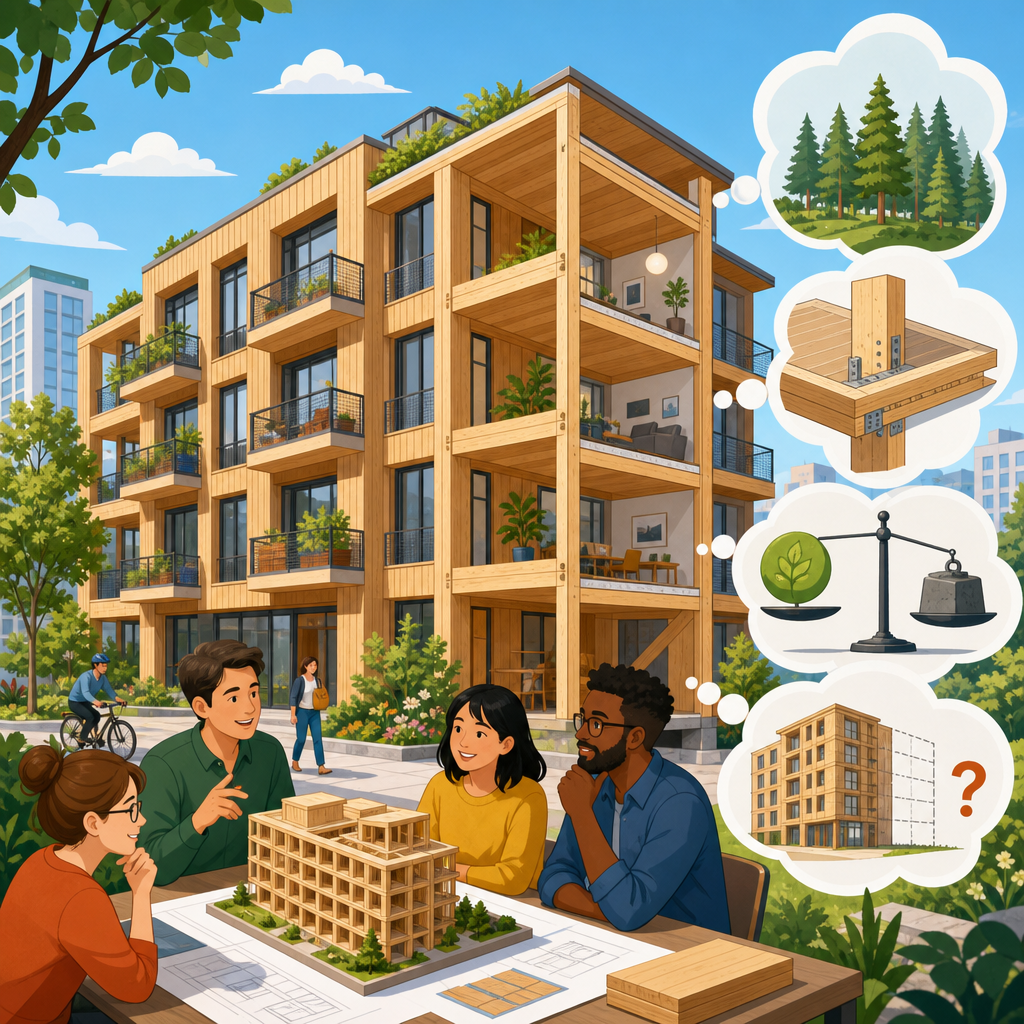
Mass timber housing is moving from niche demonstration projects to mainstream urban development because it promises lower embodied carbon, faster installation, and a warmer residential experience than conventional concrete or steel. In practice, mass timber refers to large engineered wood products such as cross-laminated timber, glue-laminated timber, nail-laminated timber, and dowel-laminated timber that can serve as structural walls, floors, and roofs. Housing includes multifamily apartments, student residences, affordable housing, senior living, and mixed-use buildings with residential floors above commercial space. When developers ask whether mass timber housing is practical, they are usually asking three linked questions: does it reduce climate impact, does it work financially, and can it meet code, fire, and acoustic requirements in dense cities?
Those questions matter because buildings account for a major share of global energy-related carbon emissions, and the materials used before occupancy can dominate a project’s climate footprint. I have worked on early design studies where a switch from reinforced concrete to a mass timber frame reduced estimated embodied carbon significantly, but only after careful coordination of spans, grid spacing, fire ratings, and supplier lead times. Mass timber is not a universal replacement for every structural system. It is a design strategy with clear strengths and nontrivial constraints. Understanding both is essential for architects, developers, housing agencies, and city planners who want durable, code-compliant homes while also meeting decarbonization goals, construction timelines, and resident expectations.
What mass timber housing includes and where it works best
Mass timber housing works best when the building type aligns with the material’s structural logic and manufacturing methods. The most common systems are CLT floor and wall panels paired with glulam beams and columns, although point-supported CLT flat plates and hybrid timber-concrete assemblies are also used. Mid-rise multifamily buildings, student housing, and modular or panelized affordable housing are especially good candidates because they use repetitive unit layouts, regular structural grids, and predictable service zones. Repetition supports off-site fabrication, which reduces cutting waste and shortens installation. In cities with constrained sites, lighter foundations can also help, particularly on poor soils or above existing podium structures where every tonne matters.
Height, span, vibration, and transfer conditions determine feasibility. For housing, spans of roughly 5 to 8 meters are often efficient, matching apartment bay dimensions and corridor-loaded plans. Longer spans are possible with glulam or hybrid systems, but material use and connection complexity increase. If a project requires large open retail transfers under housing, extensive underground parking, or irregular cantilevers, a hybrid concrete or steel solution may be more rational. That does not mean mass timber loses its value. Many successful projects use concrete cores for lateral stability and egress, with timber framing for the residential floors. This hybrid approach often balances code approvals, cost control, and carbon savings better than an all-timber concept.
Climate and sustainability benefits
The strongest case for mass timber housing is usually embodied carbon. Concrete and steel are highly effective structural materials, but cement production and primary steelmaking are carbon intensive. Responsibly sourced timber stores biogenic carbon while requiring less fossil fuel-intensive processing. In whole-building life-cycle assessment, the exact reduction depends on baseline design, forest management, transport distance, replacement assumptions, and end-of-life scenarios, but reductions in upfront embodied carbon can be meaningful. In my project comparisons, the biggest gains came when the design team optimized the structure early rather than simply swapping timber into a concrete geometry. Efficient timber buildings are designed around timber dimensions, connection logic, and fabrication constraints from day one.
Environmental performance also depends on procurement quality. Timber is only as sustainable as its source. Specifying certified wood through FSC or PEFC-aligned supply chains, confirming chain of custody, and understanding regional forestry practices are basic requirements, not optional extras. Moisture protection during construction, durability detailing, and envelope performance are equally important because replacing damaged components erodes environmental benefits. Operational carbon still matters too. A mass timber housing project with poor air tightness or oversized glazing can underperform a conventional building with an excellent envelope and efficient heat pumps. The right conclusion is not that timber automatically makes a building green, but that it can be a powerful decarbonization tool when paired with disciplined design, verified sourcing, and robust building performance standards.
Construction speed, quality, and cost realities
Mass timber housing can shorten schedules because structural components arrive prefabricated, labeled, and ready for assembly. On well-planned projects, crews erect floors quickly, and the dry construction process reduces curing delays associated with concrete. Faster dry-in can lower financing exposure and neighborhood disruption. Precision manufacturing also improves fit and can reduce rework. For housing, this matters because repeatable unit stacks favor standardized panel openings, coordinated mechanical penetrations, and prefabricated bathroom or facade components. The most successful teams lock in structural and MEP coordination early, often using building information modeling down to connection plates and service routes. Late design changes are expensive because each panel is a manufactured product, not a generic on-site pour.
Cost, however, is more nuanced than marketing suggests. In some regions, timber structure alone still costs more than conventional alternatives due to limited supplier competition, transport constraints, insurance conditions, and conservative pricing for unfamiliar risk. Savings often appear elsewhere: reduced foundation loads, shorter program duration, less site labor, and lower finishing costs when wood is left exposed. The financial outcome depends on local market maturity. Developers should compare total project cost, not only material rates per square meter. They should also test procurement timing. Factory slots can be a hidden constraint, and long-lead items may offset erection speed if supplier capacity is tight.
| Design question | Typical mass timber answer | Main tradeoff |
|---|---|---|
| Can it build housing faster? | Yes, if design is frozen early and fabrication is coordinated with site logistics. | Late changes become costly and can delay factory production. |
| Is it always lower carbon? | Usually lower upfront carbon than concrete or steel, especially in mid-rise housing. | Benefits shrink with long transport distances, poor sourcing, or excessive hybridization. |
| Is it cheaper? | Sometimes at project level through faster schedules and lighter foundations. | Direct structural costs may still be higher in immature markets. |
| Can residents see the wood? | Often yes in selected ceilings or walls, subject to fire and acoustic design. | More exposed timber can complicate code strategy and finishing coordination. |
Fire safety, building codes, and insurance concerns
Fire safety is the first concern raised by public officials and residents, and it deserves a direct answer: mass timber can meet stringent fire-resistance requirements when designed and tested correctly. Large timber members char predictably, forming an insulating layer that protects the core for a defined period. CLT and glulam assemblies are therefore evaluated through tested assemblies, encapsulation strategies, connection protection, and code-recognized calculations. The International Building Code has expanded pathways for tall timber in several construction types, while many national and local codes now include explicit provisions for engineered timber. Still, approvals depend on jurisdiction, occupancy, sprinkler requirements, and whether the building uses exposed or concealed timber surfaces.
The key issue is not whether timber burns, because all buildings contain combustible contents, but how the entire assembly performs in a fire. Designers must address compartmentation, concealed space detailing, penetrations, continuity of fire-rated membranes, and site moisture that can affect gypsum protection. Adhesive performance under heat, self-extinguishment behavior in some assemblies, and firefighter access are part of the review. Insurers may remain cautious where local loss data are limited, especially during construction before full sprinkler commissioning. That is why risk planning should include temporary fire protection, hot-work controls, moisture management, and a contractor with timber-specific experience. Well-documented fire engineering and a clear code path reduce uncertainty more than broad sustainability claims ever will.
Acoustics, vibration, moisture, and resident comfort
Housing succeeds or fails at the level residents actually experience: noise, movement, thermal comfort, and durability. Mass timber floors are lighter than concrete slabs, so airborne sound, impact sound, and vibration need focused design attention. A bare CLT plate rarely meets high residential acoustic expectations on its own. Effective assemblies typically add resilient underlayments, topping slabs, suspended ceilings, insulation, and careful perimeter detailing to control flanking transmission. I have seen teams underestimate flanking paths at facade edges and service penetrations, only to lose performance on paper before occupancy even begins. Good acoustic consultants are essential, particularly for luxury apartments, co-living, and student residences where resident tolerance for noise is low.
Moisture is equally critical. Timber performs well when kept within acceptable moisture ranges, but repeated wetting can cause staining, swelling, mold risk, and long-term durability problems. The core rule is simple: protect the structure early, detail drainage aggressively, and verify moisture content before enclosure. Temporary roof membranes, staged wrapping, sensor monitoring, and disciplined sequencing are standard best practices. Thermal comfort is generally excellent when timber is paired with a high-performance envelope, but the lower mass of lightweight assemblies can influence overheating risk and temperature swings. Mechanical design, shading, and ventilation strategy therefore remain central. Residents may love the visual warmth of exposed wood, yet comfort depends far more on the total assembly than on the structural material alone.
Design process, supply chain, and the most common housing questions
The best mass timber housing projects start with integrated design rather than late material substitution. Architects, structural engineers, fire engineers, facade consultants, contractors, and manufacturers need to align early on grid, spans, unit stacking, shaft locations, and allowable penetrations. Common client questions are practical. How high can we go? The answer depends on local code and whether a hybrid core is used. Can kitchens and bathrooms be routed efficiently? Yes, if wet walls and risers are standardized. What about balconies? They are feasible, but thermal bridging, weathering, and connection detailing need close attention. Can affordable housing use mass timber? Yes, particularly where repeatability, speed, and lower disruption support policy goals, though capital cost and procurement rules still shape feasibility.
Supply chain capacity often decides success more than design ambition. Panel sizes are limited by factory equipment and transport rules. Regional manufacturing presence affects cost, lead time, and carbon outcomes. Connections also matter more than newcomers expect. Steel knife plates, self-tapping screws, bearing details, hold-downs, and tolerance management govern buildability and fire protection. Digital coordination using Revit, Tekla, and CNC-linked fabrication workflows is now standard on serious projects. For developers creating a hub strategy across a housing portfolio, the winning move is to standardize repeatable details and procurement templates, then improve them project by project. Mass timber rewards disciplined replication. If you are evaluating it for an upcoming scheme, run an early comparative study with structural, fire, acoustic, and cost input before the concept hardens.
Mass timber housing offers a credible path to lower-carbon residential development, but its value comes from informed execution, not material branding. The core benefits are clear: meaningful embodied carbon reductions, rapid and precise installation, lighter structures, and interior environments many residents find attractive. The core limits are equally clear: code pathways vary, acoustics and moisture demand rigorous detailing, insurance can be cautious, and cost advantages depend heavily on market maturity and team experience. In short, mass timber is strongest when the building type, structural grid, and procurement model fit the material rather than force it into an unsuitable form.
For developers, architects, and public agencies, the practical lesson is to treat mass timber housing as an integrated delivery challenge. Start with life-cycle assessment, code analysis, and supply chain mapping. Test hybrid options instead of assuming all-timber is best. Design acoustics, fire protection, and weather resilience as primary systems, not afterthoughts. When those steps are followed, mass timber can deliver durable, code-compliant homes with a smaller carbon footprint and a competitive construction program. If mass timber is on your shortlist, the next step is simple: commission an early feasibility study and compare it against concrete and steel using the same performance criteria.
Frequently Asked Questions
What is mass timber housing, and how is it different from traditional wood-frame construction?
Mass timber housing uses large engineered wood components as primary structural elements for residential buildings, including multifamily apartments, condominiums, student housing, affordable housing, and mixed-use projects with housing above. Instead of relying on many small framing members such as light wood studs and joists, mass timber systems use large panels and beams made from layers or laminations of wood that are bonded or mechanically fastened together. Common products include cross-laminated timber (CLT), glue-laminated timber (glulam), nail-laminated timber (NLT), and dowel-laminated timber (DLT). These products can form floors, roofs, load-bearing walls, and long-span structural frames.
The main difference from conventional wood-frame construction is scale, structural behavior, and level of prefabrication. Light wood framing is typically assembled from smaller dimensional lumber pieces on site, while mass timber elements are often precision-fabricated off site using digital models and CNC machinery, then delivered ready for installation. That approach can improve dimensional accuracy, reduce waste, and accelerate erection. Mass timber also performs differently in terms of spanning capacity, stiffness, fire design strategy, and acoustics. It is often considered for mid-rise and taller housing where developers want a lower-carbon structural system but still need robust performance and efficient construction.
Another important distinction is architectural expression. In many housing projects, mass timber is not just structure but also part of the finished interior experience. Exposed ceilings or beams can create a warmer, more natural feel than concrete or steel, which is one reason residents, developers, and designers are paying attention to the system. That said, not every project leaves the timber visible. Some buildings use mass timber selectively, or conceal portions of it to meet acoustic, fire-resistance, or durability requirements. In other words, mass timber housing is not simply “bigger wood framing.” It is a different design and delivery approach that blends engineered materials, prefabrication, structural efficiency, and architectural intent.
What are the biggest benefits of using mass timber in housing projects?
The biggest benefit most often cited is lower embodied carbon compared with conventional concrete and steel structures, particularly when wood is responsibly sourced and the design uses material efficiently. Because housing is being built at large scale in growing urban areas, developers and municipalities are increasingly focused on reducing the upfront emissions associated with construction. Mass timber can help on that front by substituting a renewable material for more carbon-intensive structural systems. Sustainability claims should still be verified through project-specific life-cycle assessment, but in many cases mass timber creates a credible pathway to lower embodied carbon for multifamily housing.
Speed of construction is another major advantage. Since mass timber components are prefabricated, they can arrive on site pre-cut for openings, connections, and service coordination, which can significantly reduce installation time. Faster dry-in can shorten the schedule, reduce labor congestion, and lower neighborhood disruption in dense urban settings. For housing developers, time matters directly because a shorter construction cycle can reduce financing costs and allow units to come online sooner. This schedule advantage is often strongest when the design team, fabricator, and contractor are aligned early and the project is carefully coordinated in a digital model.
There are also meaningful benefits in resident experience and marketability. Exposed timber interiors can make apartments and shared amenity spaces feel more comfortable, distinctive, and visually warm. That can support leasing, branding, and occupant satisfaction, especially in projects that want a more natural or wellness-oriented identity. On the technical side, mass timber is relatively lightweight compared with concrete, which may reduce foundation demands and be particularly helpful on constrained sites or over poor soils. In some urban infill conditions, lighter structures can simplify logistics and lessen impacts on adjacent properties.
Finally, mass timber can support cleaner job sites and a more industrialized building process. Prefabrication can reduce material waste, improve quality control, and create safer, more organized construction environments. None of these benefits is automatic, but when mass timber is selected for the right project and integrated early into the design process, it can deliver a compelling combination of carbon reduction, construction efficiency, architectural quality, and commercial value.
What are the main limitations or challenges of mass timber housing?
Mass timber offers real advantages, but it is not a universal solution. One of the biggest limitations is that project success depends heavily on early coordination. Because mass timber components are prefabricated with high precision, late design changes can be expensive and disruptive. Openings for stairs, shafts, ducts, plumbing, and façade interfaces need to be resolved earlier than in many conventional projects. Teams that are used to making field adjustments during construction may find the transition challenging. The system rewards planning discipline, but it can punish poorly coordinated design.
Code compliance and approvals can also be more complex depending on building height, occupancy, jurisdiction, and the specific fire-resistance strategy. Building codes in many regions now provide clearer pathways for taller timber buildings, but the rules still vary, and local authorities may require detailed documentation or third-party review. Fire design, concealment requirements, connection protection, and penetrations through rated assemblies all need careful attention. In housing, acoustics are another common challenge. Residents expect quiet units, and timber floors and walls often need layered assemblies, toppings, insulation, resilient mounts, suspended ceilings, or other measures to meet impact and airborne sound targets. That can affect cost, floor-to-floor heights, and the amount of wood that remains exposed.
Cost and supply chain conditions are another practical constraint. Material pricing for mass timber can vary by region, and the number of qualified manufacturers, installers, and experienced consultants may be limited in some markets. Shipping large panels over long distances can reduce schedule and cost advantages. Connection detailing, fire protection, and acoustic build-ups can also add complexity that is not obvious in early concept studies. For some projects, a hybrid approach using mass timber with concrete cores, steel transfer structures, or conventional podiums makes more sense than an all-timber solution.
Moisture management is a further consideration. Wood must be protected during transport, storage, and installation, and the building enclosure needs to be designed to avoid long-term durability problems. This is manageable, but it requires disciplined sequencing and site practices. In short, the limits of mass timber housing are not only about engineering capacity. They include code pathways, acoustics, supply chain maturity, cost certainty, moisture risk, and the need for a highly integrated design-and-construction process.
How does mass timber perform in fire, acoustics, and long-term durability for residential buildings?
These are three of the most common design questions, and they are exactly the right ones to ask. In fire, mass timber does not behave the same way as light wood framing. Large timber elements can be designed to achieve fire resistance because the outer layer chars at a predictable rate, which can insulate and protect the core for a defined period. Engineers account for this by sizing members appropriately and by protecting connections and interfaces. Depending on the code path and project goals, some timber surfaces may be left exposed, while others may need encapsulation with gypsum board or other protective layers. Fire safety in housing is not based on aesthetics or assumptions; it is based on tested assemblies, code compliance, suppression systems, compartmentation, and detailed coordination of penetrations and joints.
Acoustics often require even more practical attention than fire. Residential buildings must control both airborne sound, such as voices and televisions, and impact sound, such as footsteps or moving furniture. Because mass timber is lighter than concrete and transmits vibration differently, floor and wall assemblies usually need supplemental layers to reach target performance. Typical strategies include acoustic mats, concrete or gypsum toppings, insulated cavities, suspended ceilings, resilient channels, and carefully isolated mechanical systems. Junctions matter as much as the main assemblies, because flanking paths can undermine otherwise strong lab-tested performance. The takeaway is that mass timber can meet residential acoustic expectations, but it rarely does so with bare structure alone.
For durability, moisture control is the central issue. Timber performs well when it stays within intended service conditions, but repeated wetting or prolonged elevated moisture can create risks. Good durability design starts with protecting the structure during construction and continues with robust façade detailing, drainage planes, vapor control, ventilation where needed, and avoidance of trapped moisture. Interior humidity in housing also needs to be considered, especially in bathrooms, kitchens, and laundry areas. Long-term durability is not a weakness unique to timber; every structural material has environmental vulnerabilities. The difference is that timber requires a clear moisture strategy from day one.
When fire, acoustics, and durability are handled properly, mass timber housing can perform at a very high level. The key is to stop thinking of these issues as afterthoughts. They should drive early assembly selection, structural depth decisions, service routing, and architectural detailing. Projects that treat them as core design criteria tend to achieve better outcomes and fewer surprises in permitting or construction.
When does mass timber make the most sense for housing, and what should owners or design teams evaluate early?
Mass timber tends to make the most sense when a housing project values a combination of lower embodied carbon, speed of erection, distinctive interior character, and a collaborative delivery process. It is especially attractive for mid-rise urban housing, mixed-use buildings with residential levels above a podium, student housing, and projects in markets where planning authorities or investors place real