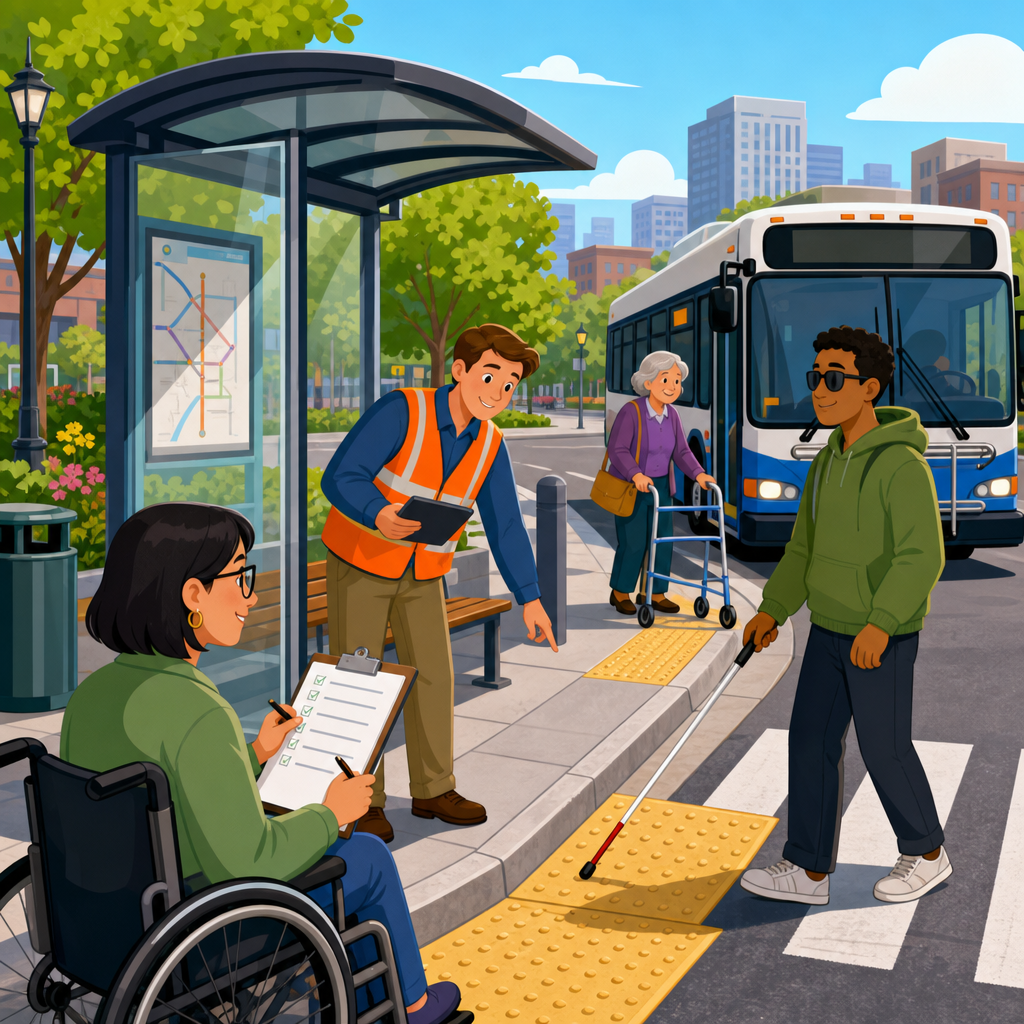
Accessibility audits for transit stops are one of the most practical ways cities can improve everyday mobility, because they turn broad inclusion goals into measurable site conditions and fixable design problems. In this guide, accessibility means whether a person with a disability, an older adult, a parent pushing a stroller, a traveler carrying luggage, or anyone with temporary mobility or sensory limitations can reach, understand, and use a stop safely and independently. A transit stop can be a bus stop, tram platform, streetcar boarding area, shuttle bay, or on-demand pickup point; an audit is the structured inspection process used to evaluate barriers against legal requirements, technical standards, and lived experience. I have worked with municipalities, campus operators, and private shuttle systems on these reviews, and the same lesson appears every time: a stop can look adequate on paper yet fail completely once you test the pedestrian approach, boarding edge, signage, lighting, and maintenance in real conditions.
This matters because the transit stop is the first and last link in a journey. If the curb ramp is too steep, the detectable warning is missing, the shelter blocks wheelchair turning space, or the schedule is unreadable for low-vision riders, the network is not truly accessible no matter how modern the vehicles are. Accessibility audits also support sustainability goals. They help increase transit use, reduce dependence on private cars, improve safety, and make public investment serve a wider range of residents. In practice, audits reveal patterns that planners often miss in desktop reviews: utility poles narrowing the clear path, drainage grates placed in the boarding area, snow storage covering tactile surfaces, crosswalk timing too short for slower walkers, and inconsistent stop spacing that forces unnecessary transfers.
A practical accessibility audit is not just a compliance checklist. It combines field measurements, observation of user behavior, interviews with riders and operators, and review of applicable standards such as the Americans with Disabilities Act Standards for Accessible Design, Public Rights-of-Way Accessibility Guidelines, local roadway manuals, and transit agency design criteria. The strongest audits also document severity, frequency, and cost so agencies can prioritize improvements instead of producing reports that sit on shelves. This article explains what a transit stop accessibility audit should include, how to conduct one, what common barriers to expect, and how to turn findings into an upgrade program that delivers visible results.
What an accessibility audit for transit stops should examine
An accessibility audit should evaluate the full rider path, not only the waiting area. In the field, I break every stop into six zones: approach route, crossing point, curb ramp and landing, waiting area, boarding and alighting area, and information environment. That structure prevents a common mistake in which agencies inspect the shelter pad but ignore the broken sidewalk a block away that makes the stop unreachable. For each zone, record dimensions, slopes, surface condition, obstructions, and maintenance issues. Cross slope and running slope matter because excessive grades affect wheelchair control and standing stability. Surface texture matters because loose gravel, cracked asphalt, and vertical displacement create trip hazards and rolling resistance.
Waiting and boarding spaces require especially careful review. A stop needs a firm, stable surface, adequate clear width, and a landing area that aligns with vehicle doors or ramps. Benches and shelters are helpful only if they do not reduce maneuvering space. Sign placement should preserve head clearance and keep the pedestrian access route continuous. Information elements deserve equal attention. Route numbers, timetables, wayfinding signs, and real-time displays must be legible, placed at useful heights, and supported by nonvisual alternatives where possible. Audio announcements, tactile cues, and high-contrast graphics can dramatically improve usability, but only when maintained consistently.
Context also changes the audit. A suburban roadside stop with no sidewalk has different risks from an urban transfer point with heavy foot traffic. Near hospitals, senior housing, schools, and major civic buildings, expect higher use by riders with varied mobility, sensory, and cognitive needs. Weather exposure matters too. In hot climates, lack of shade becomes an accessibility issue for riders with heat sensitivity. In cold regions, snow clearing and ice control are essential parts of stop access, not optional maintenance extras. A good audit therefore captures both fixed design conditions and operational conditions that affect day-to-day access.
How to conduct the audit in the field
Start with a defined methodology and consistent tools. Every audit team should carry a digital level or smart level, measuring tape, wheel measure, camera, GPS-enabled form, and standard rating rubric. I prefer a stop inventory form that records exact location, route served, stop type, surrounding land use, and observed barriers with photos tied to each item. Audit at different times when possible: peak period, off-peak, after dark, and after adverse weather. Conditions can vary sharply. I have seen stops that appear compliant at noon but become inaccessible at dusk because glare makes the timetable unreadable and the landing disappears into shadow.
Use a repeatable sequence. First, approach the stop from each likely pedestrian direction and document whether a continuous accessible path exists. Second, inspect crossings, signal timing, refuge islands, and curb ramps. Third, measure the waiting pad and boarding area. Fourth, assess signs, lighting, seating, shelter design, and rider information. Fifth, note maintenance and operations issues such as overgrown vegetation, ponding water, temporary construction barriers, and snow piles. Sixth, if possible, observe one or two vehicle arrivals to confirm whether operators can deploy ramps cleanly and whether the bus kneels into the available space without conflict.
Include people with disabilities in the process. This is not symbolic outreach; it changes findings. Wheelchair users identify subtle cross-slope problems, blind and low-vision travelers expose wayfinding failures, and people with cognitive disabilities can show where information is confusing even when technically present. Transit operators add another critical perspective because they know which stops consistently create boarding problems, fare disputes, or missed pickups. When I run audits, I separate code compliance from user experience but score both. A stop may meet minimum dimensional rules and still perform poorly if riders cannot find it, feel unsafe reaching it, or need assistance to board.
Common barriers found at transit stops
Most accessibility audits uncover the same cluster of recurring issues. The first is the missing accessible path of travel. Stops are often installed on grass shoulders, behind drainage ditches, or beside sidewalks with pinch points narrower than required clear width. The second is poor curb-ramp design: excessive slopes, no level top landing, flared sides in the walking path, or detectable warnings placed incorrectly. The third is inadequate boarding area geometry, especially where shelters, trash cans, newspaper boxes, bike racks, and utility cabinets compete for limited sidewalk space. The result is a stop that technically exists but cannot support independent boarding.
Information failures are just as serious. Route signs may use low-contrast colors, small type, abbreviations unfamiliar to infrequent riders, or placements hidden behind advertising panels. Real-time information displays sometimes sit too high, produce reflections, or rely on touch interfaces without tactile or audio support. Lighting is another underestimated barrier. Insufficient illumination reduces facial recognition, sign reading, and obstacle detection, which affects personal security as well as usability. Maintenance problems compound everything. A perfect design is undermined by broken pavement, leaf accumulation, standing water, and snow that blocks the boarding edge. Agencies often budget for capital upgrades but underfund the recurring maintenance that preserves access.
| Barrier | Typical field symptom | Impact on riders | Common corrective action |
|---|---|---|---|
| Missing accessible route | No sidewalk, narrow pinch point, uneven surface | Wheelchair users and walkers cannot reach stop safely | Build continuous firm path with compliant clear width |
| Faulty curb ramp | Steep slope, no landing, absent tactile warning | Unsafe street crossing and poor orientation | Reconstruct ramp to current public right-of-way standards |
| Obstructed boarding area | Shelter posts, bins, poles, or signs block maneuvering space | Ramp deployment and turning movements fail | Relocate street furniture and enlarge pad |
| Poor information design | Small text, glare, low contrast, inaccessible interface | Missed buses and reliance on assistance | Use high-contrast signs, larger fonts, and multimodal info |
| Weak maintenance | Cracks, ponding, snow, vegetation, debris | Trips, slips, blocked access, and vehicle-stop mismatch | Set inspection cycles and maintenance response times |
Another frequent barrier is the disconnect between stop design and surrounding traffic engineering. Crosswalks may be unsignalized across multilane roads, pedestrian pushbuttons may be out of reach, or refuge islands may be too small for mobility devices. At transfer hubs, crowding can erase clear routes during peak periods. In constrained corridors, agencies sometimes choose a shelter model that fits procurement standards rather than site dimensions, leading to blocked circulation. These examples show why a stop audit must coordinate with street design, signal operations, and maintenance teams, not only the transit department.
Standards, measurements, and documentation that make findings actionable
Good audits are precise enough that engineers, maintenance crews, and budget officers can act on them immediately. That means documenting actual measurements rather than writing vague phrases such as “sidewalk narrow” or “ramp too steep.” Record clear width, landing depth, cross slope, running slope, vertical level changes, distance from curb, sign height, lighting condition, and obstruction type. If local standards differ by stop class or street type, note which standard applies. In the United States, agencies commonly reference ADA Standards, ADA guidance on bus stop accessibility, Manual on Uniform Traffic Control Devices provisions for pedestrian signs and signals, and state department of transportation design manuals. Elsewhere, equivalent national accessibility and roadway standards should anchor the review.
Prioritization is where many audits fail. I use a matrix with three factors: severity of barrier, rider exposure, and implementation complexity. Severity asks whether the issue prevents independent access, merely degrades convenience, or creates a direct safety hazard. Rider exposure asks how many people are affected, with extra attention to stops serving medical centers, schools, transfer points, and dense housing. Implementation complexity estimates whether the fix is operational, minor civil work, or major reconstruction involving utilities and drainage. This creates tiers. Re-striping a crossing, trimming vegetation, moving a trash can, and replacing a sign can be done quickly. Rebuilding a sidewalk network or widening a constrained island may need capital programming and interagency design.
Documentation should support both compliance and capital planning. Each stop record should include overview photos, close-up defect photos, a location map, measurements, code references, and a recommended action. Cost ranges help decision makers. For example, replacing a stop pole and sign is a low-cost task; reconstructing a curb ramp and landing is moderate; building a new concrete pad with drainage modifications or utility relocation is high. Once data is standardized, agencies can map deficiencies network-wide and look for clusters. That is how operators move from one-off complaints to a strategic accessibility improvement program.
From audit findings to a transit stop improvement program
The best audit is the one that changes the network. After fieldwork, group recommendations into quick wins, scheduled maintenance, corridor projects, and full capital upgrades. Quick wins usually include sign replacement, contrast improvements, vegetation clearing, bench relocation, stop balancing, and refreshed pavement markings. Scheduled maintenance covers crack repair, snow response routes, drainage cleaning, and lighting replacement. Corridor projects address linked barriers such as missing sidewalks between several stops and nearby destinations. Full capital upgrades involve boarding islands, raised platforms where appropriate, shelter replacement, signal changes, and drainage reconstruction.
Public communication should be transparent and specific. Riders want to know which stops were reviewed, what problems were found, what will be fixed first, and how to report emerging issues. Publish a stop inventory map, describe the rating method in plain language, and update progress regularly. When budgets are limited, explain why some locations move ahead sooner than others. In my experience, trust improves when agencies show a clear prioritization logic rather than promising systemwide upgrades with no timeline. Partnerships also matter. Public works departments, disability advisory committees, metropolitan planning organizations, school districts, and hospital campuses can all help align funding and construction windows.
Technology can strengthen long-term performance if used carefully. GIS-based asset management systems let agencies track stop conditions, maintenance tickets, and capital needs at each location. Mobile inspection apps reduce inconsistent reporting. Real-time passenger information can improve usability, but digital tools should never substitute for physical accessibility. A rider still needs a clear path, safe crossing, stable waiting area, readable sign, and reliable boarding interface. The strongest transit stop accessibility programs treat audits as a recurring operational discipline, not a one-time study. Reinspect after construction, major route changes, and severe weather seasons, and use rider feedback to validate whether changes worked.
Accessibility audits for transit stops succeed when they look beyond minimum compliance and evaluate the whole journey a rider experiences on the ground. The key lesson is simple: access begins before the stop and continues through crossing, waiting, boarding, information, and maintenance. A well-run audit uses clear standards, direct field measurements, rider participation, and photographic documentation to identify barriers that prevent independent travel. It then converts those findings into prioritized actions, from fast operational fixes to capital reconstruction, so agencies can improve the network systematically rather than reacting to complaints one stop at a time.
For sustainable urban development, this work has an outsized payoff. Better transit stop accessibility expands who can use public transport, strengthens equity, supports aging in place, reduces car dependence, and makes public spending more effective. It also improves daily experience for nearly everyone, including people carrying groceries, traveling with children, or recovering from injury. If your city, campus, or transit agency has not reviewed its stops recently, start with a structured audit, involve actual riders, and publish the results. The fastest way to build a more inclusive transit network is to inspect the stops people use today and fix the barriers that are already visible.
Frequently Asked Questions
What is an accessibility audit for a transit stop, and what does it usually evaluate?
An accessibility audit for a transit stop is a structured review of how well people with different mobility, sensory, cognitive, and temporary access needs can approach, understand, and use the stop safely and independently. In practice, it turns a broad goal like “make transit more inclusive” into a set of observable site conditions that can be documented, measured, prioritized, and improved. Rather than relying on assumptions, an audit looks at the stop from the user’s perspective and asks whether someone can actually get there, wait there, board there, and navigate the surrounding environment without unnecessary barriers.
A thorough audit usually evaluates the full journey to and through the stop, not just the sign or shelter itself. That includes the pedestrian approach route, sidewalk width and condition, curb ramps, crosswalk access, surface quality, slopes, drainage, lighting, seating, shelter placement, boarding area dimensions, vertical and horizontal gaps, obstructions, signage legibility, route information, wayfinding, and the presence of hazards such as broken pavement, poles in the path of travel, or inconsistent transitions between surfaces. It also considers whether the stop supports people who are blind or low vision, deaf or hard of hearing, using wheelchairs or other mobility devices, pushing strollers, carrying luggage, or dealing with fatigue, injury, or age-related limitations.
The strongest audits also document context. For example, a stop may technically include a bench and a pad, but still be functionally inaccessible if the only approach is across grass, if a driveway cuts through the path without a detectable edge, or if the boarding area floods after rain. That is why accessibility audits are so valuable: they reveal the difference between nominal compliance and real usability. The result is a practical inventory of conditions, often paired with photos, measurements, severity ratings, and recommended corrective actions that agencies can use for maintenance planning, capital improvements, and policy decisions.
Why are accessibility audits so important for transit stops instead of just relying on general design standards?
General design standards are essential, but they do not replace field auditing because standards alone cannot capture how a stop performs in real-world conditions. Transit stops are affected by site constraints, maintenance history, utility placement, adjacent land uses, drainage, weather exposure, sidewalk gaps, and changing streetscape conditions. A stop that may have been built to a standard at one time can become difficult or unsafe to use later because tree roots lift the pavement, signage blocks the clear path, snow storage covers ramps, or roadway resurfacing changes the boarding relationship between the curb and the vehicle. An audit identifies these conditions as they actually exist.
Accessibility audits are especially important because transit access is cumulative. A small barrier at any single point in the trip can make the entire stop unusable. For instance, a shelter may be present, but if the crosswalk to reach it lacks curb ramps, or if the landing area is too narrow for a wheelchair user to maneuver, the stop is not truly accessible. The same is true for older adults who need seating, travelers hauling bags, parents with strollers, or people with temporary injuries who may struggle with uneven pavement, steep grades, or unclear information. Audits help agencies see accessibility as a complete experience rather than a checklist of isolated features.
They also support better decision-making. Instead of spreading resources evenly or responding only to complaints, agencies can use audit findings to prioritize improvements where barriers are most severe, where ridership is highest, where critical destinations are nearby, or where upgrades can produce the greatest benefit. In that sense, accessibility audits are not just compliance tools. They are practical planning tools that help cities improve safety, increase equitable access, reduce user frustration, and build confidence in the transit system.
What are the most common accessibility problems found at bus stops and other transit stops?
Some of the most common problems are surprisingly basic, which is exactly why audits matter. Missing or damaged sidewalks are a major issue, especially near suburban or edge-of-network stops where riders may be expected to walk along the roadway or across unpaved ground. Even where sidewalks exist, auditors often find narrow clear widths, heaving or cracked pavement, abrupt level changes, ponding water, and utility poles or signs placed directly in the path of travel. These problems can limit access for wheelchair users, create tripping hazards for older adults, and make the route difficult for anyone using a stroller, cane, walker, or rolling luggage.
At the stop itself, frequent issues include inaccessible boarding and waiting areas, poorly positioned shelters, lack of seating, insufficient maneuvering space, and conflicts between amenities. A shelter might provide weather protection but reduce the clear space needed for boarding. A bench may be helpful for someone with limited stamina but become a barrier if it blocks the approach. Other common findings include missing curb ramps, ramps with poor alignment, inaccessible crossings to reach the stop, lack of tactile or visual cues, confusing or illegible signage, and lighting conditions that reduce personal safety or visibility of hazards. In some locations, the stop exists as a sign on a pole with no defined landing area at all.
Another category of problems involves information and independence. Riders need to know where to wait, which route serves the stop, and how to connect safely to nearby destinations. Audits often uncover missing route information, poor contrast on signage, inconsistent naming, and layouts that are hard to interpret for people with low vision, cognitive disabilities, or limited familiarity with the system. Environmental maintenance also matters. Overgrown vegetation, snow and ice, debris, surface deterioration, and drainage failures can erase accessibility even when the original design was sound. These recurring conditions show why an audit should examine both design and ongoing operations, because accessibility is not achieved once and then left alone; it must be maintained over time.
How is a practical accessibility audit of a transit stop typically conducted?
A practical audit usually begins with a clear scope and a repeatable method. The team defines what types of stops are being reviewed, what criteria will be measured, and what tools will be used to document conditions consistently. Many agencies create or adapt a field checklist that covers the approach route, crossing conditions, waiting area, boarding area, amenities, information, visibility, lighting, maintenance, and overall usability. The checklist should be detailed enough to support action, but simple enough that multiple staff or consultants can apply it consistently across many locations.
Fieldwork is the core of the process. Auditors visit each stop and record measurements, observations, and photographs. They typically assess whether a person can approach the stop continuously from the surrounding pedestrian network, whether the surface is firm and stable, whether slopes and transitions are manageable, whether there is sufficient clear width and maneuvering space, and whether the boarding area aligns with vehicle operations. They also look at the relationship between the stop and nearby intersections, driveways, medians, and adjacent uses such as schools, clinics, senior housing, or commercial centers. In many cases, the most useful findings come from observing conditions that standard plan review would miss, such as puddling, informal desire paths, blocked sidewalks, or passenger crowding at peak times.
The best audits include lived-experience input. That may involve participating with disability advocates, older adults, parents of young children, or riders who regularly use mobility aids. Their insight helps agencies understand not only what is technically present, but what is actually usable. After field collection, the findings are organized into a database or inventory, often with severity ratings, quick-win maintenance items, medium-term upgrades, and larger capital needs. The final output should not just describe problems; it should guide action by identifying what needs to change, where improvements should be prioritized, and how agencies can track progress over time. A practical audit succeeds when it produces a realistic roadmap for improving access stop by stop.
How often should transit stops be audited, and what should agencies do with the results?
Transit stops should be audited on a recurring basis rather than as a one-time effort. A systemwide baseline audit is often the best starting point because it establishes current conditions and highlights the most urgent barriers. After that, agencies should revisit stops on a schedule that reflects risk, ridership, location type, and the pace of change in the surrounding environment. High-use stops, transfer points, stops near hospitals or senior facilities, and locations with known barriers may warrant more frequent review. Agencies should also trigger re-audits after roadway reconstruction, utility work, resurfacing, stop relocations, major service changes, or repeated maintenance complaints, since these events can significantly alter accessibility.
The results should feed directly into maintenance, capital planning, and program management. Small issues such as trimming vegetation, replacing signs, repairing pavement defects, improving drainage, or relocating obstructions can often be addressed quickly and at relatively low cost. Larger issues, such as adding sidewalk connections, reconstructing boarding pads, redesigning curb ramps, or relocating stops for better crossing access, should be prioritized in capital improvement programs. The most effective agencies do not leave audit reports on a shelf. They assign responsibility, define timelines, set funding strategies, and create a tracking system so improvements can be measured and reported.
Just as important, agencies should use audit results to build a long-term accessibility strategy. Patterns across many stops can reveal systemic problems such as inconsistent stop placement, weak maintenance coordination, outdated standard details, or insufficient attention to pedestrian connections. By analyzing findings at both the site level and system level, agencies can improve standards,