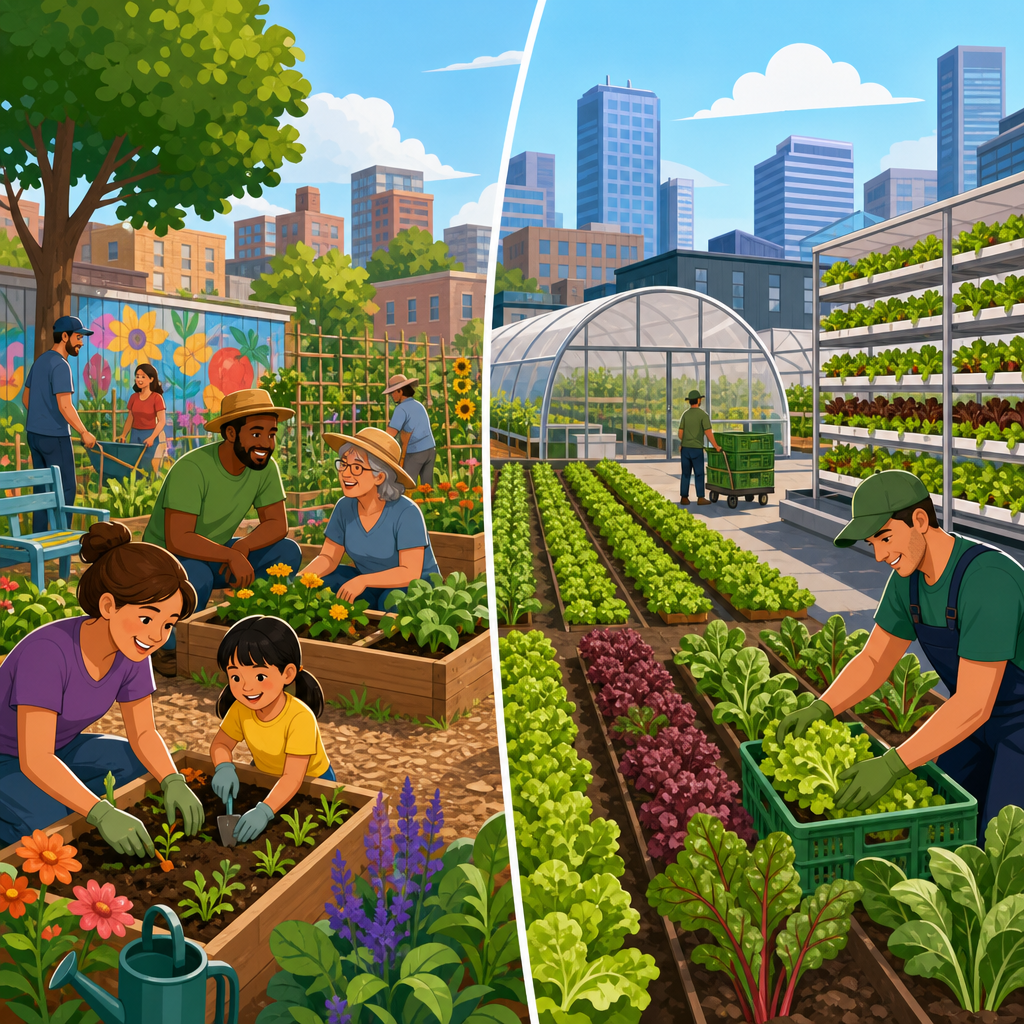
Community gardens and urban farms are often treated as interchangeable, yet they serve different purposes, operate under different constraints, and succeed by using different design choices. In practice, both put food production into cities, but the goals behind the land, the people involved, and the way the site is organized can vary dramatically. A community garden is usually a shared growing space where residents cultivate individual or collective plots for household use, education, recreation, or neighborhood connection. An urban farm is typically a production-focused site designed to grow food or flowers at a scale that supports sales, jobs, institutional purchasing, or structured distribution.
That distinction matters because design follows purpose. When I have evaluated city growing sites, the most common planning mistake has been assuming that raised beds, a water line, and a fence are enough for every model. They are not. A community garden often needs welcoming circulation, shared tool storage, multilingual signage, and governance systems that reduce conflict among members. An urban farm may need wash-pack stations, cold storage, crop planning areas, loading access, and soil testing protocols strong enough to satisfy buyers, insurers, and local regulators. Both benefit from good sunlight, healthy soil, and reliable water, but beyond those basics, the site program diverges quickly.
For sustainable urban development, getting this right affects far more than vegetables. These spaces influence public health, stormwater management, heat island reduction, neighborhood identity, small business development, and equitable access to land. They also interact with zoning, public agencies, nonprofit partners, schools, and food systems infrastructure. This article serves as a hub for the broader topic by clarifying the core differences between community gardens and urban farms, explaining how goals shape design, and outlining what planners, developers, municipal staff, and community leaders should evaluate before committing land, money, and long-term expectations.
Defining the mission before designing the site
The first question is not what to build, but what outcome the land is meant to produce. Community gardens are usually missioned around participation. Their success is measured by member retention, social cohesion, youth engagement, cultural expression, and the amount of food households can grow for themselves. Urban farms are usually missioned around production and service delivery. Their success is measured by yield, revenue, contracts, labor efficiency, educational programming hours, or pounds donated through food access programs. Some sites combine these aims, but hybrid models work only when the design intentionally supports both instead of letting one function undermine the other.
A simple example shows the gap. A forty-plot neighborhood garden may perform well with wide pathways, shade seating, ornamental borders, and decentralized water spigots that make the site comfortable for older adults and families. That same layout would frustrate a commercial grower trying to move harvest totes quickly, standardize bed lengths, or run a seeding and harvest schedule across the site. Conversely, a tightly organized market garden with narrow permanent beds, a central pack area, and dedicated propagation space can feel inaccessible or overly controlled if the community expects open participation and personal expression. Clarity at the mission stage prevents expensive redesign later.
Ownership and tenure also shape the mission. Community gardens are frequently placed on public land, school property, faith-based campuses, housing sites, or temporarily vacant lots. Urban farms can occupy those spaces too, but production-focused operations often require more secure leases because infrastructure investment is higher. Installing deer fencing, irrigation headers, a wash station, and a cooler makes little sense on a one-year revocable agreement. In most cities, tenure security is one of the strongest predictors of whether a site evolves into a resilient food-producing landscape or remains a fragile temporary amenity.
Land use, layout, and infrastructure requirements
Once goals are defined, the physical design can match them. Community gardens usually benefit from flexible plot geometry. Individual or family plots may range from small raised beds to in-ground allotments. Accessibility is a central requirement, not an afterthought. Best practice often includes ADA-aligned route planning, some elevated beds, gate widths that support wheelchairs and carts, and seating distributed through the site. Shared spaces matter too: compost bins, potting tables, bulletin boards, pollinator habitat, and gathering areas all support the garden’s social function. The landscape should invite people to linger, learn, and build relationships.
Urban farms require a more operational layout. In most productive city farms I have toured, flow is everything. Inputs arrive, seedlings are propagated, crops are planted in standardized blocks, harvest moves to wash-pack, and product exits efficiently. That means thinking about bed orientation, hose reach, drainage, vehicle access, biosecurity, and storage from the start. Farms usually need dedicated propagation areas, secure tool and materials storage, hand-washing capacity, and a workflow that separates clean produce from muddy tools and compost handling. If the operation sells to restaurants, schools, or a CSA, post-harvest handling becomes a design driver, not a secondary convenience.
Soil and water decisions also differ in intensity. Both models should test soil for nutrients and contaminants, especially lead in older urban neighborhoods. Guidance from the U.S. Environmental Protection Agency and many land-grant extension programs supports routine testing before food production begins. Community gardens may respond with raised beds and imported soil if contamination is localized. Urban farms often need a more comprehensive management plan, including mulched paths, standardized compost inputs, irrigation zoning, and recordkeeping that supports consistent crop quality. Water demand is also more predictable and higher on a farm, making pressure regulation, filtration, and metering more important than they may be in a casual shared garden.
| Design factor | Community garden priority | Urban farm priority |
|---|---|---|
| Primary purpose | Participation, household food, education, recreation | Production, revenue, jobs, distribution, contracts |
| Site layout | Flexible plots and gathering space | Standardized beds and efficient workflow |
| Infrastructure | Shared tools, seating, signage, compost | Wash-pack, storage, propagation, cold chain access |
| Access needs | Inclusive circulation and community visibility | Vehicle access and operational control |
| Management style | Member governance and shared rules | Centralized management and labor scheduling |
Governance, labor, and financial models
Design is never only physical. The social operating system determines whether the site remains functional after ribbon cutting. Community gardens usually need clear governance documents: membership criteria, plot assignment rules, maintenance expectations, conflict resolution, shared work requirements, and policies on water use, pesticides, compost, and abandoned plots. When those systems are vague, neglected beds, interpersonal disputes, and inequitable access appear quickly. The best gardens often have a steering committee, seasonal orientation, transparent waiting list management, and a communication rhythm using signage, email, and in-person workdays. These are management tools, but they should be considered part of design because they influence how common spaces are used.
Urban farms rely more on structured management and labor planning. Someone must be responsible for crop plans, enterprise budgets, planting calendars, volunteer supervision, sales channels, and compliance. If workers are paid, the farm design must support labor efficiency and safety. That includes ergonomic bed widths, shaded break areas, secure storage for personal items, and clearly organized wash-pack areas with sanitary surfaces. If volunteers are central, task design matters even more. High-turnover volunteer labor can help with broad-acre tasks like mulching or bed flipping, but it is usually less reliable for precise harvest timing, recordkeeping, and quality control. Good farm managers design systems around labor reality, not idealized assumptions.
The money model also changes priorities. A community garden may operate through modest membership fees, municipal support, grants, donations, or housing-community budgets. Because income is limited, durable but simple infrastructure is often appropriate. An urban farm may blend produce sales, training contracts, philanthropic support, agritourism, workshops, or institutional partnerships. That complexity means the site may need point-of-sale capacity, educational space, insurance coverage, refrigeration, and year-round storage. It also means financial resilience depends on design choices that reduce recurring costs. Efficient irrigation, weather protection, and standardized bed systems are not luxuries; they are operating margin decisions.
Regulation, food safety, and environmental performance
Urban agriculture exists inside a regulatory landscape that many first-time organizers underestimate. Zoning codes may define gardens and farms differently, affecting whether on-site sales, composting, structures, livestock, greenhouses, or employee parking are allowed. Building and health departments may require permits for sheds, wash stations, electrical service, or public events. In several U.S. cities, produce washing for commercial sale triggers food safety expectations that a casual garden never encounters. Anyone planning an urban farm should review local zoning text, stormwater rules, lease terms, and state agriculture guidance before finalizing the site plan.
Food safety is especially important on production-oriented sites. While not every urban farm falls under the same federal requirements, accepted practice follows risk reduction principles associated with Good Agricultural Practices. That means clean water sources, hand-washing, sanitary harvest bins, separation of compost from produce handling, wildlife exclusion where feasible, and records showing what happened and when. A community garden also benefits from these habits, but the exposure profile is different when food enters commerce, donations, or institutional procurement. If a school district or hospital is the buyer, they will often ask direct questions about handling procedures, traceability, and site sanitation.
Environmental performance should be evaluated honestly. Both community gardens and urban farms can improve infiltration, biodiversity, and neighborhood cooling compared with vacant lots or paved surfaces. However, not every site is automatically sustainable. Hauling in large volumes of imported soil, overusing peat-based media, relying on inefficient irrigation, or driving small deliveries across a city can weaken the environmental case. Strong projects measure inputs and outcomes. Rainwater capture, compost sourced from local organics programs, integrated pest management, native pollinator plantings, and low-till systems all improve performance when matched to the site. The right model is the one that meets social and food goals while using land, water, labor, and capital responsibly.
Choosing the right model for neighborhoods and institutions
The best choice depends on context, not ideology. In a dense residential neighborhood with limited private yard space, strong resident interest, and a need for intergenerational gathering, a community garden is often the better fit. It creates visible neighborhood ownership, modest food production, and a durable social asset. Near schools, libraries, parks, and affordable housing, that model can support nutrition education and community stewardship with relatively low operating complexity. The design should emphasize safety, accessibility, storage, shade, and a governance structure that survives staff turnover or changing volunteer energy.
Where the priority is local supply, workforce training, or institutional purchasing, an urban farm may create more value. I have seen farms succeed on larger parcels near transit-accessible labor pools, food hubs, or anchor institutions that can buy consistently. In these cases, the right design includes contiguous production space, utility access, secure tenure, and room for post-harvest handling. It also requires realistic business planning. Urban land is expensive, labor costs are real, and small-scale production rarely works by produce sales alone. The strongest operations pair farming with education, training, events, seedlings, or mission-driven funding, and the site should be planned to support those revenue layers without disrupting crop flow.
For planners and developers working within sustainable urban development, the central lesson is simple: choose the model first, then design with discipline. Do not label a site a farm if the community wants personal plots and collective stewardship. Do not promise production targets from a garden designed mainly for recreation and education. Match governance, infrastructure, regulation, and budget to the mission. When that alignment happens, community gardens strengthen neighborhoods and urban farms strengthen local food systems. If you are evaluating a site, start with goals, tenure, users, and operating model, then build the physical plan around those realities. That is how urban agriculture becomes durable, equitable, and genuinely useful.
Frequently Asked Questions
What is the main difference between a community garden and an urban farm?
The biggest difference is purpose. A community garden is usually designed around shared access, neighborhood participation, and small-scale growing for personal or household use. People may rent or steward individual plots, work a communal growing area, or participate in educational and social programming tied to the site. In that setting, the garden often functions as much as a community-building space as it does a food-producing one. It supports recreation, skill-sharing, cultural expression, and local stewardship, with food harvest being important but not always the only priority.
An urban farm, by contrast, is typically organized around production goals. It may still provide education, community engagement, or job training, but its layout, management, and infrastructure are often driven by the need to produce a larger and more consistent yield. Urban farms are more likely to focus on crop planning, labor efficiency, wash-pack areas, storage, distribution, and market channels such as restaurants, CSA programs, farm stands, or institutional buyers. In short, both grow food in cities, but community gardens prioritize participation and shared use, while urban farms are more likely to prioritize output, operational systems, and revenue-generating production.
Why do community gardens and urban farms need different design approaches?
They need different design approaches because they are trying to solve different problems. A community garden must be welcoming, flexible, and easy for many different users to navigate. That usually means incorporating clear pathways, accessible beds, shared tool storage, water access near plots, gathering spaces, signage, seating, composting areas, and systems for equitable plot assignment and maintenance. The design has to accommodate a wide range of ages, experience levels, and cultural preferences, so user comfort and social function matter just as much as growing space.
An urban farm requires a more operational design. The layout needs to support workflow from planting to harvest to post-harvest handling. That can include standardized bed systems, efficient irrigation zones, propagation areas, fencing, equipment access, wash stations, cold storage, packing space, and loading areas. If the farm sells produce, circulation patterns and cleanliness protocols become especially important. Labor also influences design; a farm needs a site plan that reduces wasted movement and supports repeatable tasks. In other words, community gardens are often designed for participation first, while urban farms are designed for production efficiency first. When those distinctions are ignored, the site may end up underperforming for everyone involved.
Can a community garden also function like an urban farm?
Yes, but only if the goals are clearly defined and the design reflects that hybrid model. Many urban agriculture sites combine elements of both. For example, a neighborhood space may include individual garden plots, a communal orchard, and a central production area that grows food for donation or sale. That kind of mixed-use setup can work very well, especially in cities where land is limited and organizations want one site to meet several community needs. However, combining models without clear planning often creates conflict.
The reason is simple: the management needs of a shared garden are different from the management needs of a production-focused farm. Plot gardeners may value flexibility, experimentation, and seasonal personal use, while a farm operation may need strict planting schedules, standardized beds, restricted access to certain areas, and coordinated labor. If those differences are not addressed early, users may become frustrated by competing expectations around tools, pathways, harvest rights, volunteer roles, or how much space is devoted to revenue crops versus personal gardening. A successful hybrid site usually works best when each zone has a defined purpose, written rules, and supporting infrastructure that matches how the space is meant to function.
What site features are most important for a successful community garden?
For a community garden, the most important features are the ones that make the site usable, inclusive, and easy to steward over time. Good sunlight, reliable water access, healthy or remediated soil, secure fencing where needed, and practical tool storage form the basic foundation. Beyond that, successful community gardens usually benefit from wide and stable paths, raised beds or accessible growing options, compost systems, shade, seating, bulletin boards or signage, and spaces for workshops or informal gatherings. These features help the site support both food growing and social interaction, which is often central to its mission.
Management-related features also matter more than people sometimes realize. A well-designed entrance, visible rules, clear plot numbering, centralized water points, and shared work areas can make day-to-day use much smoother. Safety and visibility are important as well, especially in urban settings where gardens must feel inviting and well cared for. If the garden is intended for children, seniors, or first-time growers, educational signage and easy-to-maintain beds can make a major difference. Ultimately, a successful community garden is not just a place where plants can grow; it is a place where people can participate consistently, comfortably, and with a strong sense of ownership.
What site features are most important for a successful urban farm?
For an urban farm, the most important features are the ones that support productivity, consistency, and efficient operations. That starts with fundamentals such as full sun, dependable water, secure land access, and soil that is either safe for food production or managed through raised beds and imported growing media. From there, the site needs infrastructure that supports commercial or programmatic farming: propagation space, organized bed systems, irrigation, wash-pack stations, storage for tools and amendments, compost handling, and secure fencing. If the farm uses intensive production methods, every square foot and every movement path need to be planned carefully.
Post-harvest and distribution features are especially important on urban farms because they are often what separates a productive garden from a true farming operation. Clean harvest handling areas, refrigeration or cool storage, protected packing space, and vehicle access for deliveries can significantly affect crop quality and profitability. Labor efficiency is another major factor, so the site should minimize unnecessary hauling, awkward circulation, and scattered infrastructure. Depending on the mission, an urban farm may also need classroom space, volunteer management areas, retail points, or offices, but those should be integrated in a way that does not compromise production flow. In practice, a successful urban farm is designed as a working system, not just a collection of growing beds.