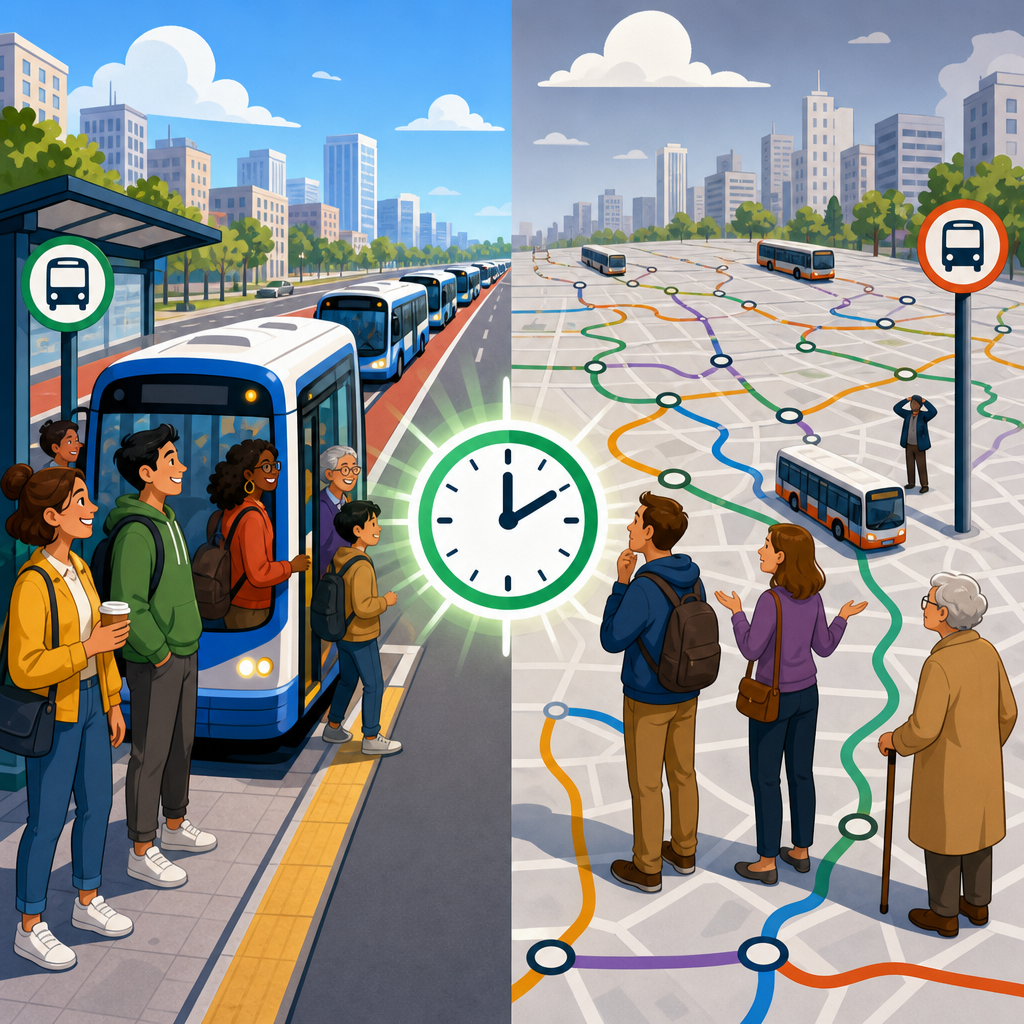
Transit frequency often shapes whether public transportation feels useful, reliable, and competitive with driving far more than route coverage alone. In many cities, officials still celebrate sprawling maps with lines reaching every district, yet riders experience transit through wait times, transfer risk, and the confidence that another bus or train will arrive soon. Frequency means how often vehicles come, usually measured in minutes between trips, while route coverage describes how widely a network spreads across neighborhoods. Both matter, but when agencies must choose where limited operating funds go, frequent service usually delivers greater mobility, higher ridership, and stronger social and environmental returns.
I have worked on network redesign discussions where map coverage looked politically impressive but actual service was too thin to change travel behavior. A bus that comes every sixty minutes technically serves a corridor, but for most daily trips it does not offer practical access to jobs, school, health care, or shopping. Miss one vehicle and the entire plan collapses. By contrast, a route every ten or fifteen minutes reduces the need to memorize schedules, makes transfers realistic, and turns transit from a backup option into a dependable part of city life. That difference is why transit frequency matters so much in sustainable urban development.
This issue matters beyond convenience. High-frequency transit supports compact land use, lowers household transportation costs, improves access to opportunity, and helps cities reduce congestion and emissions. It also determines whether investments in bus lanes, rail stations, sidewalks, and housing near transit actually produce value. A station surrounded by homes and offices cannot perform well if service is infrequent. Research and agency practice repeatedly show that riders respond strongly to wait time and reliability, often perceiving minutes spent waiting as more burdensome than minutes spent in motion. For many urban trips, the quality of service beats the theoretical reach of the network.
What transit frequency changes for everyday riders
Frequency changes the basic math of urban travel. A person deciding whether to take transit rarely starts by studying a full regional map. They ask simpler questions: When is the next bus? Can I transfer without a long delay? If I leave work late, can I still get home? Frequent service answers these questions positively. Most agencies define high-frequency service as every ten to fifteen minutes or better during much of the day, because at that level riders can often arrive without checking a timetable. That freedom is one of transit’s most valuable features in dense cities.
Coverage-heavy networks usually spread available service hours thinly across many low-ridership routes. The result is a city with many lines on paper but long waits in practice. Long waits increase total travel time, but they also create uncertainty. Riders build in extra buffer time because a missed bus could mean thirty or sixty minutes lost. Parents arranging childcare, workers with fixed shifts, and older adults going to medical appointments feel that risk acutely. In corridor planning, I have seen ridership projections change dramatically when headways improved from thirty minutes to twelve, even without changing route alignment.
Frequency also makes transfers work. Modern network design often relies on connected corridors rather than one-seat rides to every destination. That approach only succeeds if each leg of the trip arrives often enough to keep connection penalties low. Jarrett Walker’s ridership-coverage tradeoff is useful here: agencies can maximize direct geographic reach or maximize useful service, but limited budgets rarely allow both. In many cities, a connected frequent grid outperforms a tangle of infrequent neighborhood loops because it creates many viable trip combinations rather than a few fragile ones.
Reliability improves with frequency as well. On a corridor where buses arrive every six minutes, one delayed trip is inconvenient but usually recoverable. On a route every forty minutes, the same disruption can derail a trip entirely. This is why many agencies, from Transport for London to frequent bus networks in Houston and Seattle, focus operational attention on core corridors. When service is frequent, real-time passenger information, transit signal priority, and all-door boarding deliver larger benefits because riders have more chances to catch the next vehicle and less reason to abandon transit after one delay.
Why ridership and network efficiency usually favor frequent service
Frequency is a ridership engine because it reduces generalized travel cost, the broader burden users perceive when choosing how to travel. Transport economists and planners do not evaluate trips only by in-vehicle time. They include walking, waiting, transfer penalties, unpredictability, and fare complexity. Waiting time often carries a heavier perceived cost than riding time because it is unproductive and stressful. Therefore, cutting headways from twenty minutes to ten can attract riders more effectively than modestly shortening in-vehicle travel time on the same corridor. Agencies seeking mode shift need to understand that psychological dimension, not just map geography.
High-frequency routes also use operating resources more productively. Buses, operators, depots, and maintenance budgets are expensive. When those resources are spread across low-demand branches, each service hour carries fewer passengers. Concentrating service on dense corridors where many people already travel creates stronger all-day demand and better farebox recovery, though no transit system should be judged by fare recovery alone. Consider a commercial street with apartments, schools, clinics, and offices. Running service every eight minutes there may generate sustained boardings from early morning to evening, while three hourly neighborhood circulators may remain nearly empty most of the day.
Network redesigns across North America illustrate this point. Houston’s 2015 bus network redesign retained about the same operating budget while increasing the proportion of residents with access to frequent service. Ridership trends were affected by broader regional factors, but the redesign is widely studied because it improved all-day usefulness through a simpler frequent grid. Seattle’s frequent bus corridors have similarly shown how strong service paired with walkable urban form can support high ridership even before rail extensions arrive. The lesson is not that coverage should disappear; it is that a network anchored by frequent trunks usually performs better than one dominated by sparse lines.
| Network choice | Typical headway | Main rider experience | Likely outcome |
|---|---|---|---|
| Wide coverage, thin service | 30–60 minutes | Schedule dependence, risky transfers, long waits | Low spontaneous use and weaker ridership |
| Focused frequent corridors | 5–15 minutes | Show up and go, easier transfers, lower uncertainty | Higher utility, stronger ridership, better network effect |
| Hybrid network with strong core and coverage edges | 10–15 minutes on core; 30+ on local routes | Dependable main corridors with targeted basic access | Balanced performance when funding is limited |
The efficiency argument becomes stronger when cities consider induced transit demand. Frequent service does not simply serve existing riders better; it changes behavior. People choose housing, jobs, and daily routines based on whether transit is dependable. Employers become more willing to hire from a wider labor pool when workers can arrive on time without owning a car. Retail streets benefit from easier customer access. Over time, this creates a reinforcing loop between service quality and land use. Coverage alone rarely produces that loop because infrequent service does not alter location choices in a meaningful way.
Frequency, equity, and access to opportunity
Some critics hear the case for frequency and assume it neglects equity by favoring already busy corridors. In practice, the opposite is often true. Lower-income households, young people, older adults, people with disabilities, and many essential workers depend most on transit that is actually usable all day. A bus line that reaches a neighborhood but arrives once an hour does not deliver meaningful opportunity. It imposes severe time penalties on people who already have the least flexibility. Equity is not achieved by drawing lines on a map; it is achieved by providing practical access to jobs, education, groceries, childcare, and health services.
Frequent service particularly matters for trip chains and nontraditional schedules. Many transit-dependent riders do not travel in a simple suburb-to-downtown pattern. They may drop off children, work variable shifts, stop at a clinic, and shop on the way home. Infrequent transit punishes these linked trips because each transfer or stopover creates another long wait. This is why agencies that conduct Title VI service equity analyses and accessibility studies increasingly look beyond raw route presence. They examine how many destinations can be reached within a reasonable travel time, often forty-five or sixty minutes. Frequency has a major effect on those accessibility outcomes.
There are real tradeoffs. A pure ridership strategy can bypass low-density areas where vulnerable residents live, and that is not acceptable. Cities need baseline service coverage for social inclusion. The stronger policy position is to protect a minimum coverage network while dedicating most operating investment to frequent corridors that connect key destinations. Demand-responsive transit, paratransit coordination, microtransit pilots in carefully defined areas, school transportation integration, and safer walking and cycling links can help fill gaps. But these tools work best as complements, not substitutes, for frequent fixed-route service where demand is concentrated and repeated daily.
Land use, sustainability, and the limits of route maps
Transit frequency is inseparable from urban form. Dense mixed-use districts generate short walks, all-day travel demand, and balanced two-way ridership that justify frequent service. In return, frequent service supports more housing and commercial activity near corridors and stations. This relationship is central to sustainable urban development. If a city wants lower per capita emissions, less traffic, and reduced infrastructure costs, it must align transit operations with land-use policy. Upzoning near major corridors, reducing parking mandates, improving sidewalks, and allowing mixed uses are more effective when people know service comes every few minutes rather than a few times per hour.
Route coverage can create a misleading sense of accomplishment because maps are visible and politically legible. Officials can point to a line in every district and claim mobility has been delivered. Yet emissions reduction and car-ownership reduction depend on mode shift at scale, and that requires service people can trust. A household may be willing to own one fewer car if the nearest route is frequent enough for commuting, school trips, and errands. It is unlikely to give up a car because a bus passes nearby six times a day. Frequency turns transit from symbolic infrastructure into functioning urban infrastructure.
Rail projects demonstrate this clearly. Cities often invest billions in light rail or metro extensions expecting development and ridership gains, then underdeliver on service levels because operating funds lag behind capital spending. The corridor may have excellent stations, but if trains run every twenty or thirty minutes outside peak periods, many potential riders continue driving. Bus systems face the same issue. A bus rapid transit corridor with off-board fare collection and dedicated lanes still needs short headways to create a rapid-transit experience. Capital quality matters, but operating frequency is the daily product users actually consume.
How cities should balance frequency and coverage
The best transit networks do not choose frequency or coverage in absolute terms; they set clear priorities and invest accordingly. A practical framework starts by identifying a frequent network connecting the region’s largest destinations and highest-demand corridors: major job centers, hospitals, colleges, civic institutions, dense neighborhoods, and transfer hubs. Service on these corridors should be simple, legible, and all-day, ideally every ten to fifteen minutes or better from early morning into evening. Next, agencies should define a coverage network that guarantees basic access, especially for vulnerable communities, while being honest that these routes serve a different purpose.
Planning should be guided by data rather than anecdote. Stop-level boarding counts, origin-destination data, automatic passenger counters, on-time performance, load profiles, and accessibility modeling reveal where frequency will do the most good. Agencies should also measure span of service, not just headways; a route every twelve minutes is less useful if it ends before late shifts do. Street design matters too. Bus lanes, queue jumps, signal priority, level boarding, and stop consolidation allow agencies to improve frequency without proportionally increasing fleet size because vehicles complete trips faster and more reliably.
Public communication is crucial because reducing low-ridership deviations can trigger political resistance even when overall access improves. In outreach sessions I have seen riders support redesigns once planners clearly explained the tradeoff: fewer one-seat rides, but far shorter waits and better all-day mobility. Agencies should publish simple network maps highlighting frequent corridors, expected headways, and transfer opportunities. They should also connect this subtopic to broader sustainable urban development goals such as housing affordability, safer streets, cleaner air, and economic inclusion. When residents see transit frequency as city-building policy rather than a timetable detail, better decisions follow.
In many cities, transit frequency matters more than route coverage because people value usefulness over nominal availability. A line that exists but comes too rarely cannot reliably connect residents to opportunity, reduce car dependence, or support compact development. Frequent service lowers wait times, makes transfers practical, strengthens reliability, increases ridership, and produces better returns on limited operating budgets. It also advances equity when designed around real destinations and paired with a protected basic coverage network for areas that need guaranteed access.
The central lesson is straightforward: sustainable urban development depends not just on where transit goes, but on how often it comes. Cities should build networks with strong frequent corridors, coordinated local coverage, supportive land use, and street designs that keep vehicles moving. If you are evaluating your local system, start by looking beyond the map. Check headways, span of service, transfer quality, and the number of key destinations reachable within an hour. Those measures reveal whether transit is truly useful. Prioritize frequency first, and the whole network becomes more credible, efficient, and transformative.
Frequently Asked Questions
Why does transit frequency often matter more to riders than route coverage?
For most riders, transit is not experienced as a map on a planning document; it is experienced as time. A bus line that technically reaches many neighborhoods may look impressive on paper, but if it comes only every 30, 45, or 60 minutes, it feels unreliable and inconvenient in daily life. High frequency reduces the time people spend waiting, lowers the stress of missing a vehicle, and makes the entire system easier to use without careful scheduling. That is why frequent service often does more to make transit feel practical than simply extending routes into more places.
Frequency also improves flexibility. When buses or trains arrive every 10 to 15 minutes or better, riders can travel more spontaneously, make connections with less anxiety, and trust that a small delay will not ruin the rest of their trip. This is especially important for workers with shifting schedules, parents making multiple stops, and people who depend on transit for essential trips rather than occasional errands. In many cities, a smaller network with strong all-day frequency can serve riders better than a larger network with thin, infrequent service spread everywhere.
What is the difference between transit frequency and route coverage?
Transit frequency refers to how often buses, trains, or trams arrive on a route, usually described as the number of minutes between vehicles. For example, a bus that comes every 8 minutes has high frequency, while one that comes every 40 minutes has low frequency. Route coverage, by contrast, refers to how widely the system extends across the city or region. It answers the question of whether a transit line exists near a certain neighborhood, not whether that line is useful for frequent, dependable travel.
Both concepts matter, but they serve different goals. Coverage is about geographic access, while frequency is about quality of access. A city can boast that nearly every district has a transit line, but if those lines run rarely, riders still face long waits, missed connections, and long total travel times. That is why transportation planners increasingly distinguish between “being near transit” and “having meaningful transit service.” In practical terms, a nearby bus that comes once an hour offers much less mobility than a slightly farther route that arrives every 10 minutes all day.
How does higher frequency make public transportation more competitive with driving?
Driving is attractive in many cities because it offers immediate departure. Most people can walk to their car and leave whenever they want. Frequent transit narrows that advantage by reducing the penalty of waiting. If a train comes every 5 minutes or a bus every 10 minutes, transit begins to feel much more like a turn-up-and-go option rather than a service that requires planning around a timetable. That change is crucial because people compare total travel time, not just time spent in motion.
Higher frequency also cuts down on transfer risk, which is one of the biggest hidden barriers in transit use. A trip with one or two transfers can work well when the next vehicle arrives soon. The same trip becomes frustrating when a missed connection means standing on a platform or sidewalk for 20 or 30 extra minutes. Frequent service makes networks function as networks instead of isolated routes. It lets riders combine lines more easily, broadens the number of practical destinations, and improves confidence that transit can get them where they need to go without major uncertainty. In that sense, frequency does not just save minutes; it improves the overall experience enough to make transit a realistic alternative to driving.
Can focusing too much on route coverage actually weaken a transit system?
Yes, it can. When agencies try to provide a little bit of service everywhere, they often end up spreading limited resources too thin. The result is a large network with many low-ridership, low-frequency routes that are expensive to operate but not especially useful. Riders may technically have access to transit nearby, yet the service is so infrequent that they avoid it whenever possible. This creates a cycle in which low frequency suppresses ridership, and low ridership is then used to justify keeping service weak.
A stronger strategy in many cities is to build a core frequent network on the routes where demand is highest and where people need dependable all-day mobility. That does not mean coverage should be ignored, especially for seniors, people with disabilities, lower-income communities, or neighborhoods with limited transportation options. But it does mean cities should be honest about tradeoffs. If every corridor gets a little service, no corridor may get enough service to become truly useful. Concentrating investment in frequency can generate higher ridership, better reliability, stronger connections, and more public confidence in the system overall.
What level of frequency is usually considered good transit service?
There is no universal threshold that fits every city or route, but many planners consider service every 10 to 15 minutes or better to be the range where transit starts to feel genuinely convenient for everyday use. At that level, riders often do not need to consult a schedule, and missing one vehicle is not a major problem. Service every 5 to 10 minutes is even stronger, especially on busy urban corridors and rail lines, because it supports easy transfers and makes transit feel available on demand.
Service every 20 to 30 minutes can still be workable in lower-density areas, but it usually requires more planning and creates more friction for riders. Once headways stretch beyond that, transit tends to become much less attractive except for people with no better option or highly predictable routines. Importantly, good frequency should not be limited to rush hour. A route that runs often only during peak commuting times but becomes sparse midday, evenings, and weekends fails many real-world trips. Reliable all-day frequency is what helps transit serve students, shift workers, families, shoppers, and anyone whose life does not fit neatly into a traditional 9-to-5 schedule.