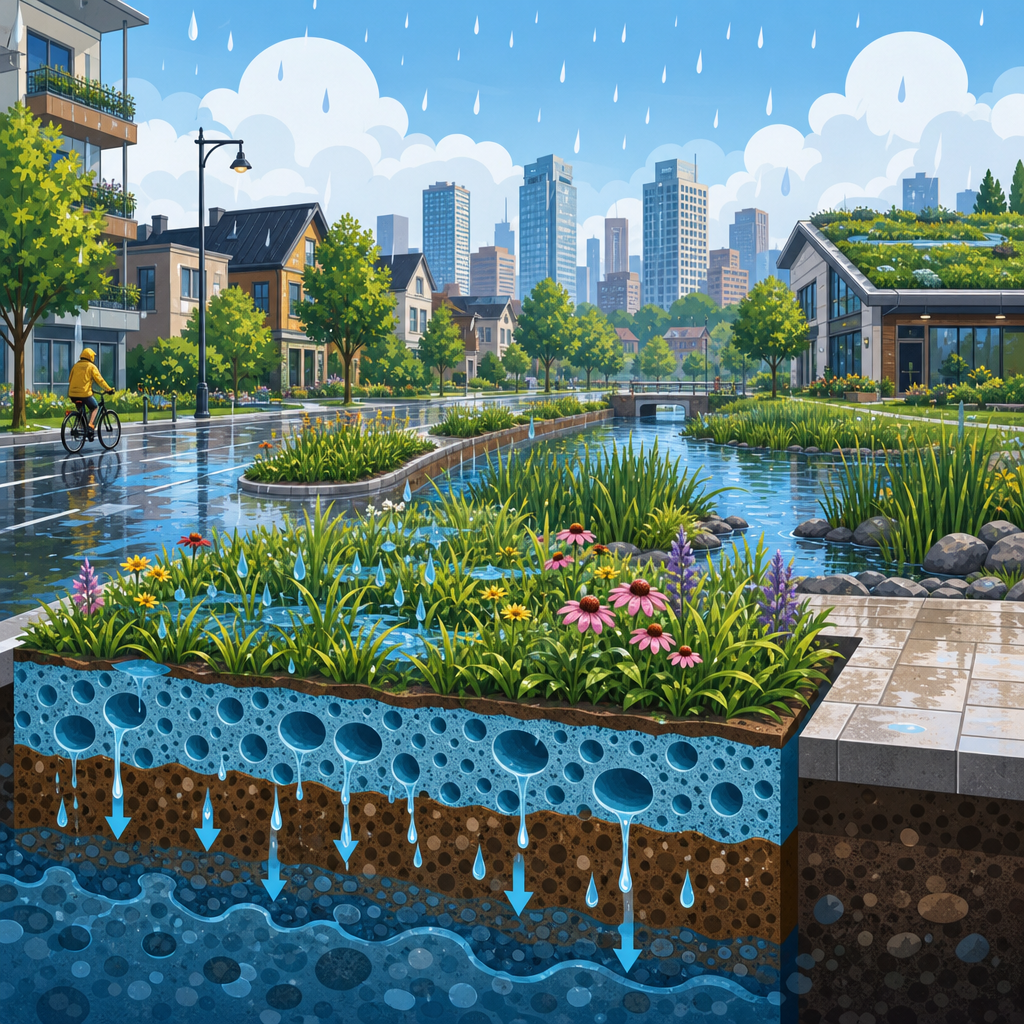
A sponge city is an urban area designed to absorb, store, filter, and slowly release rainwater instead of sending it rapidly into storm drains. The concept combines green infrastructure, water-sensitive planning, and engineered drainage systems so streets, parks, roofs, wetlands, and public spaces work like a sponge during storms. In practice, that means using permeable pavement, bioswales, green roofs, detention ponds, restored streams, and connected open space to reduce flooding, improve water quality, and recharge groundwater. I have worked on stormwater planning discussions where one blocked inlet caused street flooding across several blocks, and that experience makes the appeal of sponge city design very concrete: when water has nowhere to go, every weakness in urban design is exposed.
The idea matters because climate change is increasing the intensity of short-duration rainfall in many regions, while urbanization replaces soil with asphalt and rooftops. Traditional gray infrastructure, built around pipes, culverts, and fast conveyance, still has an important role, but by itself it often struggles under modern storm conditions. Many U.S. cities also face combined sewer overflows, heat island effects, degraded rivers, and high costs from repetitive flood damage. A sponge city approach addresses several of those problems at once. It is not a single product or master plan. It is a citywide framework for managing water where it falls, using layered systems that provide flood control, cooling, habitat, and public amenity.
The term gained global attention through large-scale implementation efforts in China, where national sponge city pilot programs encouraged municipalities to capture and reuse a significant share of stormwater runoff. But the principles are broader than any one country. They align with low-impact development, sustainable drainage systems, green stormwater infrastructure, and nature-based solutions already used in the United States, Europe, and Australia. The real question is not whether the model is technically possible in the United States. It is whether U.S. cities can adapt policy, funding, maintenance, and land-use decisions quickly enough to make it work at meaningful scale.
How a sponge city works in practice
A sponge city works by slowing runoff at multiple points across a watershed. Rain first lands on roofs, streets, parking lots, and landscaped areas. In a conventional urban system, much of that runoff is collected and moved away as quickly as possible. In a sponge city, designers try to intercept it early. Green roofs retain a first flush of rainfall. Street trees and soil cells store water around roots. Bioswales move runoff through engineered soil that filters sediment and pollutants. Rain gardens hold water temporarily, letting it infiltrate over hours rather than minutes. Larger parks, wetlands, and detention basins then provide overflow storage during bigger storms.
The most effective projects use what stormwater engineers call a treatment train. Instead of expecting one feature to solve everything, runoff passes through several connected controls. A school campus might direct roof water into cisterns for irrigation, overflow into a bioretention area, and then discharge excess water to a restored creek corridor. A downtown street reconstruction might add permeable sidewalks, curb extensions that double as rain gardens, and underground storage beneath a plaza. Each measure handles part of the storm volume. Together, they reduce peak flow, improve water quality, and lower pressure on pipes downstream.
Performance depends on design details. Soil infiltration rate, groundwater depth, underdrain configuration, rainfall intensity, and maintenance all determine whether systems perform as intended. In places with clay soils or high water tables, designers often use lined systems or underdrains rather than relying on deep infiltration. In cold climates, permeable pavement can still work well, but aggregate depth, winter sanding practices, and vacuum sweeping matter. In dense districts, underground tanks may supplement green infrastructure because land is limited. A sponge city is therefore not anti-engineering. It is engineering that uses landscape as infrastructure and treats hydrology as a central urban design constraint.
Why cities are pursuing the model
The main driver is flood resilience. Urban flooding causes direct damage to homes, roads, transit, utilities, and commercial property, but indirect losses are also severe. Businesses close, emergency services are diverted, and transportation networks fail. By retaining water near where it falls, sponge city strategies reduce the volume and speed of runoff entering drainage systems. That lowers the chance that a cloudburst overwhelms local inlets and trunk lines. Even when green infrastructure does not prevent all flooding, shaving the peak flow can mean the difference between nuisance ponding and destructive inundation.
Water quality is another major benefit. Stormwater runoff carries oil, metals, trash, nutrients, and sediment into rivers, lakes, and coastal waters. Vegetated systems remove pollutants through filtration, settling, adsorption, and biological uptake. Cities under regulatory pressure from the Clean Water Act or municipal separate storm sewer system permits often use green stormwater infrastructure to meet water-quality objectives. There are also energy and livability gains. Trees and planted surfaces reduce surface temperatures. Parks designed for temporary water storage create usable public space in dry weather. Property values often rise near well-designed green corridors, although cities must plan carefully to prevent displacement.
Public health and drought resilience strengthen the case. Captured stormwater can be reused for irrigation, toilet flushing, industrial cooling, or groundwater recharge where regulations allow. That matters in water-stressed regions such as California, Arizona, Nevada, and parts of Texas. During heat waves, additional shade and evapotranspiration can reduce dangerous street-level temperatures. I have seen residents support drainage upgrades much more strongly when projects include safer sidewalks, new trees, and neighborhood open space. A pipe under the road is necessary, but a visible landscape improvement creates political momentum and community ownership that hidden infrastructure rarely achieves.
Lessons from international implementation
China made the sponge city idea famous by moving from isolated pilot projects to a national policy framework. Beginning in the mid-2010s, pilot cities including Wuhan, Xiamen, and Shenzhen tested targets for runoff capture, flood mitigation, and urban ecological restoration. Common measures included wetland parks, sunken green spaces, permeable paving, and redesigned waterfronts. The ambition was substantial: cities were encouraged to manage a large share of annual rainfall on site, often using a target around 70 percent depending on local conditions. Results have varied, but the program proved that national direction can accelerate standards, financing, and technical capacity.
Other countries offer parallel lessons. Singapore’s Active, Beautiful, Clean Waters program transformed utilitarian concrete drains into integrated waterways and public landscapes. Rotterdam has used water plazas that function as public squares in dry weather and temporary storage basins during storms. Copenhagen redesigned streets and parks after major flooding, building cloudburst routes that safely convey excess water during extreme events. These examples show that the best systems combine everyday stormwater management with emergency pathways for larger events. They also show that no city relies on green elements alone. Resilient water design pairs distributed retention with upgraded conveyance and clear hydraulic planning.
| City | Notable approach | Key lesson for U.S. cities |
|---|---|---|
| Wuhan | Wetland restoration and district-scale storage | Use parks and blue-green corridors as flood assets |
| Singapore | Integrated drainage and public realm design | Make stormwater infrastructure visible and useful |
| Rotterdam | Water plazas and adaptive public spaces | Design spaces for dual use during dry and wet periods |
| Copenhagen | Cloudburst streets and overflow routing | Plan for extreme events, not just routine rain |
The limitation is equally important. High-profile sponge city projects do not eliminate flood risk from record-breaking storms, river flooding, storm surge, or poor upstream land management. Some Chinese pilot cities still experienced severe flooding, leading critics to assume the model had failed. That is too simplistic. A bioretention street retrofit cannot offset rainfall well beyond design capacity, blocked channels, and rapid urban growth across a watershed. The correct takeaway is that sponge city design works best as part of layered flood management, including land-use controls, emergency planning, river restoration, pumping where necessary, and updated drainage standards based on future climate conditions.
Could the model work in the United States?
Yes, but the United States would implement it under different names, institutions, and legal structures. Many core tools already exist. Philadelphia’s Green City, Clean Waters program uses greened acres to reduce combined sewer overflows. New York City has invested in bioswales, blue roofs, cloudburst planning, and neighborhood-level drainage upgrades. Portland, Seattle, and Washington, D.C., have long records with green streets, ecoroofs, and stormwater retention standards. Los Angeles County voters approved Measure W to fund watershed-scale stormwater capture projects. In other words, the technical foundation is already present. What is missing in most regions is consistency, scale, and long-term coordination across agencies.
The strongest opportunities are in places facing repeated urban flooding, sewer consent decrees, water scarcity, or major redevelopment. Gulf Coast cities need better ways to handle intense rainfall on flat terrain. Midwestern legacy cities with combined sewers need distributed retention to complement tunnel and storage investments. Sun Belt metros can pair stormwater capture with water reuse and heat mitigation. Fast-growing suburbs can avoid locking in poor drainage patterns if they preserve floodplains and require on-site retention before full buildout. Sponge city principles are especially practical when embedded in street reconstruction cycles, school modernization, park projects, and transit corridor upgrades rather than treated as stand-alone beautification.
Several barriers remain. U.S. local governments are fragmented, with stormwater responsibilities split among public works departments, utilities, parks agencies, transportation departments, flood control districts, and private developers. Funding is often project-based rather than systemic. Maintenance is chronically underplanned; a clogged curb cut can disable a rain garden as effectively as a broken pipe. Liability concerns, outdated engineering standards, and neighborhood resistance can slow adoption. There is also a skills gap. Designing a successful bioretention system requires coordination among civil engineers, landscape architects, soil specialists, and operations staff. Cities that solve those governance problems are the ones most likely to make the model work.
What successful U.S. adoption would require
First, cities need watershed-based planning instead of site-by-site improvisation. Stormwater does not respect parcel lines, and isolated green projects provide limited benefit if downstream choke points remain. Municipalities should map drainage areas, flood complaints, sewer capacity, heat exposure, and vulnerable populations, then prioritize corridors where multiple benefits overlap. Updated design storms should reflect current rainfall data and future projections, not outdated assumptions. Asset management matters too. Every bioswale, cistern, and permeable pavement installation needs inspection schedules, maintenance budgets, and clear ownership from day one.
Second, codes and finance must reinforce the goal. Stormwater utilities can create stable revenue through user fees tied to impervious area. Development codes can require retention of the first inch or more of runoff, depending on local hydrology. Street standards should allow curbside bioretention, narrower travel lanes where appropriate, and tree trenches with sufficient soil volume. Public procurement should value lifecycle performance, not just lowest upfront cost. When cities compare green and gray options fairly, including avoided flood damage, water-quality compliance, heat reduction, and public space value, hybrid systems often make the best economic case.
Third, implementation should focus on visible neighborhood benefits as well as hydrologic metrics. Residents care about flooded intersections, basement backups, unsafe crossings, dead street trees, and parks that become mud pits after every storm. Projects gain support when they solve those real problems. The most credible path is incremental but cumulative: retrofit one corridor, monitor results, adjust standards, then scale. If your city is revising a comprehensive plan, stormwater manual, or capital improvement program, that is the moment to push for sponge city principles. Embedding them in routine decisions is how the model moves from pilot to normal practice.
The bottom line is clear: a sponge city is not a utopian idea or a foreign planning slogan. It is a practical model for building urban flood resilience by working with water instead of fighting it only with bigger pipes. The approach uses proven tools such as green roofs, permeable surfaces, restored waterways, detention landscapes, and smarter street design to reduce runoff, improve water quality, cool neighborhoods, and create better public spaces. International examples show the concept can scale, while U.S. programs in Philadelphia, New York, Portland, and Los Angeles demonstrate that the underlying methods already fit American conditions.
Could the model work in the United States? Yes, if cities treat it as core infrastructure rather than optional landscaping. Success depends on watershed planning, updated standards, reliable funding, maintenance discipline, and coordination across transportation, parks, utilities, and private development. It also depends on honesty about limits: green infrastructure complements gray systems and emergency planning; it does not replace them. For city leaders, planners, engineers, and residents, the opportunity is significant. Start with the places that flood repeatedly, invest in projects that deliver visible community benefits, and build a stormwater system designed for the climate realities ahead.
Frequently Asked Questions
What is a sponge city, and how does it work?
A sponge city is an urban area intentionally designed to manage rain where it falls by absorbing, storing, filtering, and slowly releasing stormwater rather than pushing it as quickly as possible into pipes and drains. Instead of relying only on conventional “gray” infrastructure such as storm sewers, channels, and concrete drainage systems, the sponge city model combines those engineered systems with green infrastructure and water-sensitive planning. The goal is to make the built environment behave more like a natural landscape, where soil, vegetation, wetlands, and floodplains help manage water over time.
In practical terms, this means integrating features such as permeable pavement, rain gardens, bioswales, green roofs, urban wetlands, detention and retention ponds, restored streams, and connected park space into everyday city design. During storms, these elements capture runoff from streets, roofs, parking lots, and sidewalks. Some of that water infiltrates into the ground, some is temporarily stored, some is filtered through soil and plant roots, and the rest is released gradually. This process reduces the sudden surges of water that can overwhelm storm drains and cause flash flooding.
The concept also improves overall urban water management. By slowing runoff, sponge cities can reduce erosion, improve water quality by trapping pollutants, lower heat in dense neighborhoods through added vegetation, and create more attractive public space. In other words, a sponge city is not just a flood-control strategy. It is a broader urban design approach that treats rainfall as a resource to be managed intelligently rather than as a waste product to be removed as fast as possible.
Why are sponge cities becoming more important for flood control and urban planning?
Sponge cities are becoming more important because many urban areas were built around the assumption that rainwater should be drained away quickly, but that approach is increasingly under strain. As cities expand, natural ground surfaces are replaced with rooftops, roads, parking lots, and other impermeable materials that prevent water from soaking into the soil. The result is more runoff, faster runoff, and greater pressure on drainage systems that may already be outdated or undersized.
At the same time, many places are experiencing heavier downpours, more frequent extreme weather, and more visible flooding. Even cities with large storm sewer networks can struggle when intense rainfall arrives in a short period. Traditional drainage systems are often designed to move water efficiently, but they do not always provide enough storage, filtration, or flexibility for today’s conditions. That is where the sponge city model offers a major advantage: it distributes water management across the landscape instead of relying on a single network of underground pipes.
From an urban planning perspective, sponge city principles also support multiple goals at once. They can improve neighborhood resilience, reduce pollution entering rivers and lakes, recharge groundwater in some settings, and enhance public spaces with trees, parks, and restored waterways. This makes them appealing not only to engineers and flood managers, but also to planners, landscape architects, public health officials, and communities looking for more livable cities. In short, sponge cities matter because they provide a more adaptive and multifunctional response to the water challenges modern cities now face.
Could the sponge city model work in the United States?
Yes, the sponge city model could work in the United States, and in many places it already exists in partial form. While the term “sponge city” is not always used in U.S. planning, many American cities are already implementing the same core strategies through green stormwater infrastructure, low-impact development, floodplain restoration, and climate-resilient design. Projects that use bioswales, permeable pavement, green roofs, rain gardens, expanded park systems, and restored urban waterways are all consistent with sponge city thinking.
The United States has a wide range of climates, geographies, and urban forms, so the model would not look the same everywhere. A dense northeastern city, a Gulf Coast metro area, a Midwestern river city, and an arid southwestern community would each need a different approach. In wetter regions, the emphasis might be on storing and slowing intense rainfall. In flood-prone coastal areas, sponge city features could complement pumping systems, levees, and tidal defenses. In drier areas, the focus may include capturing rainfall for reuse, improving soil moisture, and reducing landscape stress while still managing occasional heavy storms.
The biggest point is that sponge city design is not an all-or-nothing blueprint. It is a framework that can be adapted to local conditions, regulations, and budgets. In the United States, it can work especially well when integrated into street redesigns, public parks, school campuses, redevelopment districts, and infrastructure upgrades that are already planned. The model becomes most effective when cities stop treating water management as a separate utility problem and instead build it into transportation, housing, open space, and land-use decisions from the start.
What are the main benefits of sponge city design beyond reducing flooding?
Although flood reduction is one of the most visible benefits, sponge city design delivers a much broader set of advantages. One of the most important is improved water quality. When stormwater runs over roads, rooftops, and other hard surfaces, it can pick up oil, metals, sediment, fertilizers, and other pollutants before reaching streams, rivers, or lakes. Green infrastructure features such as bioswales, wetlands, and planted retention areas help filter that runoff, allowing soil and vegetation to remove or trap contaminants before the water is discharged.
Another major benefit is better urban livability. Trees, green roofs, planted corridors, and open space can help cool neighborhoods that otherwise absorb and radiate heat. This can reduce the urban heat island effect, improve comfort during hot weather, and support public health. Sponge city elements can also add beauty, biodiversity, and recreational value by turning purely functional drainage areas into parks, green streets, and habitat-rich landscapes that people actually use and enjoy.
There are economic and infrastructure benefits as well. By reducing peak runoff, sponge city strategies can lower stress on aging storm sewer systems and, in some cases, reduce the need for expensive pipe expansions or repeated flood damage repairs. Over time, that can make cities more resilient and potentially more cost-effective. In some areas, capturing and reusing stormwater can also support irrigation or landscape maintenance. Taken together, these benefits make sponge city design attractive not just as an environmental concept, but as a practical long-term investment in healthier, more resilient urban communities.
What challenges could limit sponge city adoption in U.S. cities?
The biggest challenges are not usually technical; they are institutional, financial, and spatial. Many U.S. cities were built around separate departments and funding systems for transportation, stormwater, parks, utilities, and land use. Sponge city design works best when these systems are coordinated, but that kind of cross-agency planning can be difficult. A street project may focus on traffic flow, a drainage department may focus on regulatory compliance, and a parks department may have separate priorities. Without alignment, opportunities to integrate water-sensitive design into routine public works projects can be missed.
Cost and maintenance are also important concerns. While green infrastructure can reduce long-term damage and improve system performance, it still requires upfront investment, careful design, and ongoing upkeep. Permeable pavement must be maintained to remain effective. Bioswales and rain gardens need vegetation management and sediment removal. Green roofs require structural planning and maintenance access. If cities install these features without dedicated maintenance plans or funding, performance can decline over time. That can lead to skepticism even when the underlying concept is sound.
There are also physical and social constraints. Dense built-out neighborhoods may have limited space for large surface-level water features. Soil conditions, groundwater levels, contamination, or utility conflicts can limit where infiltration is appropriate. In some communities, residents may worry about parking loss, construction disruption, or changes to familiar streetscapes. For sponge city strategies to succeed in the United States, local governments need strong planning, public communication, realistic maintenance commitments, and designs tailored to each neighborhood’s needs. The model is highly promising, but successful adoption depends on adapting it thoughtfully rather than treating it as a one-size-fits-all solution.