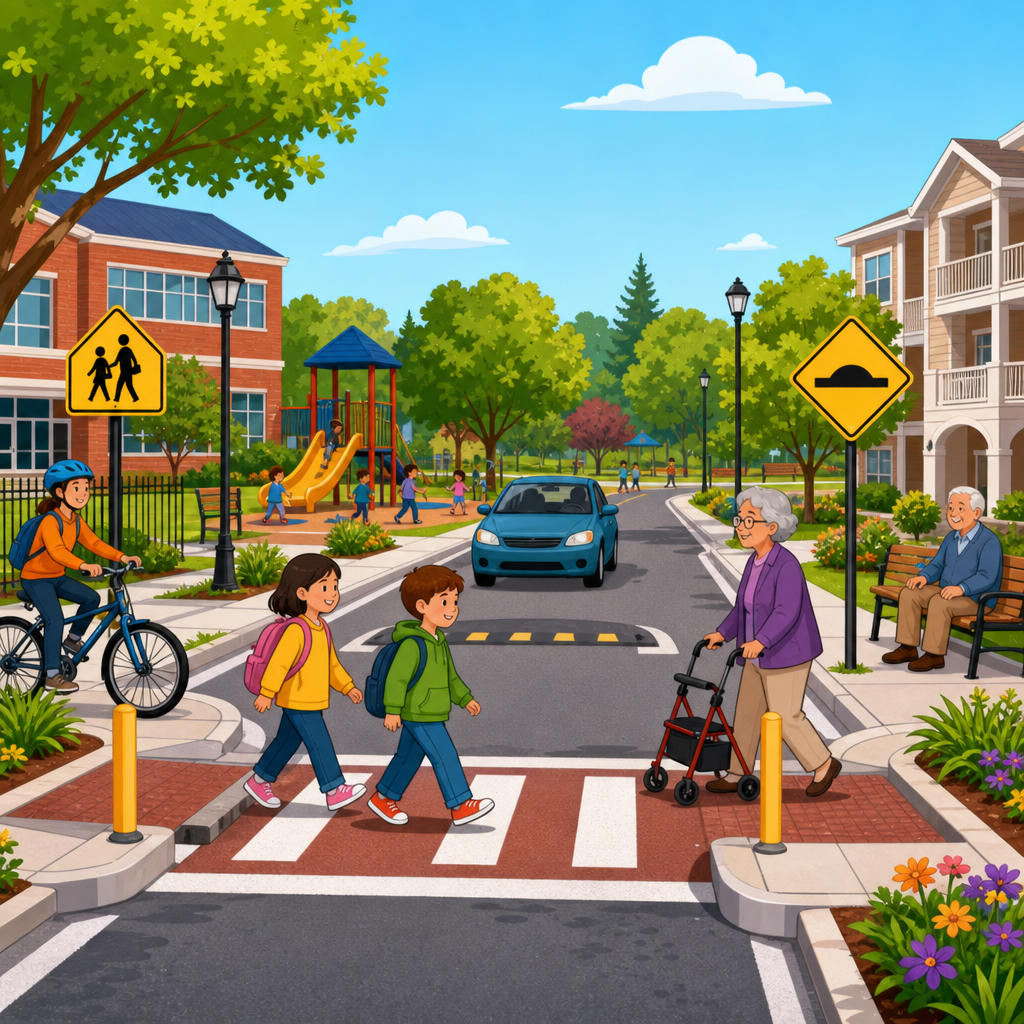
Traffic calming near schools, parks, and senior housing is one of the most practical ways cities can reduce crashes, lower vehicle speeds, and make everyday walking safer for children, caregivers, older adults, and people with limited mobility. Traffic calming refers to street design and policy measures that slow drivers and reduce cut-through traffic without eliminating access. Common tools include speed humps, raised crosswalks, curb extensions, lane narrowing, mini roundabouts, protected pedestrian islands, lower speed limits supported by design, and timed school-zone controls. I have worked with corridor redesigns where a painted crosswalk changed almost nothing, while a raised crossing paired with daylighting and a shorter curb radius transformed driver behavior within days. That difference matters because vulnerable users are not protected by steel frames, airbags, or momentum. They rely on visibility, predictability, and time to cross safely.
These places deserve special treatment because they generate short, frequent, local trips by people whose movement patterns differ from peak commuter traffic. A school arrival period creates bursts of turning vehicles, children walking in groups, buses stopping, and distracted caregivers unloading quickly. Parks bring intermittent surges, weekend activity, and users entering from multiple directions, often outside signalized intersections. Senior housing adds slower walking speeds, assistive devices, paratransit loading, and a higher risk of severe injury when a crash occurs. According to widely used road safety research, the chance of pedestrian death rises sharply as impact speed increases, which is why a street operating at 20 to 25 miles per hour is fundamentally safer than one operating at 35. The core goal is not inconvenience for drivers; it is matching street design to human vulnerability and surrounding land use.
Good traffic calming also supports broader sustainable urban development goals. Slower, legible streets encourage walking, reduce noise, improve local air quality near front doors and playground edges, and make transit stops easier to reach. They can strengthen social cohesion because residents feel more comfortable using the public realm instead of treating the sidewalk as leftover space beside a traffic conduit. For municipalities, these projects are often more affordable and faster to deliver than major roadway reconstructions, especially when agencies start with tactical pilots, speed studies, and targeted capital upgrades. The challenge is that effective traffic calming must be context-sensitive. A measure that works beside an elementary school may be wrong for a bus route, emergency access street, or freight corridor. The most successful programs use crash data, operating-speed analysis, turning-movement counts, and direct observation of how people actually move through the block.
Why Sensitive Land Uses Need a Different Street Design Standard
Schools, parks, and senior housing are not edge cases in street planning; they are the clearest test of whether a transportation network serves people safely at the point of greatest vulnerability. Traditional roadway design often prioritizes vehicle throughput, wider curb radii, and long uninterrupted blocks. Near sensitive land uses, those features can be dangerous because they increase turning speed, lengthen crossings, and make yielding less likely. The design standard should shift from moving the maximum number of cars to enabling safe access for the most vulnerable users. In practice, that means lower target speeds, shorter crossing distances, stronger visual cues, and more forgiving geometry. The National Association of City Transportation Officials, the Federal Highway Administration, and the Institute of Transportation Engineers all provide guidance supporting lower-speed, self-enforcing street design in pedestrian-rich areas.
Children have limited peripheral vision and less experience judging gaps. Older adults may need more time to start and complete a crossing, and many rely on canes, walkers, or scooters that are destabilized by steep cross slopes and broken pavement. Park users include runners, stroller pushers, dog walkers, and cyclists entering unpredictably compared with office commuters. When I audit these areas, the red flags repeat: faded school crosswalks on multilane roads, parking that blocks sight lines, driveways directly opposite park gates, and senior residences fronting streets with long signal cycles and no median refuge. Each condition is manageable, but only if agencies stop treating every frontage as a generic roadside condition. The right question is simple: what speed and geometry allow a driver to see, process, and yield to a person who may move slowly, hesitate, or make a mistake?
Core Traffic Calming Measures That Actually Change Driver Behavior
Effective traffic calming is self-enforcing, meaning the street geometry makes fast driving uncomfortable or impossible instead of relying solely on signs. Speed humps and speed cushions are among the clearest examples. On local streets near schools or parks, they reduce operating speeds between intersections and discourage cut-through traffic. Raised crosswalks extend that principle by lifting the pedestrian crossing to sidewalk level, improving visibility and accessibility while creating vertical deflection. Curb extensions shorten crossing distance and help pedestrians see around parked cars; when paired with daylighting, they can dramatically improve yielding at unsignalized crossings. Median refuge islands split a crossing into two manageable stages and are especially helpful for older adults who cannot cross a wide roadway in one signal phase.
Horizontal deflection works too. Chicanes, mini roundabouts, and tighter corner radii reduce the speed path available to drivers. Road diets convert excess travel lanes into turn lanes, bike lanes, or wider buffers, often lowering crash rates while maintaining acceptable traffic operations. Near parks and senior housing, lane narrowing and edge friction from trees, lighting, and street furnishing can reinforce lower speeds when designed carefully. The key is matching the tool to the street type. A fire route may tolerate speed cushions better than full-width humps. A transit street may benefit more from raised intersections, bus boarding islands, and signal timing changes than repeated vertical devices. Paint alone rarely delivers lasting speed reduction. Real change comes from vertical deflection, horizontal deflection, reduced exposure, and stronger visual enclosure.
| Measure | Best Use Near | Main Safety Benefit | Key Limitation |
|---|---|---|---|
| Raised crosswalk | Schools, parks, senior housing entrances | Slows vehicles and elevates pedestrian visibility | Needs drainage and careful snow operations |
| Curb extension | Intersections and midblock crossings | Shortens crossing distance and improves sight lines | May affect drainage, loading, or bus operations |
| Median refuge island | Wide streets with steady traffic | Allows two-stage crossing and reduces exposure | Requires sufficient roadway width |
| Speed hump or cushion | Local access streets | Lowers midblock speed and discourages cut-through traffic | Can affect emergency response or rider comfort |
| Road diet | Overbuilt corridors | Reduces conflict points and calms overall operations | Needs traffic analysis and public communication |
Designing for Schools: Arrival Patterns, Pick-Up Chaos, and Child Safety
School zones are unique because the highest risk often occurs during short windows when the street is overloaded with competing behaviors. Parents stop illegally for convenience, buses need curb space, children appear from between vehicles, and volunteers may direct crossings without physical protection. The most effective school-area traffic calming starts with a circulation plan, not a single device. Separate bus loops from parent pick-up where possible. Create designated loading zones on the school side of the street. Use raised crossings at the main desire lines, not just where a standard block pattern suggests they belong. Tighten curb radii at entrances used by turning vehicles. Add daylighting near every crossing so the first child in line is visible before stepping off the curb.
Speed limit changes are useful only when the roadway supports them. Flashing beacons, school-zone signs, and pavement legends can help, but they should reinforce physical design rather than substitute for it. I have seen multilane school frontages posted at 20 miles per hour while drivers still traveled above 30 because lane width, corner geometry, and long sight lines signaled speed. Converting one lane to a protected waiting area, adding modular curb extensions during a pilot, and installing a raised crosswalk produced better compliance than enforcement alone. Safe Routes to School programs show that engineering, education, and limited enforcement work best together. Sidewalk continuity matters as much as curbside management. If families must walk in gravel shoulders or cross unsignalized drive aisles, the school zone is incomplete no matter how many warning signs are installed.
Designing for Parks: Multiple Gateways, Weekend Peaks, and All-Ages Access
Parks generate a wider range of users and trip purposes than most frontages. Children run ahead of adults. Teenagers arrive by bike or scooter. Older adults may use loop paths for exercise. Families cross with coolers, strollers, and sports gear. Because entry points are often dispersed, park traffic calming must address both intersections and midblock crossings. The strongest approach is to map actual desire lines between surrounding neighborhoods, transit stops, parking areas, and park gates. Then place crossings where people already go, supported by curb extensions, refuge islands, or raised tables. If a park fronts a collector street, a single marked crossing at one corner will not capture real behavior. People will cross where the fence opening, playground entrance, or trailhead draws them.
Parking turnover near parks also changes risk. Weekend congestion can create blocked crosswalks, illegal U-turns, and drivers backing out into streams of pedestrians. Managing curb space is therefore part of traffic calming. Time-limited parking, protected loading areas, and restrictions close to crossings preserve sight distance. Shared streets or slow zones around park edges can work well where volumes are low and pedestrian activity is continuous. Lighting is critical for parks because use extends into early morning and evening; crossings should be lit for facial recognition, not just roadway brightness. Where trails connect across roads, agencies should consider raised intersections or pedestrian-activated beacons if traffic volumes and speeds justify them. The success measure is simple: can an eight-year-old, an older walker, and a distracted parent all understand where to cross and feel drivers will yield?
Designing for Senior Housing: Slower Walking Speeds and Higher Injury Risk
Senior housing requires precision because small design failures carry larger consequences. Older adults often need more crossing time than standard signal assumptions provide. They may also have reduced contrast sensitivity, hearing loss, or difficulty stepping over uneven surfaces. Traffic calming near senior residences should therefore combine lower approach speeds with accessibility details that are often overlooked. Median refuges should be wide enough for wheelchairs and scooters, with cut-through openings aligned to the crosswalk. Curb ramps need gentle slopes, tactile warnings, and direct alignment so users do not roll into the intersection at an angle. Benches near crossings can support people who need to rest, and shade improves comfort in hot climates where heat stress affects older residents quickly.
Signal timing is especially important. Leading pedestrian intervals, longer walk phases, and reduced right-turn conflict can significantly improve comfort and safety. Where a residence sits along a busy arterial, consider whether the front door should connect first to a service road or access lane rather than directly to high-speed traffic. At unsignalized locations, rectangular rapid flashing beacons may improve yielding, but they perform best when combined with geometric changes and a reasonable crossing width. One recurring mistake is assuming that because senior housing generates fewer school-like peaks, it needs less treatment. In reality, exposure is continuous and the severity risk is higher. A fall caused by poor pavement or a near miss during a long crossing can reduce a resident’s willingness to walk for months, undermining independence, health, and social participation.
Implementation, Measurement, and Long-Term Maintenance
The best traffic calming programs move from diagnosis to pilot to permanent construction with clear performance metrics. Start with speed studies that measure the 85th percentile and the full distribution, not just average speed. Review crash history, including near schools and park edges where nonreported incidents may be common. Observe turning behavior, queue spillback, and illegal parking during peak periods. Quick-build pilots using modular curbs, temporary islands, planters, and flexible delineators can test geometry before concrete is poured. This approach helps agencies refine emergency access, drainage, and maintenance needs while building community understanding. Public engagement should focus on tradeoffs honestly: some drivers will lose a few seconds, some curb space may change, and bus stops may shift. Those costs are usually minor compared with preventing severe injury.
After installation, evaluate results with before-and-after speed data, yielding rates, crossing compliance, and user feedback from school staff, park managers, and senior residents. Maintenance is not secondary. Faded markings, ponding water, damaged bollards, and snow piled in curb extensions can erase safety gains. Asset management plans should assign responsibility for sweeping refuge islands, repainting crossings, and preserving tactile surfaces. Enforcement still has a role, especially during transition periods, but design should carry most of the burden. Funding can come from local capital budgets, Safe Streets and Roads for All grants, Highway Safety Improvement Program funds, school district partnerships, and park improvement budgets. When cities institutionalize these practices through design standards and corridor review triggers, traffic calming stops being a one-off intervention and becomes a normal expectation for every sensitive land use.
Traffic calming near schools, parks, and senior housing works because it addresses the root problem: streets that are designed for speeds and movements that exceed what vulnerable users can safely tolerate. The most reliable interventions are physical, context-sensitive, and measurable. Raised crossings, curb extensions, median refuges, road diets, tighter radii, signal timing changes, and disciplined curb management all reduce risk when matched to actual land use and travel behavior. Schools need circulation planning and protected arrival zones. Parks need crossings aligned with real gateways and curb management for surges. Senior housing needs slower approaches, accessible geometry, and longer crossing opportunities. In every case, the guiding principle is the same: design for the person with the least protection and the greatest need for time, visibility, and predictability.
For sustainable urban development, these projects deliver more than safety. They support walking, public health, neighborhood livability, and confidence in local public space. They also create a practical framework for future investment because once a city identifies sensitive frontages and adopts a clear toolkit, improvements can be prioritized systematically instead of reactively after a tragedy. If you are planning, funding, or reviewing a corridor near a school, park, or senior residence, begin with operating speed, crossing distance, and visibility. Then choose the smallest set of physical changes that will reliably lower speed and reduce exposure. Start with one block if needed, measure the outcome carefully, and build from there. Safer access is not a luxury feature. It is basic street performance, and communities should expect it everywhere vulnerable people live, learn, and gather.
Frequently Asked Questions
What is traffic calming, and why is it especially important near schools, parks, and senior housing?
Traffic calming is the use of street design features and policy tools to slow vehicle speeds, reduce shortcut driving, and make roads safer for people walking, biking, rolling, and driving. Instead of relying only on signs or enforcement, traffic calming changes the physical environment so drivers naturally move more carefully. Near schools, parks, and senior housing, this matters because these areas have a higher concentration of people who may be more vulnerable in traffic, including children, older adults, caregivers pushing strollers, people using walkers or wheelchairs, and residents with limited vision or hearing. Even small reductions in vehicle speed can significantly lower the severity of crashes, which is why communities often prioritize these locations for safety upgrades.
In practical terms, traffic calming can include speed humps, raised crosswalks, curb extensions, narrower travel lanes, mini roundabouts, protected pedestrian crossings, improved signage, and lower speed limits supported by better street design. These measures help create a more predictable and forgiving roadway. Around schools, they can improve student arrival and dismissal safety. Near parks, they can make it easier for families and children to cross streets comfortably. Around senior housing, they can provide longer crossing opportunities, shorter crossing distances, and better visibility for people who move at different speeds. The goal is not to eliminate access for drivers, but to balance access with safety so the street works better for everyone.
Which traffic calming measures are most effective in these sensitive areas?
The most effective traffic calming measures are usually the ones that physically influence driver behavior rather than simply asking drivers to slow down. Speed humps and speed tables are widely used because they consistently reduce vehicle speeds on local streets. Raised crosswalks are especially valuable near schools, parks, and senior housing because they both slow approaching traffic and make pedestrians more visible. Curb extensions, also called bulb-outs, shorten crossing distances and help people waiting to cross become more visible to drivers. Lane narrowing can also be highly effective, since wide lanes tend to encourage higher speeds while narrower lanes signal that drivers should proceed more cautiously.
Other strong options include mini roundabouts to reduce conflict points and lower turning speeds, pedestrian refuge islands that allow people to cross in two stages, and high-visibility marked crosswalks paired with rapid flashing beacons where warranted. In corridors with frequent walking activity, protected pedestrian intervals at traffic signals can give people a head start before turning vehicles move. The best results usually come from combining several measures into a complete safety strategy rather than installing a single treatment in isolation. For example, a school zone may benefit from raised crossings, curb extensions, improved signage, daylighting at corners, and a pickup-and-drop-off design that reduces conflicts. A senior housing area may benefit from longer crossing times, median refuges, smoother sidewalk connections, and clearer curb ramp alignment. Effectiveness depends on the street’s layout, traffic volume, and surrounding land uses, so good planning and engineering are essential.
Do traffic calming projects create delays for drivers, emergency vehicles, or local residents?
One of the most common concerns about traffic calming is whether it will slow emergency response, create congestion, or make it harder for residents to reach their homes. In most cases, well-designed traffic calming does not eliminate access or cause major disruption. Instead, it moderates speed and encourages more orderly travel. Local residents can still drive on their streets, receive deliveries, host visitors, and use curbside access. What usually changes is that drivers are less likely to speed through neighborhoods or use residential streets as shortcuts to avoid busier roads.
Emergency access is an important design consideration, and cities typically coordinate with fire, police, and EMS during project planning. Some measures, such as speed cushions, can be designed to accommodate the wheelbase of larger emergency vehicles while still slowing passenger cars. Mini roundabouts and curb extensions can also be designed with mountable aprons or turning templates that preserve access for necessary large vehicles. In terms of delays, traffic calming may add a small amount of travel time, but that tradeoff is often minor compared with the safety benefits. Near schools, parks, and senior housing, reducing high-speed traffic is a clear public safety priority. Many communities find that the modest reduction in speeding and cut-through traffic improves overall quality of life, lowers crash risk, and makes streets feel more comfortable for residents and visitors alike.
How do cities decide where traffic calming should be installed first?
Cities usually prioritize traffic calming based on a combination of safety data, roadway conditions, and community need. Streets near schools, parks, senior housing, transit stops, and other destinations with high pedestrian activity are often elevated because they serve people who may face greater risk when crossing or traveling along the street. Officials may review crash history, documented speeding, traffic volumes, sidewalk gaps, crossing difficulty, and whether the street is part of a common walking route. They may also consider equity factors, such as whether a neighborhood has historically lacked safety investment or has a larger share of residents who rely on walking, transit, or mobility devices.
Public input is another major part of the process. Residents, school administrators, parents, park users, senior advocates, and accessibility groups often provide firsthand insight into where drivers speed, where visibility is poor, or where crossing feels unsafe. In strong programs, cities pair this local knowledge with formal engineering analysis and field observation. Temporary installations or pilot projects may be used to test ideas before permanent construction. This helps agencies confirm what works in real conditions and refine the design if needed. The most effective prioritization systems are transparent and data-informed, but they also recognize that not every safety issue shows up clearly in crash statistics. Sometimes people avoid walking in dangerous places, which means the need is real even if incident numbers seem low. That is why context matters so much in deciding where to act first.
What should a successful traffic calming project accomplish for pedestrians, families, and older adults?
A successful traffic calming project should do more than reduce vehicle speeds on paper. It should make people feel safer and more comfortable using the street in everyday life. For pedestrians, that means shorter crossings, better visibility, more predictable driver behavior, and fewer situations where a person has to guess whether a driver will yield. For families, it means safer routes to school, less stress during park visits, and a street environment where children are not exposed to fast-moving traffic at every turn. For older adults, it means designs that reflect real mobility needs, such as more time to cross, gentler curb ramps, smoother walking surfaces, places to pause if needed, and intersection layouts that reduce confusion and conflict.
The strongest projects also improve the overall function and livability of a neighborhood. They can discourage aggressive driving, reduce noise from hard acceleration, support public health by encouraging walking, and strengthen community confidence in nearby streets and public spaces. Measurable outcomes may include lower average speeds, fewer severe crashes, better driver yielding rates, and increased walking activity. Just as important are the lived outcomes: parents feeling comfortable letting children walk with supervision, older residents being able to cross to a bus stop or park entrance, and caregivers navigating with strollers or mobility aids without unnecessary barriers. In that sense, successful traffic calming is not only a transportation strategy. It is a safety, accessibility, and quality-of-life investment that helps streets serve the people who use them every day.